Compiled & Edited by: Deep Tide TechFlow
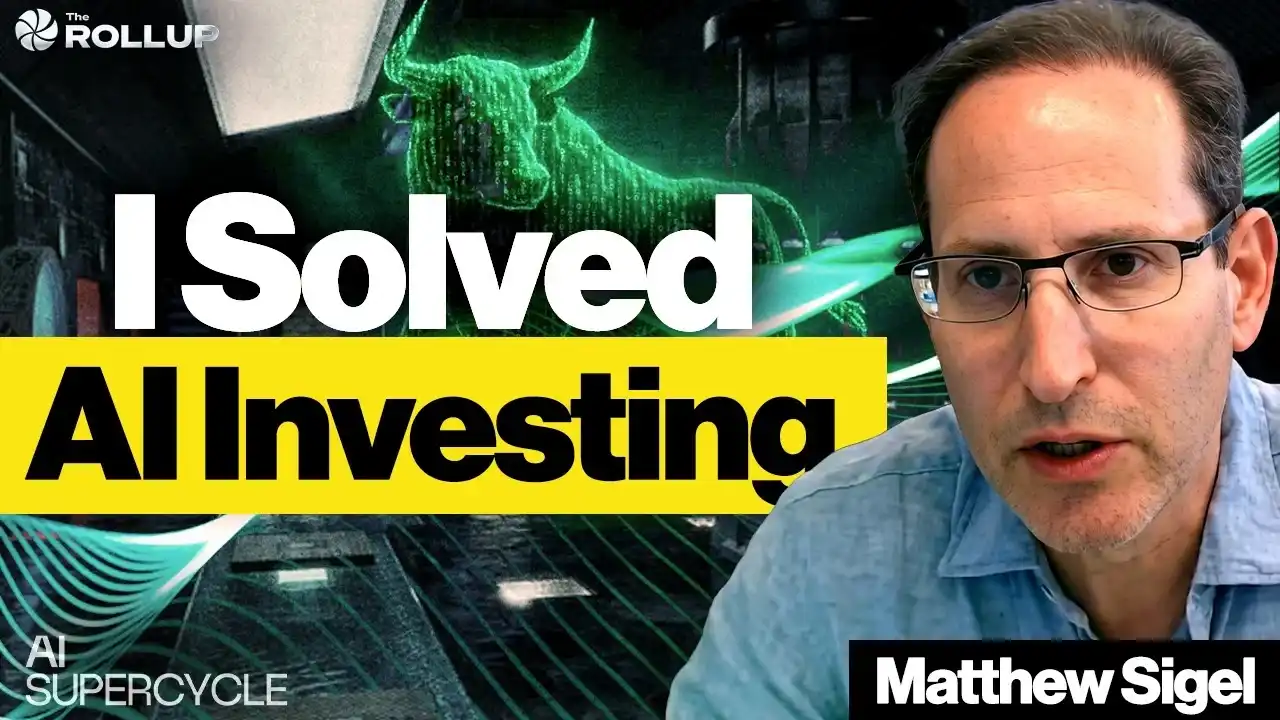
Guest: Matthew Sigel, Head of Digital Assets Research at VanEck, Portfolio Manager of the VanEck Onchain Economy ETF (NODE)
Hosts: Rob (Robbie Klages) & Andy, The Rollup 《AI Super Cycle》
Podcast Source: The Rollup
Original Title: VanEck Research Head: Why This Isn't The AI Bubble Everyone Fears (Here's Why)
Release Date: August 10, 2026
Disclosure: Matthew Sigel is Head of Digital Assets Research at VanEck and Portfolio Manager of NODE. The views expressed may align with the holdings of VanEck funds.
Key Takeaways
The VanEck Onchain Economy ETF (NODE) managed by Matthew Sigel has outperformed Bitcoin by nearly 100 percentage points over the past 15 months, primarily by anticipating the transition of Bitcoin miner stocks into AI data centers. He believes the market was highly concentrated in the first five months of the year: companies spending the most on capital expenditures saw their stock prices rise the most. However, this logic reversed after June, with software assets (including Bitcoin and crypto tokens) being sold off together, and capital expenditure itself becoming a source of punishment.
Sigel's stance can be summarized by two judgments: First, AI infrastructure is not a bubble, distinct from the 19th-century railroad bubble because this round of financing comes from private sector long-term leases, not government land grants and speculative bonds. Second, the real pressure in the crypto market is not macroeconomic, but institutional disappointment with major L1s. VanEck has reduced exposure to mainstream L1s like Solana and ETH since the election, shifting focus to enterprise chains like Circle, Stripe, and Robinhood. He believes that if the CLARITY Act passes and establishes an information disclosure regime, related tokens could see a massive relief rally, but until then, he remains cautious.
Key Insights
On the Shift in Market Structure
- "In the first five months of the year, the companies spending the most money performed best; but since June, the companies spending the most money have been punished the hardest."
- "Bitcoin is software, open-source software at that. When software stocks are under pressure overall, Bitcoin and crypto tokens can hardly escape unscathed."
- "I hope the market sees more differentiation, not a single factor determining everything. That way we have a chance to find alpha in individual assets."
On the AI Transition of Bitcoin Miner Stocks
- "ASICs are not a miner's most valuable assets; electricity and land are."
- "The early miner business model was to continuously issue shares to buy ASICs, just staying ahead of competitors. But revenue halves every four years—it's a melting ice cube. Now they can finance through debt markets, no longer diluting shareholders."
- "For CleanSpark to return to pure mining, Bitcoin would need to reach $360,000, because only then would it be worth tearing up the signed AI lease agreements."
On AI Infrastructure vs. the Railroad Bubble
- "The U.S. invested 3% of GDP into railroads for nearly 20 consecutive years, while AI has only just reached that level for one year so far."
- "The railroad bubble was government-led: Congress passed the Railroad Act of 1862, granting land upfront with ownership transferring only after the network was complete; Treasury bonds issued for construction were subordinate to private capital."
- "An AI factory is useful as soon as it's connected to the grid, fiber is laid, and chips are installed—it can immediately train models and perform inference. Railroads had to connect the East and West Coasts before becoming truly useful."
- "The four major cloud providers have over $2 trillion in contract backlogs, many with customer prepayments, customer-furnished GPUs, and terms exceeding five years. In 1870, no one bought train tickets for travel in 1885."
On L1s vs. Enterprise Chains
- "Many tokens doubled after the election, but there was no truly breakout application, no application sucking in global capital."
- "What's winning now are enterprise chains: Circle has one, Stripe has one, Robinhood has one, even Wells Fargo is building its own custom chain."
- "Banks and other regulated entities don't want to place real capital on open-source chains; even if they support them, they'd have to support three to five chains simultaneously, diluting any single L1's winner-take-all nature."
- "If the CLARITY Act passes, bringing a real information disclosure regime, some tokens could see a massive relief rally. Until then, we remain cautious."
Main Text
Chapter 1: Market Shifts from 'Chasing Capex' to 'Punishing Capex'
Rob: First, tell us about the market state you've observed lately. There was a period where digital assets showed little positive reaction to news like DTCC, the CLARITY Act. Now Saylor is selling Bitcoin, CLARITY seems unlikely to pass, the market isn't really moving up or down, completely indifferent. Meanwhile, AI and U.S. stocks seem to be sucking up all liquidity. Is that what you see?
Matthew Sigel: Yes. The market was very concentrated in the first five months of the year—the companies spending the most money had the best stock performance. But starting June 1, that relationship reversed. Setting aside the recent bounce from the Situational Awareness blow-up bottom, that period saw the highest capex companies fall the hardest.
Bitcoin and crypto tokens are actually categorized as 'software.' Many track the relative performance of semiconductors vs. software. Bitcoin is software, open-source software at that. AI capabilities like Claude, Codex are having a tangible impact on many open-source projects, but their upgrade cycles aren't top-down like Web2 companies. You can't force users to upgrade. This overall software underperformance weighs heavily on Bitcoin and crypto tokens.
Add in the psychological four-year halving cycle, the market respects this pattern. I hope the market sees more differentiation, more dispersion in returns, allowing us to find alpha in individual stocks and assets, not just betting on a single factor. I don't think it has to be AI up, crypto down, or vice versa; reality is more nuanced.
As for my own positioning, I still have exposure to the AI infrastructure theme via Bitcoin miners. I'm optimistic about a Bitcoin bottom in Q4 and expect a market rebalancing. However, I prefer to wait for positive catalysts with volume confirmation; trading short-term swings in choppy markets isn't my style.
Chapter 2: Why NODE Made a Big Bet on Miner AI Transition
Rob: So what's your current specific positioning? I see some tickers like MARA, Riot, APLD, WULF—essentially Bitcoin miner stocks transitioning to AI data centers. They already have infrastructure built: power, energy capacity, often in remote locations. These are exactly the raw materials AI data centers need, even existing hardware can be repurposed. How long do you think this trend lasts? Also, if so much hashrate flows from Bitcoin to AI, could that pose systemic issues for Bitcoin?
Matthew Sigel: The NODE ETF I manage has been live for 15 months, outperforming Bitcoin by nearly 100 percentage points. The biggest source of return was realizing early: each megawatt of power controlled by Bitcoin miners was severely undervalued relative to the valuation multiples of the few data center REITs at the time.
The early miner business model was to continuously dilute shareholders, issue stock to buy ASICs, just outrunning competitors. But revenue halves every four years—it's a melting ice cube, capital-intensive with thin margins. Now we see not only hyperscalers but also financing costs for build-to-suit leases around these data centers have fallen significantly. These companies can finance through debt markets, no longer needing to issue stock and dilute shareholders. And each new lease signed has better economic terms than the last. Combined with falling rates, this creates significant value.
So the market style shift since June hurt the most leveraged players the most. We don't use leverage and underweight highly leveraged companies. When we saw a fund like Situational Awareness, highly overlapping with our holdings, get liquidated by its prime broker, we bought against the trend. Last Thursday at the open, we executed the largest single-day trade since the fund's inception: exiting nearly 10% of low-volatility, low-beta positions to double down on our most favored miners.
We haven't seen a fundamental deterioration in the capital returns from this hyperscaler investment. In fact, reading earnings calls from companies like Amazon, these returns are better than earlier expectations. Old GPUs rented for $2/hour are now seeing clients wanting to renew contracts at significantly higher rates upon expiration. So we look at fundamentals first; fundamentals are still improving.
At the lows, some of our top picks were priced only for their existing lease value, with no pricing for terminal value of data centers, platform value, or potential new leases. Even assuming a 100 bps rise in the 10-year yield, that work has already been done. So at the lows, we saw a significant margin of safety.
Regarding the Bitcoin network, I don't see a systemic issue. On the contrary, as hashrate drops, remaining miners earn more. Companies we added to, like Bit Deer, MARA, still have strong optionality: continue mining or convert facilities for AI. Some future Bitcoin price might make people reconsider switching back to mining, but we're not calling for facilities already converted to AI to switch back. We estimate CleanSpark would need Bitcoin at $360,000 to justify tearing up freshly signed AI leases. So this optionality itself is valuable.
Chapter 3: This Isn't a Bubble; It's the Opposite of the 19th Century Railroads
Rob: You mentioned a historical analogy. You wrote an article comparing AI infrastructure to 19th-century railroad construction. Can you quickly walk us through why this comparison works?
Matthew Sigel: Many use the railroad bubble to counter me, saying this is another capital expenditure cycle changing the economy, but early capital gets wiped out. My response: compare scale and financing structure.
In scale, the U.S. invested nearly 3% of GDP into railroads for almost 20 consecutive years. For AI, from GPT's emergence to now is about the fifth year, and only this year reached that 3% GDP level. With current AI company valuations, the market isn't pricing in 'this build-out lasting twenty years.' Most analysts think it peaks by 2030. That's the first disconnect.
Second is financing structure. The railroad bubble was actually government-led. The Railroad Act of 1862 granted hundreds of millions of acres of federal land to railroad companies, but ownership transferred only after the entire network was completed. Furthermore, the Treasury issued construction bonds that were subordinate to private capital. The biggest railroad companies went overseas selling bonds marketed as safe assets, reliant on land sales—land they didn't even own yet. That's a bubble.
Now contrast AI factories. Railroads needed the network connected to be truly useful, having limited value before the coasts were linked. AI factories are useful as soon as connected to the grid, fiber is laid, and chips are installed—they can immediately train models and perform inference. No need to wait for a global network to sync.
The last crucial difference is contract backlog. In 1870, no one bought train tickets for travel in 1885; there was no forward freight market then; everything was built on land sale speculation. But with data centers today, just the four major cloud providers have over $2 trillion in signed contract backlog, with Microsoft and Oracle accounting for about half. Many contracts include customer prepayments, customer-furnished GPUs, with terms exceeding five years. The compute output from these factories has real purchase order backing, and financing is based on these contracts, not government subsidies.
Rob: So the conclusion is this round is more sustainable.
Matthew Sigel: Yes, more sustainable. It's backed by private sector long-term contracts with multi-year backlog as collateral.
Chapter 4: Mainstream L1s Are Losing to Enterprise Chains
Rob: Someone in the chat mentioned that in 2021 or 2023, you said Solana needed to pause L1 development. What would Solana need to do for you to become bullish again? Also, we see many L1s proposing to reduce inflation, cut validator incentives—Ethereum had a new proposal this morning, Solana and Near as well. How important are these inflation adjustments to L1 market conditions?
Matthew Sigel: After the election, when many tokens doubled but actual adoption didn't accelerate, no truly breakout application emerged, we reduced the firm's overall L1 exposure. What we've seen since is the rise of enterprise chains. Circle has one, Stripe has one, Robinhood has one—these are semi-permissioned chains allowing public companies to customize user experience and capture some economic benefit.
I understand this goes against open-source spirit and crypto purism, but those wanting to use these networks at scale need predictable fee streams. You asked about Solana, but I want to mention ETH first, because ETH is an example of too volatile transaction fees—many large institutional participants want more stable costs. So enterprise chains have taken significant market share, a key focus for our investments.
Solana's fee volatility isn't as high, but until recently you couldn't buy USDC on Solana in New York, and this morning we saw Wells Fargo researching its own tokenized deposit chain. Banks and regulated entities don't want to place real capital on open-source chains; even if they participate, they'd support three to five L1s simultaneously, diluting any single chain's winner-take-all nature. So market share is eroding, winner-take-all characteristics are weakening, making us very underweight these tokens.
If the CLARITY Act passes—though its probability is now at its lowest for the year—I think some tokens could see a massive relief rally. It would establish an information disclosure regime, letting us know the real beneficial owners, with no KOL shilling without disclosing holdings. We could see how many tokens labs and foundations hold. It's the lack of this disclosure regime that makes many institutional investors ignore this space. I hope to see this change before seriously reconsidering many L1s.
Chapter 5: Reducing Inflation Is Good, But Details Matter
Rob: ETH, Solana, Near all have proposals to reduce validator inflation. If passed, the inflationary supply for these L1s could approach zero. How important do you think these measures are for the market?
Matthew Sigel: A few quarters ago we conducted research comparing the average inflation rate of major L1s against user growth and fee revenue. There is indeed an inflation problem in this space. Our conversation started by comparing software companies to crypto tokens; this year semiconductors massively outperformed software, forcing many software companies to reconsider their new share issuance rates, with dilution notably decreasing for some.
So I think it's appropriate for L1s to explore reducing inflation. But details will determine success, and we must consider second-order effects on companies reliant on staking revenue, like Bitmine which often touts its staking yield—that could collapse. Overall, for L1s, rethinking inflation six years after inception is wise.