Plasma surges 12% – Can XPL break past THIS resistance?

ambcryptoPublicado em 2026-03-17Última atualização em 2026-03-17

Resumo

Plasma (XPL) surged 12.89% to $0.1238 on March 17, with trading volume up over 155%, signaling renewed buyer interest. The token rebounded from recent lows, reclaiming the $0.1045 support level and approaching the $0.1259 resistance. Technical indicators show buyers gaining dominance, with the +DI line above -DI and ADX around 21, indicating strengthening trend momentum. Exchange outflows of $664K suggest reduced selling pressure and accumulation behavior. Liquidity clusters above $0.128 could trigger a short squeeze if resistance is broken. Holding above $0.1045 is crucial for further upside, with a break above $0.1259 likely accelerating gains toward $0.128.

On the 17th of March, Plasma [XPL] surged 12.89% to $0.1238, while trading volume climbed over 155%, reflecting a sharp rise in participation.

The token has rebounded from recent lows, and buyers have stepped in aggressively during the latest sessions. This move suggests that interest has returned after a prolonged cooling phase.

However, the rally has not occurred in isolation, as both market structure and liquidity dynamics have started aligning with the upside.

The expansion in activity indicates that traders are repositioning rather than exiting.

As a result, this shift places XPL in a critical phase where continuation depends on how price interacts with nearby resistance zones and underlying demand strength.

Can XPL hold support and challenge resistance?

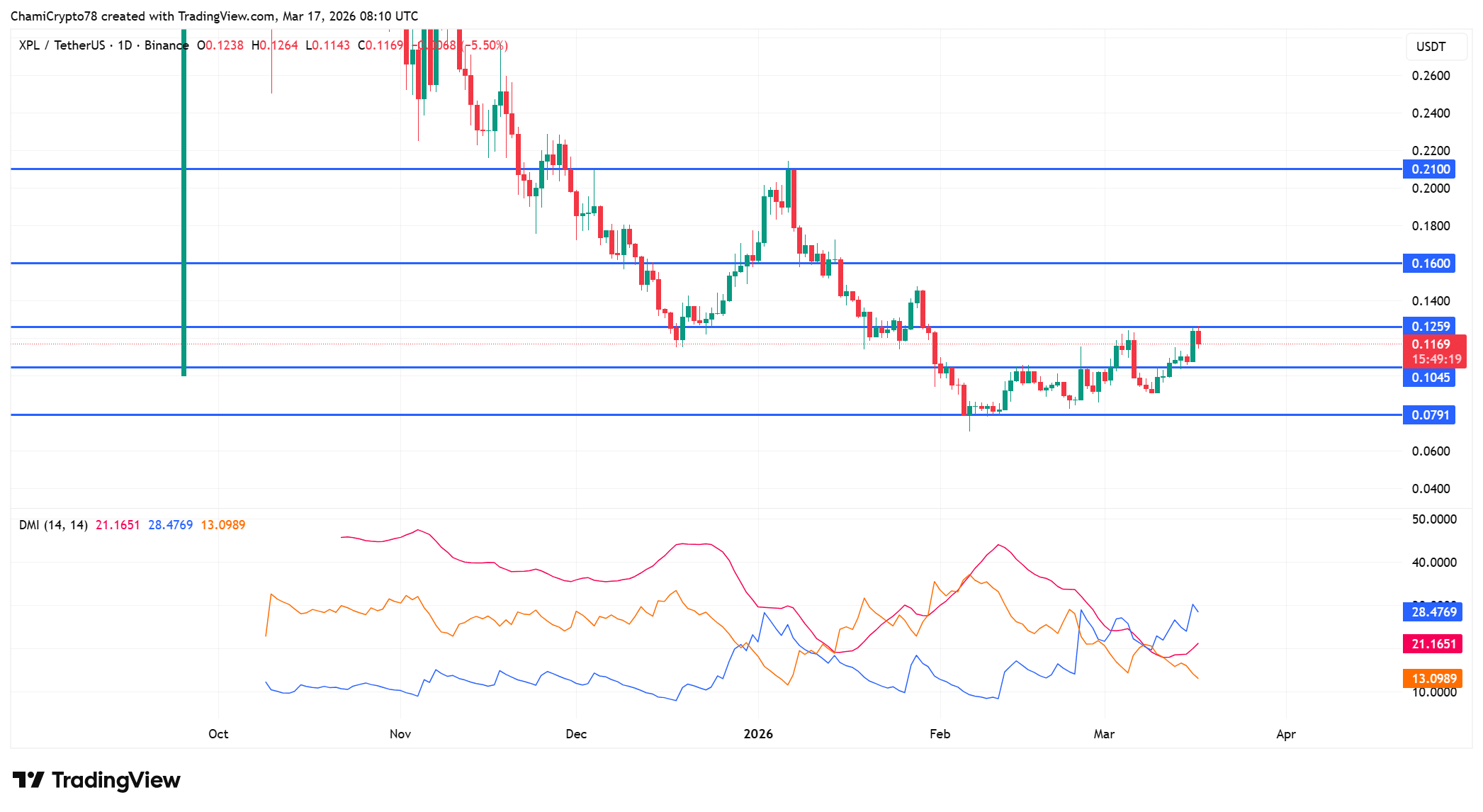
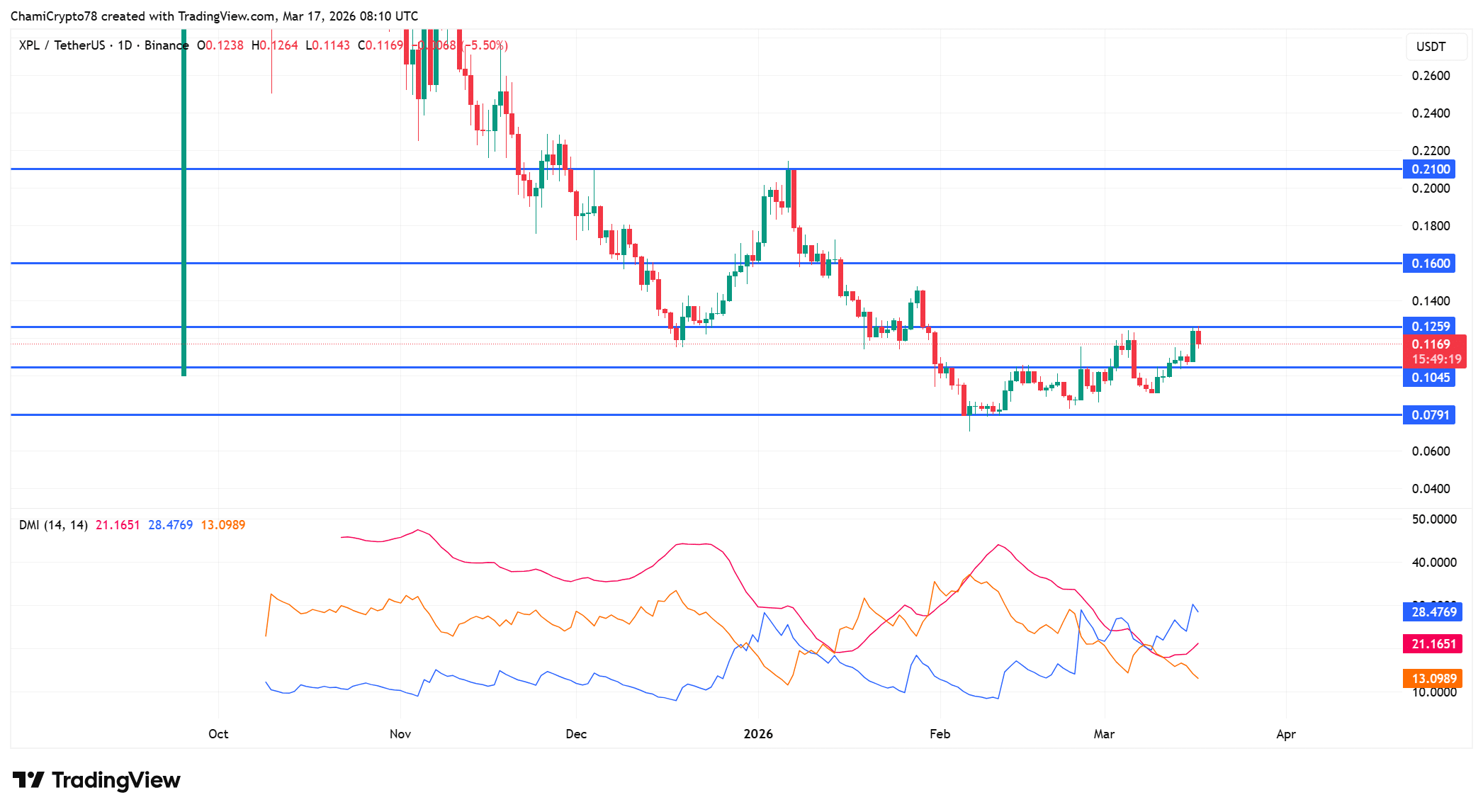
Price has reclaimed the $0.1045 level, which previously acted as a strong support base during consolidation.

Since then, XPL has pushed toward the $0.1259 resistance, where rejection has appeared before.

This area now serves as a key barrier that could define the next directional move.

However, the structure shows higher lows forming, which reflects strengthening buyer control. Each dip has attracted demand, preventing deeper retracements.

The DMI structure has shifted notably, as the +DI line has moved above the -DI line, signaling that buyers have started dominating recent price action.

At the same time, the ADX has hovered around 21, indicating that the trend strength has started building rather than fading.

This alignment reflects a transition from a neutral phase into a developing directional trend.

As the price compresses below the resistance, pressure continues building within this range.

A sustained hold above $0.1045 keeps the structure intact, while repeated tests of $0.1259 increase breakout probability.

This setup suggests that XPL is positioning for a decisive move rather than drifting sideways.
Source: TradingView

Exchange outflows tighten available supply

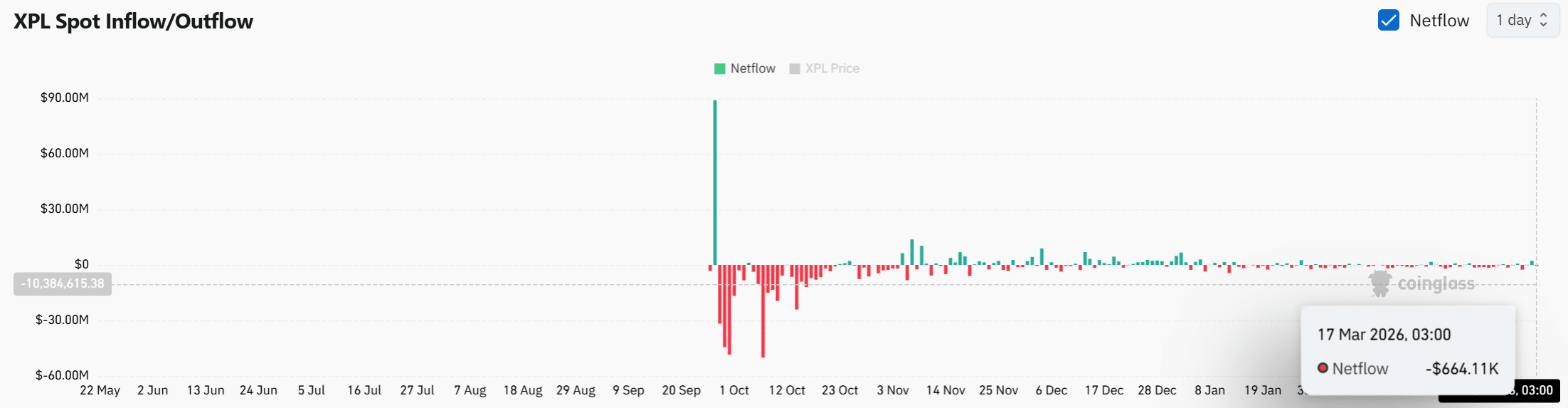
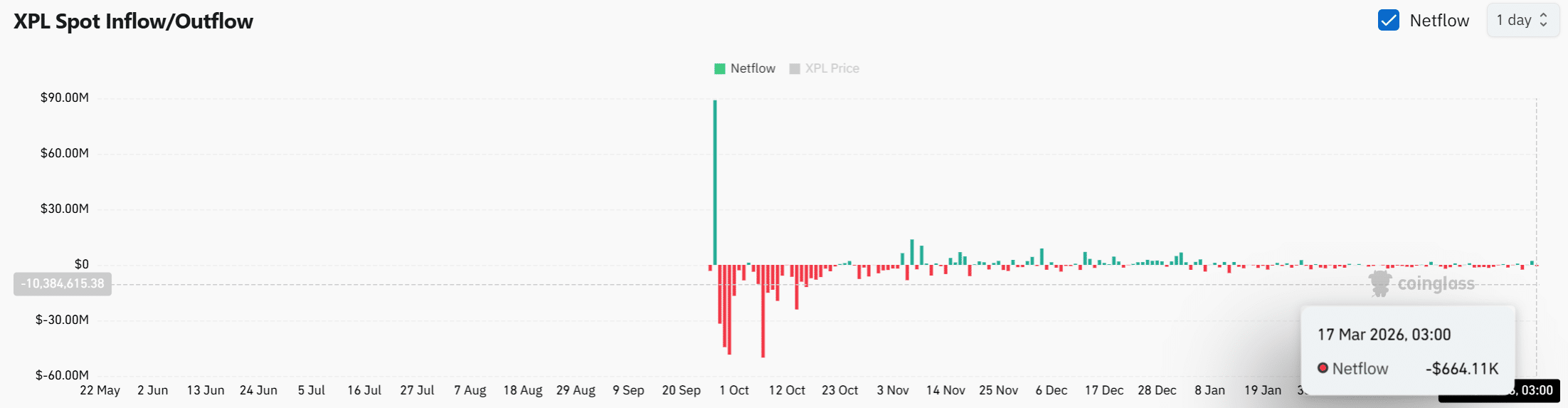
Spot Netflows have remained negative at press time, with recent outflows of approximately $664K from exchanges.

This shift indicates that tokens have been moving off trading platforms rather than preparing for immediate selling.

As supply on exchanges declines, available liquidity tightens, which can amplify price reactions during periods of strong demand.

Besides, reduced sell-side pressure creates conditions where upward moves face less resistance.

However, this dynamic also depends on whether demand continues to match the reduced supply.

As long as outflows persist, the market structure supports accumulation behavior rather than distribution.

This pattern reinforces the bullish context already visible in price action and technical indicators.
Source: CoinGlass

Liquidity clusters above price signal squeeze setup

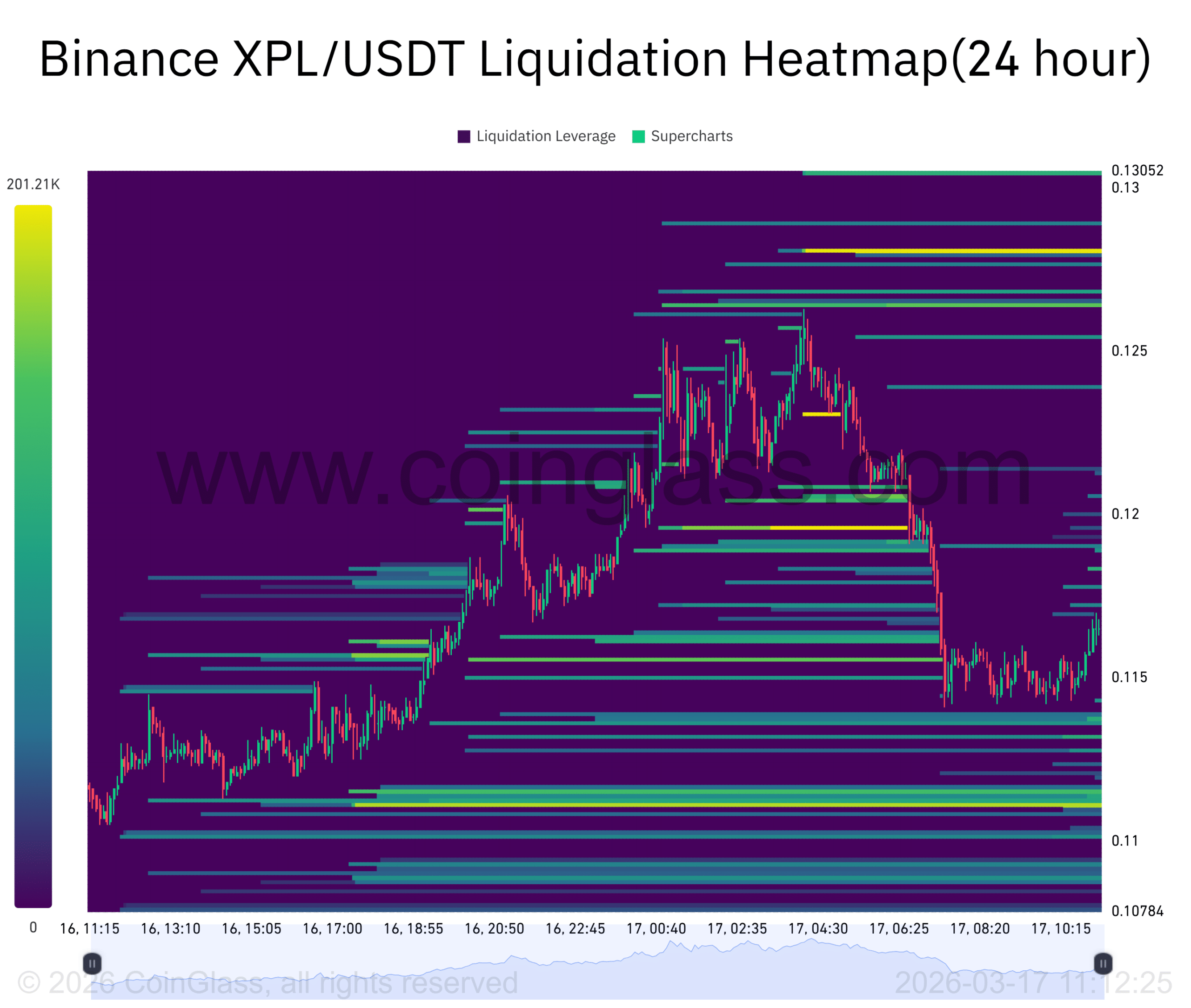
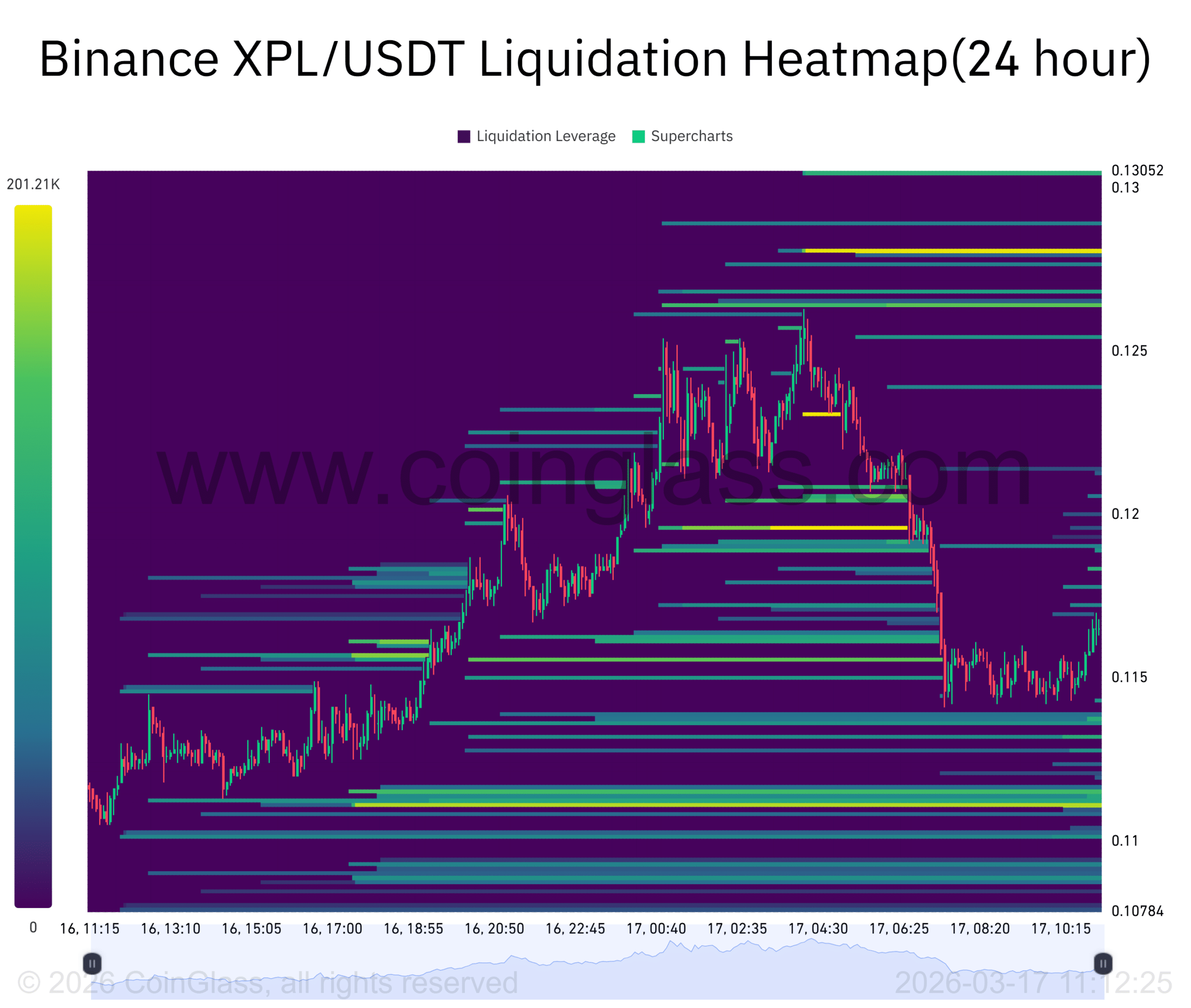
The Liquidation Heatmap has revealed dense liquidity clusters sitting above the current price, particularly around the $0.128 region.

These zones represent areas where short positions could face forced closures if the price moves higher. As XPL approaches these levels, upward pressure could accelerate due to cascading liquidations.

However, the price must first break through nearby resistance to trigger this effect.

The presence of stacked liquidity above current levels creates a magnet-like effect, drawing price toward those zones.
Source: CoinGlass

XPL appears positioned for continuation as strengthening structure, rising demand, and tightening supply align with bullish pressure.

A decisive move above $0.1259 would likely unlock liquidity around $0.128, accelerating the rally.

However, sustained strength depends on holding $0.1045 support. As long as buyers defend this base, the current setup favors further upside expansion.


Final Summary

  • XPL structure shows buyers stepping in early, building pressure that could drive continuation beyond nearby resistance levels.
  • Liquidity sitting above Plasma [XPL] price creates a path for rapid upside expansion if bullish strength remains sustained here.


Perguntas relacionadas

QWhat was the percentage increase in Plasma [XPL] price on March 17th, and what was the new price?

APlasma [XPL] surged 12.89% to $0.1238 on March 17th.

QWhat is the critical resistance level that XPL needs to break for a potential rally continuation?

AThe critical resistance level that XPL needs to break is $0.1259.

QWhat does the negative Spot Netflows value of approximately $664K indicate for XPL?

AThe negative Spot Netflows value of approximately $664K indicates that tokens are being moved off exchanges, suggesting accumulation behavior and a reduction in immediate selling pressure.

QAccording to the Liquidation Heatmap, what is the significance of the liquidity cluster around the $0.128 region?

AThe liquidity cluster around $0.128 represents a dense zone of short position liquidations. If the price reaches this level, it could trigger cascading liquidations, accelerating upward price movement.

QWhat key support level must XPL hold to maintain its current bullish structure?

AXPL must hold the key support level at $0.1045 to maintain its current bullish structure and favor further upside expansion.

Leituras Relacionadas

Silicon Valley 'Startup Guru' Steve Hoffman: Web3 + AI Could Be a Trap

Silicon Valley investor and "Godfather of Startups" Steve Hoffman warns that combining Web3 with AI is likely a trap, not a promising venture. In an interview, Hoffman argues that while AI is a foundational technology touching all industries, Web3 adds complexity, friction, and regulatory risk without solving mainstream consumer or business needs. He advises founders to focus on deep, specialized applications where startups can out-iterate giants, rather than on generic features easily replicated by large tech companies. Hoffman observes that Silicon Valley will lead foundational AI research, while China excels at rapid, large-scale application and commercialization, particularly in robotics. He stresses that AI-driven autonomous agents capable of collaborative, multi-step tasks are 2-4 years away, which will cause significant job displacement. The solution is not to slow AI but to redesign business models around human-AI collaboration and reform social systems like education and retraining. For startups, Hoffman recommends focusing on vertical, expertise-heavy domains to build defensibility. He sees major opportunities in AI fraud detection and cybersecurity. Key founder mindsets include systemic thinking over feature-focus, relentless customer centricity, building adaptive teams, and deeply understanding AI's capabilities and limits. Hoffman is also leading a non-profit initiative to establish university centers aimed at training future leaders in responsible, human-value-aligned AI innovation.

marsbitHá 3m

Silicon Valley 'Startup Guru' Steve Hoffman: Web3 + AI Could Be a Trap

marsbitHá 3m

Token Inefficient, Economy Tokenless

The article "Tokens Aren't Economical, Economics Aren't Tokenized" analyzes a pivotal shift in the AI industry from a technology-driven narrative to one dominated by capital efficiency. It highlights two concurrent trends: a severe capital shortage due to the exorbitant and recurring costs of compute (e.g., OpenAI's high burn rate) and a wave of corporate spin-offs where major tech companies are separating their AI units (like Kuaishou's Kling and Baidu's Kunlunxin). The core argument is that AI's "anti-internet" business model, where user growth increases costs rather than profits, has created a disconnect between high valuations and actual cash flow. Spin-offs address this by allowing AI assets to be valued independently. Within a parent company, they are seen as cost centers, but as standalone entities, they are priced based on their growth potential and scarcity in the primary market, leading to massive valuation premiums (e.g., Kling's estimated value tripling post-spin-off). The industry is at an inflection point, moving from "model worship" to "value realization." The competition is evolving from a pure compute (GPU) race to a broader focus on systemic efficiency and full-stack engineering (involving CPUs and orchestration) to achieve viable commercialization. The year 2026 is framed as a critical moment where the industry must definitively answer how to economically translate AI capability into tangible business value, reshaping the sector's future power structure.

marsbitHá 7m

Token Inefficient, Economy Tokenless

marsbitHá 7m

Crossing the 'Memory Wall': The Wafer-Level Revolution and Computing Power Routes in the AI Inference Era

In 2026, a historic shift occurred in AI as major cloud providers' inference spending surpassed training spending for the first time, signaling a move from "building large models" to "using large models." This shifts the core challenge from computing power to the "memory wall"—the bottleneck of data movement (model weights, activations, KV Cache) between external DRAM and processors, where energy and latency from data transfer far exceed computation itself. Companies like Nvidia face GPU idle time due to bandwidth limits. In contrast, Cerebras Systems adopts a radical "wafer-scale" approach with its Wafer-Scale Engine (WSE). Instead of cutting a silicon wafer into many chips, Cerebras uses almost the entire wafer as one massive chip (WSE-3). This design provides 44GB of on-chip SRAM, delivering memory bandwidth thousands of times higher than traditional HBM (e.g., 21 PB/s vs. Nvidia B200). For LLM inference, weights are streamed layer-by-layer from external MemoryX storage to the chip, avoiding HBM bottlenecks. This results in token generation speeds 1.5–5 times faster than Nvidia's B200 in some models and significant advantages in first-token latency and long-context tasks. Additionally, Cerebras's architecture offers much lower interconnect power consumption (0.15 pJ/bit vs. GPU's ~10 pJ/bit). However, Cerebras faces challenges: SRAM scaling has slowed with advanced nodes, limiting future capacity gains; the chip requires specialized liquid cooling and custom software stacks; and its external I/O bandwidth (150 GB/s) is low compared to NVLink, hindering multi-system scaling for very large models. Competition is intensifying. Major players are pursuing three paths: 1) Developing proprietary inference ASICs (e.g., Google TPU, Microsoft Maia), 2) Leveraging advanced packaging (e.g., TSMC's SoW) to democratize wafer-scale-like integration, potentially eroding Cerebras's process advantage within a few years, and 3) Exploring optical interconnects for ultimate bandwidth. Commercially, Cerebras is transitioning from a hardware vendor to a service provider, facing the immense challenge of building high-power, specialized data centers to meet large contracts (e.g., 250MW/year from 2026–2028). In conclusion, the AI inference era presents a fundamental architectural trade-off. Cerebras opts for extreme physical optimization for low-latency, single-task performance, while Nvidia prioritizes versatility and massive cluster throughput. The path forward remains uncertain, with technology and business models still evolving in the race toward advanced AI.

marsbitHá 13m

Crossing the 'Memory Wall': The Wafer-Level Revolution and Computing Power Routes in the AI Inference Era

marsbitHá 13m

Has Bitcoin's 'Rebound Ended', Officially Entering the Late Bear Market Phase?

**Title: Has Bitcoin's Rebound Ended, Entering the Late Bear Market Phase?** **Summary:** Bitcoin's price has declined by 13% this week, signaling a potential return to late-stage bear market conditions. The price fell to around $67k, positioned between the Realized Price and Realized Cap Weighted Average. For the first time since early 2022, the Short-Term Holder cost basis has dropped below this key average, confirming a hallmark of late-cycle bear markets. Profitability metrics have collapsed sharply. The 7-day average of the Realized Profit/Loss ratio plummeted from a local high of 3.16 to 0.29, mirroring the February panic sell-off. Critically, the 90-day average never breached the threshold of 2, indicating the recent rally to $82k was a bear market bounce, not a structural shift. Realized losses surged to $1.35 billion daily, with $770 million coming from Long-Term Holders selling at a loss. This accelerating redistribution of supply from weak to strong hands is a necessary but ongoing process for a market bottom. The rally stalled almost precisely at the aggregate cost basis (~$83k) of US spot Bitcoin ETF investors, turning that level into strong resistance and leaving the average ETF holder underwater again. Spot market flows have turned decisively negative, showing sellers are dominating order books despite the price drop. While a significant futures long liquidation event cleared over $400 million in leverage, providing a potential reset, sustained spot demand is yet to materialize. Options markets continue to price in higher future volatility (Implied Volatility) than recent price action (Realized Volatility) has shown, with a persistent skew towards put options, indicating ongoing demand for downside protection. In conclusion, multiple metrics point to a fragile market structure. Resistance at the ETF cost basis, accelerating realized losses, dominant spot selling, and cautious options pricing all suggest the bear market trend persists. A sustainable recovery likely requires a resurgence of spot demand, ETF holders returning to profit, and a clear reduction in selling pressure.

marsbitHá 14m

Has Bitcoin's 'Rebound Ended', Officially Entering the Late Bear Market Phase?

marsbitHá 14m

TechFlow Intelligence Agency: Anthropic Calls for Global Pause in AI Development While Preparing for Trillion-Dollar IPO; SpaceX IPO Roadshow Heats Up, But S&P 500 Rejects Fast-Track Inclusion

In today's TechFlow Intelligence Briefing, several major tech stories highlight a growing theme of trust and credibility gaps across AI, crypto, and finance. AI company Anthropic has publicly called for a global pause in AI development, citing risks from Claude's "recursive self-improvement." Ironically, this coincides with reports the company is preparing for a massive IPO targeting a near $1 trillion valuation. This perceived hypocrisy, coupled with widespread user complaints about Claude's declining performance, is sparking debate over whether the safety warning is genuine or a competitive tactic. Meanwhile, in a substantive security move, Anthropic open-sourced a framework for AI-powered vulnerability discovery. In the crypto market, Bitcoin's price drop below $61,000 triggered over $1.16 billion in liquidations, flipping the market into a state where more BTC is held at a loss than at a profit, a historical bearish signal. On the corporate front, SpaceX's highly anticipated IPO is generating immense Wall Street excitement, with Goldman Sachs projecting 100x revenue growth by 2030. However, the S&P 500 has refused to fast-track the company's inclusion post-IPO, potentially limiting immediate institutional demand. Separately, ByteDance's AI app Doubao lost over 6 million monthly active users after introducing a subscription model, highlighting the challenges of AI monetization. Other notable developments include Nvidia certifying HBM4 memory from Samsung, SK Hynix, and Micron; Cloudflare's acquisition of front-end tooling company VoidZero; and its CEO warning that bot traffic now exceeds human traffic online. The underlying narrative connects these events: a trust crisis. From AI firms' contradictory actions and crypto volatility to the clash between SpaceX's hyped narrative and institutional rules, a pattern is emerging where stated intentions and actual practices are increasingly misaligned.

marsbitHá 29m

TechFlow Intelligence Agency: Anthropic Calls for Global Pause in AI Development While Preparing for Trillion-Dollar IPO; SpaceX IPO Roadshow Heats Up, But S&P 500 Rejects Fast-Track Inclusion

marsbitHá 29m

Trading

Spot
Futuros

Artigos em Destaque

O que é PLASMA

Plasma: Uma Solução de Ponta para a Escalabilidade da Blockchain Introdução ao Plasma À medida que o panorama das criptomoedas evolui, também aumenta a necessidade de uma maior eficiência nas redes blockchain. O Plasma, uma solução de escalabilidade de Camada 2, surge como um jogador pioneiro neste domínio, particularmente no campo do desenvolvimento Web3. Ao deslocar estrategicamente uma parte substancial das tarefas da cadeia principal para uma série de cadeias menores, o Plasma promete aumentar significativamente a escalabilidade e o desempenho do Ethereum — uma plataforma de blockchain amplamente utilizada na vanguarda das aplicações descentralizadas. O que é o Plasma? O Plasma é uma solução inovadora de escalabilidade off-chain particularmente desenhada para a blockchain Ethereum. Foi apresentado em agosto de 2017 por Vitalik Buterin, co-fundador do Ethereum, e Joseph Poon, um proeminente defensor de soluções de escalabilidade como a Lightning Network. O Plasma serve como uma estrutura que permite a criação de aplicações escaláveis, estabelecendo uma estrutura hierárquica de cadeias filhas acima da cadeia principal do Ethereum. No seu núcleo, o Plasma permite o desenvolvimento de cadeias laterais potencialmente infinitas que podem operar de forma independente, enquanto ainda dependem da rede Ethereum para segurança e consenso. Esta arquitetura é suportada por contratos inteligentes e Árvores de Merkle, que gerenciam eficientemente transações e armazenamento de dados. Objetivos Principais do Plasma O objetivo primário do Plasma é aumentar o throughput da rede Ethereum. Ao desviar um volume substancial de transações da congestionada cadeia principal, a arquitetura do Plasma oferece velocidades de transação mais altas, processamento de dados mais eficiente e custos de transação mais baixos. Isto é particularmente vital numa era em que a demanda por aplicações descentralizadas — especialmente nas áreas das finanças, jogos e gestão da cadeia de abastecimento — está a atingir níveis sem precedentes. Criadores do Plasma O Plasma é obra de duas figuras renomadas na comunidade blockchain: Vitalik Buterin e Joseph Poon. Buterin é celebrado principalmente por co-fundar o Ethereum e por expandir os limites do que a tecnologia blockchain pode alcançar. Poon, por outro lado, é conhecido por defender soluções escaláveis, que permitem transações mais rápidas e custo-efetivas nas redes blockchain. A colaboração deles na estrutura do Plasma contribuiu amplamente para a sua natureza inovadora, combinando perceções técnicas avançadas com aplicações práticas. Investidores do Plasma Embora as fundações ou organizações específicas que apoiam o Plasma permaneçam não reveladas, o projeto atraiu o interesse de várias figuras proeminentes e intervenientes no espaço blockchain e criptomoeda. Com o seu potencial para melhorar a escalabilidade dentro do Ethereum, chamou a atenção de várias entidades que visam expandir os limites da tecnologia blockchain. Como Funciona o Plasma? A funcionalidade única do Plasma deve-se à sua estrutura arquitetónica que depende das cadeias filhas e da sua interação com a rede principal do Ethereum. Abaixo estão alguns fatores chave que contribuem para a abordagem inovadora do Plasma: Cadeias Filhas: O Plasma estabelece numerosas cadeias filhas que podem executar transações independentemente da cadeia principal do Ethereum. Cada cadeia filha opera como um contrato inteligente separado com características únicas, permitindo que os desenvolvedores criem soluções personalizadas com base nas suas necessidades específicas. Contratos Inteligentes e Árvores de Merkle: A estrutura utiliza contratos inteligentes, que são acordos autoexecutáveis com condições pré-definidas, juntamente com Árvores de Merkle que permitem a verificação eficiente de dados. Esta tecnologia permite que o Plasma alcance tanto alta escalabilidade quanto segurança. Compressão de Transações: Ao agrupar transações nas cadeias filhas, o Plasma reduz a carga de dados na rede Ethereum. Isto significa que menos transações precisam ser registadas na cadeia principal — libertando espaço e reduzindo a congestão. Segurança Aumentada: Apesar de estar off-chain, o Plasma aproveita as medidas de segurança da rede principal do Ethereum, garantindo que todas as transações nas cadeias filhas mantenham um alto nível de integridade e segurança. Linha do Tempo do Plasma Compreender o desenvolvimento do Plasma envolve traçar os seus marcos significativos: Agosto de 2017: O Plasma foi apresentado pela primeira vez por Vitalik Buterin e Joseph Poon como uma solução escalável para enfrentar os desafios de desempenho do Ethereum. 2018: A estrutura do Plasma foi oficialmente desenvolvida e disponibilizada no GitHub, marcando um passo crucial para a sua implementação em aplicações práticas. 2019: À medida que a conscientização sobre o Plasma cresceu, começou a atrair desenvolvedores interessados em escalar aplicações Ethereum, aumentando assim a sua adoção. 2020: O Plasma continuou a evoluir, com melhorias substanciais feitas à sua arquitetura e funcionalidade, tornando-o ainda mais apelativo para os desenvolvedores. Principais Características do Plasma O Plasma possui várias características que o tornam uma solução transformadora no espaço blockchain: Escalabilidade: Ao criar múltiplas cadeias filhas, o Plasma pode lidar com um volume maior de transações sem sobrecarregar ainda mais a cadeia principal do Ethereum. Velocidade: Cada cadeia filha pode processar transações mais rapidamente, proporcionando aos utilizadores uma melhor experiência e serviço. Custos de Transação Reduzidos: A estrutura do Plasma reduz efetivamente os custos associados às transações, minimizando o fardo na cadeia principal. Interoperabilidade: A arquitetura permite que o Plasma interaja de forma contínua com múltiplas blockchains, melhorando a funcionalidade entre redes. Segurança: Ao aproveitar a segurança da cadeia principal do Ethereum, o Plasma garante a integridade das suas operações enquanto utiliza as suas cadeias filhas. Casos de Uso para o Plasma A arquitetura inovadora do Plasma abre portas para várias aplicações práticas em diferentes setores: Finanças Descentralizadas (DeFi): O Plasma tem a capacidade de melhorar a escalabilidade e eficiência das aplicações DeFi, criando processos de negociação mais suaves e eficazes. Jogos: A estrutura facilita o desenvolvimento de experiências de jogos rápidas e custo-efetivas, tornando-a atraente para os desenvolvedores na indústria de jogos. Gestão da Cadeia de Abastecimento: Com a capacidade de arquivar processamento de transações eficiente, o Plasma pode promover o desenvolvimento de soluções descentralizadas de gestão da cadeia de abastecimento. Conclusão O Plasma está na vanguarda da tecnologia blockchain, posicionado como uma solução de escalabilidade de Camada 2 fundamental destinada a melhorar a eficiência da rede Ethereum e além. Através da sua estrutura única de cadeias filhas, contratos inteligentes e Árvores de Merkle, o Plasma oferece uma solução convincente para a crise de escalabilidade que tem afligido as redes blockchain por muito tempo. À medida que a tecnologia blockchain continua a avançar, soluções como o Plasma prometem remodelar a forma como os desenvolvedores abordam os desafios de escalabilidade, potencialmente revolucionando a forma como as aplicações descentralizadas funcionam. Os esforços contínuos dos seus criadores e o interesse de diversas partes interessadas sinalizam um futuro promissor para o Plasma enquanto procura elevar as capacidades da blockchain a novas alturas no domínio digital.

199 Visualizações TotaisPublicado em {updateTime}Atualizado em 2024.12.03

O que é PLASMA

Como comprar XPL

Bem-vindo à HTX.com!Tornámos a compra de Plasma (XPL) simples e conveniente.Segue o nosso guia passo a passo para iniciar a tua jornada no mundo das criptos.Passo 1: cria a tua conta HTXUtiliza o teu e-mail ou número de telefone para te inscreveres numa conta gratuita na HTX.Desfruta de um processo de inscrição sem complicações e desbloqueia todas as funcionalidades.Obter a minha contaPasso 2: vai para Comprar Cripto e escolhe o teu método de pagamentoCartão de crédito/débito: usa o teu visa ou mastercard para comprar Plasma (XPL) instantaneamente.Saldo: usa os fundos da tua conta HTX para transacionar sem problemas.Terceiros: adicionamos métodos de pagamento populares, como Google Pay e Apple Pay, para aumentar a conveniência.P2P: transaciona diretamente com outros utilizadores na HTX.Mercado de balcão (OTC): oferecemos serviços personalizados e taxas de câmbio competitivas para os traders.Passo 3: armazena teu Plasma (XPL)Depois de comprar o teu Plasma (XPL), armazena-o na tua conta HTX.Alternativamente, podes enviá-lo para outro lugar através de transferência blockchain ou usá-lo para transacionar outras criptomoedas.Passo 4: transaciona Plasma (XPL)Transaciona facilmente Plasma (XPL) no mercado à vista da HTX.Acede simplesmente à tua conta, seleciona o teu par de trading, executa as tuas transações e monitoriza em tempo real.Oferecemos uma experiência de fácil utilização tanto para principiantes como para traders experientes.

256 Visualizações TotaisPublicado em {updateTime}Atualizado em 2026.06.02

Como comprar XPL

Discussões

Bem-vindo à Comunidade HTX. Aqui, pode manter-se informado sobre os mais recentes desenvolvimentos da plataforma e obter acesso a análises profissionais de mercado. As opiniões dos utilizadores sobre o preço de XPL (XPL) são apresentadas abaixo.

活动图片