Phoenix Finance In-Depth Analysis: From "Asset Encapsulation" to "Native Finance", Reconstructing the Yield Logic of RWA

marsbitPublicado em 2026-01-21Última atualização em 2026-01-21

Resumo

Phoenix Finance is not merely an asset encapsulation protocol but a comprehensive native financial system for Real World Assets (RWA). It addresses the current fragmentation and inefficiency of the $170 billion RWA market on-chain, where assets remain siloed and disconnected from high-speed DeFi activities. Phoenix introduces a unified settlement layer (PUSD) and an intelligent yield engine to transform static real-world cash flows into composable DeFi products. Key challenges in the RWA space include liquidity fragmentation (e.g., tokenized bonds on Ethereum cannot circulate on Solana), idle capital, and mismatched yield cycles (RWA pays periodically, while DeFi demands block-level compounding). Phoenix bridges this gap with its Intelligent Execution Layer. The product suite includes: - PUSD: A cross-chain native stablecoin enabling frictionless transfers without traditional bridges. - yPUSD: A base yield layer offering automated compounding returns from fragmented RWA repayments. - PYN: Fixed-term NFT notes (7–181 days) that provide alpha returns by matching specific RWA maturity cycles. Core mechanisms powering Phoenix: 1. Teleporter: A unified credit protocol enabling native minting of PUSD on any chain by mapping cross-chain collateral, eliminating fragmentation. 2. Dynamic Reserve Stack (80/15/5): - 80% liquidity layer (USDC/USDT, short-term Treasuries) for instant redemptions. - 15% yield layer (high-grade private credit/structured RWA) for returns. - 5% b...

Phoenix is not just an asset encapsulation protocol, but a complete RWA native financial system. Facing the current situation where 170 billion dollars of RWA assets on-chain are fragmented, dormant, and disconnected from the high-speed flow of DeFi,Phoenix introduces a solution consisting of a unified settlement layer (PUSD) and an intelligent yield engine, aiming to transform static real-world cash flows into composable DeFi protocols.

I. Why Do We Need Phoenix?

"We completed the on-chain migration of assets, but we missed the on-chain migration of financial logic."

2025 stablecoin trading volume has exceeded 33 trillion dollars, far surpassing traditional payment giants like Visa. However, theRWA(Real World Asset) track remains stuck in the初级 "asset mapping" mode. Although government bonds and credit have been successfully tokenized, the market still faces severe structural mismatches:

Liquidity Fragmentation: Tokenized bonds on Ethereum cannot circulate on Solana.

Capital Passively Idle: Static tokens lie idle in wallets, unable to participate in the high-frequency closed loop of DeFi.

Yield Cycle Mismatch: Real-world assets pay yields monthly or quarterly, while DeFi pursues block-level compound growth.

Phoenix Finance is committed to bridging this gap. We not only bring assets on-chain but also build an intelligent execution layer (Intelligent Execution Layer) to orchestrate these assets.

II. Product Matrix: The Financial Refinery
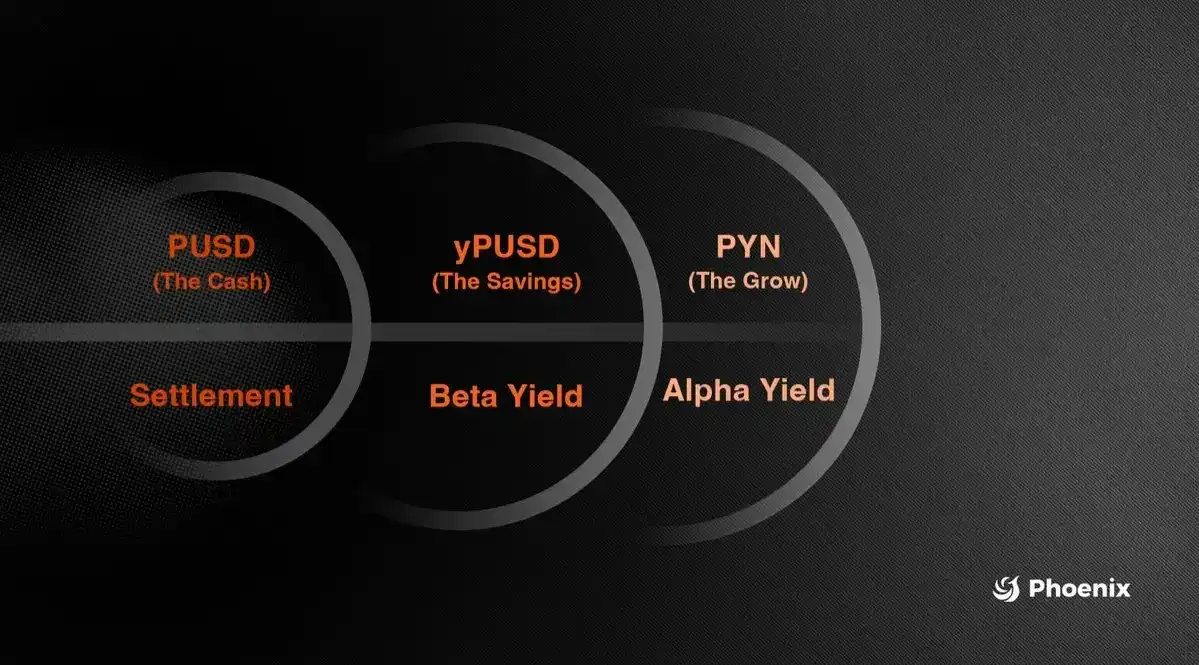
Phoenix plays the role of a"refinery", refining raw, non-standardized real-world yields - into DeFi-friendly standardized products:

PUSD(Settlement Layer): A unified cross-chain stablecoin. Without traditional bridges,PUSD enables inter-chain"instant transmission", with zero-friction circulation.

yPUSD(Base Yield Layer): Provides Beta yield, delivered through an auto-compounding exchange rate. The system smooths fragmented RWA repayments into a continuous yield curve; users gain value simply by holding,无需 manually claiming rewards.

PYN(Structured Yield Layer): Fixed-term NFT notes (7/31/89/181 days). Users lock liquidity to match specific RWA maturities (e.g., structured credit cycles), thereby earning an Alpha premium. This is equivalent to crypto-native principal tokens backed by real-world cash flows.

III. Core Engine: Mechanisms and Logic

1. Teleporter Mechanism (Teleporter): Unified Credit and Native Minting Traditional cross-chain bridges often rely on high-risk"lock-mint" models.Phoenix Teleporter operates as a unified credit protocol,它 maps users' collateral and credit status across chains, allowing for the direct native minting (Native Minting) of PUSD on the target chain. This means PUSD is a native asset on any chain, achieving zero fragmentation.

2. Dynamic Layered Reserve Stack (The Reserve Stack 80/15/5) Solvency is binary—either solvent or in default. To ensure the former, we employ a dynamic layering mechanism:

Liquidity Layer (80%): Composed of USDC/USDT and short-term U.S. Treasuries, ensuring users' ability to exit with rigid兑付 capability at any time.

Yield Layer (15%): Composed of high-rated private credit and structured RWA, serving as the core yield engine of the system.

Buffer Layer (5%): Protocol revenue acts as a"first-loss (First-loss)" layer,优先 absorbing risks before volatility is transmitted to users.

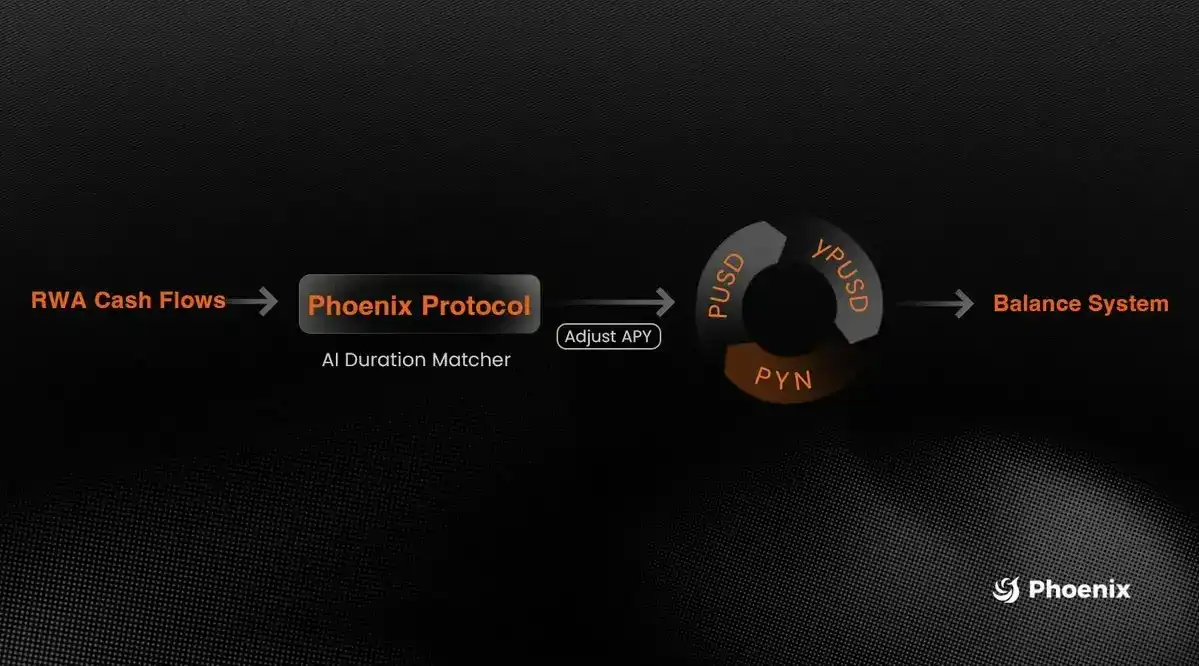
3.AI Controller (AI as Controller) Phoenix's AI is not used for price speculation but serves as a"cycle adapter" and"risk sentinel". When the system detects a mismatch between on-chain liquidity demand and off-chain asset maturity dates (e.g., rigid quarterly interest payments for RWA), theAI dynamically adjusts the APY for specific-term PYN (e.g., 89 day notes). This incentivizes users through market mechanisms to lock capital, precisely balancing the资产负债表.

IV. Transparency and Security Defenses

From Trust to Verification:

Proof of Reserve (Proof of Reserve): Real-time on-chain feeds of all underlying asset data.

Phoenix Hunters(Liquidation Network): An active defense network composed of whitelisted Keepers. When collateral value falls below the threshold,Hunters automatically bid at approximately 95% of the value, instantly clearing bad debt without waiting for lengthy governance processes.

Rejecting Black Boxes: Every bit of yPUSD yield comes from verifiable on-chain sources or audited SPVs.

RWA should not become a museum of assets.Phoenix is transforming it into a highly efficient on-chain economy.


Perguntas relacionadas

QWhat is the core problem that Phoenix Finance aims to solve in the RWA market?

APhoenix Finance aims to solve the structural mismatch in the RWA market, where $170 billion in on-chain RWA assets are fragmented, static, and disconnected from the high-speed circulation of DeFi. This includes issues like liquidity fragmentation across different blockchains, passive capital sitting idle in wallets, and a mismatch between the periodic yield payments of real-world assets and the block-by-block compound growth demanded by DeFi.

QWhat are the three main components of Phoenix's product matrix, and what role does each play?

AThe three main components are: 1) PUSD: A unified cross-chain stablecoin that acts as the settlement layer, enabling frictionless, 'instant transmission' across chains without traditional bridges. 2) yPUSD: The base yield layer that provides Beta returns through an auto-compounding exchange rate, converting fragmented RWA repayments into a continuous yield curve. 3) PYN: The structured yield layer, which are fixed-term NFT notes (7/31/89/181 days) that allow users to lock liquidity to match specific RWA maturity dates and earn Alpha premiums.

QHow does the 'Teleporter' mechanism differ from a traditional cross-chain bridge?

AUnlike traditional cross-chain bridges that rely on a high-risk 'lock-mint' model, the Teleporter acts as a unified credit protocol. It maps a user's collateral and credit status across different chains, allowing for the direct native minting of PUSD on the target chain. This means PUSD is a native asset on every chain, achieving zero fragmentation.

QDescribe the purpose and composition of the 'Dynamic Layered Reserve (80/15/5)'.

AThe Dynamic Layered Reserve Stack is designed to ensure solvency. It consists of: 1) Liquidity Layer (80%): Composed of USDC/USDT and short-term U.S. Treasury bonds to ensure rigid redemption capability for users. 2) Yield Layer (15%): Composed of high-grade private credit and structured RWA, serving as the system's core yield engine. 3) Buffer Layer (5%): Composed of protocol revenue, which acts as a 'first-loss' layer to absorb risks before they are passed on to users.

QWhat is the role of AI within the Phoenix system, and what specific problem does it address?

AThe AI acts as a 'cycle adapter' and 'risk sentinel,' not for price speculation. Its primary role is to detect and manage the mismatch between on-chain liquidity demand and the rigid payment schedules of off-chain RWA assets (e.g., quarterly interest payments). When a mismatch is detected, the AI dynamically adjusts the APY for specific PYN durations to incentivize users to lock their capital, thereby precisely balancing the system's资产负债表.

Leituras Relacionadas

You Bet on the News, the Pros Read the Rules: The True Cognitive Gap in Losing Money on Polymarket

The article explains that the key to profiting on Polymarket, a prediction market platform, lies not just predicting real-world events correctly, but in meticulously understanding the specific rules that govern how each market will be resolved. It illustrates this with examples, such as a market on Venezuela's 2026 leader, where the official rules defining "officially holds" the office overruled the intuitive answer of who was in practical control. Other examples include debates over the definition of a "token" or what constitutes an "agreement." The core argument is that a "reality vs. rules" gap creates pricing discrepancies that savvy traders ("车头" or "whales") exploit. The platform has a formal dispute resolution process managed by UMA token holders to settle ambiguous outcomes. This process involves proposal submission, a challenge window, a discussion period, and a final vote. However, the article highlights a critical flaw in this system compared to a traditional court: the lack of separation between the arbiters (UMA voters) and the interested parties (traders with financial stakes in the outcome). This conflict of interest undermines the discussion phase, leads to herd mentality, and results in opaque final decisions without explanatory rulings. Consequently, the system lacks a body of precedent, making it difficult for users to learn from past disputes. The ultimate takeaway is that success on Polymarket requires a lawyer-like scrutiny of the rules to identify and capitalize on the cognitive gap between how events appear and how they are contractually defined for settlement.

marsbitHá 1h

You Bet on the News, the Pros Read the Rules: The True Cognitive Gap in Losing Money on Polymarket

marsbitHá 1h

Trading

Spot
Futuros

Artigos em Destaque

Como comprar F

Bem-vindo à HTX.com!Tornámos a compra de Synfutures (F) simples e conveniente.Segue o nosso guia passo a passo para iniciar a tua jornada no mundo das criptos.Passo 1: cria a tua conta HTXUtiliza o teu e-mail ou número de telefone para te inscreveres numa conta gratuita na HTX.Desfruta de um processo de inscrição sem complicações e desbloqueia todas as funcionalidades.Obter a minha contaPasso 2: vai para Comprar Cripto e escolhe o teu método de pagamentoCartão de crédito/débito: usa o teu visa ou mastercard para comprar Synfutures (F) instantaneamente.Saldo: usa os fundos da tua conta HTX para transacionar sem problemas.Terceiros: adicionamos métodos de pagamento populares, como Google Pay e Apple Pay, para aumentar a conveniência.P2P: transaciona diretamente com outros utilizadores na HTX.Mercado de balcão (OTC): oferecemos serviços personalizados e taxas de câmbio competitivas para os traders.Passo 3: armazena teu Synfutures (F)Depois de comprar o teu Synfutures (F), armazena-o na tua conta HTX.Alternativamente, podes enviá-lo para outro lugar através de transferência blockchain ou usá-lo para transacionar outras criptomoedas.Passo 4: transaciona Synfutures (F)Transaciona facilmente Synfutures (F) no mercado à vista da HTX.Acede simplesmente à tua conta, seleciona o teu par de trading, executa as tuas transações e monitoriza em tempo real.Oferecemos uma experiência de fácil utilização tanto para principiantes como para traders experientes.

230 Visualizações TotaisPublicado em {updateTime}Atualizado em 2025.03.21

Como comprar F

Discussões

Bem-vindo à Comunidade HTX. Aqui, pode manter-se informado sobre os mais recentes desenvolvimentos da plataforma e obter acesso a análises profissionais de mercado. As opiniões dos utilizadores sobre o preço de F (F) são apresentadas abaixo.

活动图片