PEPE Whale Activity Jumps 60%, Among Highest In Market

bitcoinistPublicado em 2026-03-20Última atualização em 2026-03-20

Resumo

According to on-chain data from Santiment, PEPE has experienced a significant increase in whale activity, with its Whale Transaction Count surging 61% week-over-week, ranking it eighth among cryptocurrencies with market caps over $500 million. This metric tracks transfers exceeding $100,000, indicating heightened interest from large investors. Such spikes in whale activity often precede market volatility, as these substantial transactions can impact asset prices. PEPE’s price was around $0.00000334 at the time of writing, down 3% in 24 hours, following a period of recent pullback. Other notable assets on the list include Mantle (MNT), which saw a 600% increase, and stablecoins like USDT and USDC, which also recorded significant jumps in large transactions.

On-chain data shows Pepe is among the cryptocurrencies that have seen the largest week-over-week increases in the Whale Transaction Count.

Pepe Whale Transaction Count Has Witnessed A 61% Jump

In a new post on X, on-chain analytics firm Santiment has shared the top 10 list of digital assets that have seen the largest jumps in the Whale Transaction Count over the past week.

The Whale Transaction Count here refers to an indicator that keeps track of the total number of transfers occurring on a given network that involve a value of more than $100,000. Generally, only the whale entities are capable of making such large moves, so the metric represents the activity of these big-money hands.

When the value of the Whale Transaction Count rises, it means whales are ramping up their activity. Such a trend may be a sign that the large investors have increased their interest in the cryptocurrency.

On the other hand, the indicator going down suggests big-money attention may be moving away from the asset as large entities are lowering their number of transactions.

Now, here is the table shared by Santiment that shows how the assets with a minimum market cap of $500 million compare based on the weekly percentage change in the Whale Transaction Count:
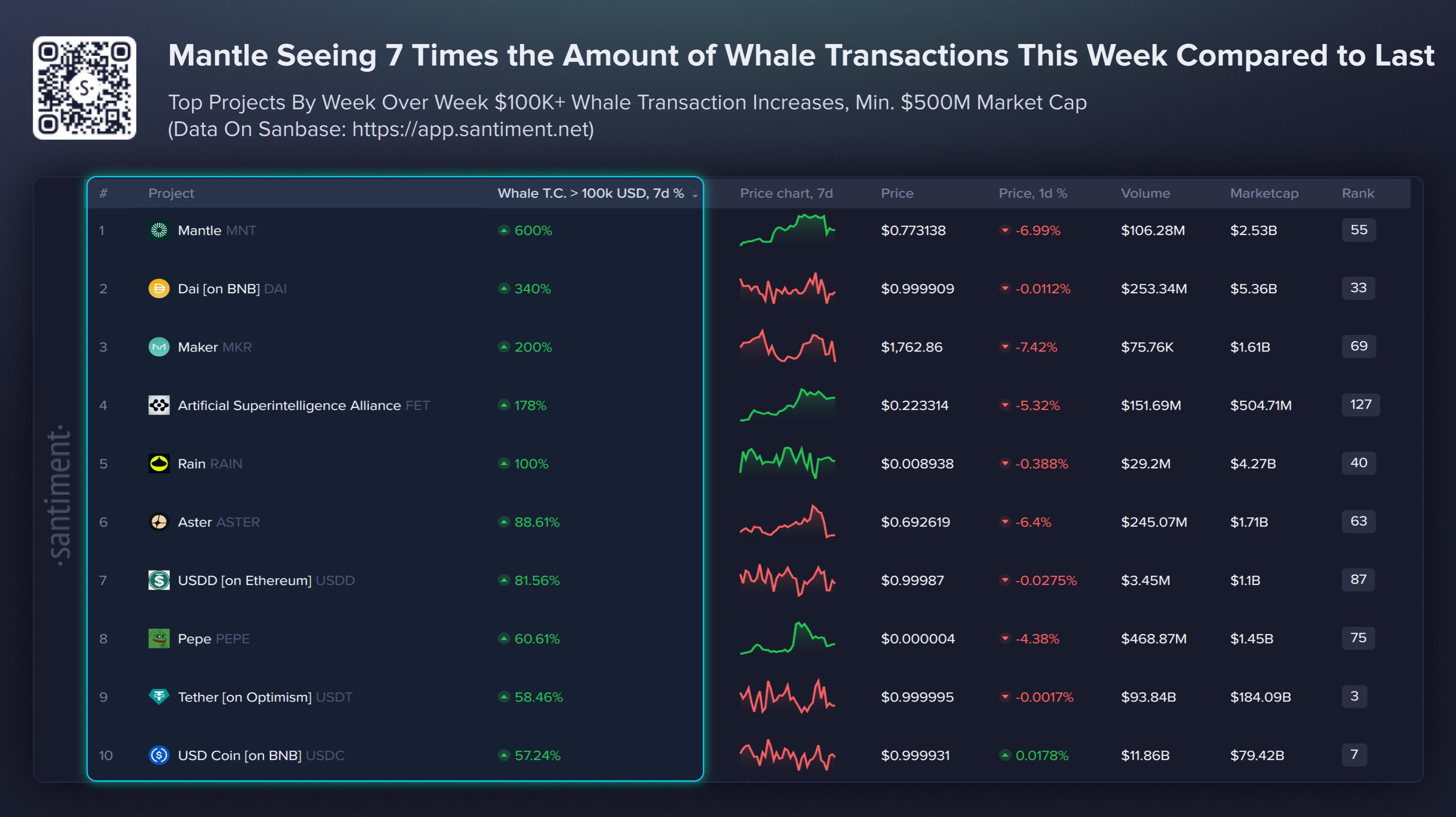
Looks like Mantle topped the list this week | Source: Santiment on X

As displayed above, Mantle (MNT) was the cryptocurrency that saw the strongest jump in the Whale Transaction Count over the last seven days: an increase of 600%. The BNB version of Dai (DAI) ranked second with an indicator rise of 340%, while Maker (MKR) came third with 200%.

Another prominent coin on the list is the memecoin Pepe (PEPE), which ranks eighth with a Whale Transaction Count of more than 60%. Earlier, the asset gained popularity due to the widely-known internet frog meme it’s associated with, but lately, the coin hasn’t been making much rounds in the news. As such, it’s interesting that whale interest in the memecoin has seen a sudden spike.

In the past, whale activity spikes have tended to proceed market volatility, as these humongous entities can create ripples big enough to shake the asset. Pepe and other assets have seen some sharp price action over the past few days, so it’s possible that the elevation in whale activity could be a factor behind it.

The largest assets by market cap on the list are USDT (on Optimism) and USDC (on BNB), garnering Whale Transaction Count jumps of 58% and 57%, respectively. Investors store capital in stablecoins when they want to avoid the volatility associated with the wider market, so these spikes could correspond to big-money hands either preparing capital for deployment into Bitcoin and other volatile assets or stashing it away in safety.

Pepe Price

At the time of writing, Pepe is floating around $0.00000334, down 3% in the last 24 hours.

The price of the memecoin seems to have pulled back over the last few days | Source: PEPEUSDT on TradingView


Perguntas relacionadas

QWhat does the Whale Transaction Count measure in the context of cryptocurrency?

AThe Whale Transaction Count is an indicator that tracks the total number of transfers on a network involving a value of more than $100,000, representing the activity of large investors or 'whales'.

QWhich cryptocurrency saw the largest percentage increase in Whale Transaction Count over the past week, and by how much?

AMantle (MNT) saw the largest increase in Whale Transaction Count over the past week, with a jump of 600%.

QWhat was the percentage increase in Whale Transaction Count for the memecoin Pepe (PEPE)?

AThe memecoin Pepe (PEPE) saw a 61% jump in its Whale Transaction Count over the past week.

QAccording to the article, what has historically tended to follow a spike in whale activity for an asset like Pepe?

AHistorically, spikes in whale activity have tended to precede market volatility, as these large entities can create significant price movements.

QWhat was the price of Pepe (PEPE) at the time the article was written, and how much had it changed in the last 24 hours?

AAt the time of writing, Pepe was trading around $0.00000334, down 3% in the last 24 hours.

Leituras Relacionadas

Bitcoin's 'Rally Ends,' Officially Entering the Later Stage of a Bear Market?

Bitcoin prices declined 13% this week, reversing the recent rebound and signaling a likely transition into the later stages of a bear market. Key on-chain metrics deteriorated, with the short-term holder cost basis falling below the Realized Price—a pattern last seen in early 2022, characteristic of bear market maturity. The rally to ~$82k proved to be a bear market bounce, as evidenced by the 90-day realized profit/loss ratio failing to sustain above the bullish threshold of 2. Daily realized losses surged to $1.35B, including significant selling from long-term holders who accumulated near cycle tops, indicating ongoing supply redistribution. Price was rejected almost precisely at the aggregate US spot ETF cost basis of ~$83k, turning that level into resistance and leaving the average ETF investor underwater again. Spot market selling pressure intensified, with the 7-day volume delta turning significantly negative to its weakest level since February. While a major long liquidation event cleared over $400M in leverage, spot demand has not yet stepped in to absorb the resulting supply. Options markets continue pricing in higher future volatility (elevated volatility risk premium) and maintain a skew toward put options, reflecting persistent demand for downside protection, though not yet panic. Overall, market structure remains fragile. Sustained recovery likely requires a reclaim of the ETF cost basis, a shift back to positive spot demand, and a slowdown in realized loss-taking. Until then, the market risks further downside or extended consolidation within the broader bear trend.

Foresight NewsHá 1h

Bitcoin's 'Rally Ends,' Officially Entering the Later Stage of a Bear Market?

Foresight NewsHá 1h

How Risky is the "Death Spiral" of MSTR and STRC?

Summary: This article explores the perceived "death spiral" risk between MicroStrategy (MSTR), its Bitcoin holdings, and its perpetual preferred stock (STRC), drawing comparisons to the LUNA-UST collapse. While both systems feature price anchors, high yields for holders, and potential feedback loops, their core mechanisms differ fundamentally. The MSTR-STRC structure relies on continuous financing to sustain its high dividend payouts, primarily through stock ATM offerings. A negative feedback cycle could occur: falling MSTR stock price makes raising equity capital harder, increasing pressure to sell Bitcoin, which undermines STRC confidence and further depresses MSTR. However, unlike LUNA-UST's automated, direct linkage, the MSTR-STRC loop is weaker and has brakes: STRC dividends can be deferred or rates lowered, and STRC holders have a $100/share liquidation preference in bankruptcy, providing a price floor. The company's sustainability hinges on its ability to continue financing. Its current ~$900 million USD reserves cover only about 6.3 months of its ~$1.71 billion annual interest/dividend burden. The next six months are critical, aligning with both the potential bottom in Bitcoin's four-year cycle and the depletion timeline of its reserves. While a LUNA-style catastrophic collapse is deemed highly unlikely due to structural differences, the key question is whether MicroStrategy can navigate this period through healthy deleveraging to restart its capital engine.

Foresight NewsHá 1h

How Risky is the "Death Spiral" of MSTR and STRC?

Foresight NewsHá 1h

Trading

Spot
Futuros
活动图片