Payy Unveils Privacy-First L2 for Institutional Capital: Why $BMIC is the Missing Layer of Quantum Defense

bitcoinistPublicado em 2026-02-05Última atualização em 2026-02-05

Resumo

Payy has launched a privacy-focused Ethereum Layer 2 solution using zero-knowledge proofs to enable institutions to settle transactions on-chain without exposing sensitive data to competitors. While this addresses transparency and front-running risks, it doesn’t protect against the long-term threat of quantum computing, which could decrypt current cryptographic systems. This vulnerability is where BMIC ($BMIC) positions itself as a critical security layer. It introduces a quantum-resistant financial stack using post-quantum cryptography (PQC) to safeguard private keys and assets from future quantum attacks. BMIC’s architecture includes AI-enhanced threat detection and integrates with ERC-4337 smart accounts for a user-friendly yet highly secure experience. The project has raised over $432K in its presale, with the token priced at $0.049474. $BMIC supports ecosystem operations through a "Burn-to-Compute" mechanism and enables quantum-secure staking. As institutional adoption of privacy L2s grows, BMIC aims to become an essential component in protecting high-value on-chain transactions from quantum decryption threats.

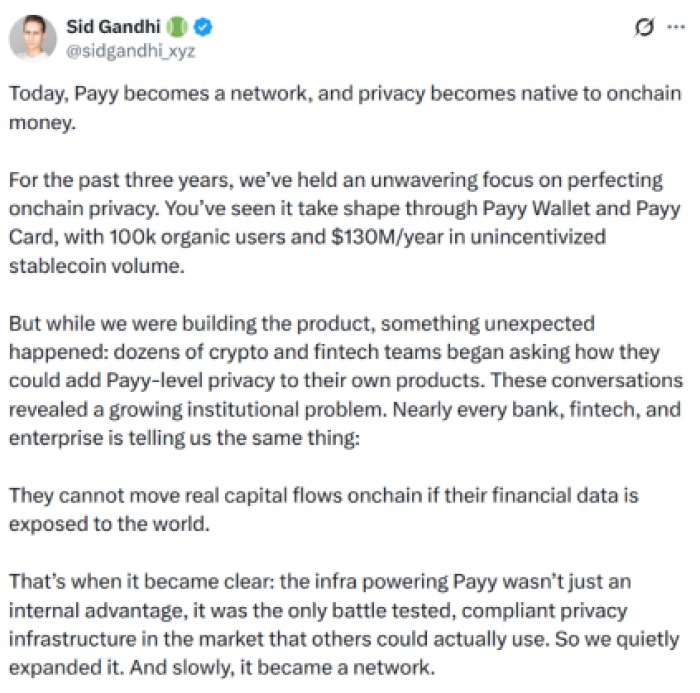
The friction between blockchain’s radical transparency and traditional finance’s need for discretion has long been a bottleneck for institutional adoption. Now, Payy is moving to break that deadlock.

With the launch of its privacy-enabled Ethereum Layer 2, the protocol uses zero-knowledge proofs to offer banks and fintechs a way to settle transactions on-chain without broadcasting their entire ledger to competitors.
This isn’t just about masking transactions. For years, major financial institutions have hesitated to move proprietary trading algorithms or sensitive settlement layers onto public ledgers like Ethereum.

Why? The ‘dark forest’ of the mempool, where MEV bots and rivals front-run visible trades, is simply too risky. While Payy’s integration with MetaMask suggests a seamless bridge for Web3 natives, the real target is the massive institutional flow that demands regulatory compliance paired with on-chain finality.

But let’s be honest: privacy is only half the battle. While Payy obscures the flow of funds, the assets themselves remain vulnerable to a quieter, existential threat: quantum computing. As banks move billions onto these new rails, they face the ‘harvest now, decrypt later’ vector, where hostile actors collect encrypted data today to crack it once quantum processors mature.

This specific gap, protecting the vault rather than just the transaction, is driving smart money toward BMIC ($BMIC), a project building the first quantum-secure financial stack for the Ethereum ecosystem.

Quantum-Proofing the Institutional Ledger

If Payy secures the pipe, BMIC is engineering the steel plating for the vault. The current cryptographic standards securing the $2.5T crypto market (Elliptic Curve Cryptography) are notoriously vulnerable to Shor’s algorithm.

That’s the method quantum computers will eventually use to reverse-engineer private keys from public addresses. For a retail trader, it’s a risk. For a bank moving nine-figure sums on Payy’s L2? It’s an unacceptable systemic failure point.

BMIC addresses this with a full finance stack running on post-quantum cryptography (PQC). Unlike legacy wallets that expose public keys during signing, BMIC uses a zero public-key exposure protocol. That matters.
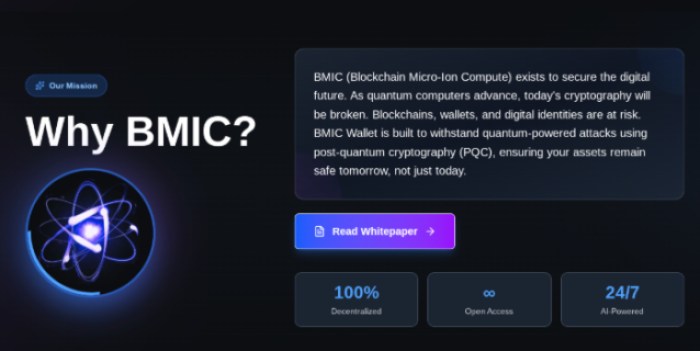
It neutralizes the primary vector for quantum attacks before they even begin. The platform’s ‘Quantum Meta-Cloud’ architecture insulates assets from underlying chain vulnerabilities, creating an environment where institutions can stake, store, and transact without fear of retrospective decryption.

The technological leap here is the integration of AI-enhanced threat detection within the wallet infrastructure itself. By combining quantum-resistant algorithms with ERC-4337 smart accounts, BMIC offers a user experience that mimics the ease of MetaMask, essential for Payy’s target demographic, while operating on a security standard that exceeds current military-grade requirements.

As the industry pivots toward privacy L2s, the infrastructure securing the keys themselves becomes the most critical, yet undervalued, layer of the stack.

LEARN MORE ABOUT THE BMIC’S QUANTUM SECURITY

$0.049474 Entry Point Attracts Defensive Capital

The market is waking up to the reality that privacy rails like Payy need quantum-resistant locks. BMIC has already raised over $432K in its ongoing presale, signaling growing awareness of the ‘quantum threat’ among sophisticated investors.

Currently priced at $0.049474, the token offers an entry point into a sector that many analysts predict will be mandatory for institutional volume by 2026. It’s easy to see why it could be the best new cryptocurrency.

Frankly, the token utility distinguishes the presale raise. $BMIC isn’t just for governance; it fuels the ecosystem’s computational power (via the ‘Burn-to-Compute’ mechanism) and is required for quantum-secure staking. In a market where yield often carries the risk of smart contract exploits or key exposure, BMIC offers a secure staking environment where cryptographic integrity beats complex, risky DeFi loops.

For investors watching the infrastructure narrative, the correlation is clear: as adoption of privacy L2s like Payy grows, the underlying security layer must scale to match the assets it protects. With the presale still under half a million dollars, the valuation hasn’t yet priced in the inevitable shift toward post-quantum standards.

As regulatory frameworks tighten around data security, protocols offering harvest-resistant encryption could decouple from the broader altcoin market.

CHECK OUT THE $BMIC PRESALE PAGE

This article is for informational purposes only and does not constitute financial advice. Cryptocurrencies are high-risk assets. The “harvest now, decrypt later” threat is a long-term projection. Always conduct your own due diligence before investing.


Perguntas relacionadas

QWhat is the primary purpose of Payy's new Ethereum Layer 2 solution?

APayy's privacy-enabled Ethereum Layer 2 uses zero-knowledge proofs to allow banks and fintech companies to settle transactions on-chain without broadcasting their entire ledger to competitors, addressing the friction between blockchain transparency and traditional finance's discretion.

QAccording to the article, what is the 'harvest now, decrypt later' threat?

AThe 'harvest now, decrypt later' threat is a vector where hostile actors collect encrypted data today with the intention of decrypting it once quantum processors become powerful enough, posing a risk to assets secured by current cryptographic standards.

QHow does BMIC ($BMIC) aim to protect against quantum computing threats?

ABMIC uses a full finance stack running on post-quantum cryptography (PQC) with a zero public-key exposure protocol. Its 'Quantum Meta-Cloud' architecture insulates assets from underlying chain vulnerabilities, preventing quantum computers from reverse-engineering private keys.

QWhat technological features does BMIC integrate to enhance its security and user experience?

ABMIC integrates AI-enhanced threat detection within its wallet infrastructure and combines quantum-resistant algorithms with ERC-4337 smart accounts. This provides a user experience similar to MetaMask while operating on a security standard that exceeds current military-grade requirements.

QWhat is the current price and key utility of the $BMIC token as mentioned in the article?

AThe $BMIC token is currently priced at $0.049474 in its presale. Its utility includes fueling the ecosystem's computational power via a 'Burn-to-Compute' mechanism and is required for participating in quantum-secure staking, offering a secure alternative to risky DeFi yield strategies.

Leituras Relacionadas

Will the Fed Still Cut Interest Rates? Tonight's Data Is Crucial

The core debate surrounding the Federal Reserve's potential interest rate cuts is intensifying amid geopolitical conflict and rebounding inflation. The key question is whether high energy prices will cause persistent inflation or weaken consumer demand enough to force the Fed to cut rates. Citigroup presents a bullish case for cuts, arguing that oil supply disruptions from the Strait of Hormuz are temporary and will not lead to lasting inflationary pressure. They point to receding bond yields and oil prices as evidence the market is pricing in a short-lived shock. Citi's data also shows tightening financial conditions, a stabilizing labor market, and healthy tax returns, supporting their view that the path to lower rates remains open. Conversely, Deutsche Bank offers a starkly contrasting, more hawkish outlook. They argue the Fed's current policy is already neutral and expect rates to remain unchanged indefinitely. Their view is based on stalled disinflation progress and a shift toward more hawkish rhetoric from key Fed officials like Waller, who cited risks from prolonged Middle East conflict and tariffs. Other officials, including Williams and Hammack, signaled rates would likely stay on hold for a "considerable time." The market pricing has shifted dramatically, now forecasting zero cuts in 2026. The imminent release of the March retail sales "control group" data is highlighted as a critical test. This metric, which excludes gas station sales, will reveal if high gasoline prices are eroding consumer spending in other areas. A weak reading could support the case for imminent rate cuts, while a strong one would bolster the argument for the Fed to hold steady. This data is pivotal for determining the near-term policy path.

marsbitHá 12m

Will the Fed Still Cut Interest Rates? Tonight's Data Is Crucial

marsbitHá 12m

The Second Half of Macro Influencer Fu Peng's Career

Fu Peng, a prominent Chinese macroeconomist and former chief economist of Northeast Securities, has joined Hong Kong-based digital asset management firm Bitfire Group (formerly New Huo Group) as its chief economist. This move, announced in April 2026, triggered an 11% surge in Bitfire's stock price. Fu, known for his accessible macroeconomic commentary and large social media following, will focus on integrating digital assets into global asset allocation frameworks, particularly combining FICC (fixed income, currencies, and commodities) with cryptocurrencies for institutional clients. His career includes roles at Lehman Brothers and Solomon International, with significant influence gained through public communication. However, in late 2024, Fu faced temporary social media bans after a controversial private speech at HSBC on China's economic challenges, though he denied regulatory sanctions. He later left Northeast Securities citing health reasons. Bitfire, a licensed virtual asset manager serving high-net-worth clients, seeks to build trust and attract traditional capital through Fu’s expertise and credibility. The partnership represents a strategic shift for both: Fu enters the crypto sector after a traditional finance peak, while Bitfire aims to leverage his macro framework for institutional adoption. Outcomes remain uncertain regarding capital inflows and compatibility within corporate structure.

marsbitHá 1h

The Second Half of Macro Influencer Fu Peng's Career

marsbitHá 1h

Trading

Spot
Futuros

Artigos em Destaque

Como comprar LAYER

Bem-vindo à HTX.com!Tornámos a compra de Solayer (LAYER) simples e conveniente.Segue o nosso guia passo a passo para iniciar a tua jornada no mundo das criptos.Passo 1: cria a tua conta HTXUtiliza o teu e-mail ou número de telefone para te inscreveres numa conta gratuita na HTX.Desfruta de um processo de inscrição sem complicações e desbloqueia todas as funcionalidades.Obter a minha contaPasso 2: vai para Comprar Cripto e escolhe o teu método de pagamentoCartão de crédito/débito: usa o teu visa ou mastercard para comprar Solayer (LAYER) instantaneamente.Saldo: usa os fundos da tua conta HTX para transacionar sem problemas.Terceiros: adicionamos métodos de pagamento populares, como Google Pay e Apple Pay, para aumentar a conveniência.P2P: transaciona diretamente com outros utilizadores na HTX.Mercado de balcão (OTC): oferecemos serviços personalizados e taxas de câmbio competitivas para os traders.Passo 3: armazena teu Solayer (LAYER)Depois de comprar o teu Solayer (LAYER), armazena-o na tua conta HTX.Alternativamente, podes enviá-lo para outro lugar através de transferência blockchain ou usá-lo para transacionar outras criptomoedas.Passo 4: transaciona Solayer (LAYER)Transaciona facilmente Solayer (LAYER) no mercado à vista da HTX.Acede simplesmente à tua conta, seleciona o teu par de trading, executa as tuas transações e monitoriza em tempo real.Oferecemos uma experiência de fácil utilização tanto para principiantes como para traders experientes.

283 Visualizações TotaisPublicado em {updateTime}Atualizado em 2025.03.21

Como comprar LAYER

Discussões

Bem-vindo à Comunidade HTX. Aqui, pode manter-se informado sobre os mais recentes desenvolvimentos da plataforma e obter acesso a análises profissionais de mercado. As opiniões dos utilizadores sobre o preço de LAYER (LAYER) são apresentadas abaixo.

活动图片