Stablecoins Don’t Meet Core Requirements Of Money, BIS Says

bitcoinistPublicado em 2026-04-21Última atualização em 2026-04-21

Resumo

The Bank for International Settlements (BIS) General Manager, Pablo Hernández de Cos, stated that existing stablecoins fail to meet the core requirements of money, specifically "singleness" and "interoperability." Singleness refers to the need for different forms of money to be interchangeable at par value, which is ensured by central banks in traditional finance but not in decentralized stablecoins. Interoperability means seamless cross-platform transactions, which stablecoins currently lack due to fragmentation across multiple blockchains. These shortcomings limit stablecoins' network effects and widespread acceptance, keeping them a "niche" payment instrument. However, de Cos acknowledged their potential to improve cross-border payments, though he also warned of risks to financial stability and monetary policy. Despite a bearish crypto market, the stablecoin market cap has reached a new all-time high of over $320 billion.

The BIS General Manager has said that existing stablecoins fall short of the requirements for a widely accepted and used payment instrument.

Stablecoins Remain A “Niche” Payment Instrument

Pablo Hernández de Cos, General Manager at the Bank for International Settlements (BIS), spoke on the topic of stablecoins at a Bank of Japan seminar in Tokyo on Monday. The BIS is an international financial institution that serves as a bank for central banks. It’s owned by constituent central banks, of which there are 63 in total at the moment. The institution has been vocal about its concerns regarding stablecoins in the past.

Stablecoins are cryptocurrencies that have their price tied to a fiat currency. In recent years, these tokens have gained popularity, inviting regulation from major economic hubs.

Since stables run on blockchain technology, they naturally offer relatively cheap 24/7 transactions. This has made their main use, besides being a store of value, as a mode of payments.

Stablecoins try to mimic fiat currencies, but do they count as “money”? de Cos has discussed the two features that decide the “moneyness” of an instrument: singleness and interoperability.

First, singleness is the idea that different forms of money should be perfectly substitutable at par across financial intermediaries and platforms. In fiat economics, this is facilitated by central banks. For the decentralized stablecoins, there is no such central settlement so deviations can emerge.

Though, these differences tend to be relatively modest. “Yet confidence shocks can widen discounts abruptly and, when they do, users may refuse to accept certain stablecoins, as seen on several occasions in the past,” said de Cos.

The other property, interoperability, means that users can send and receive funds seamlessly across platforms and networks. Today, stablecoins are distributed across a wide range of blockchains, so even versions of the same token that run on different blockchains aren’t interoperable by default.

The BIS General Manager explained:

Together, these features undermine the network effects that are key to money – the use of money begets its acceptance, and acceptance begets wider use. It is therefore conceivable that under current designs stablecoins remain a “niche” instrument.

While current stablecoin systems may fall short of the requirements of a widely accepted payment instrument, de Cos noted that they have the potential to significantly enhance cross-border payments. But the opportunities provided by fiat-tied cryptocurrencies don’t come without challenges; the BIS head cautioned that these assets can affect credit supply, financial stability, and monetary and fiscal policy.

The wider digital asset sector has faced bearish winds since Q4 2025, but the stablecoin market has managed to hold up relatively well as its market cap has seen a slight uptrend in this period, according to data from DefiLlama.
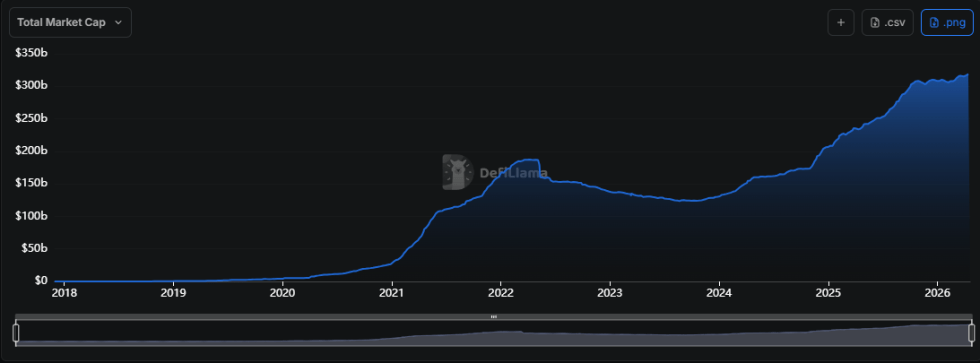
The trend in the stablecoin market cap over the last few years | Source: DefiLlama

Currently, the fiat-pegged coins have a combined valuation of over $320 billion, which is a new all-time high.

Bitcoin Price

At the time of writing, Bitcoin is trading around $75,000, up more than 6% over the past week.

The price of the coin seems to have retraced from its Friday high | Source: BTCUSDT on TradingView

Criptomoedas em alta

Perguntas relacionadas

QAccording to the BIS General Manager, what are the two key features that determine the 'moneyness' of an instrument like a stablecoin?

AThe two key features are singleness and interoperability.

QWhat is the main reason the BIS believes stablecoins currently remain a 'niche' payment instrument?

ABecause they lack the network effects that are key to money, as their design undermines singleness and interoperability, which prevents wider acceptance and use.

QDespite their shortcomings, what potential benefit of stablecoins did the BIS General Manager acknowledge?

AHe noted that stablecoins have the potential to significantly enhance cross-border payments.

QWhat is the current total market capitalization of all stablecoins as mentioned in the article?

AThe combined valuation is over $320 billion, which is a new all-time high.

QWhat are the two specific risks that the BIS head cautioned stablecoins could pose?

AThey can affect credit supply, financial stability, and monetary and fiscal policy.

Leituras Relacionadas

The Verdict in Choi Tae-won's Divorce Case: Revealing the Inheritance Undercurrent Behind SK Hynix's Trillion-Won Empire

SK Group Chairman Chey Tae-won's high-profile divorce case, involving a record 1.38 trillion won settlement, has drawn attention to the succession plans for Korea's second-largest conglomerate, especially its crown jewel, SK hynix. Unlike traditional chaebol scripts centered on the eldest son, Chey's three children from his marriage to former President Roh Tae-woo's daughter, Roh Soh-yeong, are carving distinct, non-traditional paths. Eldest daughter Chey Yun-jung (b. 1989) is seen as the most evident successor. With a scientific and consulting background, she holds executive roles at SK bioscience and SK Inc.'s growth support department, focusing on future strategy and biopharma. Her marriage is to an AI infrastructure entrepreneur, not a traditional business alliance. Second daughter Chey Min-jung (b. 1991) took a unique route, voluntarily serving as a South Korean naval officer, including an anti-piracy deployment. She later worked on policy and strategy for SK hynix in Washington D.C. before co-founding an AI-driven healthcare startup. She married a former U.S. Marine Corps officer, connecting her to U.S. defense and policy circles—networks crucial for a global semiconductor giant. The only son, Chey In-geun (b. 1995), who studied physics like his father, worked briefly at SK E&S before joining McKinsey. Despite fitting the traditional "heir" profile as the eldest son, he remains silent and holds no public position or shares in SK, suggesting the old succession playbook is obsolete. As SK hynix's valuation soars, becoming a geopolitical asset in the AI era, the heirs' legitimacy is no longer automatic. They must prove themselves in fields like AI biotech, global policy, and strategic consulting. Their marriages also reflect new elite networks in tech and defense, not old political alliances. Their inheritance is the complex challenge of navigating a globalized, tech-driven world, not just a corporate throne.

marsbitOntem 09:06

The Verdict in Choi Tae-won's Divorce Case: Revealing the Inheritance Undercurrent Behind SK Hynix's Trillion-Won Empire

marsbitOntem 09:06

From OpenSea to OpenRouter: Is Alex Atallah Repeating His 'Exit at the Peak' Playbook?

From OpenSea to OpenRouter: Is Alex Atallah Repeating His "Exit at the Peak" Playbook? According to the Wall Street Journal, payments giant Stripe is in talks to acquire the AI model aggregation platform OpenRouter in a potential deal valuing the company near $100 billion. This would mark founder Alex Atallah's second creation of a company reaching a $100 billion valuation, following his co-founding of NFT marketplace OpenSea. OpenRouter, founded just over three years ago, has grown rapidly by acting as a unified gateway for developers to access over 400 AI models. It currently has about 10 million users and processes over 200 trillion tokens monthly. While the platform's annualized revenue is around $50 million, its valuation has skyrocketed from $1.3 billion in March 2026. The potential acquisition by Stripe, a company OpenRouter's founder once likened it to, represents a major expansion into AI infrastructure for the payments leader. This move echoes Atallah's previous timing with OpenSea, where he departed before the NFT market's significant downturn. For OpenRouter, selling now may be strategic. Despite its scale, its business model—charging a 5-5.5% fee on AI inference calls—faces pressure from competition, open-source models, and potential price wars among model providers, limiting its profitability narrative for an IPO. A key asset for potential acquirers like Stripe is OpenRouter's vast repository of real-world AI usage data, which offers unique insights into model performance and developer preferences that are difficult to replicate. Whether this potential deal signifies a new valuation benchmark for AI infrastructure or another market peak signal remains to be seen.

链捕手Ontem 08:42

From OpenSea to OpenRouter: Is Alex Atallah Repeating His 'Exit at the Peak' Playbook?

链捕手Ontem 08:42

Trading

Spot

Artigos em Destaque

Como comprar CORE

Bem-vindo à HTX.com!Tornámos a compra de CORE (CORE) simples e conveniente.Segue o nosso guia passo a passo para iniciar a tua jornada no mundo das criptos.Passo 1: cria a tua conta HTXUtiliza o teu e-mail ou número de telefone para te inscreveres numa conta gratuita na HTX.Desfruta de um processo de inscrição sem complicações e desbloqueia todas as funcionalidades.Obter a minha contaPasso 2: vai para Comprar Cripto e escolhe o teu método de pagamentoCartão de crédito/débito: usa o teu visa ou mastercard para comprar CORE (CORE) instantaneamente.Saldo: usa os fundos da tua conta HTX para transacionar sem problemas.Terceiros: adicionamos métodos de pagamento populares, como Google Pay e Apple Pay, para aumentar a conveniência.P2P: transaciona diretamente com outros utilizadores na HTX.Mercado de balcão (OTC): oferecemos serviços personalizados e taxas de câmbio competitivas para os traders.Passo 3: armazena teu CORE (CORE)Depois de comprar o teu CORE (CORE), armazena-o na tua conta HTX.Alternativamente, podes enviá-lo para outro lugar através de transferência blockchain ou usá-lo para transacionar outras criptomoedas.Passo 4: transaciona CORE (CORE)Transaciona facilmente CORE (CORE) no mercado à vista da HTX.Acede simplesmente à tua conta, seleciona o teu par de trading, executa as tuas transações e monitoriza em tempo real.Oferecemos uma experiência de fácil utilização tanto para principiantes como para traders experientes.

351 Visualizações TotaisPublicado em {updateTime}Atualizado em 2026.06.02

Como comprar CORE

Discussões

Bem-vindo à Comunidade HTX. Aqui, pode manter-se informado sobre os mais recentes desenvolvimentos da plataforma e obter acesso a análises profissionais de mercado. As opiniões dos utilizadores sobre o preço de CORE (CORE) são apresentadas abaixo.

活动图片