PayPal Expands PYUSD Access To 68 New Countries Amid Stablecoin Push

bitcoinistPublicado em 2026-03-18Última atualização em 2026-03-18

Resumo

PayPal has expanded access to its U.S. dollar-pegged stablecoin, PayPal USD (PYUSD), to 70 markets worldwide, including 68 new countries this month. This expansion allows users in regions like Asia-Pacific, Europe, and Latin America to send, hold, and receive PYUSD, enabling faster and lower-cost cross-border transactions compared to traditional methods. The stablecoin, which initially faced regulatory scrutiny, saw its market cap grow to $4.1 billion after the SEC closed its investigation in February 2025. Users in most regions can also receive rewards on holdings, though exceptions include Singapore and the UK. PayPal aims to build a more inclusive global commerce ecosystem by increasing PYUSD’s utility and accessibility.

PayPal has expanded access to its stablecoin PayPal USD (PYUSD) to 70 markets, allowing users worldwide to send, hold, and receive the token while enabling faster, lower-cost global transactions.

PayPal Expands PYUSD Across 70 Markets

On Tuesday, payments giant PayPal announced that its USD-pegged stablecoin, PYUSD, will be available to users in 70 markets worldwide following its expansion into 68 new countries this month.

The fintech launched the stablecoin in August 2023 after initially pausing development due to scrutiny of PayPal’s issuance partner, Paxos. That same year, PayPal received a subpoena from the US Securities and Exchange Commission (SEC) related to its stablecoin.

As crypto regulation gained momentum and financial watchdogs loosened their grip under the Trump Administration, the Commission concluded its 16-month investigation into PYUSD without enforcement action in February 2025. Since then, PYUSD’s total market capitalization has reached $4.1 billion, a fivefold increase over the past year.

Previously, only customers in the US and the UK had access to the PYUSD. However, the latest expansion has made PYUSD available to users across multiple global regions, including Asia-Pacific, Europe, Latin America, and North America.

This includes Colombia, Costa Rica, the Dominican Republic, the Faroe Islands, Greenland, Guatemala, Honduras, Panama, Peru, Singapore, the United Kingdom, and the United States. Meanwhile, users in the remaining markets will have access to PYUSD in the coming weeks.

Users in the newly supported regions will be able to hold, send, and receive the stablecoin directly on their PayPal accounts, enabling faster settlement and lower cost than traditional payment methods.

Users will also be eligible to earn rewards on their stablecoin holdings, but rewards won’t be available to users in Singapore or the United Kingdom, the official announcement noted. Existing holders in the United States receive an annual 4% reward.

PayPal Eyes ‘More Inclusive, Global Commerce Ecosystem’

The payments giant affirmed that this geographical expansion marks a critical step in its stablecoin push to build “the liquidity, utility, and ubiquity of PYUSD necessary to create a more inclusive, global commerce ecosystem.”

While consumers and businesses worldwide are seeking faster, more seamless global transactions, the current system still incurs excessive charges and adheres to outdated timelines, May Zabaneh, Senior Vice President and General Manager of Crypto at PayPal, noted, adding that the company is working to change that.

“Enabling PYUSD in users’ accounts across 70 markets gives people faster access to their funds, lower-cost ways to send money across borders, and a more direct path to participating in the global economy, and that is what drives commerce forward for everyone,” she affirmed in the official announcement.

“Now you’re really opening up not only access—especially in places where they need it most— but also cross-border transfers and volume, where the pain is felt so high,” Zabaneh also told Fortune.

The stablecoin was initially launched on Ethereum and later expanded to other networks, including Tron, Avalanche, Aptos, and Sei, through LayerZero in September. In addition, YouTube added a new payout option last December that allows US creators to receive earnings in PYUSD.
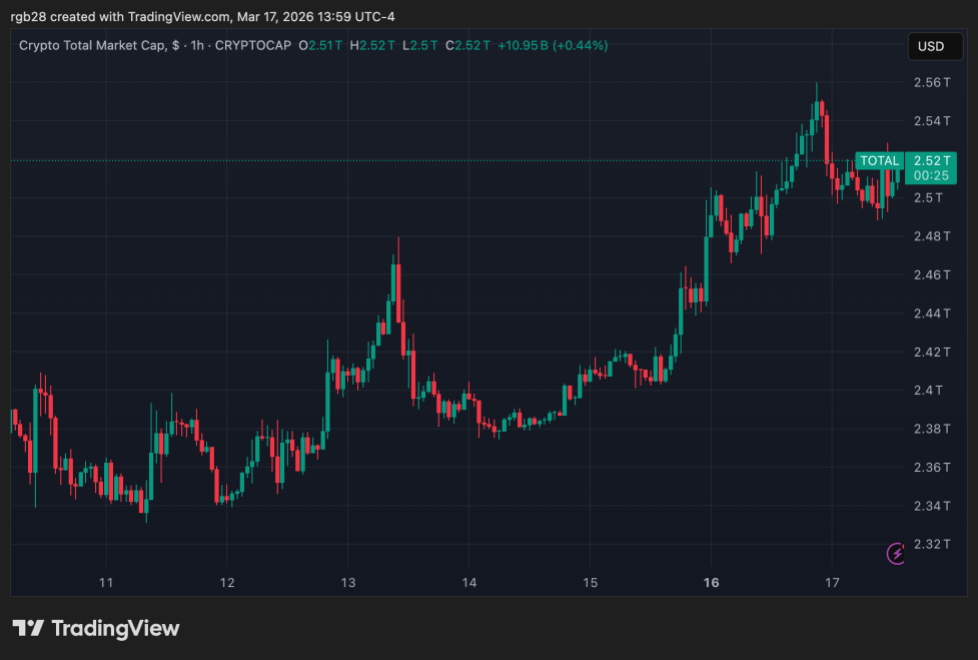
The total crypto market capitalization is at $2.52 trillion in the one-week chart. Source: TOTAL on TradingView


Criptomoedas em alta

Perguntas relacionadas

QHow many new countries did PayPal expand PYUSD access to in its latest announcement?

APayPal expanded PYUSD access to 68 new countries.

QWhat was the total market capitalization of PYUSD as mentioned in the article, and how much has it increased over the past year?

APYUSD's total market capitalization reached $4.1 billion, which is a fivefold increase over the past year.

QWhich regions are included in the latest expansion of PYUSD access?

AThe latest expansion includes users across multiple global regions, such as Asia-Pacific, Europe, Latin America, and North America.

QWhat benefits do users in newly supported regions gain from holding PYUSD?

AUsers in newly supported regions can hold, send, and receive PYUSD directly on their PayPal accounts, enabling faster settlement and lower costs compared to traditional payment methods.

QOn which blockchain networks is PYUSD available besides Ethereum?

ABesides Ethereum, PYUSD is available on other networks including Tron, Avalanche, Aptos, and Sei.

Leituras Relacionadas

L2 'Recalibration': When L1 Becomes Its Own Rollup, What Is Ethereum's Endgame?

The article discusses the evolving relationship between Ethereum's Layer 1 (L1) and Layer 2 (L2) solutions, moving beyond the initial "L2 for scaling" model. As Ethereum L1 itself scales (increasing Gas Limit, statelessness, zkEVM), the unique value proposition of L2s shifts from merely providing cheap execution to offering differentiated features like application-specific optimization, privacy, and flexible governance. The piece explores three key themes: 1. **L2's New Role:** L2s are transitioning from a pure scaling technology to a spectrum of execution environments with varying degrees of security inheritance from Ethereum L1. 2. **Interoperability as State Trust:** Solving L2 fragmentation is less about cross-chain bridges and more about enabling faster, trust-minimized state verification between environments. This involves initiatives like faster L1 finality, intent-based architectures (Open Intents Framework), and native account abstraction. 3. **Blurring Layers:** With the potential integration of zk-proofs into L1 validation (making L1 akin to its own "Rollup") and the concept of "Native Rollups," the rigid boundary between L1 and L2 may fade. The future could be a unified system with multiple execution domains (for DeFi, gaming, privacy, etc.) sharing a common security, settlement, and state framework. In conclusion, Ethereum's goal is not to abandon L2s or re-centralize everything on L1, but to re-integrate the fragmented user experience—liquidity, accounts, applications—while preserving the scaling benefits of a multi-environment ecosystem. The endgame is a cohesive "one chain" feeling for users, powered by diverse but securely interconnected execution layers.

marsbitHá 18m

L2 'Recalibration': When L1 Becomes Its Own Rollup, What Is Ethereum's Endgame?

marsbitHá 18m

The Encryption Bill Clarity's Challenge: A Thorny Path of Bipartisan Compromise in the U.S.

U.S. lawmakers are attempting to advance the Clarity Act, a significant crypto market structure bill, but its path is fraught with partisan hurdles. The process has been rocky since January, when a prior bipartisan deal in the Senate Banking Committee was upended. A key compromise in May on "yield" issues allowed the bill to move forward in committee, but only with the conditional support of two Democratic senators, Angela Alsobrooks and Ruben Gallego. They emphasized that their final vote depends on reaching an agreement on ethics provisions for elected officials. Ultimately, the Senate Agriculture Committee passed its version along party lines without Democratic support. As Republicans push for a full Senate vote in July, the demand for strong ethics language has expanded beyond Democrats. Additional controversies surround provisions related to yields (aligning some Republicans with large banks) and developer protections (opposed by enforcement agencies). Core concerns about illicit finance and consumer protection remain central to the debate. Despite consensus on the need for legislation, achieving the necessary bipartisan compromise is proving difficult. While momentum exists—including recent meetings between senators and White House officials—a reconciled bill text faces skepticism. Senator Gallego has stated that without ethics terms acceptable to Democrats, they will not provide the needed votes. The immediate goals for the crypto community in Congress are unclear: a symbolic Senate vote before the August recess, eventual passage into law by 2026, or forging a final compromise framework. The arduous, vote-by-vote effort to build bipartisan support continues, mirroring the traditional legislative grind the industry must now navigate.

Foresight NewsHá 1h

The Encryption Bill Clarity's Challenge: A Thorny Path of Bipartisan Compromise in the U.S.

Foresight NewsHá 1h

Trading

Spot

Artigos em Destaque

Como comprar PUSH

Bem-vindo à HTX.com!Tornámos a compra de Push Protocol (PUSH) simples e conveniente.Segue o nosso guia passo a passo para iniciar a tua jornada no mundo das criptos.Passo 1: cria a tua conta HTXUtiliza o teu e-mail ou número de telefone para te inscreveres numa conta gratuita na HTX.Desfruta de um processo de inscrição sem complicações e desbloqueia todas as funcionalidades.Obter a minha contaPasso 2: vai para Comprar Cripto e escolhe o teu método de pagamentoCartão de crédito/débito: usa o teu visa ou mastercard para comprar Push Protocol (PUSH) instantaneamente.Saldo: usa os fundos da tua conta HTX para transacionar sem problemas.Terceiros: adicionamos métodos de pagamento populares, como Google Pay e Apple Pay, para aumentar a conveniência.P2P: transaciona diretamente com outros utilizadores na HTX.Mercado de balcão (OTC): oferecemos serviços personalizados e taxas de câmbio competitivas para os traders.Passo 3: armazena teu Push Protocol (PUSH)Depois de comprar o teu Push Protocol (PUSH), armazena-o na tua conta HTX.Alternativamente, podes enviá-lo para outro lugar através de transferência blockchain ou usá-lo para transacionar outras criptomoedas.Passo 4: transaciona Push Protocol (PUSH)Transaciona facilmente Push Protocol (PUSH) no mercado à vista da HTX.Acede simplesmente à tua conta, seleciona o teu par de trading, executa as tuas transações e monitoriza em tempo real.Oferecemos uma experiência de fácil utilização tanto para principiantes como para traders experientes.

554 Visualizações TotaisPublicado em {updateTime}Atualizado em 2026.06.02

Como comprar PUSH

Discussões

Bem-vindo à Comunidade HTX. Aqui, pode manter-se informado sobre os mais recentes desenvolvimentos da plataforma e obter acesso a análises profissionais de mercado. As opiniões dos utilizadores sobre o preço de PUSH (PUSH) são apresentadas abaixo.

活动图片