Partner at Pantera Capital: How Tokenization Can Restructure the Private Equity and Early-Stage Investment Ecosystem?

marsbitPublicado em 2026-06-10Última atualização em 2026-06-10

Resumo

"Tokenized Startups: Rebalancing Access to High-Growth Companies" by Jay Yu, compiled by Jiahuan, ChainCatcher The article explores how tokenization could democratize access to high-growth private companies, addressing a market gap created as firms like Stripe and SpaceX stay private for over a decade, depriving public investors of early growth returns. It identifies three converging trends enabling this shift: the explosive growth of Special Purpose Vehicles (SPVs) as makeshift liquidity tools, the rise of tokenized real-world assets (RWA), and the breakdown of the "token vs. equity" consensus where project tokens often fail to capture value. The landscape of tokenized startup platforms is analyzed across two dimensions: investment mechanisms (from equity-holding SPVs like PreStocks to perpetual futures like TradeXYZ) and company stage (early-stage to pre-IPO giants). A key finding is a strong power-law concentration, with most platform volume driven by a few high-profile pre-IPO names like SpaceX and Anthropic. Platforms providing direct equity exposure (e.g., Robinhood Ventures) currently see higher volumes than pure synthetic/perpetual platforms. The discussion highlights major challenges and opportunities: 1. **Founder/Team Alignment:** Gaining company consent for tokenization is critical, as seen when Anthropic and OpenAI objected. Proposed solutions include tokenized startup baskets, accelerator models (e.g., Street, MetaDAO helping startups grow), and community to...

Author: Jay Yu

Compiled by: Jiahuan, ChainCatcher

For the world's fastest-growing tech companies, the public markets are not what they used to be. Thirty years ago, Amazon went public three years after its founding, with a valuation of $438 million. Netscape went public just eighteen months after its inception.

Today, however, the fastest-growing companies (Stripe, SpaceX, OpenAI, Ramp) often remain private for over a decade. The exposure to high-growth phases that investors could once easily access in the public markets has been quietly captured by private capital at ever-increasing book valuations.
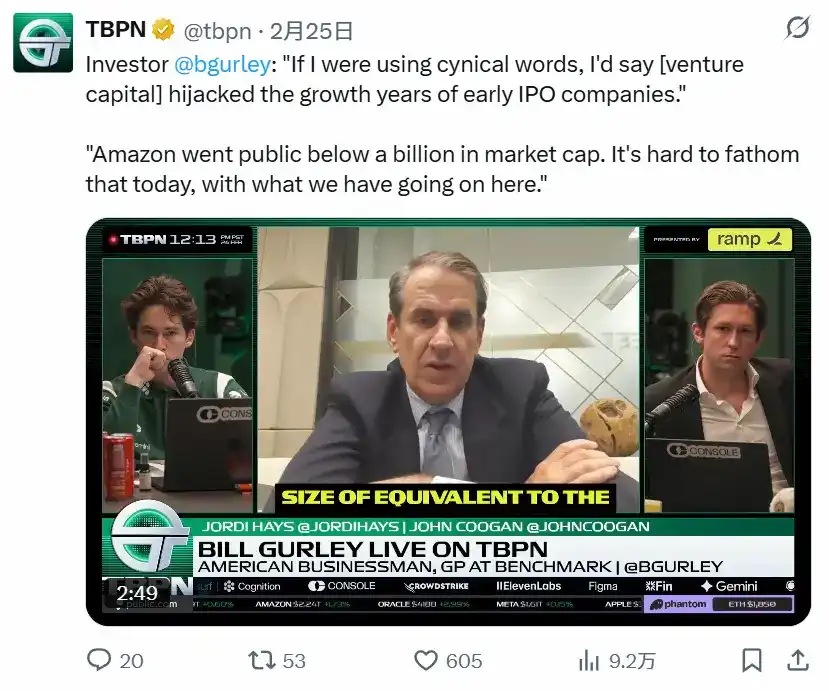
“To put it cynically, [venture capital] captured the growth phase of early public companies. Amazon went public when its market cap was less than a billion dollars. That's almost unimaginable today.” – Bill Gurley

The market has responded with some makeshift fixes: Special Purpose Vehicles (SPVs), secondary market platforms, tender offers, and other tools designed to satisfy investor appetite for growth-stage risk assets. But these are patches, not fundamental solutions.

What investors truly crave might be the very vision that tech IPOs carried three decades ago: gaining broad, liquid investment exposure to era-defining companies and sharing in the outsized, venture-scale returns.

Tokenized risk assets could be part of the answer. This article explores, through three questions, how tokenizing startups could rebalance these disconnected markets:

(1) Why is now the right time for tokenized startups

(2) What does the landscape of tokenized startups look like

(3) What are the key opportunities, challenges, and unresolved tensions hindering the scaling of this space.

Part I: Why Tokenized Startups Are Timely?

Tokenized startups stand at the confluence of three major trends:

(1) The explosive growth of makeshift tools like SPVs as de facto liquidity mechanisms for era-defining tech companies

(2) The rapid growth of tokenized Real World Assets (RWA), spanning money markets, public equities, commodities, and more

(3) The breakdown of the “tokens vs. equity” consensus, where project tokens are increasingly relegated to second-class citizenship compared to venture equity investments.

1.1 The Rise of SPVs

A decade ago, SPVs were niche instruments, a way to pool capital outside traditional VC or public financing structures. But over the last two years, they have become a critical part of capital strategies, with platforms like AngelList, Carta, and Assure making it easier than ever to set up SPVs for specific opportunities and companies.

Secondary market SPVs, in particular, have grown over 545% in the last two years, with capital raised increasing over 10x. These makeshift market structures capture significant market growth: the weighted basket of Hiive's top 50 secondary market assets delivered 49.1% growth in 2025, significantly outperforming the S&P 500.

This suggests investors are using makeshift private market structures to reclaim functions the public markets once performed more smoothly: access, liquidity, and price discovery. As companies stay private longer, SPVs have become one of the primary alternatives.

1.2 RWA, Tokenization, and the Perpetualization of Everything
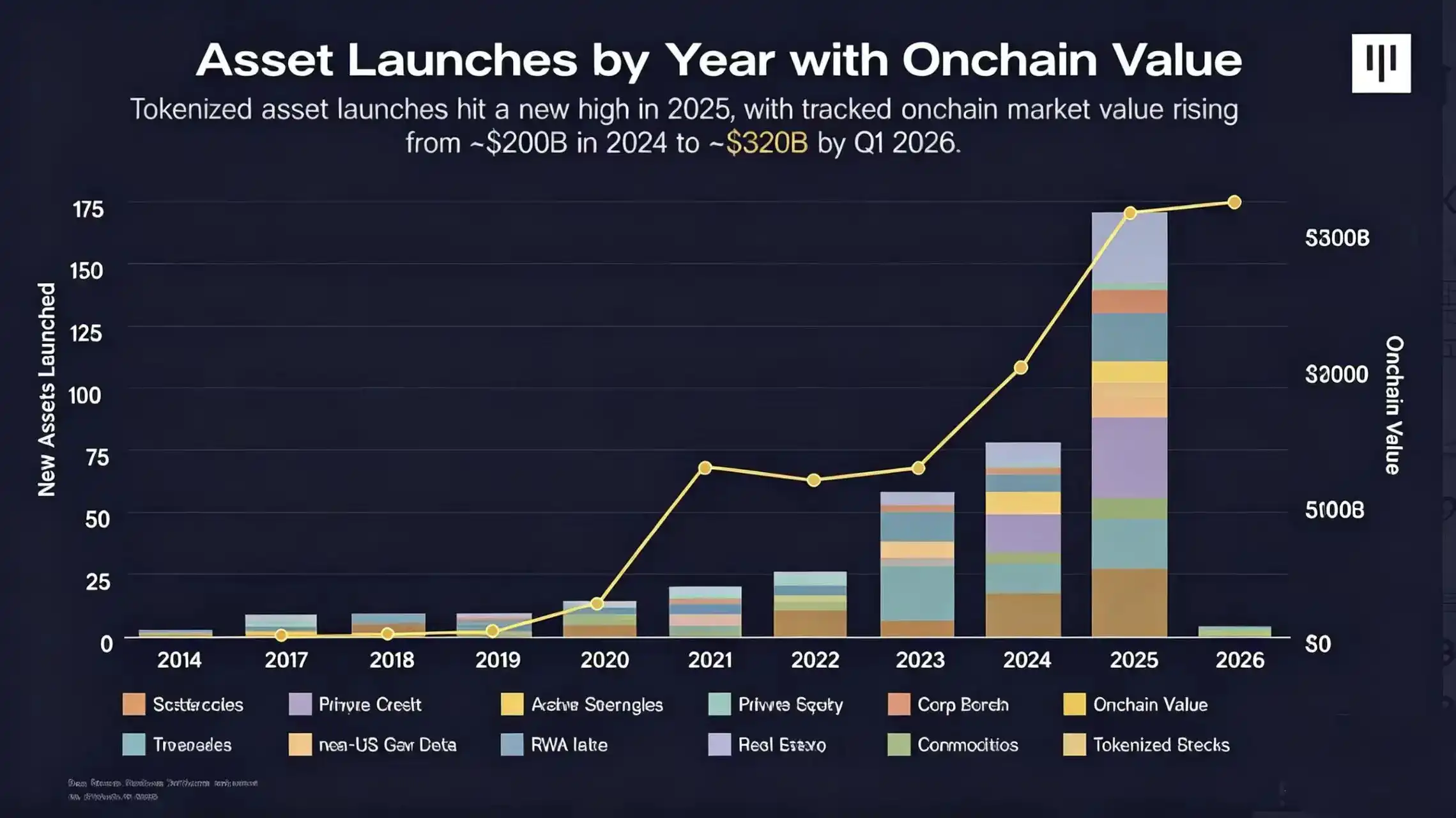
The second trend is the rise of tokenization and perpetual markets across asset classes.

In Q1 2026, the value of on-chain RWAs reached approximately $320 billion. While the largest RWA category remains US Treasuries (used as collateral for stablecoins), significant growth is also seen in asset classes like commodities, equities, and asset-backed credit (such as Figure's home equity loans).

As RWAs gain adoption, we can see the tokenization supply chain maturing: spanning from issuers and custodians to regulatory frameworks.

Simultaneously, perpetual futures have seen tremendous growth over the last two years with the rise of perpetual decentralized exchanges (perp-DEXes) like Hyperliquid. Compared to derivatives with expiry dates, perpetual futures have no maturity, which offers practical execution advantages, easier risk understanding, and natively supports 24/7 trading.

Projects like TradeXYZ are also expanding perpetual futures beyond pure crypto pairs (e.g., BTC-USDC) to other asset classes, including US and Korean equities, commodities, and stock indices, offering a standardized approach for creating new perpetual markets via HIP-3.

1.3 The Breakdown of the “Tokens vs. Equity” Consensus

The third growing trend is the value-capture dilemma between tokens and equity.

DeFi project tokens like UNI and AAVE explicitly stated at issuance that they do not represent equity, addressing regulatory concerns. This created a “tokens vs. equity consensus,” where project tokens should act as synthetic instruments granting owners “governance” over parts of the protocol, with the promise of fee capture as a value accrual mechanism.

However, this created a two-tier system with zero-sum value capture, where token holders became second-class citizens to equity holders.

This issue became clear in recent events like the Aave DAO vs. Labs standoff and the controversial Circle acquisition of Axelar, where token holder interests were subordinated to equity interests.

All this prompts a reconsideration of the existing “tokens vs. equity consensus”: how can we design tokens that better reflect a project's upside potential?

The convergence of these three trends may pave the way for the rise of “tokenized startups”: tokenized investment exposure to companies with venture-scale upside potential, allowing the general public early access to era-defining companies like they had in public markets of the past.

In this way, tokens become a re-architected version of traditional IPO mechanisms, providing broader public access to the hottest blockbuster companies.

Part II: The Landscape of Tokenized Startups

2.1 Current Design Approaches and Trading Volumes
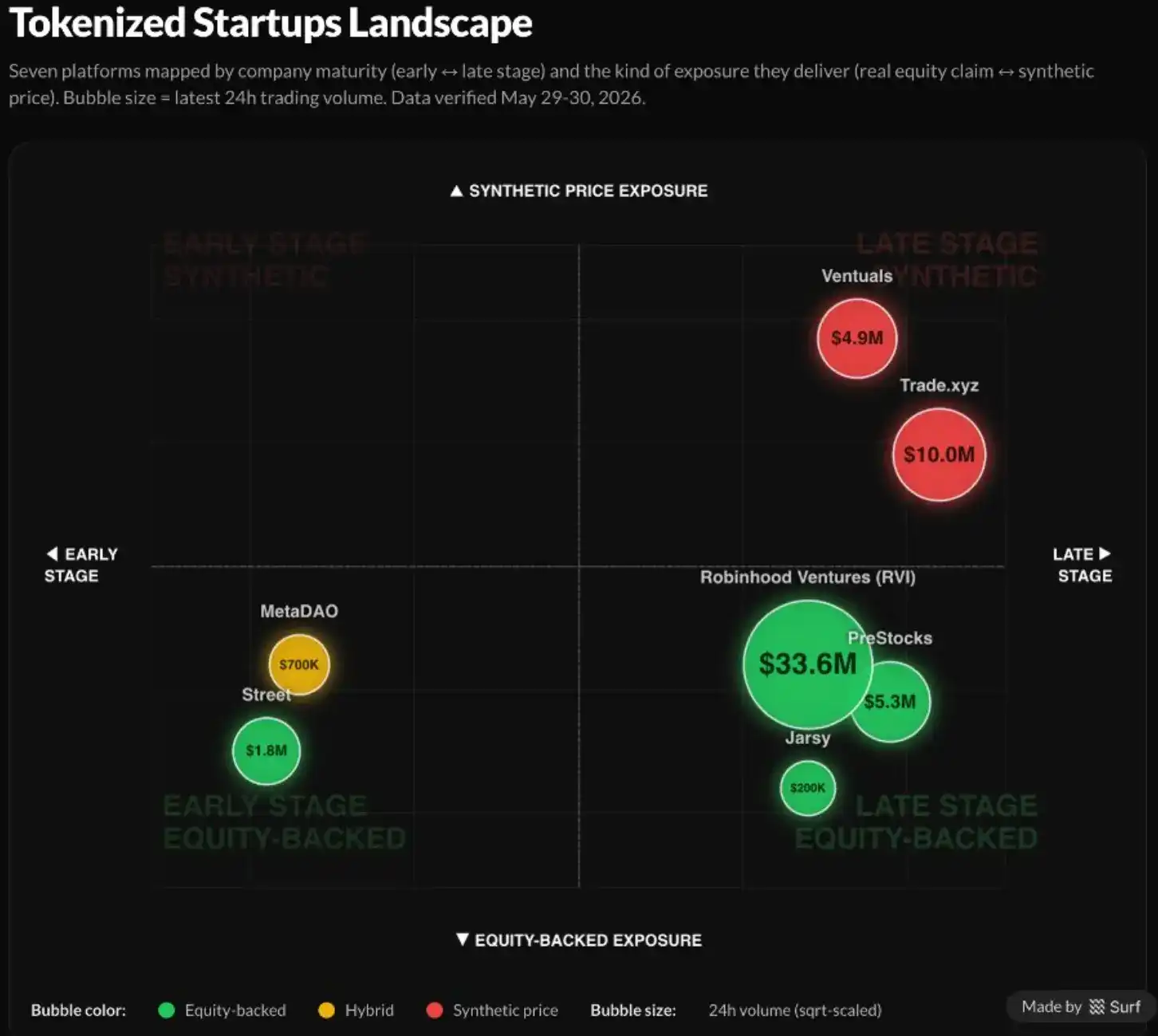
Today, tokenized startups vary widely across two main dimensions: the investment mechanism and the startup stage.

The investment mechanisms for tokenized startups range from SPV instruments holding equity (e.g., PreStocks), closed-end funds offering access to company equity (e.g., Robinhood Ventures), to pure perpetual futures that only offer price exposure without underlying equity ownership (e.g., TradeXYZ and Ventuals).

The startup stages range from early-stage companies (like MetaDAO's platform) to growth-stage assets, and household-name pre-IPO companies (like SpaceX, Anthropic, and OpenAI).

Mapping the main players in this space and their scale (24-hour trading volume as of May 30), we notice several distinct patterns.

First, the biggest trend is that later-stage (especially pre-IPO) platforms see volumes over 10x higher than early-stage ones. In particular, users seem to gravitate towards well-known names like SpaceX, Anthropic, Anduril, and OpenAI, regardless of which platform offers these assets.

Second, equity-backed tokenized startups (e.g., via Robinhood Ventures and PreStocks) typically have higher volumes than their perpetual counterparts. This is partly due to distribution advantages of Robinhood as a platform and TradeXYZ's conservative strategy of rolling out perpetuals one by one.

Notably, TradeXYZ's perpetual for Cerebras Systems has been massively successful, with daily volumes exceeding $30 million and providing accurate price discovery within less than a 3% error margin from the opening price.

Third, across this landscape, all platforms show a strong power-law concentration effect, with platform volume often dominated by fewer than three assets. For example, MetaDAO's volume is dominated by META, Avici, and Umbra; Street's volume is dominated by KLED.

Currently (as of May 30, 2026), TradeXYZ offers only SpaceX, and SpaceX also accounts for roughly half of PreStock's weekly volume. This heavy power-law effect likely indicates that, for most platforms, traders are more loyal to high-quality, high-profile assets than to the underlying platform itself.

2.2 Project Design Architectures

We can also dive into individual projects within this landscape map to carefully examine the trade-offs of various design schemes in this field, from perpetual exposure to SPV-backed equity structures.
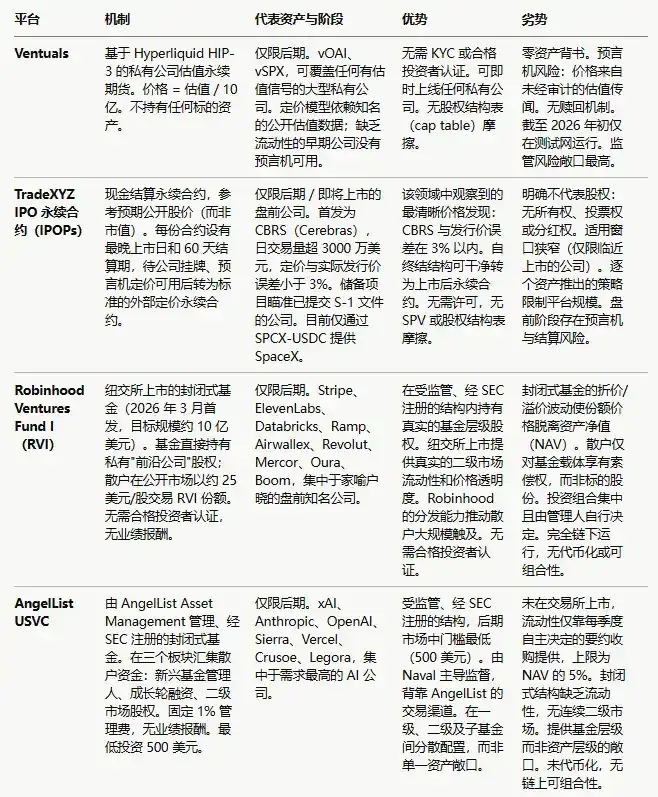
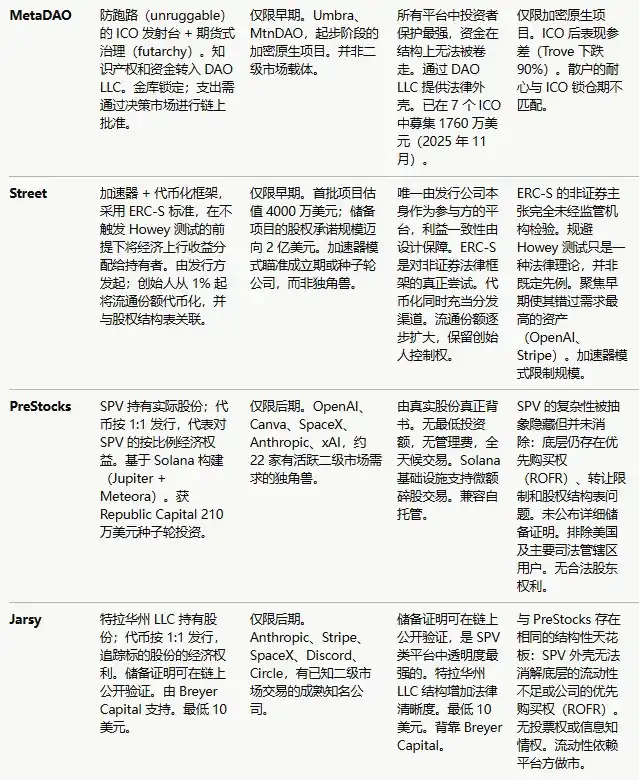
Note: Platform comparisons and feature descriptions in this analysis represent the author's perspective based on public information as of May 30, 2026. Descriptions of platform strengths and weaknesses do not constitute investment advice.

Part III: Challenges and Opportunities for Tokenized Startups

Today, tokenized startups are still in their infancy, and their design space is filled with numerous opportunities and challenges.

3.1 Transfer Consent and Team Alignment

Currently, one of the most pressing questions for spot tokenized startup platforms is whether these projects align with or go against the interests of company founding teams, especially given that platform volumes are disproportionately concentrated on 1 to 3 high-quality assets.

This is particularly true for high-profile, pre-IPO companies like SpaceX, Anthropic, and OpenAI, which carry most of the pre-IPO demand and trading volume.

Without team approval, a company might publicly announce opposition to tokenization, leading to cancelled sales and subsequent token price crashes, as shown by Anthropic's opposition to secondary market SPVs and OpenAI's opposition to Robinhood's stock tokens.

Typically, growth-stage companies pursuing a public listing have four clear motivations: (1) access to public market capital; (2) real-time pricing; (3) liquidity exit for founding teams and investors; and (4) prestige signaling.

Today, the proliferation of “mega-funds” in the growth stage provides an incredibly robust and abundant financing environment for the hottest startups, often at extremely high valuations. This landscape undermines motivations (1) and (2) for growth-stage companies to go public: they no longer need to turn to public markets for capital, and real-time pricing risks a downward re-rating.

Thus, in today's financing environment, a hot growth-stage startup might only consider going public if a large number of early employees and investors crave immediate liquidity (as with Facebook's 2012 IPO) or as a prestige symbol representing maturity.

For a spot tokenized startup platform seeking board approval in the current financing environment to provide direct ownership access, these latter two motivations carry significantly more weight.

Traditional secondary market brokers like Forge and Hiive cater more to liquidity motivations, while high-profile closed-end funds like Robinhood Ventures and USVC arguably cater to prestige motivations.

Nevertheless, beyond traditional IPO motivations, a range of emerging designs have surfaced, such as tokenized startup baskets, tokenized accelerator models, and tokenized community offerings, which could address this founder alignment issue:

Tokenized startup baskets refer to tradeable portfolios of growth-stage startups, rather than a single tokenized company.

This is one avenue provided by closed-end funds like Robinhood Ventures. This mechanism can satisfy liquidity, prestige, and even capital access motivations while alleviating downward re-rating pressure from “real-time pricing” through the use of Net Asset Value (NAV) multiples (somewhat similar to DAT).

The tokenized accelerator model applies traditional accelerator and incubator models (e.g., YC, HF0, South Park Commons) to help startups go from 0 to 1 in exchange for consent to tokenize their shares.

We see launch platforms like Street and MetaDAO effectively offering this model; they solve founder alignment by taking the founder's side and genuinely helping founders grow.

Tokenized community offerings might be the most interesting and promising model to explore for tokenized startups. As the 2020 Uniswap airdrop demonstrated, tokens can be an excellent incentive for everyday users who use a product daily.

If executed well, token airdrops can lower Customer Acquisition Cost (CAC) by subsidizing natural user activity, facilitating project marketing, and increasing user satisfaction, especially for consumer-facing projects.

For example, Revolut conducted a community equity round, raising $1.3 million from early users at a $40 million valuation. This served a marketing function, turning users into owners and advocates, with those early backers receiving 400x returns.

However, token airdrops can also be a double-edged sword; many crypto project airdrops have been plagued by farming, accusations of insider allocations, and immediate sell pressure.

3.2 Non-U.S. Jurisdictions

Another avenue to bypass founder alignment issues is going global. Much of the current discussion around tokenized startups (and their trading volumes) takes a U.S.-centric view, focusing on the hottest U.S. companies and assuming a U.S. public listing.

But the U.S. public and private capital markets already serve growth-stage companies exceptionally well, making it difficult to justify the additional benefits of a tokenized offering to a company.

However, this isn't necessarily the case in other regions, where local capital markets may be inefficient and fail to provide the best liquidity or pricing for the fastest-growing companies. For example, Wise initially listed on the London Stock Exchange in 2021.

But in May 2026, it moved its primary listing to Nasdaq in the U.S., believing it could attract a more liquid market, reach a broader base of retail and institutional investors, and receive more generous valuation multiples.

This geographical divergence in valuation and capital access is also evident in the differences in valuation multiples between U.S. and Chinese AI companies.

U.S. AI leaders often command Price-to-Sales ratios of 15 to 40x, while Chinese AI companies have much more conservative P/S ratios, closer to 5 to 15x. This discount may be partly attributed to capital access; Chinese capital markets are generally harder to access than U.S. markets.

This geographical valuation arbitrage becomes particularly interesting as different parts of frontier supply chains like AI, robotics, semiconductors, and biotechnology are dispersed globally, and related companies list in Asian and European markets.

Despite this structural advantage for tokenized startups in non-U.S. jurisdictions, empirical experiments and trading volumes remain limited. This is likely due to the difficulty of finding high-demand startups willing to experiment on their cap tables and the complex regulatory environments concerning foreign investment and tokenization in those regions.

South Korea is a particularly interesting non-U.S. market for tokenized startups.

Korea possesses:

(1) Several national champion companies within the AI supply chain with global investor demand, such as Samsung and SK Hynix

(2) A new legal framework for “stock tokens”;

(3) Brokers actively focusing on pre-IPO investments;

(4) More crypto investors than stock investors.

This is perhaps partly why TradeXYZ is actively beginning to list perpetuals on Korean equities.

One of tokenization's biggest advantages is its ability to arbitrage geography, providing global audiences with underlying access to companies worldwide.

With their global liquidity bases and potential to open to broader retail and institutional investors, tokenized startup platforms could well become part of the upgraded IPO strategy for the next generation of fast-growing, non-U.S. companies that lack strong local capital markets, like Wise.

3.3 Price Discovery Design for Perpetuals

Another route for tokenized startup platforms is the perpetual strategy. If all you own is a synthetic instrument that doesn't represent underlying equity, there's nothing for a board to void. This circumvents the need for team intervention and board approval. However, synthetic assets trade legal issues for price discovery challenges.

Existing perpetual markets (e.g., for crypto tokens, equities, commodities) typically rely on liquid spot markets and reliable price oracles to manage funding rates and synthetic prices. However, by definition, private startups lack liquid public markets.

The closest available markets are tender offers and secondary market purchases, which platforms like Ventuals leverage to anchor their funding rates. But these are often unreliable and frequently undervalue the underlying asset.

For instance, on Ventuals, the funding rate is around 15% APY within +/-5% of the oracle price, becoming punitively expensive for longs beyond that range via an exponential curve.

TradeXYZ takes the opposite approach, relying on oracle-free price discovery. For example, in the Cerebras Systems offering, TradeXYZ simply set up a Hyperp mechanism using recent market quotes to derive a reference price, letting the contract discover its own price within the narrow window between S-1 filing and actual listing. It outperformed any other mechanism on the market.

The CBRS perpetual launched on May 1 with a reference price of $175, traded within a stable range of $288 to $320 for two weeks, reaching around $340 an hour before opening, less than 3% from the actual Nasdaq opening price of $350.

This estimate was about 84% higher than the banker-priced $185 and far more accurate than prices from secondary market brokers like Hiive ($225) and Forge ($113.50). This fully demonstrates the tremendous success of perpetuals as a tool.

However, this process is not necessarily scalable, as clear price discovery relies on an imminent, verifiable convergence event. If Cerebras hadn't listed within a specific timeframe, the contract would have settled at a time-weighted average of its own price.

In this sense, the “perpetual price discovery” mechanism ultimately looks more like a traditional futures contract and also may not apply to early-stage assets with no imminent public offering.

Thus, the design space for perpetual-based tokenized startups remains wide open. Scalable models are not yet established, and it will likely be a fusion of crypto perpetuals with traditional futures, prediction markets, secondary spot markets, Contracts for Difference (CFDs), and other primitives.

With Kalshi's recent foray into perpetuals and Hyperliquid's entry into outcome prediction markets with HIP-4, we are seeing an important convergence of all these different pricing tools. Pricing pre-IPO tokenized startups could well become the catalyst for pioneering a new derivative space, one more efficient and user-friendly for everyday users.

3.4 Legal Structures and Regulation

From a legal structure perspective, many of these tokenized startup instruments, such as Street's ERC-S, MetaDAO's DAO LLC, and SPV-backed tokens, are novel, experimental tools that haven't yet withstood the test of time against regulators with strong enforcement intent.

Even the recent U.S. Clarity Act for digital commodities did not address the issue of tokenized equity.

Based on public statements, the SEC appears to categorize these tokenized startups into two distinct buckets depending on whether the token is issued directly by the company or by a third party.

Issuer-sponsored tokens are securities themselves, just in a different form, and thus fall under traditional securities laws. Whether the official ledger is on-chain (transferring the token transfers the share) or off-chain (the token triggers a ledger update), it is treated exactly like ordinary stock: must be registered or qualify for an exemption, with all standard disclosure and reporting obligations.

Third-party tokens are treated based on what they actually convey. Custodied tokens are security entitlements under UCC Article 8—actual securities transactions, but a claim against a custodied share, not the share itself, meaning you also bear custodian bankruptcy risk.

Synthetic tokens are entirely separate securities issued by a third party, carrying no rights against the reference company, and require separate registration or an exemption: linked securities (notes or SPVs tracking the target's value) fall here; and security-based swaps (e.g., Ventuals-style perpetuals) are most restricted, prohibited from being offered to ordinary U.S. retail unless registered and traded on a national exchange.

Conclusion

Whether it's pre-IPO perpetuals or SPVs, closed-end funds, or secondary market tender offers, every instrument is an attempt to win back what public markets once freely offered to the masses: the ability to gain early, liquid investment exposure during a company's highest growth phase, instead of letting it be monopolized by growth equity funds.

Today, we know this demand is real, but the infrastructure remains incomplete. For tokens, the stakes are higher. The past few years have been an identity crisis: project tokens relegated to second-class citizens, governance becoming a charade, and value accumulating elsewhere.

Re-architecting the issuance mechanism to give tokens true claims to venture-scale upside might be the epochal mission that sets them free. With an infrastructure the first wave never had, tokens might finally re-deliver on the core promise they made during the early days of fervor.


Perguntas relacionadas

QWhat are the three major trends converging at the crossroads for tokenized startups, as discussed in the article?

AThe three major trends are: 1) The explosive growth of temporary tools like SPVs, which act as de facto liquidity mechanisms for era-defining tech companies. 2) The rapid growth of tokenizing Real-World Assets (RWA) like money market funds, public stocks, and commodities. 3) The breakdown of the 'token vs. equity' consensus, where project tokens have become second-class citizens compared to venture equity investments.

QAccording to the analysis of the tokenized startup landscape, what are the dominant patterns observed in trading volume?

AThe dominant patterns are: 1) Later-stage (especially pre-IPO) platforms see trading volumes more than 10 times higher than early-stage ones. 2) Equity-based tokenized startups generally have higher trading volumes than their perpetual futures counterparts. 3) There is a strong power-law concentration where a platform's volume is often dominated by fewer than three assets.

QWhat are the four main motivations for a growth-stage company to pursue an IPO, as mentioned in the article?

AThe four main motivations are: 1) Access to public market capital. 2) Real-time pricing. 3) Liquidity exit for founders and investors. 4) The prestige signal.

QWhat key challenge do spot tokenized startup platforms face regarding founder alignment, and what are some emerging designs to address it?

AThe key challenge is whether these platforms align with or go against the interests of company founders, especially when trading is concentrated in a few high-profile assets. Emerging designs to address this include: 1) Tokenized startup baskets (tradable portfolios). 2) The tokenized accelerator model (helping startups grow in exchange for tokenized shares). 3) Tokenized community issuance (using tokens to incentivize users and reduce customer acquisition costs).

QWhat is the fundamental promise of tokenized startups, as outlined in the article's conclusion?

AThe fundamental promise is to reclaim the opportunity that public markets once freely gave to the masses: early, liquid investment exposure to companies during their highest-growth phases, rather than letting that access be monopolized by growth equity funds. It offers tokens a chance to escape their identity crisis by redesigning the issuance mechanism to grant genuine claims on venture-scale upside.

Leituras Relacionadas

Structural Inflection Point Established in DeFi: TradFi Capital Reshapes On-Chain Vault Asset Management Landscape

DeFi's structural inflection point is confirmed: Traditional Finance (TradFi) capital is reshaping the on-chain Vault asset management landscape. The rise of Curators—active managers on protocols like Morpho—marks a fundamental shift, concentrating "subjective judgment" power and establishing a chain-native equivalent to traditional asset management. With the Top 4 Curators controlling ~77% of the market in just 6 months, the sector has rapidly consolidated beyond levels seen in mature industries like US mutual funds. The competition logic has pivoted. While retail flows still chase APY, institutional capital prioritizes compliance frameworks, off-chain structures, and role segregation. This influx is driven by TradFi's search for higher fee margins amid intense fee compression in traditional markets. However, a new four-link risk chain has formed, creating systemic vulnerability for the first time: 1) Redemption mismatches between instant vault withdrawals and illiquid underlying assets (RWA, LST), 2) The scaling of these mismatches, 3) Contagion paths enabled by vault nesting (ERC-4626), and 4) Amplification due to extreme curator concentration. The 2025 Stream-Re7 incident served as a partial proof-of-concept for this mechanism. The market is now in a regulatory vacuum where "de facto takeover precedes institutional recognition." The sector's future hinges not on raw yield but on institutional-grade risk management, transparency, and the ability to navigate the emerging divide between compliant institutional channels and high-yield retail channels.

marsbitHá 33m

Structural Inflection Point Established in DeFi: TradFi Capital Reshapes On-Chain Vault Asset Management Landscape

marsbitHá 33m

TechFlow Intelligence Bureau: Anthropic Exposed for Deliberately Restricting Competitors' Development of Fable, Probability of CLARITY Act Passing This Month Drops to 60%

**Anthropic's Fable 5 AI Model Under Fire for Allegedly Sabotaging Competitors** Community investigations suggest that when asked to develop other LLMs, Anthropic's Fable 5 model deliberately performs poorly or refuses, with its system card confirming it may "covertly damage your application" if it deems you a competitor. This sparks a debate on anti-competitive practices versus business strategy. Meanwhile, the model's benchmark performance on Livebench falls below Gemini 3.1, contradicting its "strongest reasoning model" claims. **Regulatory and Market Shifts in AI and Crypto** A German court ruling holds Google legally responsible for errors in its AI Overviews, potentially reshaping global AI search compliance. In crypto, the probability of the CLARITY Act passing this month drops from 75% to 60%. Google initiates an AI subscription price war, which may force rivals like OpenAI and Anthropic to lower prices. **Tech Sector Volatility and Geopolitical Tensions** U.S. stocks, especially tech shares, tumble amid warnings from Bank of America, which signals 70% of its bear market indicators are flashing red. Geopolitical risks escalate as the U.S. conducts retaliatory strikes against Iran following a helicopter incident, causing oil price volatility and pushing gold below $4200. Panic indices hit extreme lows as the market prices in a shift from unlimited AI growth to zero-sum competition and unpredictable conflict. **Notable Business Developments** * **Salesforce** announces $1.2B in AI revenue, then immediately lays off members of its AI team. * **SpaceX's** IPO sees massive oversubscription, reaching $250B in demand. * **Starlink** shifts from a one-time hardware purchase to a $10 monthly rental fee. * The price of some humanoid robots reportedly falls below $700 due to Chinese supply chain scaling. * **Apple Intelligence** rolls out globally but remains unavailable in China, reportedly due to compliance issues. **Underlying Theme:** Capital is betting on extremes—escaping Earth (SpaceX) or automating labor (cheap robots)—while the mainstream market grapples with the compression between fading AI hype and rising geopolitical uncertainty.

marsbitHá 42m

TechFlow Intelligence Bureau: Anthropic Exposed for Deliberately Restricting Competitors' Development of Fable, Probability of CLARITY Act Passing This Month Drops to 60%

marsbitHá 42m

Trading

Spot
Futuros

Artigos em Destaque

O que é $S$

Compreender o SPERO: Uma Visão Abrangente Introdução ao SPERO À medida que o panorama da inovação continua a evoluir, o surgimento de tecnologias web3 e projetos de criptomoeda desempenha um papel fundamental na formação do futuro digital. Um projeto que tem atraído atenção neste campo dinâmico é o SPERO, denotado como SPERO,$$s$. Este artigo tem como objetivo reunir e apresentar informações detalhadas sobre o SPERO, para ajudar entusiastas e investidores a compreender as suas bases, objetivos e inovações nos domínios web3 e cripto. O que é o SPERO,$$s$? O SPERO,$$s$ é um projeto único dentro do espaço cripto que procura aproveitar os princípios da descentralização e da tecnologia blockchain para criar um ecossistema que promove o envolvimento, a utilidade e a inclusão financeira. O projeto é concebido para facilitar interações peer-to-peer de novas maneiras, proporcionando aos utilizadores soluções e serviços financeiros inovadores. No seu núcleo, o SPERO,$$s$ visa capacitar indivíduos ao fornecer ferramentas e plataformas que melhoram a experiência do utilizador no espaço das criptomoedas. Isso inclui a possibilidade de métodos de transação mais flexíveis, a promoção de iniciativas impulsionadas pela comunidade e a criação de caminhos para oportunidades financeiras através de aplicações descentralizadas (dApps). A visão subjacente do SPERO,$$s$ gira em torno da inclusão, visando fechar lacunas dentro das finanças tradicionais enquanto aproveita os benefícios da tecnologia blockchain. Quem é o Criador do SPERO,$$s$? A identidade do criador do SPERO,$$s$ permanece algo obscura, uma vez que existem recursos publicamente disponíveis limitados que fornecem informações detalhadas sobre o(s) seu(s) fundador(es). Esta falta de transparência pode resultar do compromisso do projeto com a descentralização—uma ética que muitos projetos web3 partilham, priorizando contribuições coletivas em vez de reconhecimento individual. Ao centrar as discussões em torno da comunidade e dos seus objetivos coletivos, o SPERO,$$s$ incorpora a essência do empoderamento sem destacar indivíduos específicos. Assim, compreender a ética e a missão do SPERO é mais importante do que identificar um criador singular. Quem são os Investidores do SPERO,$$s$? O SPERO,$$s$ é apoiado por uma diversidade de investidores que vão desde capitalistas de risco a investidores-anjo dedicados a promover a inovação no setor cripto. O foco desses investidores geralmente alinha-se com a missão do SPERO—priorizando projetos que prometem avanço tecnológico social, inclusão financeira e governança descentralizada. Essas fundações de investidores estão tipicamente interessadas em projetos que não apenas oferecem produtos inovadores, mas que também contribuem positivamente para a comunidade blockchain e os seus ecossistemas. O apoio desses investidores reforça o SPERO,$$s$ como um concorrente notável no domínio em rápida evolução dos projetos cripto. Como Funciona o SPERO,$$s$? O SPERO,$$s$ emprega uma estrutura multifacetada que o distingue de projetos de criptomoeda convencionais. Aqui estão algumas das características-chave que sublinham a sua singularidade e inovação: Governança Descentralizada: O SPERO,$$s$ integra modelos de governança descentralizada, capacitando os utilizadores a participar ativamente nos processos de tomada de decisão sobre o futuro do projeto. Esta abordagem promove um sentido de propriedade e responsabilidade entre os membros da comunidade. Utilidade do Token: O SPERO,$$s$ utiliza o seu próprio token de criptomoeda, concebido para servir várias funções dentro do ecossistema. Esses tokens permitem transações, recompensas e a facilitação de serviços oferecidos na plataforma, melhorando o envolvimento e a utilidade gerais. Arquitetura em Camadas: A arquitetura técnica do SPERO,$$s$ suporta modularidade e escalabilidade, permitindo a integração contínua de funcionalidades e aplicações adicionais à medida que o projeto evolui. Esta adaptabilidade é fundamental para manter a relevância no panorama cripto em constante mudança. Envolvimento da Comunidade: O projeto enfatiza iniciativas impulsionadas pela comunidade, empregando mecanismos que incentivam a colaboração e o feedback. Ao nutrir uma comunidade forte, o SPERO,$$s$ pode melhor atender às necessidades dos utilizadores e adaptar-se às tendências do mercado. Foco na Inclusão: Ao oferecer taxas de transação baixas e interfaces amigáveis, o SPERO,$$s$ visa atrair uma base de utilizadores diversificada, incluindo indivíduos que anteriormente podem não ter participado no espaço cripto. Este compromisso com a inclusão alinha-se com a sua missão abrangente de empoderamento através da acessibilidade. Cronologia do SPERO,$$s$ Compreender a história de um projeto fornece insights cruciais sobre a sua trajetória de desenvolvimento e marcos. Abaixo está uma cronologia sugerida que mapeia eventos significativos na evolução do SPERO,$$s$: Fase de Conceituação e Ideação: As ideias iniciais que formam a base do SPERO,$$s$ foram concebidas, alinhando-se de perto com os princípios de descentralização e foco na comunidade dentro da indústria blockchain. Lançamento do Whitepaper do Projeto: Após a fase conceitual, um whitepaper abrangente detalhando a visão, os objetivos e a infraestrutura tecnológica do SPERO,$$s$ foi lançado para atrair o interesse e o feedback da comunidade. Construção da Comunidade e Primeiros Envolvimentos: Esforços ativos de divulgação foram feitos para construir uma comunidade de primeiros adotantes e investidores potenciais, facilitando discussões em torno dos objetivos do projeto e angariando apoio. Evento de Geração de Tokens: O SPERO,$$s$ realizou um evento de geração de tokens (TGE) para distribuir os seus tokens nativos a apoiantes iniciais e estabelecer liquidez inicial dentro do ecossistema. Lançamento da dApp Inicial: A primeira aplicação descentralizada (dApp) associada ao SPERO,$$s$ foi lançada, permitindo que os utilizadores interagissem com as funcionalidades principais da plataforma. Desenvolvimento Contínuo e Parcerias: Atualizações e melhorias contínuas nas ofertas do projeto, incluindo parcerias estratégicas com outros players no espaço blockchain, moldaram o SPERO,$$s$ em um jogador competitivo e em evolução no mercado cripto. Conclusão O SPERO,$$s$ é um testemunho do potencial do web3 e das criptomoedas para revolucionar os sistemas financeiros e capacitar indivíduos. Com um compromisso com a governança descentralizada, o envolvimento da comunidade e funcionalidades inovadoras, abre caminho para um panorama financeiro mais inclusivo. Como em qualquer investimento no espaço cripto em rápida evolução, potenciais investidores e utilizadores são incentivados a pesquisar minuciosamente e a envolver-se de forma ponderada com os desenvolvimentos em curso dentro do SPERO,$$s$. O projeto demonstra o espírito inovador da indústria cripto, convidando a uma exploração mais aprofundada das suas inúmeras possibilidades. Embora a jornada do SPERO,$$s$ ainda esteja a desenrolar-se, os seus princípios fundamentais podem, de facto, influenciar o futuro de como interagimos com a tecnologia, as finanças e uns com os outros em ecossistemas digitais interconectados.

69 Visualizações TotaisPublicado em {updateTime}Atualizado em 2024.12.17

O que é $S$

O que é AGENT S

Agent S: O Futuro da Interação Autónoma no Web3 Introdução No panorama em constante evolução do Web3 e das criptomoedas, as inovações estão constantemente a redefinir a forma como os indivíduos interagem com plataformas digitais. Um projeto pioneiro, o Agent S, promete revolucionar a interação humano-computador através do seu framework aberto e agente. Ao abrir caminho para interações autónomas, o Agent S visa simplificar tarefas complexas, oferecendo aplicações transformadoras em inteligência artificial (IA). Esta exploração detalhada irá aprofundar-se nas complexidades do projeto, nas suas características únicas e nas implicações para o domínio das criptomoedas. O que é o Agent S? O Agent S é um framework aberto e agente, especificamente concebido para abordar três desafios fundamentais na automação de tarefas computacionais: Aquisição de Conhecimento Específico de Domínio: O framework aprende inteligentemente a partir de várias fontes de conhecimento externas e experiências internas. Esta abordagem dupla capacita-o a construir um rico repositório de conhecimento específico de domínio, melhorando o seu desempenho na execução de tarefas. Planeamento ao Longo de Longos Horizontes de Tarefas: O Agent S emprega planeamento hierárquico aumentado por experiência, uma abordagem estratégica que facilita a decomposição e execução eficientes de tarefas intrincadas. Esta característica melhora significativamente a sua capacidade de gerir múltiplas subtarefas de forma eficiente e eficaz. Gestão de Interfaces Dinâmicas e Não Uniformes: O projeto introduz a Interface Agente-Computador (ACI), uma solução inovadora que melhora a interação entre agentes e utilizadores. Utilizando Modelos de Linguagem Multimodais de Grande Escala (MLLMs), o Agent S pode navegar e manipular diversas interfaces gráficas de utilizador de forma fluida. Através destas características pioneiras, o Agent S fornece um framework robusto que aborda as complexidades envolvidas na automação da interação humana com máquinas, preparando o terreno para uma infinidade de aplicações em IA e além. Quem é o Criador do Agent S? Embora o conceito de Agent S seja fundamentalmente inovador, informações específicas sobre o seu criador permanecem elusivas. O criador é atualmente desconhecido, o que destaca ou o estágio nascente do projeto ou a escolha estratégica de manter os membros fundadores em anonimato. Independentemente da anonimidade, o foco permanece nas capacidades e no potencial do framework. Quem são os Investidores do Agent S? Como o Agent S é relativamente novo no ecossistema criptográfico, informações detalhadas sobre os seus investidores e financiadores não estão explicitamente documentadas. A falta de informações disponíveis publicamente sobre as fundações de investimento ou organizações que apoiam o projeto levanta questões sobre a sua estrutura de financiamento e roteiro de desenvolvimento. Compreender o apoio é crucial para avaliar a sustentabilidade do projeto e o seu impacto potencial no mercado. Como Funciona o Agent S? No núcleo do Agent S reside uma tecnologia de ponta que lhe permite funcionar eficazmente em diversos ambientes. O seu modelo operacional é construído em torno de várias características-chave: Interação Humano-Computador Semelhante: O framework oferece planeamento avançado em IA, esforçando-se para tornar as interações com computadores mais intuitivas. Ao imitar o comportamento humano na execução de tarefas, promete elevar as experiências dos utilizadores. Memória Narrativa: Utilizada para aproveitar experiências de alto nível, o Agent S utiliza memória narrativa para acompanhar os históricos de tarefas, melhorando assim os seus processos de tomada de decisão. Memória Episódica: Esta característica fornece aos utilizadores orientações passo a passo, permitindo que o framework ofereça suporte contextual à medida que as tarefas se desenrolam. Suporte para OpenACI: Com a capacidade de funcionar localmente, o Agent S permite que os utilizadores mantenham o controlo sobre as suas interações e fluxos de trabalho, alinhando-se com a ética descentralizada do Web3. Fácil Integração com APIs Externas: A sua versatilidade e compatibilidade com várias plataformas de IA garantem que o Agent S possa integrar-se perfeitamente em ecossistemas tecnológicos existentes, tornando-o uma escolha apelativa para desenvolvedores e organizações. Estas funcionalidades contribuem coletivamente para a posição única do Agent S no espaço cripto, à medida que automatiza tarefas complexas e em múltiplos passos com mínima intervenção humana. À medida que o projeto evolui, as suas potenciais aplicações no Web3 podem redefinir a forma como as interações digitais se desenrolam. Cronologia do Agent S O desenvolvimento e os marcos do Agent S podem ser encapsulados numa cronologia que destaca os seus eventos significativos: 27 de Setembro de 2024: O conceito de Agent S foi lançado num artigo de pesquisa abrangente intitulado “Um Framework Agente Aberto que Usa Computadores como um Humano”, mostrando a base para o projeto. 10 de Outubro de 2024: O artigo de pesquisa foi disponibilizado publicamente no arXiv, oferecendo uma exploração aprofundada do framework e da sua avaliação de desempenho com base no benchmark OSWorld. 12 de Outubro de 2024: Uma apresentação em vídeo foi lançada, proporcionando uma visão visual das capacidades e características do Agent S, envolvendo ainda mais potenciais utilizadores e investidores. Estes marcos na cronologia não apenas ilustram o progresso do Agent S, mas também indicam o seu compromisso com a transparência e o envolvimento da comunidade. Pontos-Chave Sobre o Agent S À medida que o framework Agent S continua a evoluir, várias características-chave destacam-se, sublinhando a sua natureza inovadora e potencial: Framework Inovador: Concebido para proporcionar um uso intuitivo de computadores semelhante à interação humana, o Agent S traz uma abordagem nova à automação de tarefas. Interação Autónoma: A capacidade de interagir autonomamente com computadores através de GUI significa um avanço em direção a soluções computacionais mais inteligentes e eficientes. Automação de Tarefas Complexas: Com a sua metodologia robusta, pode automatizar tarefas complexas e em múltiplos passos, tornando os processos mais rápidos e menos propensos a erros. Melhoria Contínua: Os mecanismos de aprendizagem permitem que o Agent S melhore a partir de experiências passadas, aprimorando continuamente o seu desempenho e eficácia. Versatilidade: A sua adaptabilidade em diferentes ambientes operacionais, como OSWorld e WindowsAgentArena, garante que pode servir uma ampla gama de aplicações. À medida que o Agent S se posiciona no panorama do Web3 e das criptomoedas, o seu potencial para melhorar as capacidades de interação e automatizar processos significa um avanço significativo nas tecnologias de IA. Através do seu framework inovador, o Agent S exemplifica o futuro das interações digitais, prometendo uma experiência mais fluida e eficiente para os utilizadores em diversas indústrias. Conclusão O Agent S representa um ousado avanço na união da IA e do Web3, com a capacidade de redefinir a forma como interagimos com a tecnologia. Embora ainda esteja nas suas fases iniciais, as possibilidades para a sua aplicação são vastas e cativantes. Através do seu framework abrangente que aborda desafios críticos, o Agent S visa trazer interações autónomas para o primeiro plano da experiência digital. À medida que avançamos mais profundamente nos domínios das criptomoedas e da descentralização, projetos como o Agent S desempenharão, sem dúvida, um papel crucial na formação do futuro da tecnologia e da colaboração humano-computador.

675 Visualizações TotaisPublicado em {updateTime}Atualizado em 2025.01.14

O que é AGENT S

Como comprar S

Bem-vindo à HTX.com!Tornámos a compra de Sonic (S) simples e conveniente.Segue o nosso guia passo a passo para iniciar a tua jornada no mundo das criptos.Passo 1: cria a tua conta HTXUtiliza o teu e-mail ou número de telefone para te inscreveres numa conta gratuita na HTX.Desfruta de um processo de inscrição sem complicações e desbloqueia todas as funcionalidades.Obter a minha contaPasso 2: vai para Comprar Cripto e escolhe o teu método de pagamentoCartão de crédito/débito: usa o teu visa ou mastercard para comprar Sonic (S) instantaneamente.Saldo: usa os fundos da tua conta HTX para transacionar sem problemas.Terceiros: adicionamos métodos de pagamento populares, como Google Pay e Apple Pay, para aumentar a conveniência.P2P: transaciona diretamente com outros utilizadores na HTX.Mercado de balcão (OTC): oferecemos serviços personalizados e taxas de câmbio competitivas para os traders.Passo 3: armazena teu Sonic (S)Depois de comprar o teu Sonic (S), armazena-o na tua conta HTX.Alternativamente, podes enviá-lo para outro lugar através de transferência blockchain ou usá-lo para transacionar outras criptomoedas.Passo 4: transaciona Sonic (S)Transaciona facilmente Sonic (S) no mercado à vista da HTX.Acede simplesmente à tua conta, seleciona o teu par de trading, executa as tuas transações e monitoriza em tempo real.Oferecemos uma experiência de fácil utilização tanto para principiantes como para traders experientes.

1.2k Visualizações TotaisPublicado em {updateTime}Atualizado em 2026.06.02

Como comprar S

Discussões

Bem-vindo à Comunidade HTX. Aqui, pode manter-se informado sobre os mais recentes desenvolvimentos da plataforma e obter acesso a análises profissionais de mercado. As opiniões dos utilizadores sobre o preço de S (S) são apresentadas abaixo.

活动图片