Over 100 Crypto ETPs Launching Soon but Many Won’t Survive

TheNewsCryptoPublicado em 2025-12-18Última atualização em 2025-12-18

Resumo

The cryptocurrency investment landscape is set for significant transformation with over 100 new exchange-traded products (ETPs) expected to launch. However, industry analysts predict many will not survive beyond 2027 due to insufficient investor interest and low asset accumulation. Market saturation is a key concern, with 126 filings currently awaiting SEC approval. Historical data supports these sustainability worries, as 622 ETFs closed last year, with an average lifespan of 5.4 years for those shutting down in 2023. Recent regulatory changes have accelerated approvals but also enabled more speculative products, including memecoin-related ETFs. Performance varies widely; Bitcoin ETFs attracted $57.6 billion in early 2024, while newer offerings like Solana ETFs have seen slower growth. The market's ability to support hundreds of new products competing for limited investment remains uncertain.

Next​‍​‌‍​‍‌​‍​‌‍​‍‌ year the cryptocurrency investment environment is set to undergo a big change. Projections are showing that there will be more than 100 new exchange-traded products launched. Nevertheless, a few voices in the industry have expressed their concern that a large number of these products will be unable to continue their activity after 2027 because of a lack of investors and low asset ​‍​‌‍​‍‌​‍​‌‍​‍‌accumulation.

Market Saturation Threatens New Products

According​‍​‌‍​‍‌​‍​‌‍​‍‌ to James Seyffart of Bloomberg, a considerable amount of crypto ETP liquidations will take place towards the end of 2026 or during 2027, despite the expected wave of launches. Right now, there are over 126 filings that are waiting for a green light from the SEC, thus resulting in a heavily saturated market situation in which the issuers are simultaneously experimenting with multiple ​‍​‌‍​‍‌​‍​‌‍​‍‌products.

Product​‍​‌‍​‍‌​‍​‌‍​‍‌ sustainability concerns are backed up by historical trends, as 622 ETFs closed worldwide last year, out of which 189 closed just in America. The average lifetime of American ETFs, which are set to close in 2023, is 5.4 years, as per the research done by Morningstar. The main reasons for the failures are a lack of sufficient inflows and low assets under management, thus making it impossible to be ​‍​‌‍​‍‌​‍​‌‍​‍‌profitable.

The​‍​‌‍​‍‌​‍​‌‍​‍‌ regulatory environment underwent a significant change when the SEC put in place generic listing standards in September, thus doing away with case-by-case application reviews. With this alteration, approvals are quickened; however, it also makes it possible for more and more speculative products to be introduced to the market, among which there are ETFs related to memecoins such as Melania Trump’s ​‍​‌‍​‍‌​‍​‌‍​‍‌token.

Different​‍​‌‍​‍‌​‍​‌‍​‍‌ crypto investment vehicles have shown very different results in recent market performance. In just a few weeks after the first day of trading in January 2024, Bitcoin ETFs drew a massive amount of $57.6 billion in inflows, whereas after their launch in July 2024, Ethereum products only managed to gather $12.6 billion. The latest offerings have slower growth rates as leading Solana ETFs have been able to raise only $725 million since the end of ​‍​‌‍​‍‌​‍​‌‍​‍‌October.

As​‍​‌‍​‍‌​‍​‌‍​‍‌ a matter of fact, a number of products have given in to the market demands in this year already, among which two ARK 21Shares strategies concentrate on Bitcoin and Ethereum. The move away from Bitcoin and Ethereum towards altcoins such as Litecoin, Solana, and XRP was a moderate success; however, there are still doubts as to whether the market will be able to support hundreds of new products vying for a few investor ​‍​‌‍​‍‌​‍​‌‍​‍‌capitals.

Highlighted Crypto News Today:

MSCI Crypto Treasury Exclusion Could Trigger $15B Market Selloff

TagsCryptoETP

Criptomoedas em alta

Perguntas relacionadas

QAccording to the article, why are many new crypto ETPs expected to close after 2027?

AMany new crypto ETPs are expected to close after 2027 due to a lack of investors and low asset accumulation, making them unprofitable.

QWhat historical evidence supports the concern about product sustainability for new crypto ETPs?

AHistorical trends show that 622 ETFs closed worldwide last year, with 189 closing in America. The average lifetime of U.S. ETFs set to close in 2023 was 5.4 years, primarily due to insufficient inflows and low assets under management.

QHow did the SEC's regulatory change in September affect the approval process for crypto ETPs?

AThe SEC implemented generic listing standards, eliminating case-by-case application reviews. This sped up approvals but also allowed more speculative products, including memecoin-related ETFs, to enter the market.

QWhat were the inflow differences between Bitcoin ETFs and Ethereum ETFs after their launches in 2024?

ABitcoin ETFs attracted $57.6 billion in inflows within weeks of their January 2024 launch, while Ethereum products gathered only $12.6 billion after their July 2024 launch.

QWhich altcoins have seen moderate success in ETP offerings, and what concern remains about the market's capacity?

AAltcoins like Litecoin, Solana, and XRP have seen moderate success. However, there are doubts about whether the market can support hundreds of new products competing for limited investor capital.

Leituras Relacionadas

STRC Major De-pegging's First Financial Report, How Will Strategy Repair Its Capital Flywheel?

Bitcoin treasury company Strategy released its Q2 2026 earnings report on July 31. Despite a 6.9% year-over-year revenue increase to $122 million, the company recorded a net loss of $8.22 billion, largely due to $8.32 billion in unrealized losses from Bitcoin price fluctuations. As of quarter-end, Strategy holds 843,775 BTC with an average cost of $75,000 per coin, and Bitcoin per share increased. The report highlights a critical shift in Strategy's capital model following the de-pegging of its key financing tool, STRC (Strategic Coin), which fell below its $100 target. Management's top priority is restoring STRC to its target value, aiming for a recovery by September 8. They rule out discounted STRC issuances and plan to maintain its dividend yield at 12%, instead focusing on bolstering its $3.75 billion cash reserve. Strategy has moved from a one-way "buy-and-hold" Bitcoin strategy to active capital management. This new approach, part of its "Digital Credit Capital Framework," involves flexibly managing its balance sheet across four elements: BTC, USD cash, common stock (MSTR), and digital credit securities like STRC. This allows for BTC monetization (having sold $218.4 million in BTC so far), strategic repurchases of discounted securities, and debt optimization, as seen with a $1.5 billion convertible bond buyback. The company's future hinges on two key tests: successfully re-pegging STRC to restore market confidence in its digital credit system, and a long-term recovery in Bitcoin's price to ultimately support its growth thesis.

marsbitHá 38m

STRC Major De-pegging's First Financial Report, How Will Strategy Repair Its Capital Flywheel?

marsbitHá 38m

STRC's First Financial Report Post-Depegging, How is Strategy Restoring the Capital Flywheel?

On July 31, 2026, Bitcoin treasury company Strategy released its Q2 financial report. Despite a 6.9% year-over-year increase in revenue to $122 million, the company recorded a substantial net loss of $8.22 billion, primarily due to $8.32 billion in unrealized losses from Bitcoin holdings. While Strategy's core Bitcoin strategy remains intact—its holdings grew 11% to 843,775 BTC—the company is undergoing a fundamental shift in its capital model. Following the de-pegging of its key financing tool, the STRCoin (STRC), from its $100 target in May, Strategy has pivoted from a one-directional "raise funds, buy Bitcoin" cycle to a more dynamic, multi-asset capital management approach. A key part of this new framework is the "Monetization Program," through which Strategy has sold approximately $218.4 million worth of BTC to bolster liquidity. The company's top priority is repairing STRC's peg, committing not to issue discounted shares until it returns to its target range. It has initiated a $1 billion buyback program for discounted digital credit securities, having repurchased $28.9 million face value of STRC so far. Management aims to restore the peg around September 8, 2026. Strategy now actively manages a matrix of assets: Bitcoin (for accumulation or strategic sales), USD cash reserves (now at $3.75 billion), common stock (MSTR), and digital credit securities like STRC. This allows for tactical moves like repurchasing discounted debt or equity to capture value. The future success of Strategy's "capital flywheel" hinges on two factors: the short-term ability to successfully re-peg STRC to restore market confidence in its digital credit system, and the long-term price trajectory of Bitcoin, upon which its entire investment thesis ultimately depends.

Odaily星球日报Há 43m

STRC's First Financial Report Post-Depegging, How is Strategy Restoring the Capital Flywheel?

Odaily星球日报Há 43m

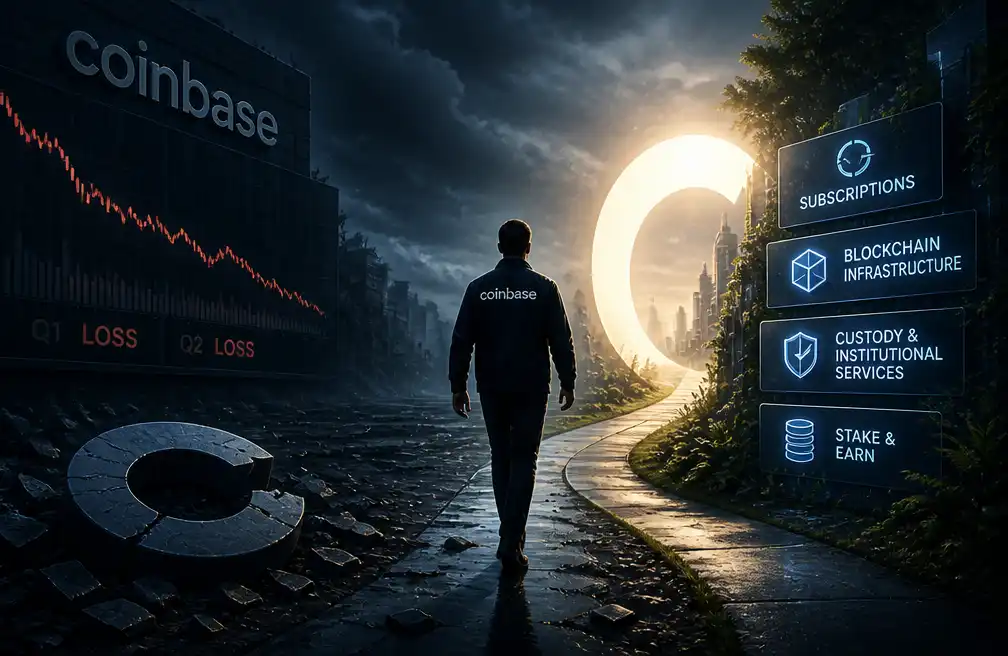
With Two Consecutive Quarters of Losses, Coinbase Must Rely on Paths Beyond Trading

Coinbase posted its second consecutive quarterly net loss of $359 million on $1.22 billion in revenue for Q2, highlighting its vulnerability to crypto market cycles where weaker prices and lower volatility reduce user trading. However, the report also reveals a strategic shift in its business model. Despite a 25% quarter-over-quarter decline in global spot trading volume, Coinbase increased its market share to a company-record 10.3%. This suggests its position as a compliant U.S. on-ramp is strengthening even in a cooler market. A key development is the diversification of revenue streams. Transaction revenue fell to $599 million, nearly equaling subscription and services revenue of $555 million. Stablecoin services, generating $292 million, are becoming a crucial revenue "floor." This income, derived from interest on the $20 billion average USDC balance held on its platform, is less tied to daily trading activity. Furthermore, while spot trading volume dropped significantly, derivatives volume held steady at $1.03 trillion. Coinbase is pushing to integrate spot, stablecoin, and derivatives liquidity to create a more interconnected and sticky ecosystem for users. The GAAP net loss includes non-cash expenses like stock-based compensation and crypto asset valuation changes. Its adjusted EBITDA remained positive at $208 million for the 14th straight quarter, indicating core operations can cover ongoing costs. The company is also reducing expenses to manage the downturn. The central question moving forward is whether Coinbase's growing market share, stablecoin revenues, and expanding product integration can sufficiently offset the inherent cyclicality of its core trading business during future market contractions.

marsbitHá 58m

With Two Consecutive Quarters of Losses, Coinbase Must Rely on Paths Beyond Trading

marsbitHá 58m

Trading

Spot

Artigos em Destaque

Como comprar SOON

Bem-vindo à HTX.com!Tornámos a compra de SOON (SOON) simples e conveniente.Segue o nosso guia passo a passo para iniciar a tua jornada no mundo das criptos.Passo 1: cria a tua conta HTXUtiliza o teu e-mail ou número de telefone para te inscreveres numa conta gratuita na HTX.Desfruta de um processo de inscrição sem complicações e desbloqueia todas as funcionalidades.Obter a minha contaPasso 2: vai para Comprar Cripto e escolhe o teu método de pagamentoCartão de crédito/débito: usa o teu visa ou mastercard para comprar SOON (SOON) instantaneamente.Saldo: usa os fundos da tua conta HTX para transacionar sem problemas.Terceiros: adicionamos métodos de pagamento populares, como Google Pay e Apple Pay, para aumentar a conveniência.P2P: transaciona diretamente com outros utilizadores na HTX.Mercado de balcão (OTC): oferecemos serviços personalizados e taxas de câmbio competitivas para os traders.Passo 3: armazena teu SOON (SOON)Depois de comprar o teu SOON (SOON), armazena-o na tua conta HTX.Alternativamente, podes enviá-lo para outro lugar através de transferência blockchain ou usá-lo para transacionar outras criptomoedas.Passo 4: transaciona SOON (SOON)Transaciona facilmente SOON (SOON) no mercado à vista da HTX.Acede simplesmente à tua conta, seleciona o teu par de trading, executa as tuas transações e monitoriza em tempo real.Oferecemos uma experiência de fácil utilização tanto para principiantes como para traders experientes.

230 Visualizações TotaisPublicado em {updateTime}Atualizado em 2026.06.02

Como comprar SOON

Discussões

Bem-vindo à Comunidade HTX. Aqui, pode manter-se informado sobre os mais recentes desenvolvimentos da plataforma e obter acesso a análises profissionais de mercado. As opiniões dos utilizadores sobre o preço de SOON (SOON) são apresentadas abaixo.

活动图片