Over 1 in 20 emails are malicious, warns internet giant Cloudflare

cointelegraphPublicado em 2025-12-16Última atualização em 2025-12-16

Resumo

More than 5% of all emails sent contain malicious content, with that figure surging to nearly 10% in November, according to Cloudflare's 2025 year-in-review report. Malicious emails are defined as those capable of causing harm, such as stealing credentials, data, or money. These threats are particularly relevant to crypto investors, as phishing attacks have increased in complexity and can result in irreversible losses. Deceptive links were the most common threat category, making up 52% of malicious emails. Identity deception followed at 38%, where attackers impersonate trusted individuals using spoofed domains. The most abused top-level domain was “.christmas,” with 92.7% of emails from it being malicious. Additional research from Barracuda found that one in four emails were unwanted spam, a quarter of all HTML attachments were malicious, and 12% of malicious PDF attachments were Bitcoin scams. Hornet Security also reported a 131% year-over-year increase in malware-laden emails, confirming email as a consistent vector for cyberattacks.

More than 5% of all emails sent worldwide contain malicious content, according to internet infrastructure giant Cloudflare.

The web security giant revealed that an aggregate of 5.6% of global email traffic analyzed by the firm over the past year was found to be malicious. This equates to more than one in every twenty emails containing harmful content.

In November, that figure surged to almost one in 10, nearly double the average for the year, it found.

Malicious emails include those that can cause harm, such as the theft of credentials, data, or money, Cloudflare explained in its 2025 year-in-review report.

The findings are particularly relevant to crypto investors, as phishing attacks targeting crypto traders, investors, and executives have increased in complexity and surged in recent months.

Crypto phishing links can be especially damaging. Once a victim falls for one of these malicious links or sends cryptocurrency to a scammer, there’s usually no way back.
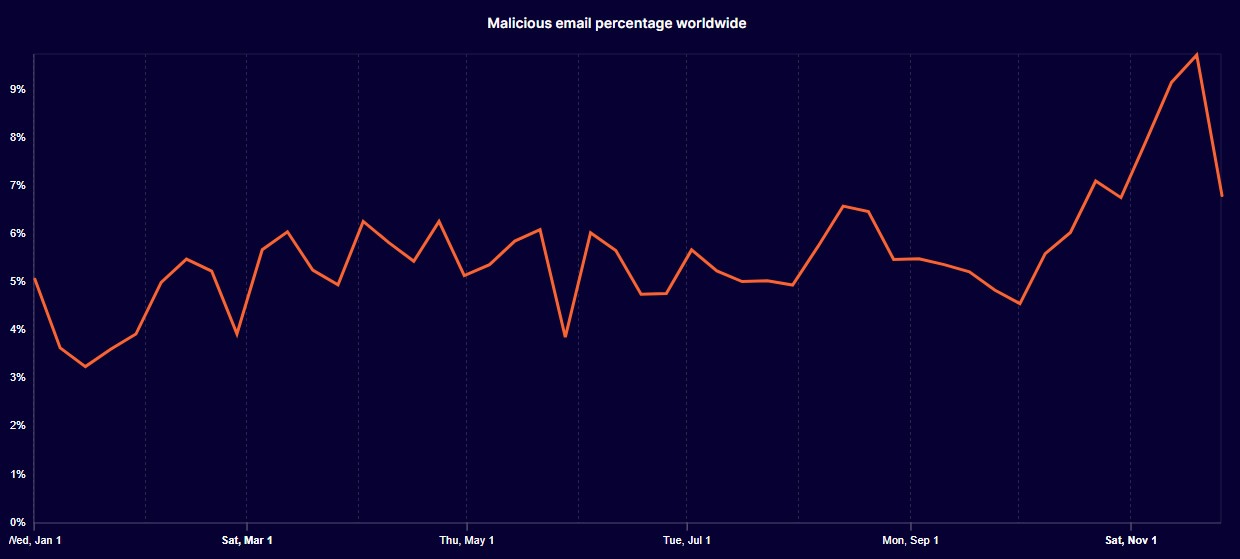
Malicious emails surged to 9.7% in November. Source: Cloudflare

Deceptive links dominate threat categories

More than half of these malicious emails, or 52%, contained a deceptive link, which was the highest threat category, it reported.

Identity deception was the second-highest at 38%, up from 35% in 2024, as attackers impersonated trusted individuals using spoofed domains, similar-looking domains, or display name tricks.

Related: Email auto-reply vulnerability allows hackers to mine cryptocurrency

Cloudflare also revealed that the most abused top-level domain (TLD) extension was “.christmas,” with 92.7% malicious emails and 7.1% spam originating from this domain type.

Other highly abused domain names included “.lol,” “.forum,” “.help,” “.best” and “.click.”
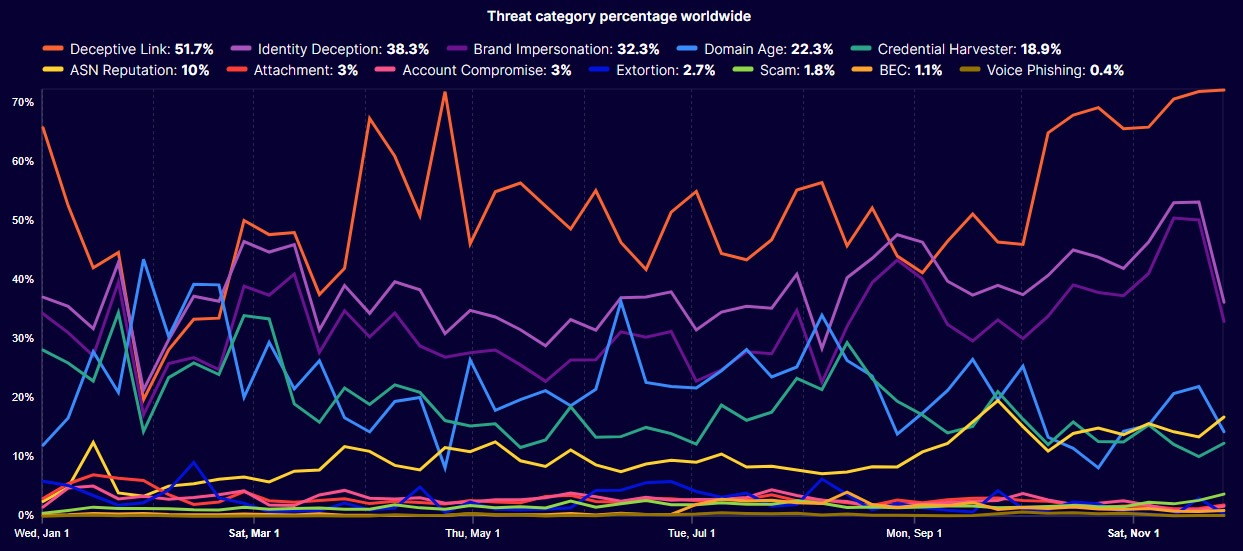
Deceptive links were the highest threat category among malicious emails. Source: Cloudflare

A quarter of HTML attachments are malicious

Earlier this year, researchers at cybersecurity company Barracuda analyzed 670 million emails that were malicious or unwanted spam.

They discovered that email remains the most common attack vector for cyber threats, with malicious attachments and links being used to distribute malware, launch phishing campaigns, and exploit vulnerabilities.

As many as one in four emails were unwanted spam, a quarter of all HTML attachments were malicious, and 12% of malicious PDF attachments were Bitcoin scams, they reported.

In November, Hornet Security reported that email was a “consistent delivery vector” for cyberattacks in 2025, with malware-laden emails surging by 131% year-over-year.

Magazine: Do Kwon sentenced to 15 years, Bitcoin’s ‘choppy dance’: Hodler’s Digest

Criptomoedas em alta

Leituras Relacionadas

Bitcoin Boom in Full Swing: Saylor's Latest Statement Fuels Buying Speculation

MicroStrategy's Executive Chairman Michael Saylor has fueled speculation about a new Bitcoin purchase by posting "Bitcoin Drive engaged" on August 2, accompanied by the company's customary purchase tracker. This aligns with his pattern of hinting at treasury changes ahead of weekly reports. The accompanying report showed MicroStrategy's Bitcoin holdings at 843,775 BTC, with an average cost of $75,653 per coin and an unrealized loss of -$10.58B. A similar signal preceded the company's July 27 announcement, strengthening expectations for a treasury update on Monday. However, MicroStrategy's real-time ledger reflects two recent Bitcoin sales totaling 3,588 BTC, reducing holdings from 847,363 BTC to the current 843,775 BTC. The company stated these sales funded preferred stock dividends and replenished its U.S. dollar reserve. Recent reports indicate the company made no Bitcoin purchases the week ending July 26 while increasing its dollar reserve to approximately $3.75B. The company faces financial headwinds after reporting an $8.33B operating loss for Q2 2026, including an $8.32B unrealized loss on its digital assets. Management may sell up to $1.25B more in Bitcoin to meet cash obligations. The expected Monday update will reveal if the "Bitcoin Drive" signal marks a return to accumulation as MicroStrategy balances its massive Bitcoin stash against growing cash commitments.

cryptonews.ruHá 48m

Bitcoin Boom in Full Swing: Saylor's Latest Statement Fuels Buying Speculation

cryptonews.ruHá 48m

Trading

Spot

Artigos em Destaque

Como comprar T

Bem-vindo à HTX.com!Tornámos a compra de Threshold Network Token (T) simples e conveniente.Segue o nosso guia passo a passo para iniciar a tua jornada no mundo das criptos.Passo 1: cria a tua conta HTXUtiliza o teu e-mail ou número de telefone para te inscreveres numa conta gratuita na HTX.Desfruta de um processo de inscrição sem complicações e desbloqueia todas as funcionalidades.Obter a minha contaPasso 2: vai para Comprar Cripto e escolhe o teu método de pagamentoCartão de crédito/débito: usa o teu visa ou mastercard para comprar Threshold Network Token (T) instantaneamente.Saldo: usa os fundos da tua conta HTX para transacionar sem problemas.Terceiros: adicionamos métodos de pagamento populares, como Google Pay e Apple Pay, para aumentar a conveniência.P2P: transaciona diretamente com outros utilizadores na HTX.Mercado de balcão (OTC): oferecemos serviços personalizados e taxas de câmbio competitivas para os traders.Passo 3: armazena teu Threshold Network Token (T)Depois de comprar o teu Threshold Network Token (T), armazena-o na tua conta HTX.Alternativamente, podes enviá-lo para outro lugar através de transferência blockchain ou usá-lo para transacionar outras criptomoedas.Passo 4: transaciona Threshold Network Token (T)Transaciona facilmente Threshold Network Token (T) no mercado à vista da HTX.Acede simplesmente à tua conta, seleciona o teu par de trading, executa as tuas transações e monitoriza em tempo real.Oferecemos uma experiência de fácil utilização tanto para principiantes como para traders experientes.

542 Visualizações TotaisPublicado em {updateTime}Atualizado em 2026.06.02

Como comprar T

Discussões

Bem-vindo à Comunidade HTX. Aqui, pode manter-se informado sobre os mais recentes desenvolvimentos da plataforma e obter acesso a análises profissionais de mercado. As opiniões dos utilizadores sobre o preço de T (T) são apresentadas abaixo.

活动图片













