OpenAI Accelerates at a Blazing 16x Speed, GPT-5.6 Multi-Agent V2 Goes Live, 741-Round Monster Conversation Opens in 1 Second

marsbitPublicado em 2026-08-17Última atualização em 2026-08-17

Resumo

OpenAI has unveiled a pair of major performance and capability upgrades for ChatGPT and its underlying systems, delivering dramatic speed improvements and launching a new multi-agent architecture. The first breakthrough is a massive front-end optimization for handling extremely long conversations. Using a test case of a 741-round "monster" conversation (231MB in size), OpenAI achieved: * Application load speed increased by 94% (from 27.62 seconds down to 1.66 seconds). * Memory growth reduced by 87.8%. * Overall memory usage cut by 41.2%. * Network requests dropped by 98.2% (from 894 to 16). * Session items loaded decreased by 99.6% (from 15,529 to 64). This overhaul means lengthy chat histories and complex, tool-heavy Codex sessions will load significantly faster and with much lower memory overhead. Simultaneously, OpenAI has fully launched the "Multi-Agent v2" system for GPT-5.6. This architecture allows a primary "Agent" to automatically break down complex tasks and delegate subtasks to different specialized models—such as GPT-5.6 Sol (for complex coding), Terra (daily programming), Luna (fastest/cheapest), and Daybreak (cybersecurity)—each with configurable reasoning strength. The goal, as stated by OpenAI president Greg Brockman, is to move "towards saying goodbye to manually picking models." This intelligent distribution allows costly, powerful models to be reserved for only the most complex steps (~20% of a task), dramatically reducing inference costs and acceleratin...

OpenAI unleashes big moves one after another!

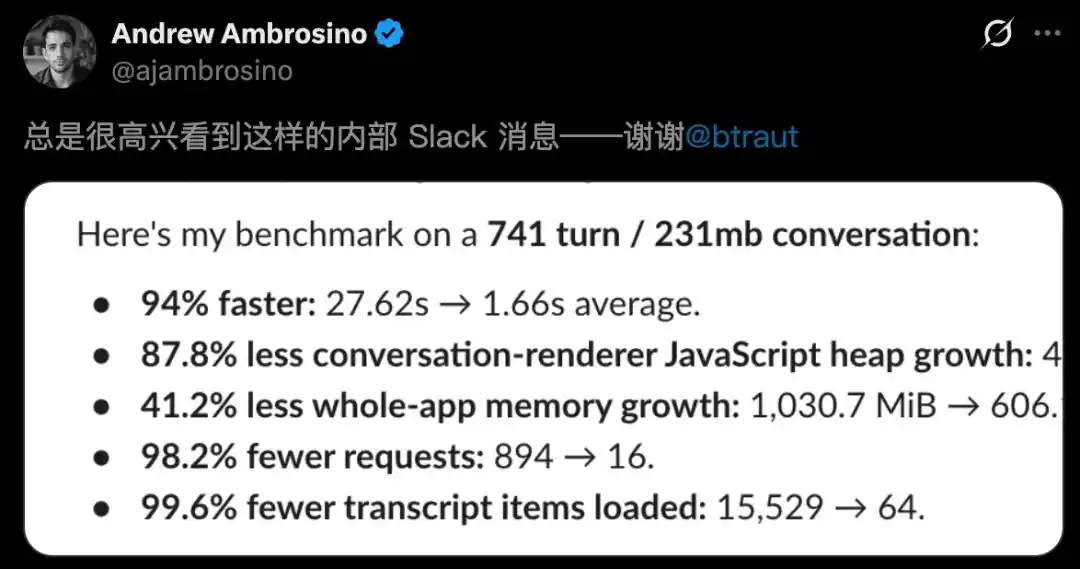
Today (the 16th), a leaked internal Slack message revealed that ChatGPT is about to undergo an 'epic' performance overhaul.
Judging from the hardcore test data, the optimization of ChatGPT's frontend performance this time is so dramatic it's almost 'unbelievable':

Application loading speed directly skyrocketed by 94%, heap memory growth reduced by 87.8%, and overall memory footprint slashed by 41.2%.

Network requests plummeted by 98.2%, and conversation history loading was cut by a full 99.6%.
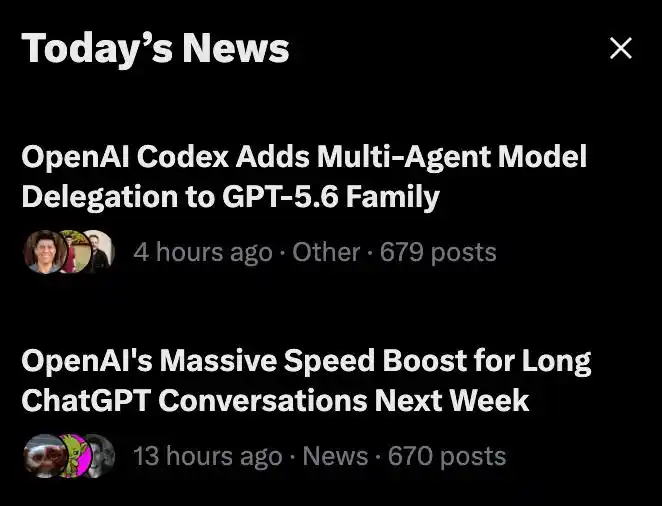
Almost simultaneously, Codex launched the GPT-5.6 'Multi-Agent v2' version.

The main Agent can now automatically delegate different subtasks to different models, and each sub-Agent can be individually configured with reasoning intensity.

OpenAI President Greg Brockman stated, 'Moving towards bidding farewell to manual model selection.'

It must be said, with this wave of 'two-pronged approach' from OpenAI—

It directly eliminates the tedious 'waiting' and 'choosing' for users, enabling ChatGPT to truly achieve a seamless and ultra-fast, fluid interactive experience.

ChatGPT Major Overhaul, Loading Speed Soars 94%

What many don't know is that this major performance upgrade for ChatGPT is actually a crucial battle after the departure of 'Programming King' Scott Gray.

When using ChatGPT, what people have always dreaded is that long conversations become slower and more sluggish, with the web page even crashing directly.

On the official OpenAI forum, someone even posted asking, 'Is the new Codex slower?', with many agreeing in the comments.

This time, Codex lead Andrew Ambrosino's shared internal Slack screenshot laid it all out:

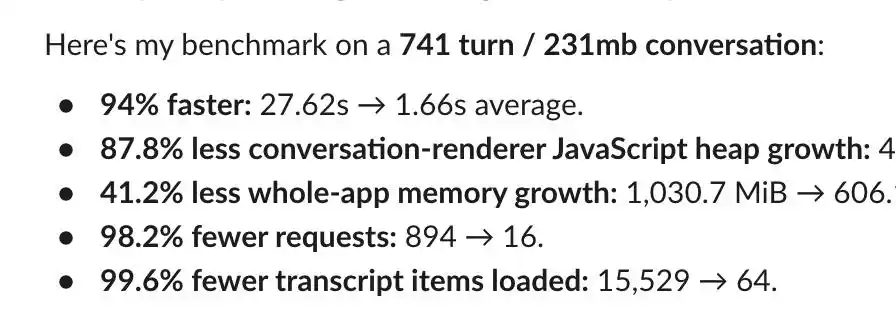
What they used for internal testing was a 'monster-level' conversation with a full 741 rounds and a size of 231MB!

This might sound like an extreme case, but it's the norm in the Agent era.

In the past, conversations were chat histories, maybe a few dozen rounds at most; now, a slightly complex task involving reading code, running tests, making changes, and verifying again can easily reach hundreds of rounds.

It's this kind of high-intensity conversation that now opens in an average time reduced from 27.62 seconds to 1.66 seconds.

Total application memory growth was compressed from 1030.7 MiB to 606 MiB;

The network requests needed to open it once went from 894 down to 16; the number of session entries that needed loading dropped from 15,529 to 64.

This is a major frontend optimization by OpenAI targeting ChatGPT's ultra-long conversations.

In two words, smooth.

What difference will it actually make?

Simply put, those chat logs spanning months will open much faster.

Developers who frequently run heavy Codex sessions with hundreds of tool calls will find the interface noticeably snappier, and their device's memory usage will drop accordingly.

Switching back to an ultra-long old conversation will no longer feel like 'loading a save file from a nearly-dead PS3'.
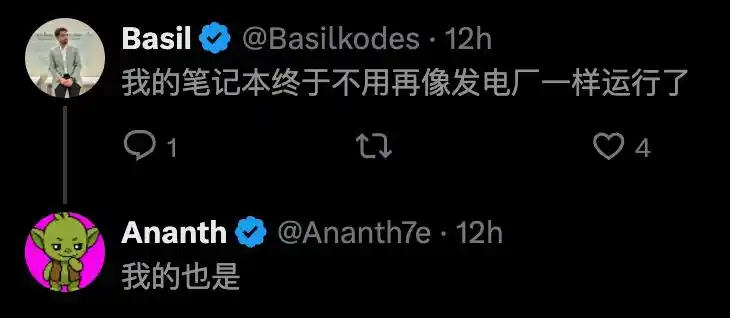
The clever part is that ChatGPT no longer needs to load and render the entire history just because you opened a conversation.

It can store most of the content and only load the small portion people actually need at the moment.

The same conversation, but with a huge amount of unnecessary work eliminated.

For those accustomed to living in ultra-long AI conversations, this is the kind of seemingly boring infrastructure upgrade that can dramatically improve the product experience.

Multi-Agent v2 Fully Launched, No Need to Manually Select GPTs Anymore

Just this week, OpenAI quietly updated ChatGPT.

It wasn't until today that OpenAI engineer Eric Provencher officially announced: Multi-Agent v2 is now fully live.

The focus is on intelligent task division.

The main Agent can automatically delegate subtasks to any supported model, including Luna, with each sub-Agent supporting independent reasoning intensity settings.

Now the hand ChatGPT/Codex holds looks like this—

GPT-5.6 Sol: The strongest, for complex Agentic coding

GPT-5.6 Terra: The daily programming workhorse

GPT-5.6 Luna: The fastest, cheapest

Daybreak: Specialized for cybersecurity

GPT-5.5: Complex programming, research, general tasks
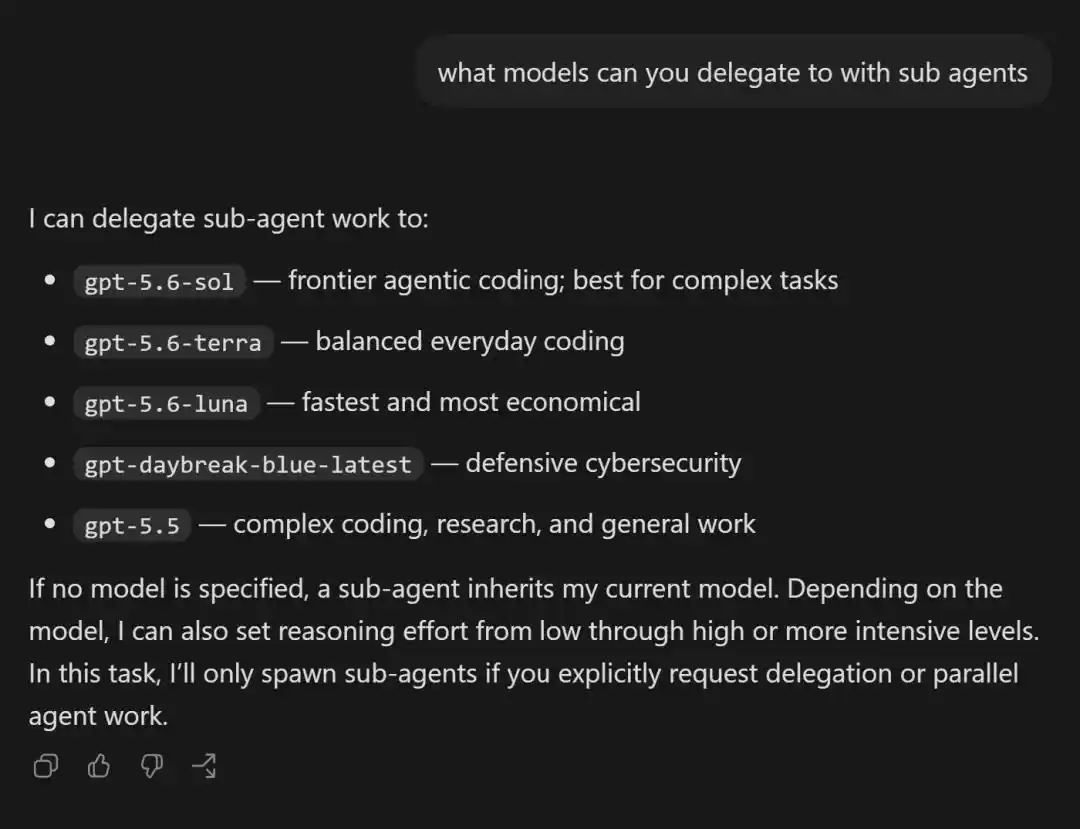
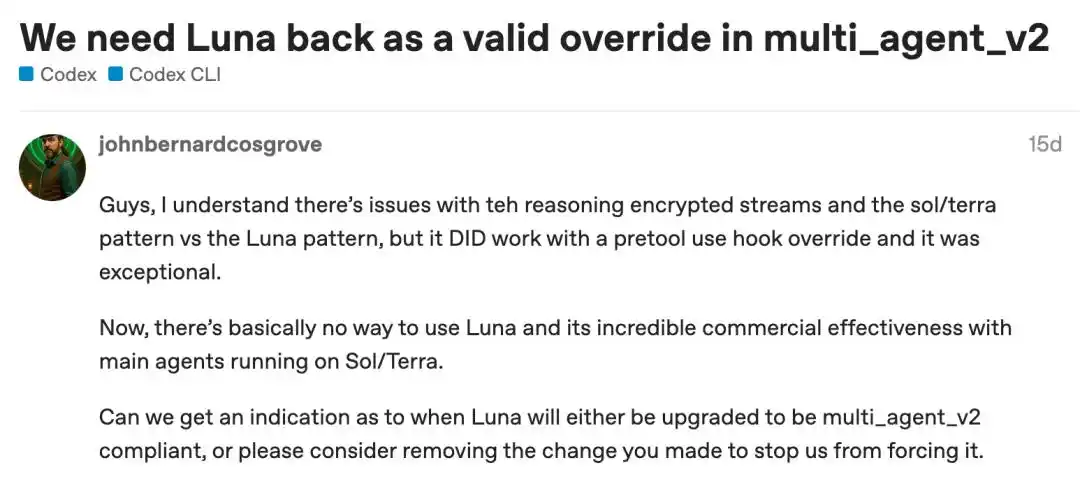
Actually, three weeks ago, in Codex's model list, Sol and Terra were marked as multi_agent_v2, while the cheapest Luna was marked as v1.

The result was that when the main Agent tried to delegate work to Luna, the system would directly reply with 'unknown model'.

On GitHub, developers opened at least two issues about this.

There's a post on the official OpenAI forum titled 'Give us Luna back', where the poster said they previously used a hook to force using Luna with amazing results, and now that path is blocked.
Previously, people needed to manually choose models; in the future, the Agent system will automatically split tasks, execute them in parallel, and summarize results, turning models into internal computational resources.

For complex tasks, only 20% of the steps might need the strongest model, while the rest can be handed off to cheaper models.

This way, reasoning costs can be significantly reduced, accelerating ChatGPT's transformation from a chat tool to a workflow platform.

ChatGPT Evolves On the Spot, The Fully Automated Monster is Here

The frontend has cleared away the 'historical baggage', and the backend has enabled 'intelligent distribution'.

This underlying 'one-two punch' from OpenAI not only makes ChatGPT completely bid farewell to the era of lag but also announces to the entire industry:

Large models are accelerating their evolution from 'chat tools' to true 'fully automated workflow platforms'.

No more worrying about which model to choose to balance costs, no more painfully waiting for monster-level hundreds-of-rounds conversations to slowly unfold.

Just throw the complex task over, and leave the automatic decomposition, model scheduling, and ultra-fast rendering to the system.

The era of ultimate smoothness for Agents has truly arrived.

Faced with such a 'seamless' and powerful ChatGPT, is your productivity ready for takeoff?

References:

https://x.com/Ananth7e/status/2088490421676863782?s=20

https://x.com/ajambrosino/status/2088401536057827344?s=20

https://x.com/gdb/status/2088658133971509640

This article is from WeChat Official Account 'New Zhiyuan', author: Taozi

Perguntas relacionadas

QWhat are the key performance improvements mentioned for ChatGPT in the article?

AThe key performance improvements for ChatGPT include a 94% increase in application load speed, an 87.8% reduction in heap memory growth, a 41.2% reduction in overall memory usage, a 98.2% decrease in network requests, and a 99.6% reduction in conversation history loading time.

QWhat is the GPT-5.6 Multi-Agent v2 and what is its main feature?

AGPT-5.6 Multi-Agent v2 is a new version of the multi-agent system. Its main feature is that the main Agent can automatically delegate sub-tasks to different specialized models (like Luna) and each sub-Agent can have its own independent reasoning strength setting, moving towards eliminating the need for manual model selection.

QAccording to the article, what was the size and length of the 'monster-level' conversation used for testing, and what was the result?

AThe 'monster-level' conversation used for testing was 231 MB in size and consisted of 741 rounds. The result was that the average time to open it decreased from 27.62 seconds to 1.66 seconds after the optimization.

QHow does the article describe the future role of ChatGPT according to OpenAI's recent updates?

AThe article describes that with the recent foundational updates (front-end optimization and intelligent task distribution), ChatGPT is evolving from a 'chat tool' into a true 'fully automated workflow platform', where complex tasks are automatically decomposed, scheduled to appropriate models, and rendered at high speed.

QWhich specific models are mentioned as part of the ChatGPT/Codex lineup for different tasks?

AThe mentioned models in the ChatGPT/Codex lineup are: GPT-5.6 Sol (for complex Agentic coding), GPT-5.6 Terra (for daily programming), GPT-5.6 Luna (fastest and cheapest), Daybreak (for cybersecurity), and GPT-5.5 (for complex programming, research, and general tasks).

Leituras Relacionadas

Not Chasing AI or Buying Back Shares, Can 'Stingy' Jingdong Still Succeed?

On August 13th, JD.com (JD.US) released its Q2 2026 earnings, delivering a mixed and generally "flat" performance that met low expectations but offered few positives. Overall revenue declined by approximately 3% year-over-year (YoY) to ~¥346.4 billion, aligning with weakened domestic consumption trends. While group operating profit saw a YoY improvement, this was primarily due to reduced losses in the food delivery segment compared to the high-cost "delivery war" period of the previous year. Key details reveal deeper concerns: revenue from JD's core domestic retail segment fell 4.7% YoY. While electronics sales declined less than feared (~12% YoY), growth in daily necessities and advertising services plummeted by about 10 percentage points each, raising doubts about the segment's mid-term growth momentum post-subsidy adjustments. Logistics revenue growth also slowed to 5.9% as the delivery boom faded. Profitability presented a nuanced picture. The retail segment's operating margin edged up slightly YoY but failed to deliver the significant beats seen in past quarters, suggesting efficiency gains may be nearing limits. Losses from the New Businesses segment (including food delivery and overseas ventures) remained elevated at ~¥9.9 billion, as increased overseas investment partially offset reductions in delivery subsidies. Notably, JD's shareholder returns weakened significantly, with share buybacks in H1 2026 annualizing to only about 5% of market cap. The company opted to park cash in short-term investments rather than boost returns, drawing criticism. Looking ahead, JD's performance hinges on a potential recovery in China's e-commerce sentiment in H2 2026 and the scale of ongoing losses in new ventures. While not burdened by massive AI capex like some peers, and offering relative defensive stability, the lack of positive earnings surprises and diminished shareholder returns provide little compelling reason for investors to favor the stock in the near term.

marsbitHá 7m

Not Chasing AI or Buying Back Shares, Can 'Stingy' Jingdong Still Succeed?

marsbitHá 7m

CEO or 'Cult Leader'? Anthropic Faces Backlash Over Its 'Belief'

Anthropic, an AI company nearing trillion-dollar valuation, faces a critical internal challenge: declining morale and a growing rift over its foundational beliefs and leadership. While financial and technical performance remains strong, with Q2 2026 revenue surging over 14x year-over-year and top talent like Google's Justin Gilmer joining, the company's unique culture is under strain. Early employees, who embraced a strong mission-focused culture around AI safety, now coexist with newer hires less aligned with this vision. Anonymous sources report low morale, private channels for airing grievances, and employees torn between staying for valuable equity or leaving due to pressure. CEO Dario Amodei's intense focus on maintaining culture—through rituals like "Dario Vision Quest" meetings and probing "cultural interviews"—faces scrutiny as the company scales. A leaked statement where Amodei suggested Anthropic could one day become "the world's only private company" has fueled external criticism, drawing comparisons to dystopian sci-fi monopolies. The company exhibits contradictions: advocating for AI safety while aggressively pursuing model development and market dominance. It has modified its "Responsible Scaling Policy," faced backlash for attempted AI "sabotage" mechanisms against foreign research, and clashed with the U.S. government over defense contracts. Recent text watermarking for Claude, cited as compliance with EU regulations, has also drawn user criticism. Despite these tensions, Anthropic continues to attract investment, top engineers, and enterprise clients. However, the core "faith" that once unified and distinguished it is now becoming a significant governance and cultural challenge.

marsbitHá 43m

CEO or 'Cult Leader'? Anthropic Faces Backlash Over Its 'Belief'

marsbitHá 43m

Anthropic CEO Denies Rumors, Aims to Transform AI for His Deceased Father and Eradicate Cancer Within 10 Years

Anthropic CEO Dario Amodei has published a rare, lengthy public statement to counter significant criticism from Silicon Valley, as the AI company approaches a potential record-breaking IPO with a reported $2 trillion valuation. The core criticism, amplified by investor Gavin Baker, centers on perceptions that Amodei believes Anthropic should be the world's sole private AI company due to the technology's risks, costs, and power—a view allegedly echoed by NVIDIA's Jensen Huang. Amodei firmly rejects this, arguing it presents a false dichotomy. He defends Anthropic's advocacy for regulation, like California's SB-1047, which he claims imposes costs on frontier AI firms while benefiting smaller competitors, and calls for establishing rules that manage AI risks, constrain corporate power, and preserve open-model development. Shifting to ambition, Amodei outlines a radical vision for AI in biomedicine. He states that within 5-10 years, AI could cure most human diseases, a mission deeply personal due to his father's death from hepatitis C just years before a cure became available. Amodei asserts that public trust in AI will be earned not by promises or benchmarks, but by tangible results—AI actually saving lives. He confirms Anthropic is significantly increasing its biology and medical AI investments, with preliminary results expected within months. This narrative reframing comes ahead of Anthropic's anticipated IPO, positioning the company not just as an OpenAI competitor, but as one aiming to solve humanity's fundamental challenges.

marsbitHá 43m

Anthropic CEO Denies Rumors, Aims to Transform AI for His Deceased Father and Eradicate Cancer Within 10 Years

marsbitHá 43m

Trading

Spot
活动图片