Only 60% Real Win Rate: Data Reveals the Truth Behind ICO Predictions on Polymarket

marsbitPublicado em 2026-01-31Última atualização em 2026-01-31

Resumo

Polymarket's TokenSale markets have processed nearly $250 million in volume, boasting impressive accuracy rates—100% for fundraising amounts and over 90% for fully diluted valuations (FDV). However, an analysis of 231 prediction markets across 29 token sales reveals these figures are misleading. The platform functions more as a sentiment indicator, often acting as a contrarian signal. Key findings show that the true prediction accuracy one week before market close is only 66.7%, meaning the crowd is wrong one-third of the time, with errors consistently skewing toward over-optimism. FDV predictions averaged a 35% overestimation. Analysis of 24-hour post-launch volatility showed an average price swing of ±23%, with 75% of tokens facing sell-offs. Only 62.5% of 24-hour FDV predictions were accurate. The 100% accuracy claim is meaningless because markets close after results are known. High trading volume on Polymarket often serves as a reverse indicator—more optimism typically leads to greater inaccuracy. Tokens with conservative predictions (e.g., Monad, Football.fun) saw smaller declines. Actionable signals: High volume (>$50M) and high optimism (>50% FDV overestimation) are bearish. Low volume (<$5M) and accurate predictions (within 20% of actual FDV) are relatively bullish. In a market where most tokens fall below ICO price, "less bad" is the best outcome. Polymarket’s token sales market is essentially a hype meter—extreme confidence often signals maximum investor pain.

Author: @WazzCrypto, Legion

Compiled by: Frank, PANews

Observations on Prediction Markets in the Token World

Polymarket's Token Sale market has processed nearly $250 million in trading volume. The platform's advertised accuracy data is impressive: 100% accuracy in fundraising amount predictions and over 90% for FDV (Fully Diluted Valuation). However, a deeper analysis reveals that these numbers are misleading. The real signal is not what the crowd predicts, but how wrong they are.

By analyzing 231 prediction markets across 29 token sale events and cross-referencing Polymarket's historical probability data with actual token performance on CoinGecko, we found that "prediction markets are not reliable forecasting tools. Instead, they are actually sentiment indicators, and often a contrarian signal.

Key Finding: One week before market close, the real prediction accuracy was only 66.7%. At critical moments, the crowd is wrong one-third of the time, and incorrect predictions often show systematic over-optimism.

24-Hour Volatility Issue: Using CoinGecko's hourly data, we found that Polymarket's markets for "FDV above X 24 hours after launch" are essentially bets on extreme volatility. The average 24-hour price change was ±23% (e.g., Best performer: Monad +54.8%; Worst performer: Trove -38.7%). 75% of tokens faced selling pressure within 24 hours of launch. In this context, Polymarket's accuracy for 24-hour FDV predictions was only 62.5%.

The Fallacy of Accuracy: The Market is Wrong One-Third of the Time

When we track how market probabilities evolve over time, rather than just looking at static data at settlement, a completely different picture emerges. The fundraising amount prediction markets appear "100% accurate" because the final figures are inevitably leaked gradually as the sale progresses. Insiders and observers update prices accordingly; this is merely ex-post price discovery.
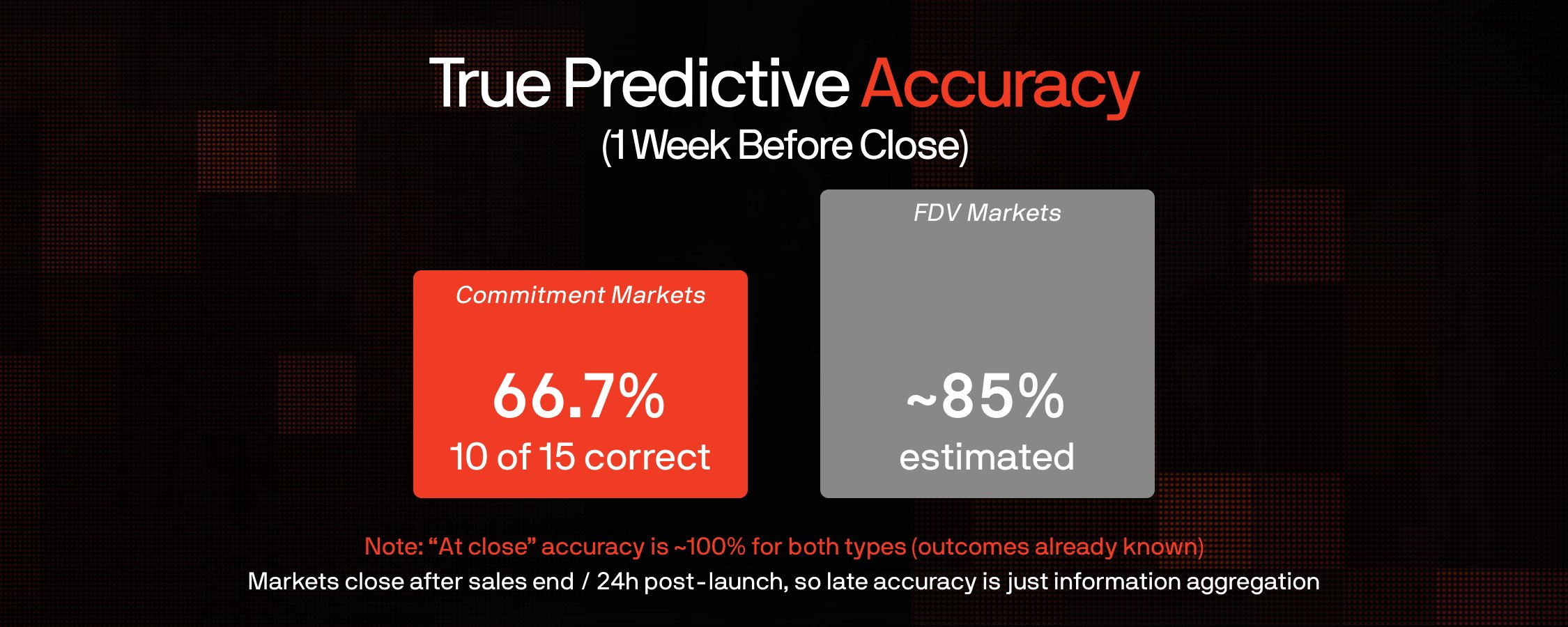
Key Insight: The reason fundraising and FDV markets tend towards 100% accuracy at close is because they settle *after* the outcome is largely certain. Fundraising markets close after the sale ends; FDV markets close 24 hours after launch. The only meaningful predictive metric is the accuracy one week before close, when genuine uncertainty exists. The 66.7% accuracy rate for fundraising predictions shows that, at the critical moment, the market is wrong 1/3 of the time.

Crowd Predictions Err on the Side of Excessive Optimism

We reviewed every prediction market where "crowd confidence exceeded 60% but ultimately failed to materialize." In every case, the error was consistent: over-optimism. The crowd consistently believed the raise would be higher and the valuation more expensive than reality.
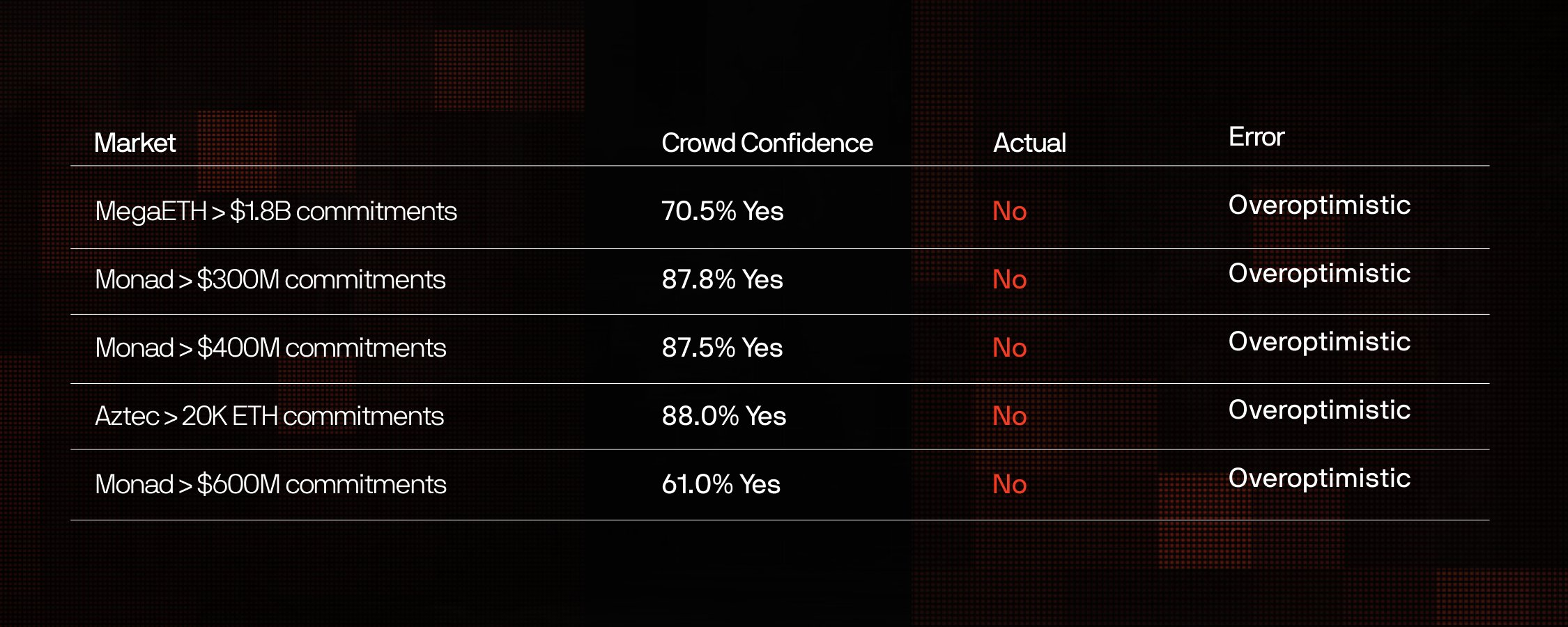
This systematic bias suggests the participants in these markets are optimistic speculators, attracted to token sales precisely because they are bullish.

Over-Optimism vs. Token Performance (Based on ICO Data)

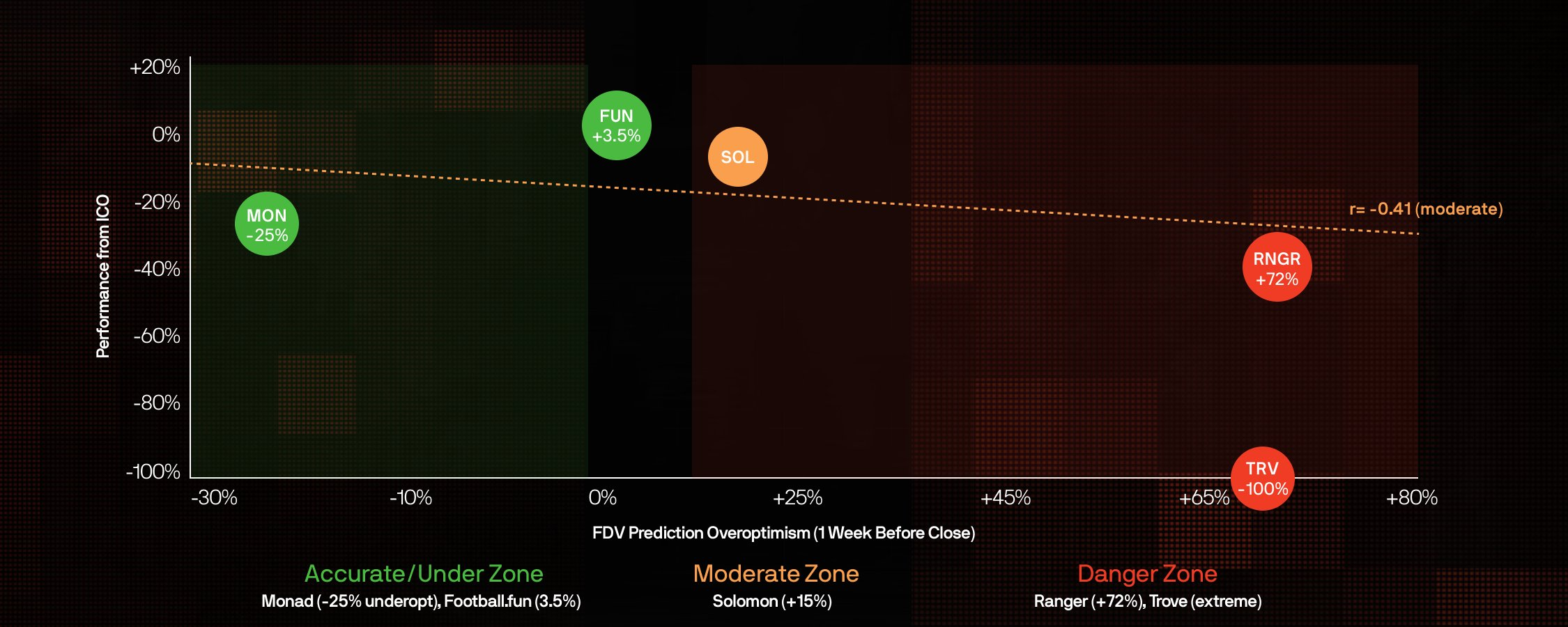
Methodology: This analysis only includes markets for projects that conducted a public ICO and have issued a token, using Polymarket odds from one week before market close.

Degree of Over-Optimism = (Polymarket Predicted FDV - Actual 24h FDV) / Actual 24h FDV.

The Y-axis shows price performance from ICO to current.

The data shows a moderate negative correlation (r=-0.41) between the degree of over-optimism and ICO returns. Monad was "underestimated/pessimistic" by the market (-25%), yet its price is still down 24% from ICO. Ranger was the most "over-optimistic" (+72%) and is currently down 32% from its ICO price. Only Football.fun remains above its ICO price (+1%).
Token Performance Ranking: 40% Launch Below Valuation

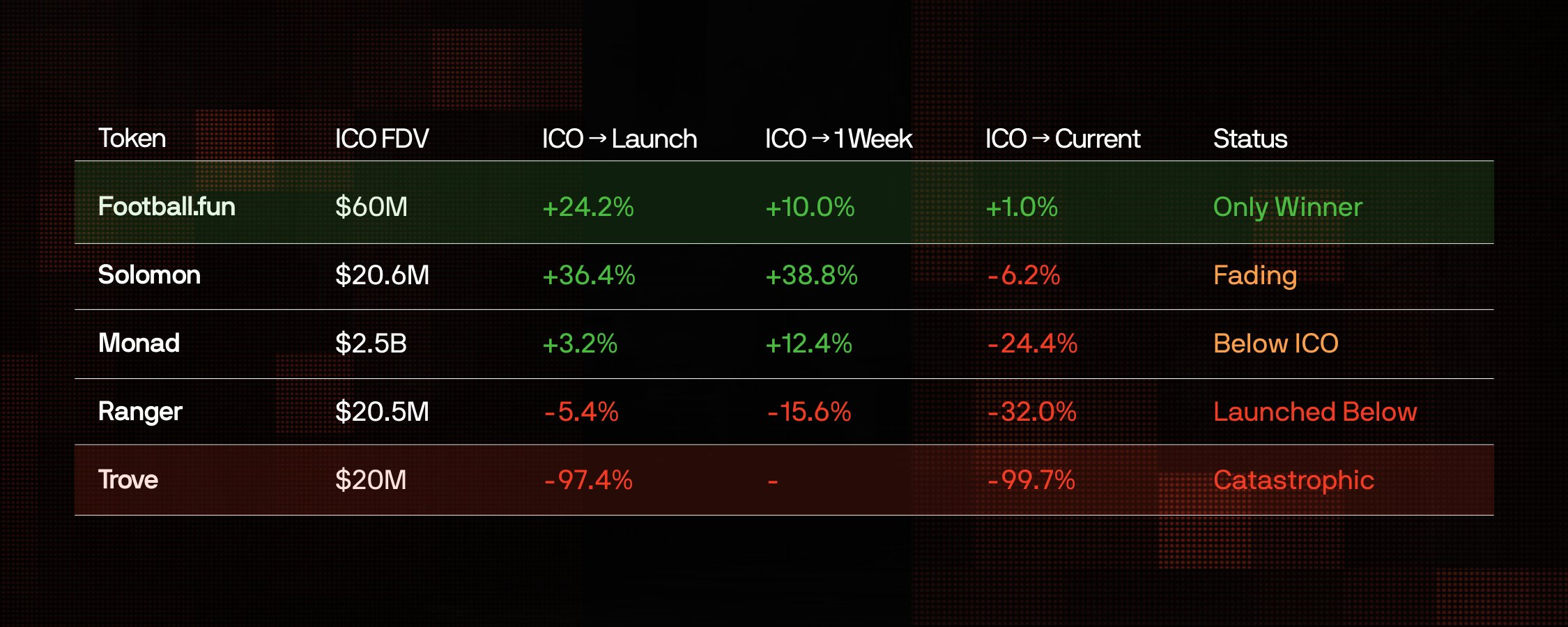
The table below, using historical Polymarket odds from one week before close, reveals the true prediction accuracy. The pattern is clear: extreme over-optimism预示 disaster, and high trading volume on Polymarket, even when predictions are correct, is often a contrarian signal.
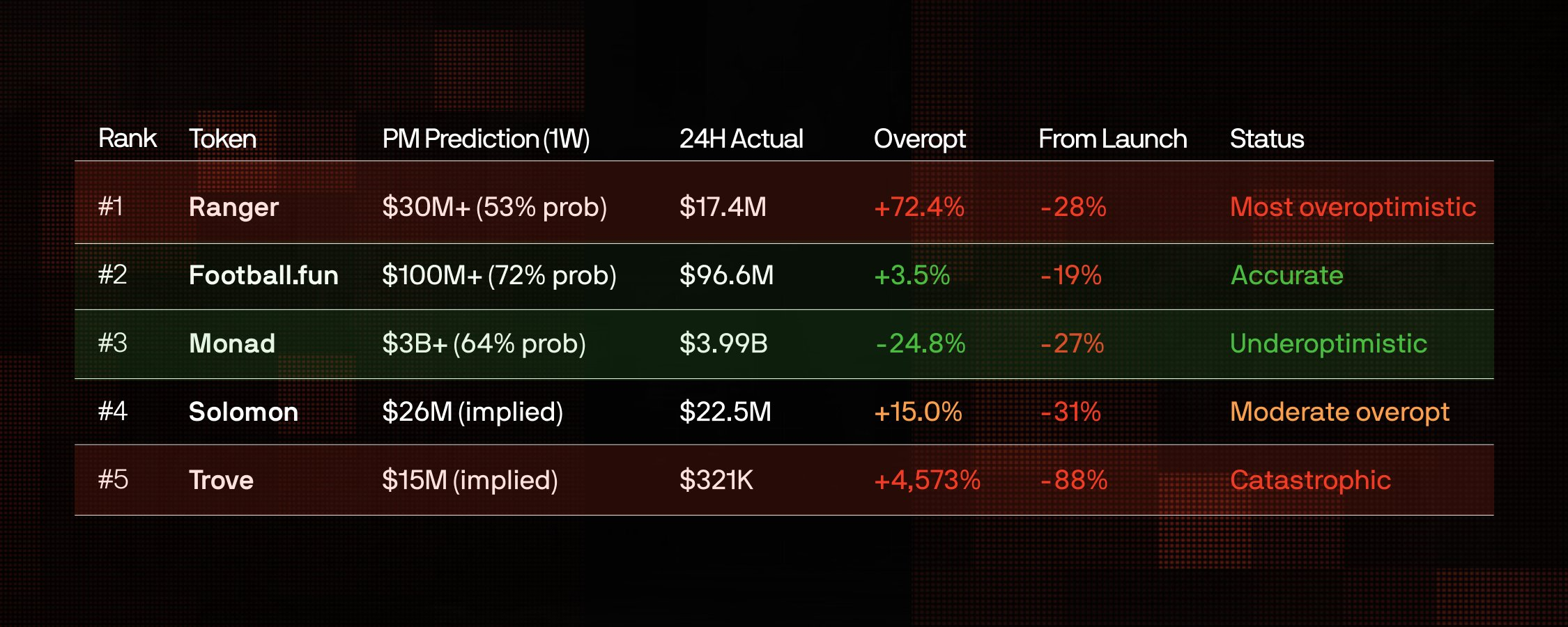
Key Finding: Among tokens with ICO data, 40% launched at a price below their ICO valuation. The average return from ICO to current is -32.2%. Only Football.fun is trading above its ICO price.
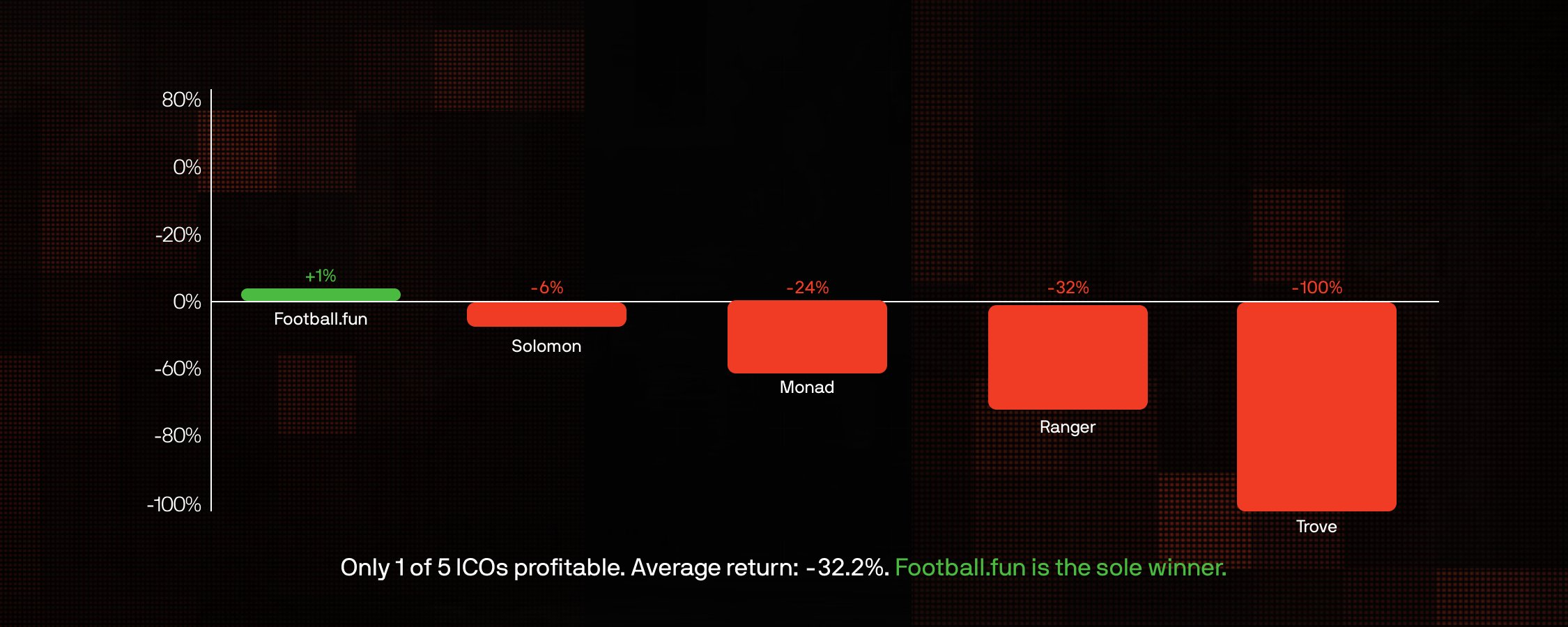
The pattern is brutal: Even tokens that launched above their ICO valuation (e.g., Monad, Solomon) eventually fell below the issue price. Football.fun is the only winner among the 5 ICO tokens in this dataset, currently just 1% above its ICO price.
Core Conclusions:

After analyzing 231 markets, $241.5 million in trading volume, and 8 tokens with verified 24-hour FDV data, several conclusions are clear:

  1. "100% Accuracy" is meaningless. Markets close for settlement *after* the outcome is known (fundraising markets post-sale, FDV markets 24 hours later), so late-stage accuracy unsurprisingly nears 100%. But the real predictive accuracy one week before close is only 66.7%. At the critical moment, the crowd guesses wrong 1/3 of the time.

  2. Systematic Over-Optimism. Among the top 15 markets, 5 markets showed over 60% confidence in thresholds that were never reached. FDV was overestimated by an average of +35%.

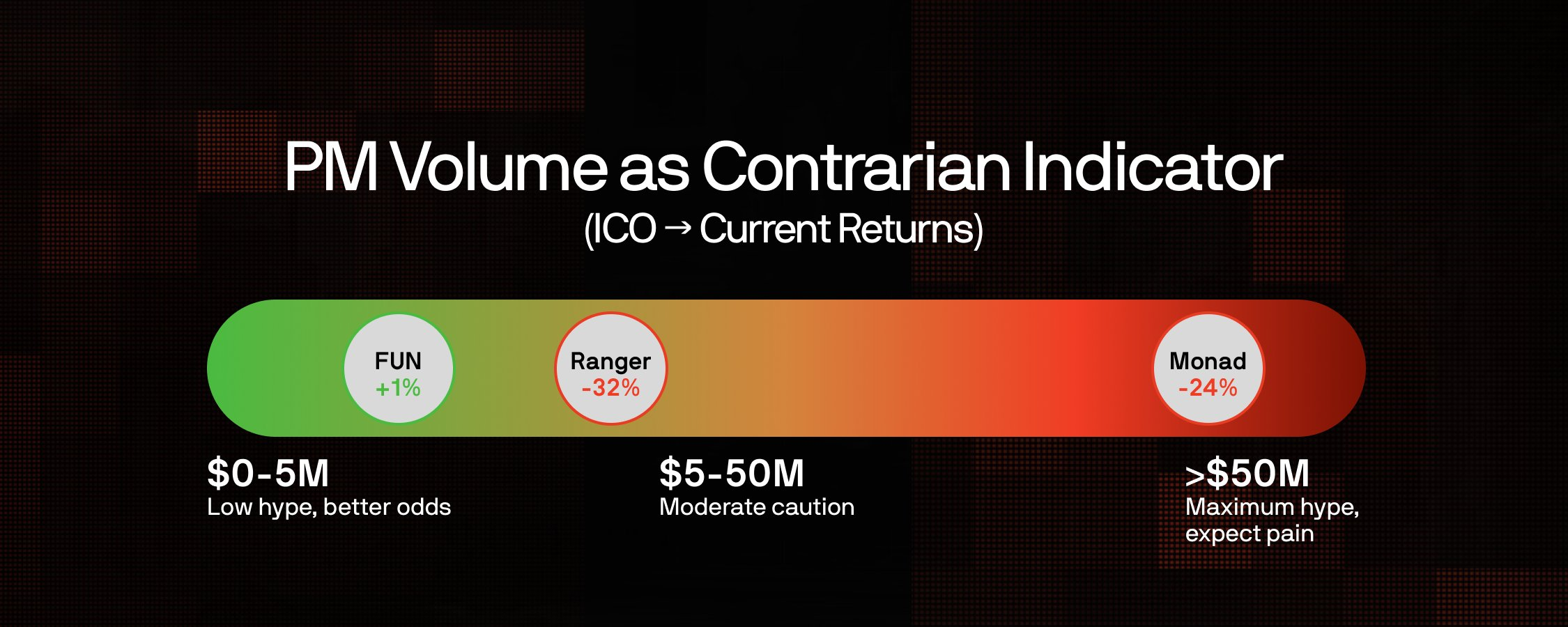
  3. High prediction market volume is a contrarian signal. Monad ($89M) and MegaETH ($67M) had the highest degrees of over-optimism. The more money the crowd bets, the more confident they are, and the more wrong they tend to be.

  4. Conservative Predictions = Better Outcomes. Tokens with relatively accurate predictions (Monad, Football.fun) fell less. Low hype and accurate predictions appear to be bullish signals.

Trading Signals:

Based on the analysis, we can distill actionable signals for evaluating future token sales. These are not absolute guarantees but represent patterns that held consistently within the dataset.
Bearish Signals:

  • Polymarket trading volume > $50 Million

  • FDV Over-Optimism degree > 50%

  • All FDV prediction thresholds are likely to fail

  • Fundraising amount Over-Optimism degree > 30%

Bullish Signals (Relatively)

  • Polymarket trading volume < $5 Million

  • FDV prediction偏差 within 20%

  • Multiple FDV prediction thresholds are met

  • Crowd expectations are relatively conservative

This asymmetry is important. Bearish signals are strong indicators of poor outcomes. Bullish signals are weaker, only suggesting the token might perform "less badly" than over-hyped alternatives. In a market where all tokens are down from their all-time highs (ATH), "losing less" is the best-case scenario.

Summary

Polymarket's token sale section is effectively a Hype Meter. The signal is not in the prediction itself, but in how much it deviates. When the crowd piles money into bets for higher valuations, caution is warranted. Historically, "extreme confidence" from the masses has often meant "maximum pain" for investors.


Perguntas relacionadas

QWhat is the actual prediction accuracy rate of Polymarket's ICO markets one week before closing, according to the analysis?

AThe actual prediction accuracy rate one week before closing is 66.7%, meaning the crowd is wrong one-third of the time.

QWhat systematic bias was identified in the predictions where the crowd had over 60% confidence but was ultimately wrong?

AThe systematic bias identified was consistent over-optimism. The crowd consistently predicted higher fundraising amounts and more expensive valuations than what occurred in reality.

QWhat percentage of tokens analyzed experienced selling pressure within 24 hours of their launch?

A75% of the tokens analyzed experienced selling pressure (were sold off) within 24 hours of their launch.

QAccording to the article, what is a key 'Bearish Signal' for a token sale based on Polymarket data?

AA key bearish signal is Polymarket trading volume exceeding $50 million, which often indicates extreme over-optimism that historically leads to poor outcomes.

QThe article suggests that Polymarket's TokenSale markets are not reliable prediction tools but are instead a measure of what?

AThey are not reliable prediction tools but are instead indicators of market sentiment, or 'Hype Meters,' and often act as a contrarian signal.

Leituras Relacionadas

Global Stock Market's Storm Center: South Korea's Stock Market De-leveraging Is Largely Complete

Storm's Eye: South Korean Market De-leveraging Nears Completion The recent sharp correction in South Korean equities, with the KOSPI index dropping 32% from its June high, has been a key trigger for global tech stock volatility. The core driver was not a fundamental shift but a forced de-leveraging process within the market's unique structure, which is now largely complete. Two main leverage channels amplified the sell-off: 1. **Leveraged ETFs:** Their size, proportionally four times larger than in the U.S., peaked near $50 billion. Their mandatory daily rebalancing mechanism created a vicious cycle of "price drop → forced selling → further drop." Approximately 75% of this excess has been unwound, shrinking to $26 billion, with regulatory curbs now blocking new inflows. 2. **Hedge Fund Leverage:** Using swaps to magnify exposure, hedge funds saw their net long positioning fall by over 50% from peak levels. The most intense phase of this institutional de-leveraging is over. In contrast, **retail margin debt** poses minimal systemic risk. At 0.5% of market cap, it is far lower than in the U.S. or China, lacks automatic triggers, and is concentrated in smaller stocks. The conclusion: the high-leverage structures most prone to "chain-reaction selling" have been substantially cleared. The market is transitioning from a liquidity-driven crash to one priced more on fundamentals. The article argues that the AI trend—centered on Korean memory chips—remains intact. This episode represents a painful but necessary clearing of crowded trades, not the end of the AI revolution. For investors, the key question is conviction in the long-term AI direction; if the trend is real, current volatility is a cost of entry, not a terminal risk.

链捕手Há 28m

Global Stock Market's Storm Center: South Korea's Stock Market De-leveraging Is Largely Complete

链捕手Há 28m

The Eternal Fragments of Money: Third-Party Payment Has No First Principle

"The Enduring Fragments of Money: Third-Party Payments Lack a First Principle" Stripe is reportedly attempting to acquire PayPal, marking a significant shift reminiscent of PayPal's merger with the original X.com 30 years ago. The article analyzes Stripe's strategic challenges and the broader payments industry landscape. Despite its initial success with a developer-friendly API model, Stripe missed its optimal IPO window during the pandemic and has since seen its valuation decline. Its attempts to expand through acquisitions and new ventures, particularly in stablecoins (like its OUSD project) and Agent-focused payments (ACP/MPP protocols), have faced headwinds. The author argues that the payment industry remains highly fragmented and is ultimately an adjunct to the traditional banking system. This structure limits the potential for any single player, including Stripe, to achieve complete dominance. While stablecoins and the future rise of autonomous Agent economies present potential growth avenues, they are not yet mainstream and still require integration with the existing financial system. For now, Agent-based transactions are largely used for speculative "volume boosting" rather than substantive business applications. Stripe's current move to acquire PayPal is seen as an attempt to bolster its weak consumer-facing (C-side) business after its stablecoin-focused strategies faltered. Meanwhile, PayPal is described as structurally outdated, unable to revive itself through new products like Venmo or PYUSD. The future of payments may lie not in payments themselves but in value-added services like more efficient settlement networks. The author suggests that companies like Stripe and Circle, which are building their own blockchains (Tempo, Arc) and stablecoins, are positioning themselves to eventually profit from high-efficiency settlement systems. These new networks could potentially bypass some traditional banking layers. In conclusion, the article posits that third-party payment is a perpetually fragmented battlefield where scale alone cannot ensure victory. Players must find new models, focusing on efficiency to compete with the entrenched banking system. Stripe's acquisition of PayPal represents a bet on this uncertain future.

链捕手Há 51m

The Eternal Fragments of Money: Third-Party Payment Has No First Principle

链捕手Há 51m

Trading

Spot
活动图片