On-Chain Whales' New Battleground: Hyperliquid Confronts Wall Street and Compliance Challenges

比推Publicado em 2026-03-17Última atualização em 2026-03-17

Resumo

Hyperliquid, a leading decentralized exchange (Perp DEX) for perpetual futures, is rapidly expanding beyond crypto into traditional finance, particularly through its HIP-3 market for real-world assets (RWAs) like commodities and indices. With a monthly trading volume of $173.4 billion and over 172.9 million users, it has become a hub for institutional and large-scale traders, with the top 100 addresses accounting for over 81% of total trading activity. Recent geopolitical events, such as the U.S.-Iran conflict, have highlighted Hyperliquid’s role in providing 24/7 price discovery for assets like WTI crude oil, attracting attention from mainstream financial media like Bloomberg. This positions Hyperliquid as a emerging competitor to traditional markets like CME. However, its growth brings regulatory challenges. As U.S. regulators, including the CFTC, move toward approving crypto perpetual futures, Hyperliquid faces pressure to comply with financial regulations while preserving its permissionless, non-custodial nature. To address this, it has established a policy center in Washington, D.C., led by Jake Chervinsky, to engage with regulators and shape a legal framework for DeFi. The platform’s future depends on balancing innovation with compliance as it seeks to become a sustainable part of the global financial infrastructure.

Author: Nancy, PANews

Original Title: Hyperliquid "Invades" Wall Street: A Playground for On-Chain Whales, Facing Compliance Pressure


The narrative of on-chain finance is rapidly expanding into global markets.

Within less than a week, multiple mainstream media outlets have turned their attention to Hyperliquid. This Perp DEX, which previously focused on crypto derivatives, is experiencing a "breakout moment," with decentralized pricing power becoming a focal point of discussion on Wall Street. However, as the volume of on-chain transactions continues to grow, the balance between decentralized innovation and compliance regulation is becoming an unavoidable challenge.

HIP-3 Invades Mainstream Finance, Hyperliquid is a Whale Playground

As a leading Perp DEX, Hyperliquid is continuously widening the gap with its competitors and gradually becoming an emerging infrastructure force in mainstream financial markets.

According to DeFiLlama data, as of March 16, Hyperliquid's monthly trading volume reached $173.42 billion, far surpassing similar platforms.

RWA (Real World Asset) trading is a significant growth driver for Hyperliquid recently. Platform data shows that in the past 24 hours alone, its perpetual futures trading volume reached $5.4 billion, with the HIP-3 sector contributing approximately 21.3% (about $1.15 billion).
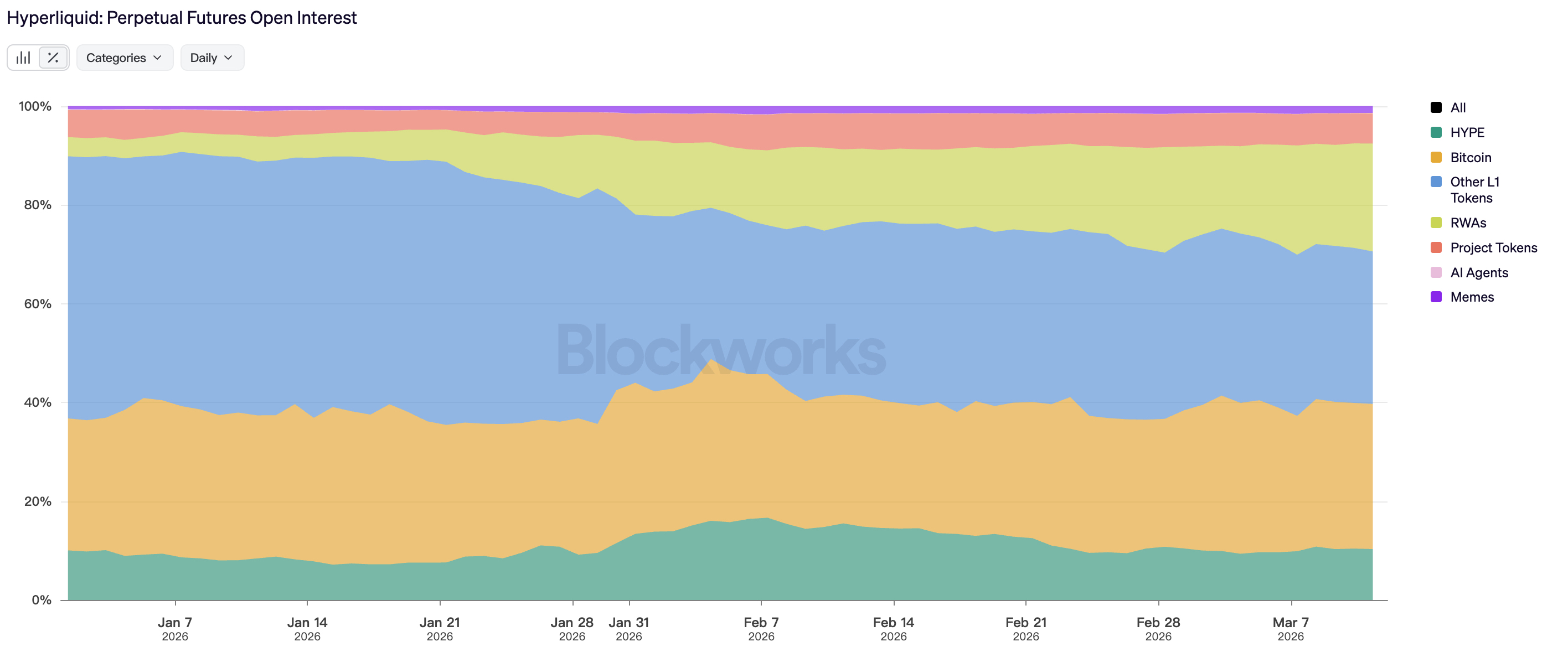
HIP-3 deploys perpetual futures markets for various assets such as commodities and stock indices. Among these traditional assets on HIP-3, WTI crude oil, silver, Brent crude oil, and XYZ100 currently show the most significant demand and activity, with WTI crude oil's daily trading volume accounting for over 35% of the total.

Behind the rapid expansion of trading scale is the influx of a large number of whale players into Hyperliquid, whose global user base has exceeded 1.729 million. Further analysis by Hyperliquid Hub, an ecosystem data analysis service, points out that Hyperliquid's total trading volume has reached a staggering $411 trillion, with the top 100 addresses contributing over $334 trillion, accounting for 81.3% of all trading volume. The top 200 addresses account for almost 98.81%, leaving only about 1.19% of the trading volume for the remaining addresses.
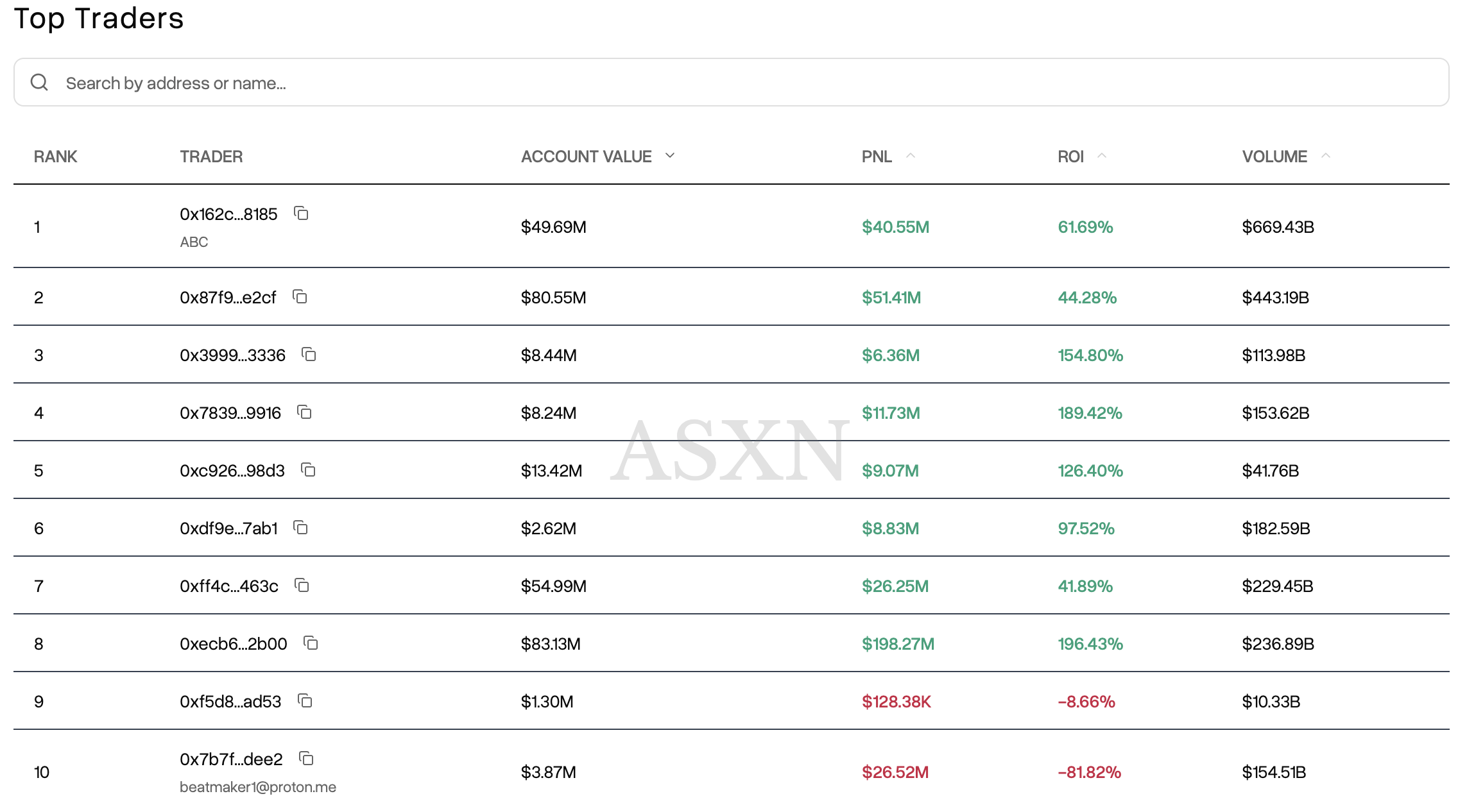
Clearly, Hyperliquid is not a playground for retail investors but is dominated by a small number of well-funded, highly active traders, such as institutions, whales, high-frequency traders, and professional market makers.

Looking further, the number of unique traders on HIP-3 has accumulated to over 1.85 million (Note: the same wallet connecting on different days is counted as two separate wallets), with over 810,000 new traders added in the past month alone, further confirming the demand for tokenized asset trading.
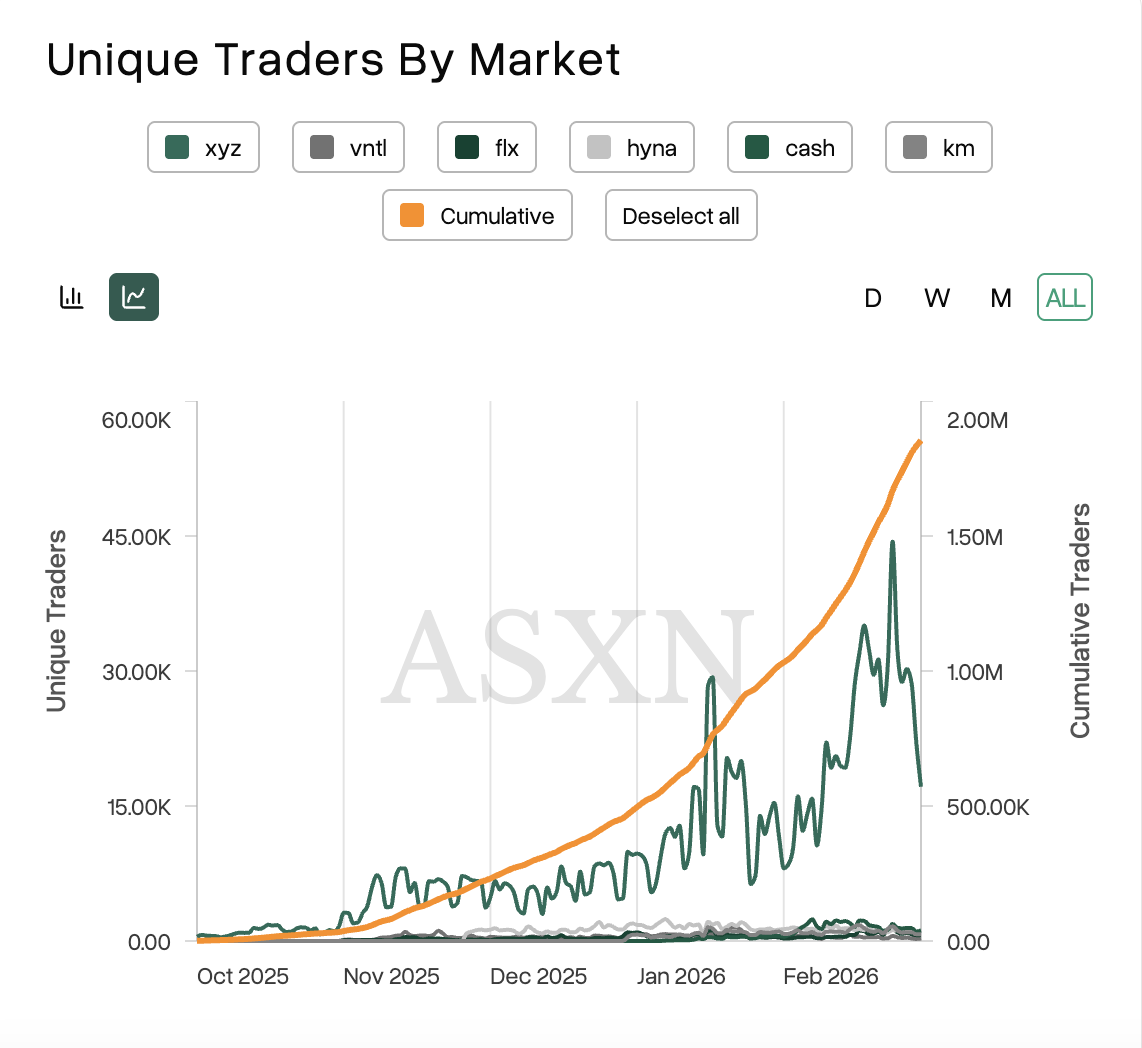
The recent significant growth in HIP-3 business is directly linked to the US-Iran conflict event, making Hyperliquid a new hub for global macro trading. Mainstream media outlets like Bloomberg, Wall Street News, and Fortune, in recent reports, directly referenced Hyperliquid's crude oil contracts as a price reference and pointed out that before the CME (Chicago Mercantile Exchange) opened on Monday, Hyperliquid had already completed price discovery over the weekend, becoming a real-time window for global macro assets.

It is by seizing TradFi pricing power, liquidity vacuums, and macro hedging demand that Hyperliquid has begun to truly "invade" mainstream financial markets.

Matt Hougan, Chief Investment Officer of Bitwise, also stated that the US-Iran event has put the non-stop crypto market in the spotlight. In the past, if a major geopolitical shock occurred on a Sunday morning, investors typically had to wait for the US futures market to open on Sunday at 6 PM (Eastern Time) to understand its impact. Now, they can directly turn to 24/7 on-chain trading platforms to execute trades in real-time. The shift of the financial industry to on-chain is an irreversible trend, like a ball rolling down a hill, unstoppable and far faster than imagined. However, there are still barriers to participating in on-chain markets, including familiarity with wallets, stablecoins, and platforms like Hyperliquid and Uniswap. (Related reading: Beyond Wall Street Time, Traditional Asset Pricing Power Shifts On-Chain)

Faced with this rapidly developing trend of on-chain finance, traditional financial players like Nasdaq and CME have also begun to lay out tokenized trading businesses to seize future market opportunities for themselves.

Crypto Perpetual Futures May Land in the US Next Month, Hyperliquid Faces Compliance Challenges Head-On

Since last year, the Perp DEX market has witnessed a significant explosion in liquidity.

A recent CoinGecko report pointed out that DEX perpetual futures surged to $6.7 trillion in 2025, an increase of about 346% compared to the previous year, while CEX open interest fell by 20.8% during the same period. Behind this trend is the rise of perpetual DEXs like Hyperliquid and Lighter, also reflecting the large-scale migration of funds from CEXs to DEXs.
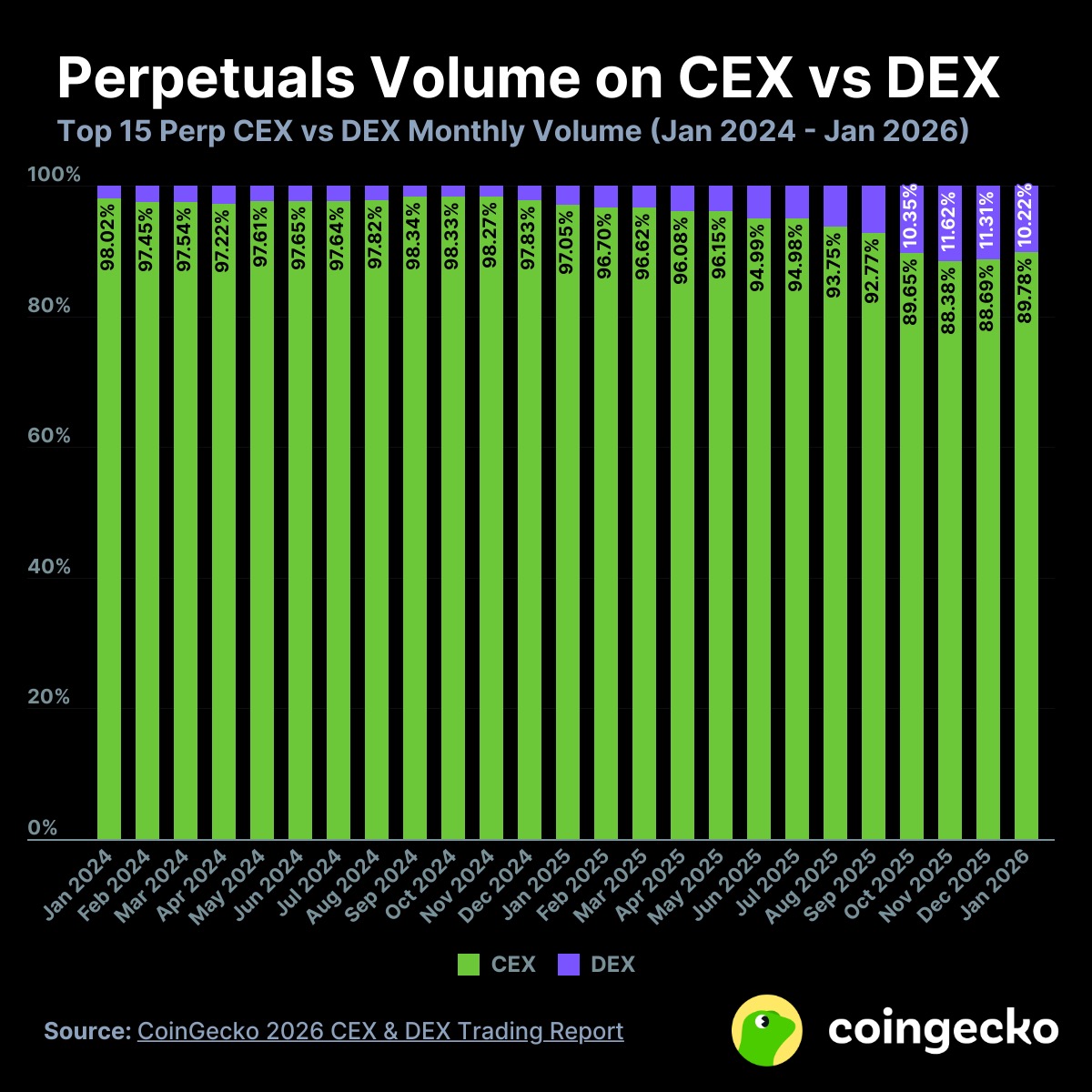
The gradual clarification of the regulatory environment is further amplifying the development space of the perpetual futures market, making more mainstream capital willing to enter this field. Recently, Mike Selig, Chairman of the U.S. Commodity Futures Trading Commission (CFTC), also discussed the regulatory progress of crypto perpetual futures and prediction markets in a public speech. He stated that the CFTC is working to launch true perpetual futures in the US and expects to announce relevant policies in about a month to attract liquidity back to the US while providing investors with more comprehensive protection. Selig also pointed out that in the past, due to regulatory uncertainty, a large amount of liquidity flowed overseas, and the CFTC is cooperating with US SEC Chairman Paul Atkins to advance Project Crypto to coordinate and promote digital asset regulatory reform.

However, regulatory clarity could also lead to another outcome. Once the permissionless, intermediary-free on-chain trading path is broken due to compliance requirements, the core appeal of Perp DEXs may be significantly diminished, and they will directly face competition from compliant crypto platforms and traditional financial institutions.

In fact, for many users, besides factors such as incentive mechanisms, self-custody needs, capital efficiency, and hedging demand, the lack of KYC is also an important reason attracting funds to on-chain trading.

For example, on-chain analyst Eye previously posted that some institutional trading parties active on Hyperliquid showed obvious discomfort after their on-chain trading wallets were identified, even actively contacting the analyst to pressure them to stop disclosing information, often related to the possibility of losing trades being known to the outside world.

If Hyperliquid hopes to be seen as a legitimate participant in the new financial system, it may have to accept and comply with corresponding regulatory rules. Especially in the context of previous controversial cases involving token manipulation and insider trading on the platform, its compliance pressure may further increase.

To address regulatory challenges, Hyperliquid formally established the Hyperliquid Policy Center in Washington, D.C., in February, with veteran crypto lawyer Jake Chervinsky as its first CEO. The center aims to create a legal path for the widespread adoption of DeFi in the US, help Congress and federal agencies understand the underlying technology of DeFi, and provide professional support for regulatory rule-making.

Chervinsky stated that the current regulatory framework was formed in the "analog era" and struggles to encompass new trading forms like decentralized protocols. One of the policy center's primary tasks is to develop a legal framework for perpetual contracts. To support its operation, the affiliated Hyperliquid Foundation has donated 1 million platform native tokens HYPE (currently worth approximately $28 million).

Hyperliquid co-founder Jeff Yan emphasized in a recent interview that he wants the platform to "be used forever," not to fade away quickly with market hype. He also stressed distinguishing Hyperliquid Labs from the Hyperliquid platform and ecosystem, and is committed to building Hyperliquid into a financially neutral platform, providing sustainable infrastructure for the development of on-chain perpetual contracts and decentralized finance.

When DeFi attempts to challenge traditional finance, compliance has become a prerequisite for opening up larger markets. This is not only a test for Hyperliquid but also a reality that other DEXs and even the entire DeFi track must face head-on.


Twitter:https://twitter.com/BitpushNewsCN

Bitpush TG Discussion Group:https://t.me/BitPushCommunity

Bitpush TG Subscription: https://t.me/bitpush

Original link:https://www.bitpush.news/articles/7620373

Perguntas relacionadas

QWhat is Hyperliquid and what role is it playing in the global financial markets according to the article?

AHyperliquid is a decentralized exchange (Perp DEX) that started with crypto derivatives but has expanded to include real-world assets (RWA) like commodities and indices. It is becoming a new infrastructure force in mainstream finance, acting as a global macro trading hub and challenging traditional financial pricing power, especially during events like the US-Iran conflict when it provided real-time price discovery before traditional markets opened.

QHow significant is the trading volume and user concentration on Hyperliquid, and what does it indicate about its user base?

AHyperliquid's monthly trading volume reached $1734.2 billion as of March 16. The platform is dominated by a small number of large players; the top 100 addresses contributed over 81.3% of the total $4.34 trillion in historical trading volume, and the top 200 addresses accounted for nearly 98.81%. This indicates that the platform is primarily used by institutions, whales, high-frequency traders, and professional market makers, not retail散户 investors.

QWhat is HIP-3 on Hyperliquid and which assets are most actively traded within it?

AHIP-3 is a sector on Hyperliquid that deploys perpetual futures markets for various traditional assets like commodities and stock indices. The most active and in-demand assets are WTI crude oil, silver, Brent crude oil, and XYZ100. WTI crude oil alone accounted for over 35% of the daily trading volume in this sector.

QWhat regulatory challenges does Hyperliquid face as it grows, and how is it addressing them?

AHyperliquid faces compliance challenges as decentralized finance (DeFi) innovation clashes with regulatory frameworks. The need for KYC and adherence to rules could diminish its permissionless appeal. To address this, Hyperliquid established the Hyperliquid Policy Center in Washington D.C., led by lawyer Jake Chervinsky, to help create a legal path for DeFi adoption in the U.S. and donated $28 million worth of HYPE tokens to support its operation.

QAccording to the CFTC Chairman, what is the expected timeline for crypto perpetual futures to be officially launched in the U.S., and why is this significant?

ACFTC Chairman Mike Selig stated that he expects policies for 'true crypto perpetual futures' to be unveiled in the U.S. within about a month. This is significant because clearer regulations are expected to attract liquidity back to the U.S. and provide better investor protection, potentially increasing mainstream capital inflow into the perpetual合约 market.

Leituras Relacionadas

Has the 'Digital Gold' Narrative for BTC Failed?

**Title: Has the "Digital Gold" Narrative for Bitcoin Failed?** The article argues that Bitcoin's "digital gold" narrative remains valid despite a recent sharp price decline (from a peak near $126k in Oct 2025 to briefly under $61k in Feb 2026). It presents a long-term investment framework based on three core points: **1. Viewing Bitcoin as an Asset:** Bitcoin is presented as a superior potential store of value compared to gold. Key arguments are its absolute scarcity (21 million cap), superior portability, and transparent auditability via its public ledger. While acknowledging its current use in early, volatile stages (~3-4% global adoption), the author draws parallels to the early, disruptive phases of the internet and e-commerce. **2. Understanding the Recent Downturn:** The current ~50% correction is framed as a predictable, consensus-driven cycle following its post-halving peak (the 2024 halving preceded the Oct 2025 high). A crucial factor is a historic "changing of hands": the influx of new institutional buyers via ETFs allowed early, low-cost holders (miners, OG believers) to take profits. The author notes that while severe, Bitcoin's historical drawdowns (e.g., 93% in 2011, 77% in 2021-22) have been progressively smaller, suggesting maturing holder structure and decreasing volatility over time. **3. The Long-Term Perspective:** The long-term thesis hinges on Bitcoin capturing a portion of gold's market value. With Bitcoin's market cap at ~$1.4 trillion (at $70k) versus gold's ~$20 trillion, significant upside potential exists if the "digital gold" narrative is partially realized. However, the author strongly cautions that short-term risks remain, the bottom is unpredictable, and high volatility is inherent. The real risk is not Bitcoin failing but poor personal position management (over-leverage, wrong capital) and a lack of deep understanding, which can force investors out during severe downturns. The conclusion uses Amazon's 95% crash post-2000 dot-com bubble and subsequent 42x recovery as an analogy. The ultimate question is not if Bitcoin's price will rise, but if an investor's strategy and conviction can withstand the volatility to see the long-term play out. The recent divergence (gold up, Bitcoin down) is posed not as a narrative failure, but as potential evidence of this ongoing, painful transition from a speculative asset to a mainstream allocation.

marsbitHá 9h

Has the 'Digital Gold' Narrative for BTC Failed?

marsbitHá 9h

Has BTC's 'Digital Gold' Narrative Failed?

The article discusses Bitcoin's "digital gold" narrative, its recent price drop, and long-term outlook through the perspective of "Jason". It argues the narrative is not a failure but that Bitcoin represents a superior, new asset class due to its fixed supply (21 million), portability, and auditability. The piece compares its current ~3-4% global adoption rate to early internet/e-commerce, suggesting significant growth potential. Regarding the 2025-2026 price decline (from ~$126k to briefly under $61k), the author views it as a predictable, consensus-driven sell-off within Bitcoin's ~4-year cycle post-halving, exacerbated by a major "handover" from early, low-cost holders to new institutional buyers via ETFs. A key observation is that historical peak-to-trough drawdowns have lessened over time (e.g., 93% in 2011 to ~50% in 2026), indicating maturing volatility as holder structure changes. For the long term, the author uses a simple framework: Bitcoin's total market cap (~$1.4T at $70k) is only about 7% of gold's (~$20T). Even capturing 30-50% of gold's value would imply substantial upside. However, the article strongly cautions against viewing this as investment advice, emphasizing extreme volatility and the critical importance of risk management, position sizing, and deep fundamental understanding to survive severe drawdowns. It concludes by drawing a parallel to Amazon's 95% crash in 2000 and subsequent 42x recovery, stressing that the key is surviving market cycles to realize long-term potential.

链捕手Há 10h

Has BTC's 'Digital Gold' Narrative Failed?

链捕手Há 10h

From Code to Cognition: A Ten-Thousand-Word Guide to the Evolution of the Robot Brain

"From Code to Cognition: The Evolution of Robot Brains" The journey of robotic intelligence has shifted dramatically from manually coded systems to AI-driven brains. For decades, robots relied on layered software stacks—perception, state estimation, planning, control—each handcrafted. While predictable, they lacked adaptability. The 2010s saw deep learning revolutionize perception (e.g., object detection) and control (via reinforcement learning), but learned skills remained narrow. The arrival of Large Language Models (LLMs) marked a turning point. LLMs acted as high-level planners, interpreting natural language instructions and generating sequences of actions for traditional robotic systems to execute. However, true integration came with Visual-Language-Action (VLA) models, which fused vision, language, and motion prediction into a single network. Pioneered by models like RT-2 and open-source projects like OpenVLA, VLAs enable robots to reason and act directly from visual input and commands. The most advanced humanoid robots now employ a "dual-brain" architecture: a slow-thinking, large VLA (System 2) for reasoning and planning, and a fast-reacting, small network (System 1) for high-frequency motion control, sometimes with an even lower-level System 0 for balance. This split balances cognition with the physics of real-time movement. Computation is split between onboard hardware (e.g., NVIDIA Jetson) for safety-critical control loops and cloud/edge servers for non-critical tasks like learning and interfaces. A crucial driver is the open-source ecosystem—models like GR00T and OpenVLA allow startups to build upon pre-trained brains and fine-tune them with their own data, accelerating development. Despite progress, current systems struggle with recovery from errors, sample inefficiency, and long-horizon tasks. This has spurred the rise of **World Models**—neural networks that predict the consequences of actions. By simulating possible futures before acting (like NVIDIA Cosmos or Meta V-JEPA), robots can plan, recover, and generalize better. This represents the next frontier: shifting intelligence from learned reactions to an internal model of physics and cause-and-effect. The field is rapidly evolving. While not yet at its "ChatGPT moment," the convergence of cheaper hardware, scalable simulation, and world models points toward robots that are increasingly capable, adaptive, and useful. The question is shifting from "what can robots do?" to "what *should* they do?"

marsbitHá 10h

From Code to Cognition: A Ten-Thousand-Word Guide to the Evolution of the Robot Brain

marsbitHá 10h

Trading

Spot
Futuros
活动图片





