On-Chain Migration of Precious Metal Assets: WEEX Expands Tokenized Gold and Silver Trading Layout Amid Rising RWA Narrative

marsbitPublicado em 2025-12-31Última atualização em 2025-12-31

Resumo

Amidst global financial market volatility driven by high interest rates and geopolitical uncertainties, gold and silver are gaining renewed attention as stable value assets. This cycle, however, extends beyond traditional finance into the crypto market through the tokenization of real-world assets (RWA). Precious metals tokenization, exemplified by projects like PAX Gold (PAXG), Tether Gold (XAUt), and silver ETF token SLVON, enables 24/7 trading on blockchain. This shift enhances price discovery, liquidity, and accessibility while maintaining 1:1 backing with physical assets. WEEX Exchange has expanded its offerings to include spot and合约 trading for these tokenized metals, positioning itself as a neutral infrastructure provider focused on robust risk management and continuous trading capabilities. The platform emphasizes that RWA integration requires mature technical and operational frameworks to support all-hour markets. Beyond precious metals, this trend signals a broader move toward diversified RWA adoption, with future expansion likely to include more asset types. The focus is shifting from mere on-chain representation to trading depth, liquidity quality, and risk control—key factors in the evolving crypto-traditional finance bridge.

Over the past period, global financial markets have continued to fluctuate in an environment intertwined with high interest rates, geopolitical tensions, and macroeconomic uncertainties. In contrast to the volatility of risk assets, the market has been reassessing stable value assets and real-world asset-anchored targets. Precious metals such as gold and silver, as some of the oldest value storage assets, have once again become a key focus for institutions and investors.

Unlike previous cycles, this wave of attention is not confined to the traditional financial system but is extending into the crypto market. As blockchain infrastructure gradually matures, the tokenization of real-world assets (RWA) is moving from concept to practice, with precious metals being regarded as one of the most representative early adoption scenarios.

From "Holding Physical Gold and Silver" to "On-Chain Mapping," Precious Metals Are Undergoing Structural Changes

In the traditional financial system, precious metal investments have long faced issues such as limited trading hours, fragmented liquidity, and high交割 and custody costs. Even participation through financial instruments like ETFs relies on specific market hours and makes it difficult to manage alongside other assets in a unified manner.

The emergence of precious metal tokenization is not fundamentally about reshaping the attributes of gold and silver but rather about upgrading the trading form and market structure. By anchoring physical gold and silver to on-chain tokens in a 1:1 ratio, these assets can enter the crypto market system, which operates 24/7, showcasing new possibilities in price discovery efficiency, liquidity, and composability.

The emergence of precious metal tokenization does not alter the value attributes of gold and silver but instead incorporates them into the 7×24-hour continuously operating crypto market system through on-chain mapping. This means that precious metal prices are no longer passively reflected during limited trading windows but can continuously undergo price discovery and trading matching in the global market.

Taking the relatively mature tokenized gold projects PAX Gold (PAXG) and Tether Gold (XAUt), currently listed on WEEX Exchange, as examples, their core value does not lie in the "decentralization narrative" but in providing a higher-frequency, more transparent, and more accessible trading form for precious metals. The tokenized silver project SLVON further extends this logic to the precious metal ETF space, enabling traditional financial assets to participate in global trading in digital form.

It is widely believed within the industry that the emergence of such assets represents a relatively low-risk and low-cognitive-cost step in the process of RWA entering the crypto market.

WEEX: Building a Complete 7×24-Hour Trading Scenario for Precious Metal Tokens

As RWA assets gradually enter the on-chain market, the role of trading platforms is also evolving. Platforms are no longer merely "asset listing parties" but need to strike a balance between asset screening, trading structure design, risk control, and user awareness.

WEEX Exchange recently announced the listing of spot and contract trading for tokenized gold PAXG, XAUt, and tokenized silver ETF project SLVON, covering various trading scenarios and providing users with more comprehensive trading options for precious metal assets.

Unlike the listing of a single asset, the core of WEEX's current layout lies in the systematic introduction of stable-value assets and their integration into a 7×24-hour trading system. By combining spot and contract trading, users can not only participate in precious metal price fluctuations at any time but also conduct more flexible risk management and strategy adjustments during market changes.

Ethan, Co-founder and Chief Security Officer of WEEX, stated in a previous public exchange that RWA is not a short-term narrative but a long-term project with extremely high requirements for trading infrastructure. "When real-world assets enter the on-chain market, and trading hours shift from 'limited periods' to '24/7 operation,' platforms need to possess more stable system architectures and more mature risk control mechanisms to sustain the continuous trading demand for such assets."

In his view, trading platforms should play the role of neutral infrastructure providers in the RWA process, rather than merely pursuing the expansion of asset quantities. This also means that when introducing real-world assets like precious metals, platforms need to maintain a balance between liquidity, trading continuity, and risk control.

Starting with Precious Metals, RWA Asset Trading Is Moving Towards Diversification

From a longer-term perspective, precious metal tokenization is not the end goal but rather a "stress test" for RWA assets entering the crypto market. Their trading activity, user participation, and risk performance are providing reference samples for the subsequent onboarding of more real-world assets.

Based on this assessment, WEEX Exchange is simultaneously advancing the construction of a precious metals trading zone and may gradually launch more types of precious metal token projects in the future, expanding the coverage of real-world asset trading.
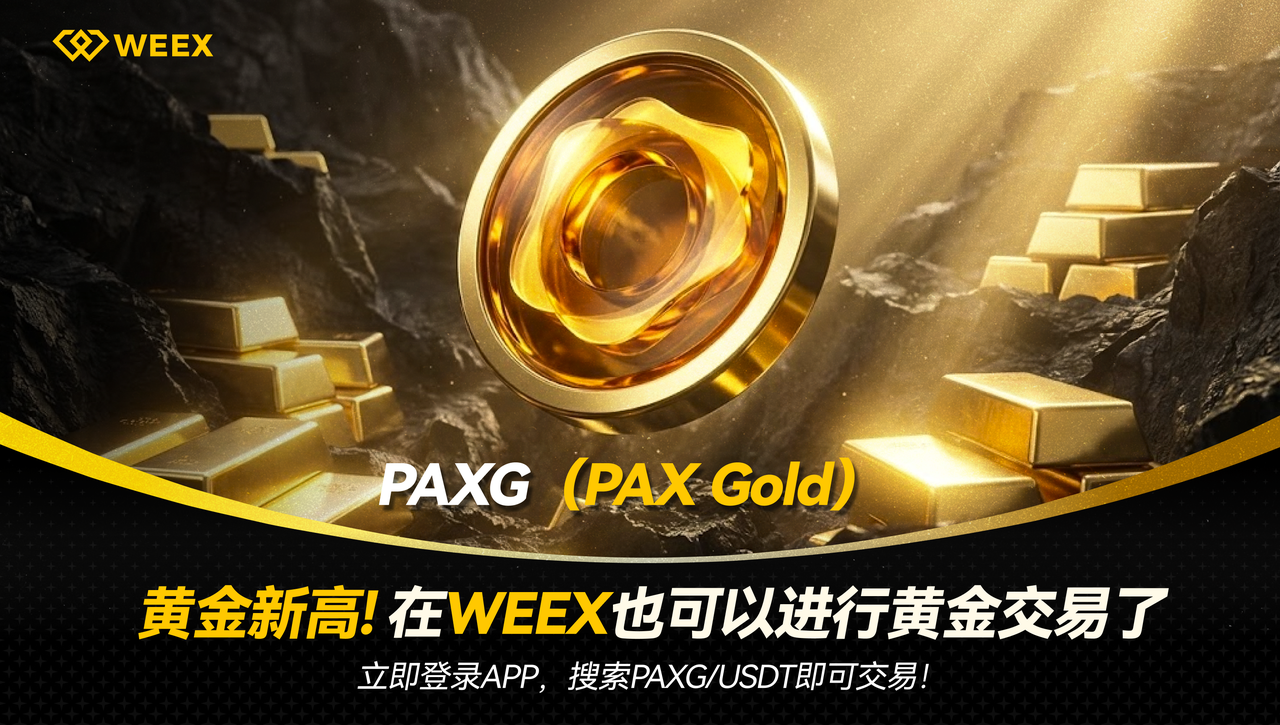
From the industry's perspective, as RWA-related products gradually increase, the market's focus will shift from "whether assets are on-chain" to trading depth, liquidity quality, and risk management capabilities. This also places higher demands on trading platforms.

In the evolving crypto market, tokenized precious metals may represent not a short-term hot asset but a transitional form connecting traditional finance and the crypto market. The infrastructure development围绕 this form is becoming an important direction for the differentiated competition among trading platforms.


Perguntas relacionadas

QWhat is the core value proposition of tokenized gold and silver assets like PAXG, XAUt, and SLVON according to the article?

AThe core value proposition is not about decentralization, but about providing a higher-frequency, more transparent, and more accessible trading form for precious metals, integrating them into a 7x24-hour continuous crypto market system for more efficient price discovery and liquidity.

QHow does the article describe the role of trading platforms like WEEX in the RWA tokenization process?

AThe article states that platforms are evolving from being mere 'asset listing parties' to acting as neutral infrastructure providers. They must balance asset selection, trading structure design, risk control, and user understanding, requiring stable system architecture and mature risk mechanisms to handle continuous trading.

QWhat are the traditional challenges of investing in precious metals that tokenization aims to solve?

ATraditional challenges include limited trading hours, fragmented liquidity, and high costs associated with physical delivery and custody. Even participation through ETFs is restricted to specific market hours and is difficult to manage alongside other assets in a unified way.

QWhat broader trend does the tokenization of precious metals represent beyond just a new asset class?

AIt represents a 'stress test' and a transitional form connecting traditional finance with crypto markets. It is seen as a relatively low-risk, lower-cognitive-cost step for RWA entering the crypto space, paving the way for more diverse real-world assets to be tokenized.

QWhat future developments does the article mention for WEEX's involvement in RWA trading?

AThe article mentions that WEEX is advancing the construction of a precious metals trading zone and may subsequently launch more types of precious metal token projects, gradually expanding the coverage of real-world asset trading on its platform.

Leituras Relacionadas

OpenAI Post-Training Engineer Weng Jiayi Proposes a New Paradigm Hypothesis for Agentic AI

OpenAI engineer Weng Jiayi's "Heuristic Learning" experiments propose a new paradigm for Agentic AI, suggesting that intelligent agents can improve not just by training neural networks, but also by autonomously writing and refining code based on environmental feedback. In the experiment, a coding agent (powered by Codex) was tasked with developing and maintaining a programmatic strategy for the Atari game Breakout. Starting from a basic prompt, the agent iteratively wrote code, ran the game, analyzed logs and video replays to identify failures, and then modified the code. Through this engineering loop of "code-run-debug-update," it evolved a pure Python heuristic strategy that achieved a perfect score of 864 in Breakout and performed competitively with deep reinforcement learning (RL) algorithms in MuJoCo control tasks like Ant and HalfCheetah. This approach, termed Heuristic Learning (HL), contrasts with Deep RL. In HL, experience is captured in readable, modifiable code, tests, logs, and configurations—a software system—rather than being encoded solely into opaque neural network weights. This offers potential advantages in explainability, auditability for safety-critical applications, easier integration of regression tests to combat catastrophic forgetting, and more efficient sample use in early learning stages, as demonstrated in broader tests on 57 Atari games. However, the blog acknowledges clear limitations. Programmatic strategies struggle with tasks requiring long-horizon planning or complex perception (e.g., Montezuma's Revenge), areas where neural networks excel. The future vision is a hybrid architecture: specialized neural networks for fast perception (System 1), HL systems for rules, safety, and local recovery (also System 1), and LLM agents providing high-level feedback and learning from the HL system's data (System 2). The core proposition is that in the era of capable coding agents, a significant portion of an AI's learned experience could be maintained as an auditable, evolving software system.

marsbitHá 3m

OpenAI Post-Training Engineer Weng Jiayi Proposes a New Paradigm Hypothesis for Agentic AI

marsbitHá 3m

Your Claude Will Dream Tonight, Don't Disturb It

This article explores the recent phenomenon of AI companies increasingly using anthropomorphic language—like "thinking," "memory," "hallucination," and now "dreaming"—to describe machine learning processes. Focusing on Anthropic's newly announced "Dreaming" feature for its Claude Agent platform, the piece explains that this function is essentially an automated, offline batch processing of an agent's operational logs. It analyzes past task sessions to identify patterns, optimize future actions, and consolidate learnings into a persistent memory system, akin to a form of reinforcement learning and self-correction. The article draws parallels to similar features in other AI agent systems like Hermes Agent and OpenClaw, which also implement mechanisms for reviewing historical data, extracting reusable "skills," and strengthening long-term memory. It notes a key difference from human dreaming: these AI "dreams" still consume computational resources and user tokens. Further context is provided by discussing the technical challenges of managing AI "memory" or context, highlighting the computational expense of large context windows and innovations like Subquadratic's new model claiming drastically longer contexts. The core critique argues that this strategic use of human-centric vocabulary does more than market products; it subtly reshapes user perception. By framing algorithms with terms associated with consciousness, companies blur the line between tool and autonomous entity. This linguistic shift can influence user expectations, tolerance for errors, and even perceptions of responsibility when systems fail, potentially diverting scrutiny from the companies and engineers behind the technology. The article concludes by speculating that terms like "daydreaming" for predictive task simulation might be next, continuing this trend of embedding the idea of an "inner life" into computational processes.

marsbitHá 5m

Your Claude Will Dream Tonight, Don't Disturb It

marsbitHá 5m

Trading

Spot
Futuros
活动图片




