Odds Of Crypto Market Structure Bill Passing This Year Fall To 40% On Polymarket

bitcoinistPublicado em 2026-02-25Última atualização em 2026-02-25

Resumo

According to prediction market Polymarket, the odds of the crypto market structure bill, the CLARITY Act, passing this year have fallen sharply to 42%. This drop reflects growing skepticism that ongoing high-level negotiations between the crypto industry and banking representatives will reach a breakthrough in time, despite months of discussions at the White House. A key sticking point is draft legislation addressing bank concerns, particularly around crypto rewards programs. A major outcome is that paying yield on idle stablecoin balances is now off the table. The debate has shifted to whether rewards can be tied to specific user activities instead of simple account balances. Market experts suggest that if passed, the bill could significantly impact Bitcoin derivatives markets. It would likely cement the CFTC's authority, potentially leading to more regulated US trading venues and the emergence of CFTC-registered perpetual futures platforms. This clarity could encourage greater institutional participation and reduce discrepancies between spot and futures markets. Furthermore, Bitcoin options markets might see new regulated venues and potentially lower volatility, making strategies like hedging more accessible.

The likelihood that the long‐awaited crypto market structure legislation, known as the CLARITY Act, will become law this year has fallen sharply over the past 24 hours, according to data from prediction platform Polymarket.

Traders now assign the bill a 42% chance of passing in 2026, reflecting growing skepticism that ongoing negotiations between the crypto industry and the banking sector will produce a breakthrough in time.

Crypto And Banks Remain Divided

The drop in confidence comes despite months of high-level discussions at the White House. Lawmakers and industry representatives have been attempting to build consensus around a broader market structure framework.

However, three key White House meetings between crypto firms and banking representatives have yet to yield a final agreement. Even so, public messaging from officials has remained upbeat.
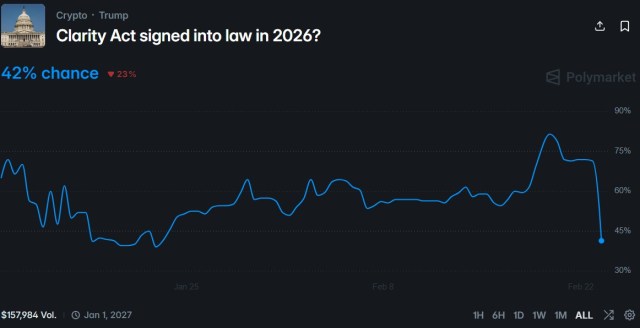
Crypto market structure bill odds of passing drop to 42%. Source: Polymarket

As Bitcoinist reported last week, Patrick Witt, Executive Director of the President’s Council of Advisors for Digital Assets, described the latest round of talks as “a big step forward.” “We’re close,” Witt wrote, adding that if both sides continue negotiating in good faith, he expects the administration’s March 1 deadline to be met.

At the center of the discussions is draft legislative language designed to address concerns raised by banks in a document titled “Yield and Interest Prohibition Principles.”

While the proposed text acknowledges the banking sector’s objections, it also makes clear that any restrictions on crypto rewards programs would be narrowly tailored.

One significant outcome of the negotiations is that paying yield on idle stablecoin balances — a major objective for many crypto firms — is effectively off the table.

Instead, the debate has shifted toward whether companies should be permitted to offer rewards tied to specific user activities rather than simple account balances.

How New Rules Could Change Bitcoin Derivatives Markets

Beyond the political back‐and‐forth, market expert MartyParty recently highlighted potential structural shifts that could follow the bill’s passage, arguing that the changes may be more significant than many investors realize.

In the Bitcoin (BTC) futures market, clearer jurisdictional boundaries would likely cement the Commodity Futures Trading Commission’s (CFTC) authority over digital asset commodities.

The expert believes that could accelerate the growth of regulated US trading venues, similar to CME, and potentially open the door to CFTC‐registered perpetual futures platforms.

According to MartyParty’s analysis, clear commodity classification may also encourage greater institutional participation, particularly from funds that are restricted from investing in assets deemed securities.

Perpetual futures contracts — a crypto‐native product widely used outside the United States — could also evolve. With CFTC registration, US‐based perpetual products might emerge with stronger consumer protections, greater transparency around funding rates, and tighter safeguards against manipulation.

Greater regulatory clarity could also reduce discrepancies between spot and futures markets, narrowing price gaps and stabilizing funding dynamics. At the same time, stricter leverage caps or margin requirements imposed under CFTC rules could limit the extreme levels of retail speculation currently seen on offshore platforms.

Bitcoin options markets would likely experience parallel shifts. The expert asserts that a clearer regulatory framework could encourage the development of additional US‐regulated options venues offering both physically settled and cash‐settled contracts tied to Bitcoin futures.

Reduced enforcement uncertainty may also lower implied volatility premiums, potentially making options more affordable for hedging and speculative strategies.

Institutional investors, in particular, could more confidently deploy advanced strategies — including collars and straddles — if Bitcoin’s commodity status is firmly established.

The 1D chart shows BTC’s price consolidation, currently at around $66,000. Source: BTCUSDT on TradingView.com

Featured image from OpenArt, chart from TradingView.com

Perguntas relacionadas

QAccording to Polymarket, what are the current odds that the CLARITY Act will pass this year?

AThe current odds that the CLARITY Act will pass this year are 42%.

QWhat is the major sticking point in the negotiations between the crypto industry and banks, as mentioned in the article?

AA major sticking point is the debate over whether companies should be permitted to offer rewards tied to specific user activities rather than simple account balances, with paying yield on idle stablecoin balances effectively being off the table.

QWhich US regulatory body is expected to gain clearer authority over digital asset commodities if the bill passes?

AThe Commodity Futures Trading Commission (CFTC) is expected to have its authority over digital asset commodities cemented.

QWhat potential benefit for institutional investors does the expert MartyParty highlight regarding Bitcoin's classification?

AMartyParty highlights that if Bitcoin's commodity status is firmly established, institutional investors could more confidently deploy advanced options strategies like collars and straddles.

QWhat was the public messaging from officials like, despite the lack of a final agreement from the White House meetings?

ADespite the lack of a final agreement, public messaging from officials remained upbeat, with one executive director describing the latest talks as 'a big step forward' and expressing that they are 'close' to a deal.

Leituras Relacionadas

Analyst Forecasts Bitcoin's Movement in August

Analyst Forecasts Bitcoin Movement in August Bitcoin ends July under market caution due to a lack of new macroeconomic catalysts and regulatory uncertainty, according to Bitbanker analyst Andrey Poroshin. He forecasts that in August, BTC may first test the $60,000–$62,000 range before recovering to around $70,000. The analyst notes that the U.S. Federal Reserve's neutral stance provided no strong market signals, with inflation remaining above target. Currently, Bitcoin trades below the U.S. mining cost range of $73,000–$75,000, a key global profitability benchmark, though costs are lower in some countries like Russia. Significant July events include the bankruptcy of derivatives exchange BitMEX, which Poroshin views as a capitulation of weaker market participants, often preceding potential reversal zones. Retail investor activity has declined, with many placing stop orders in the $60,000–$62,000 range, where significant liquidity is concentrated and could be tested. While geopolitical factors like U.S.-Iran tensions are losing market impact, regulatory uncertainty persists as the U.S. CLARITY Act vote was postponed to September. Typically, August sees lower trading activity due to holidays, leading to more technical, less volatile price movements. Poroshin's base scenario for August is a test of $60,000–$62,000 followed by a recovery to $70,000, with more significant moves likely in September post-Fed signals and potential CLARITY Act developments. Separately, a Russian deputy finance minister stated that non-qualified investors in Russia will soon be allowed to legally purchase Bitcoin, Ethereum, and major stablecoins, with an annual limit of 300,000 rubles per intermediary.

cryptonews.ruHá 8m

Analyst Forecasts Bitcoin's Movement in August

cryptonews.ruHá 8m

The Blockchain Industry Enters a Phase of Mass Adoption and Efficiency

In Q2 2026, the blockchain industry demonstrated a divergence between market sentiment and fundamental network growth. While on-chain activity surged, network fee revenues declined due to protocol designs making block space cheaper and more abundant. Ethereum saw institutional staking reach an all-time high of 40.2 million ETH. Despite processing nearly double the transactions per second, its network revenue fell 51% YoY to $64 million, with staker yields driven primarily by consensus rewards. Solana processed nearly 10 billion transactions, but its economic value also dropped to $51 million due to reduced congestion. Notably, its real-world asset (RWA) sector boomed, with tokenized stock trading volume growing 2,479x YoY to $3.32 billion in June 2026. Hyperliquid emerged as an outlier, generating $175 million in revenue with 32% of its $652 billion trading volume from non-crypto markets like commodities. Avalanche saw transaction growth but a sharp drop in fee revenue, while focusing on sovereign L1s for enterprise use. The NEAR Protocol ecosystem shifted from gas-intensive apps to Intents-based trading and introduced a novel feature allowing users to pay for AI services via staked tokens. The Tempo network, backed by Stripe and Paradigm, processed $386 million in stablecoin transfers, including $30 million for contractor payouts by Deel. The report concludes that the industry is transitioning from high-fee speculation to a phase of mass adoption and infrastructure efficiency, where cheap block space fuels transaction growth and institutional entry.

cryptonews.ruHá 9m

The Blockchain Industry Enters a Phase of Mass Adoption and Efficiency

cryptonews.ruHá 9m

Trading

Spot
活动图片