Not Betting on Goals but on 'Tears': Polymarket Users Argue Over Ronaldo's Final World Cup Match

Foresight NewsPublicado em 2026-07-08Última atualização em 2026-07-08

Resumo

Title: Beyond Goals, Betting on Tears: Polymarket Users Clash Over Ronaldo's Emotional World Cup Exit On July 6, Portugal's 0-1 loss to Spain in the World Cup round of 16 marked the final tournament for Cristiano Ronaldo. The 41-year-old star's emotional reaction—red eyes, wiping his face, fighting back tears—was captured globally. Concurrently, a fierce debate erupted on the crypto prediction platform Polymarket over a specific market: "Will Ronaldo cry during the 2026 FIFA World Cup?" The market, with over $23 million in volume, saw its "YES" probability surge to 99% after the match, but the result was disputed and entered a final review phase. The core conflict centered on the market's precise rules: it required "clearly visible tears streaming down [Ronaldo's] face" in photos/videos taken on the field or bench area during Portugal's matches. While major media outlets described Ronaldo as "in tears" and footage showed him emotional, "NO" bettors argued visible tear tracks were not conclusively evident, only red eyes and dampness. Polymarket's official clarification on July 8 stated that eligible evidence existed showing Ronaldo crying with visible tears on his face post-match. The dispute now goes to a UMA oracle community vote for resolution. This incident highlights a recurring challenge for prediction markets: they excel with quantifiable events but can spark major controversies over subjective, visual, or emotional interpretations. It also serves as a reminder for p...


Byline: Ma He, Foresight News


On July 6th, the FIFA World Cup Round of 16 kicked off at AT&T Stadium in Arlington. Portugal narrowly lost 0-1 to Spain, with Mikel Merino heading in the winner during the first minute of stoppage time. This marked the end of the sixth and final World Cup for 41-year-old Cristiano Ronaldo (Ronaldo). Ronaldo was visibly emotional—images of his red eyes, wiping his face, and fighting back tears were captured by global media and widely circulated.


Simultaneously, in the crypto prediction market, people were fiercely debating whether he actually cried or not.
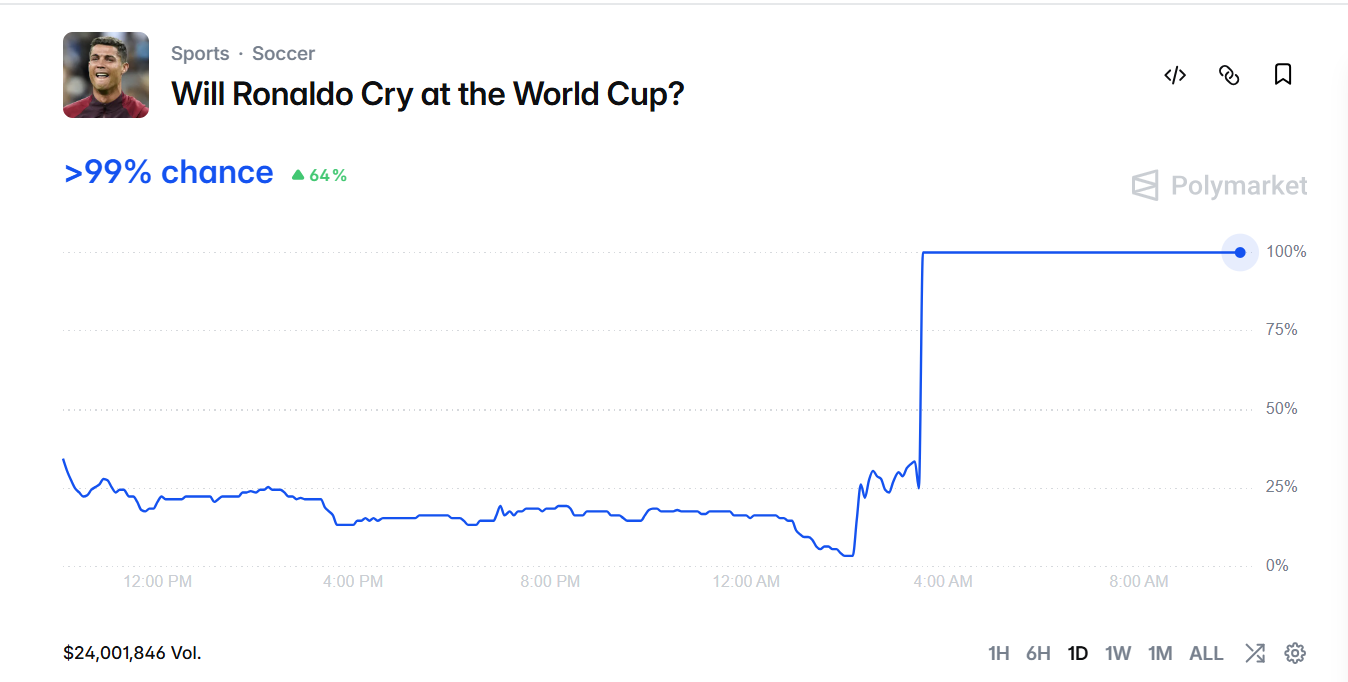


In June this year, Polymarket launched a prediction market on whether Ronaldo would cry during the World Cup, once again becoming a focal point. Its total trading volume has reached $23.94 million. On the evening of July 6th, the market price indicated a 15% probability for Yes, with No dominating. However, the result was twice proposed as "No," leading to a dispute. On July 8th, the probability for Yes suddenly surged to over 99%, with the final review period remaining about 1 day.


YES holders and NO holders argued fiercely: the core disagreement centered on whether it was "clearly crying" and if it met the rule requirement of clearly visible tears rolling down the face.


So, what exactly are the specific rules stated on Polymarket?


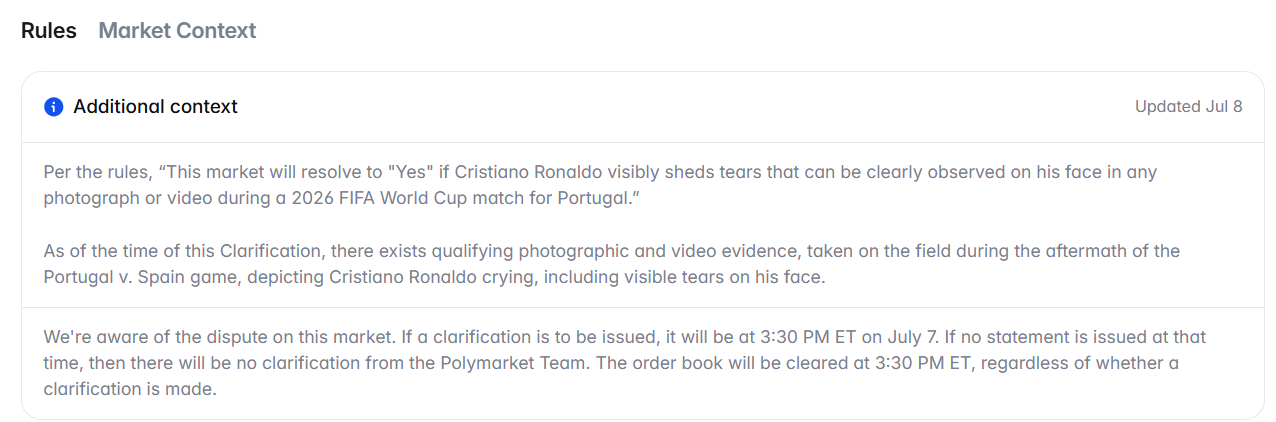
The rules are as follows: This market will resolve to Yes if, in any photograph or video from the 2026 FIFA World Cup while Ronaldo is representing Portugal, clearly visible tears are seen rolling down his face. Otherwise, it will resolve to No. "Crying" must occur while Ronaldo is on the field or in the technical/substitute bench area; crying in the locker room or other areas does not count. Crying may occur before, during, or after a match. Otherwise, this market will resolve to "No."


Therefore, the key issue returns to two core questions: whether Ronaldo's tears were clearly visible and where he was when crying.


Ronaldo's Final Match


There is no dispute about his red eyes on the pitch.


Multiple authoritative media outlets described Ronaldo's reaction immediately after the match. U.S. ESPN, the UK's The Independent, among others, consistently used phrases like "in tears," "tearful," "bursts into tears," and "emotional with tears in his eyes." Broadcasters like FOX Sports released post-match emotional reaction compilations, with fans and reporters capturing moments of Ronaldo's red eyes, wiping his face, and grim expressions in the stands and mixed zone.



These images were not from private areas but occurred in public spaces like the pitch, near the substitute bench, or the player tunnel, meeting the time and location requirements of "before, during, or after the match, on the field or in the technical/substitute bench area" per Polymarket rules. The images and videos are authentic on-site captures, with no suspicion of post-production, AI, or old footage.


On Xiaohongshu, topics related to Ronaldo's eyes welling up with tears once trended on the hot topics list.
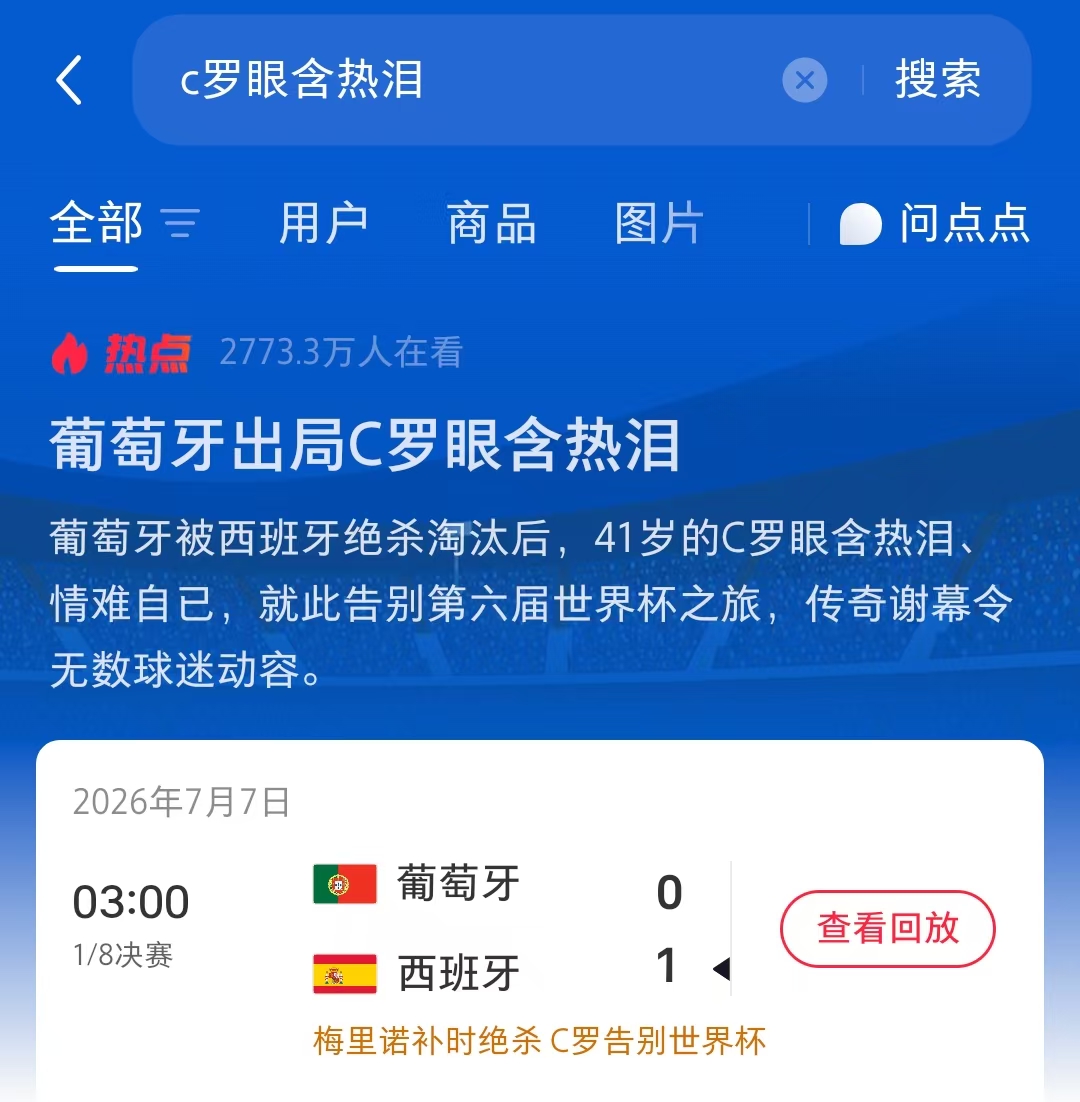


Upon examining video clips on Xiaohongshu, the author observed that his eyes indeed contained some tears, but it was impossible to clearly determine whether those tears noticeably rolled down his face.



And this is precisely the focal point of the ongoing dispute on Polymarket.


The Controversy Erupts


The YES side argues that multiple high-definition photos and videos show Ronaldo's moist eyes, glistening tears, and wiping his face with his hand or sleeve. Global mainstream media reports and the photos/videos themselves are proof.


The NO side contends that the rules require a distinct teardrop rolling down the face, not just red eyes or suppressed tears. Some holders believe the available footage requires zooming in to barely discern, failing to meet the "clearly observable" detail.


Currently, the market has twice been proposed to resolve as No, both times met with protests, and has entered final review to be decided by a UMA oracle community vote—this is Polymarket's standard mechanism for handling disputes. However, oracle community votes often heavily favor large holders, making retail traders mere rule-takers.


This market once again proves: prediction markets are extremely efficient for quantifiable, verifiable events, but in scenarios involving subjective visual judgments and subtle emotional distinctions, they are prone to massive controversy.


On July 8th, the platform added a detailed clarification: As of the time of this clarification, photo and video evidence meeting the conditions exists. This evidence was captured on the pitch after the Portugal vs. Spain match, showing Cristiano Ronaldo crying with visible tears on his face.


Similar controversies have played out multiple times in Polymarket's history. Recently, a prediction market on MicroStrategy selling Bitcoin also sparked significant controversy. While MicroStrategy did sell 32 BTC before May 31st, because the 8-K filing was issued on June 1st, Polymarket forcibly introduced a supplemental interpretation to resolve as NO, leading to widespread online outcry of "PolyScam."


This also reminds participants: when betting on emotional or visual events, one must carefully study the literal meaning of the rules, not just rely on public perception or media headlines.


Perhaps for Polymarket, the greater the controversy and the more irreconcilable the conflict, the higher the platform's trading volume, fees, and exposure on social media. The platform likely has no desire for airtight rules; gray areas with loopholes serve as bait to attract massive long and short capital to gamble. The platform pockets hefty fees, UMA gains governance relevance, while only the retail traders on both sides are left fighting in the ruins over whether a single tear rolled down a cheek.

Perguntas relacionadas

QAccording to the article, what is the core issue that users on Polymarket are arguing about regarding Cristiano Ronaldo after Portugal's World Cup exit?

AThe core argument is whether Cristiano Ronaldo visibly shed tears on his face, as defined by the specific market rules, or merely had watery/red eyes and an emotional reaction.

QWhat are the specific location and visibility requirements set by the Polymarket rules for the 'C罗是否会在世界杯上哭' (Will Ronaldo cry at the World Cup) market?

AThe rules state that for the market to resolve to 'Yes,' clear and visible tears must be seen rolling down Ronaldo's face in any photo or video. This must occur while he is on the field or in the substitute bench area during, before, or after a Portugal match at the 2026 FIFA World Cup. Crying in locker rooms or other areas does not count.

QHow did the probability for 'Yes' in the Polymarket prediction change around the time of Portugal's match, and what mechanism is being used to resolve the final dispute?

AOn July 6th, the 'Yes' probability was around 15%. After the match, it was initially proposed as 'No' twice, causing disputes. By July 8th, the 'Yes' probability surged to over 99%. The final dispute resolution is being handled through a final review and a community vote by the UMA oracle.

QWhat point did the author make by referencing a past Polymarket event involving MicroStrategy's Bitcoin sales?

AThe author referenced the MicroStrategy event to illustrate that Polymarket has a history of controversial resolutions. In that case, although the action (selling Bitcoin) happened within the market's timeframe, a technicality regarding the official filing date led to a 'No' resolution, causing user backlash. This highlights the importance of scrutinizing the literal rules over general perception.

QWhat is the article's implied criticism regarding how Polymarket potentially benefits from markets with ambiguous rules?

AThe article implies that Polymarket may benefit from ambiguous or 'grey area' rules because they generate greater controversy, which in turn drives higher trading volumes, fees, and social media exposure for the platform, while leaving retail traders to fight over the subjective outcomes.

Leituras Relacionadas

Bernstein Analysis: Can the $142 Billion Long-Term Order Hold Up the Memory Cycle?

Bernstein revisits long-term agreements (LTAs) in the memory industry, highlighting new contracts with purchase commitments, minimum prices, and financial guarantees signed by Micron and SanDisk. These aim to provide an earnings floor for the coming years. Micron has 16 strategic customer agreements, with 14 representing approximately $100 billion in minimum revenue and about $22 billion in cash deposits/commitments. SanDisk has contracts for around $42 billion in minimum revenue and over $11 billion in guarantees. Combined, these ~$33 billion in guarantees make it more costly for major clients to walk away. However, Bernstein models that the potential revenue needing protection over 3-5 years is around $5.2 trillion. The existing guarantees thus cover only about 0.6% of that scale. While LTAs provide a cushion, they cannot fully shield profits in a severe downturn, as clients may still find it cheaper to breach contracts if spot prices fall deeply below floor prices. LTAs are most suitable for large, credit-worthy customers like U.S. cloud service providers with stable, high-volume AI infrastructure needs. Consumer segments (phones, PCs) and some Chinese clients are less likely to adopt them, leaving an estimated 30-50% of the DRAM/NAND market exposed to spot price volatility. AI demand (e.g., HBM for training, storage for inference) supports higher valuations and makes LTAs more attractive for locking in high-demand customers. Yet, Bernstein stresses that LTAs soften, but do not eliminate, the memory cycle. Their true test will come in the next downturn, revealing whether clients honor contracts and whether guarantees provide sufficient pain to maintain supplier discipline.

marsbitHá 5m

Bernstein Analysis: Can the $142 Billion Long-Term Order Hold Up the Memory Cycle?

marsbitHá 5m

Dialogue with Jia Hang | Looking Back at Two Decades of Chinese Payment Going Global

**Summary: A Conversation with Jia Hang on Two Decades of China's Payment Globalization** Jia Hang, a veteran with over twenty years in payments, reflects on China's attempts to build a global payment network through three key phases: UnionPay (card networks), Alipay+ (digital wallets), and now, stablecoins. His journey began at UnionPay International, aiming to establish China's card network abroad. While successful in following Chinese tourists ("where Chinese go, UnionPay goes"), it struggled to achieve true global scale. The core lesson: card networks like Visa/Mastercard's unassailable advantage isn't just technical standards, but their deeply entrenched **governance and profit-sharing models** that create powerful network effects. Competing as the "same species" is nearly impossible. At Ant Group, he led Alipay+, a strategy to bypass card networks by interconnecting local e-wallets worldwide. While innovative, it faced a similar ceiling. Mobile QR payments and card swipes were essentially **the same species competing for the same pie**, lacking a disruptive value proposition for users or a sustainable new incentive model to replace the card networks' established flywheel. Today, at Singapore's DCS, Jia focuses on stablecoin-based payments. He argues stablecoins represent a fundamental shift. They are not competing with Visa for consumer payments but challenging the **traditional banking and account system for value movement**. Products like "U Cards" (stablecoin-linked payment cards) are transitional, leveraging existing card networks for acceptance while building new rails. The real potential lies in stablecoins enabling seamless, low-cost global value transfer, potentially reorganizing the financial infrastructure around **accounts rather than cards**. Jia believes stablecoin adoption for local retail payments, cross-border transactions, and as high-yield savings vehicles is becoming irreversible. This could gradually reduce reliance on traditional fiat channels, especially in regions with weak currencies or capital controls. The quest for the "next global payment network" continues, now centered on whether stablecoins can successfully bridge Web2 and Web3, establish new governance, and create compelling user value beyond mere cost reduction.

marsbitHá 28m

Dialogue with Jia Hang | Looking Back at Two Decades of Chinese Payment Going Global

marsbitHá 28m

Circle's Stock Price Plunges 76%, Hong Kong Dollar Stablecoin Set to Launch Within Two Weeks

Circle's stock price has plunged approximately 76% from its 2023 peak, reflecting a major market revaluation. Despite this, Circle President Heath Tarbert emphasized the company's focus on long-term execution and its dominant position with USDC's $73 billion circulation across 34 blockchains. The competitive landscape is intensifying. A new consortium-backed stablecoin, Open USD, is attempting to challenge incumbents by sharing reserve yields with partners. More significantly, Visa's new stablecoin platform, initially supporting Open USD while also being compatible with USDC, could erode Circle's network effects. In response, Circle is expanding into real-world payments through partnerships like the one with Japan's JCB. Separately, Tether (USDT) faces a two-year compliance window under new U.S. regulations, requiring it to adjust its reserve composition away from assets like Bitcoin and loans towards cash and U.S. Treasuries. Meanwhile, in Hong Kong, Standard Chartered-backed fintech firm Dian Dian is poised to launch a licensed HKD-pegged stablecoin (HKDAP), moving the industry into a phase where the real test is integrating licensed stablecoins into actual payment flows and corporate treasury systems. The sharp decline in Circle's stock underscores a broader shift: the stablecoin market is moving from a winner-takes-all dynamic to a multi-player competitive arena where execution, compliance, and real-world utility are becoming paramount.

marsbitHá 29m

Circle's Stock Price Plunges 76%, Hong Kong Dollar Stablecoin Set to Launch Within Two Weeks

marsbitHá 29m

Trading

Spot
活动图片