Not AI, Not War: Should the US Stock Market Be Most Concerned About Japan?

链捕手Publicado em 2026-07-24Última atualização em 2026-07-24

Resumo

The article warns that global markets may be underestimating a systemic risk from Japan, centered on the potential for its Government Pension Investment Fund (GPIF) to repatriate capital. With JPY at multi-decade lows and improving domestic investment appeal, political pressure is growing for GPIF—managing $1.8 trillion—to shift more assets home. Such a move, involving reallocating part of its ~$930 billion in overseas holdings, could boost demand for JPY and Japanese government bonds while pressuring US Treasuries (raising yields), weakening the USD, and weighing on risk assets like US stocks. A concurrent unwinding of yen carry trades could amplify the pressure. While markets currently price in little immediate risk, technical signals like the narrow USD/JPY cross-currency basis warrant attention. Conversely, the shift could benefit Japanese equities, which trade at a discount and are driven by corporate governance reforms rather than AI hype, though persistent JPY weakness remains a headwind for foreign investors.

Author: Zhao Ying

The global market is underestimating a potential systemic risk—Japan. As the yen falls to multi-decade lows and the attractiveness of Japanese domestic assets rises, the world's largest pension fund is facing policy pressure to repatriate assets on a massive scale. Once this process begins, the US stock market, bond market, and the US dollar could simultaneously face pressure.

Recently, Japanese Prime Minister Takaichi Sanae stated that the government will encourage the Government Pension Investment Fund (GPIF) and other national pension funds to increase investment in Japan's domestic financial assets. Finance Minister Katayama Satsuki had previously signaled similar intentions. Although GPIF has not announced any formal asset allocation adjustments, the market has begun to assess its potential impact: if the fund repatriates its overseas holdings, US Treasury yields could rise, the US dollar could weaken, and risk assets could come under pressure.

Currently, the market's pricing for the above risks remains relatively calm, but some technical indicators are already showing subtle changes. Investors should not be complacent.

The $1.8 Trillion Variable

GPIF manages about $1.8 trillion, with domestic and foreign assets each accounting for roughly half. Its overseas holdings total about $930 billion. In recent years, the fund's holdings of Japanese government bonds have decreased from about $770 billion to about $515 billion, while its holdings of foreign bonds have increased from about $128 billion to about $470 billion.

This structural change means that even a modest asset reallocation could trigger significant volatility in global markets. According to MarketWatch, analyst Michael Kramer points out that if GPIF repatriates some overseas assets, it would directly boost demand for the yen and introduce large-scale buying into the Japanese government bond market—a positive for Japan, but implying higher interest rates and a weaker dollar for the US.

At the same time, a large-scale unwinding of yen carry trades (borrowing low-interest yen, converting to dollars, and investing in US assets) would further weigh on the performance of risk assets.

Yen and JGBs: Rising Attractiveness of Domestic Assets

Driving GPIF's potential reallocation is a substantial improvement in the fundamentals of Japanese domestic assets. As Japan's inflation recovers and economic growth resumes, the appeal of domestic investment opportunities has increased significantly. In February of this year, the spread between US and Japanese two-year government bond yields narrowed to its lowest level since early 2022.

At the same time, the yen continues to weaken, with USD/JPY breaking above 163, reaching its highest level since 1986. From a technical analysis perspective, if the exchange rate rises further, the next resistance level is around 176. According to the Financial Times, Fredrik Repton of Neuberger Berman believes that if GPIF allocates more funds to domestic assets, it could be a "very elegant solution" to Japan's macro problems, but other domestic financial institutions would also need to follow suit, and "this process would take a very long time."
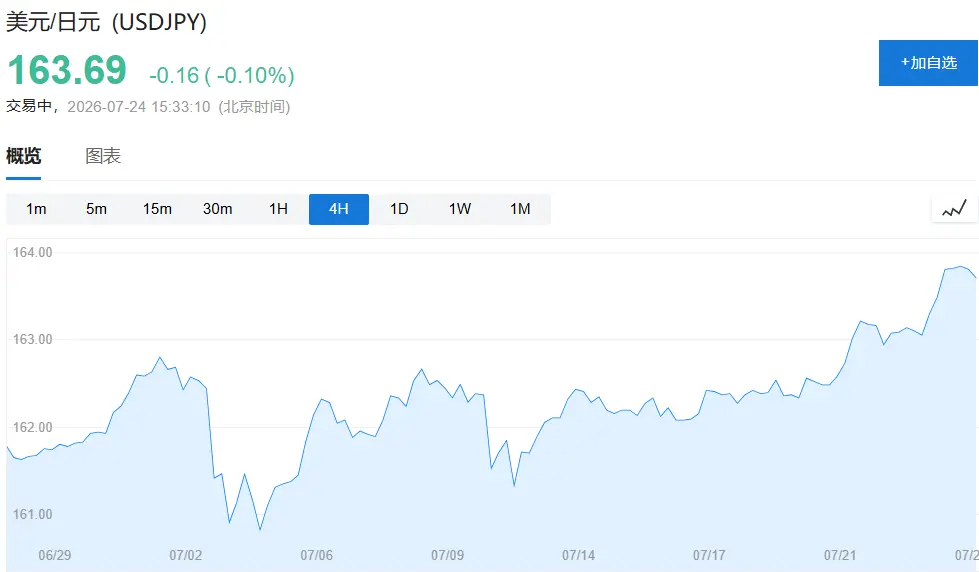
Japan's 10-year government bond yield recently touched 2.7%, the first time in 30 years. Deutsche Bank analyst Mallika Sachdeva noted in a recent report that the focus of Japanese authorities' policy may be shifting from exchange rate management to yield management. If this shift materializes, it would put further pressure on the yen.

The Market Hasn't Priced It In, But Signals Are Emerging

Currently, the global market's reaction to the risk of Japanese capital repatriation remains relatively restrained. The five-year USD/JPY cross-currency basis swap recently stood at around minus 30 basis points, the narrowest level since the data series began in 2021, indicating that the market's demand to hedge against yen appreciation has not risen significantly.

However, this indicator itself is a key signal for observing whether capital flows are beginning to shift. Historical data shows that the S&P 500 index and cross-currency basis swaps have moved in tandem during multiple periods—when hedging demand rises sharply, US stocks often fall as liquidity tightens. Once market expectations for yen appreciation heat up, demand for dollar hedging will climb, and the liquidity tightening effect will become more pronounced.

Japanese Stocks: The Other Side of the Risk

It is worth noting that GPIF's potential asset reallocation, while bringing pressure to the US market, also provides a new narrative for Japanese stocks. The Japanese stock market is benefiting from drivers quite different from those in the US market: the concentration of the technology sector in the Topix index is much lower than in the S&P 500, its exposure to artificial intelligence is relatively limited, and its valuation still trades at a discount of over 20% compared to the S&P 500.

Corporate governance reform is a core catalyst for Japanese stocks. Dan Rasmussen of Verdad Advisers points out that there are still about 1,000 companies in Japan whose stock prices are below book value. Among the cheapest one-fifth of companies, cross-shareholdings still account for about 40% of their market value. As cross-shareholdings are gradually unwound, a large amount of historically accumulated profits is expected to be released, providing a substantive positive impact on corporate earnings.

However, for foreign investors, the persistently weak yen is the biggest obstacle—yen depreciation over the past two years has significantly eroded the real returns for foreign capital in Japanese stocks. How to handle currency hedging, and whether the cost of hedging is bearable, remain core issues facing global investors.


Criptomoedas em alta

Perguntas relacionadas

QAccording to the article, what is the potential systemic risk that global markets might be underestimating?

AThe article suggests that global markets are underestimating the potential systemic risk posed by Japan, specifically the possibility of massive capital repatriation by Japan's Government Pension Investment Fund (GPIF) back to domestic assets.

QWhat could be the impact on the US if Japan's GPIF reallocates its assets back to Japan?

AIf GPIF reallocates assets from overseas back to Japan, it could lead to higher U.S. Treasury yields, a weaker U.S. dollar, and put pressure on U.S. risk assets like stocks.

QWhat is the approximate size of Japan's GPIF and its overseas holdings?

AJapan's GPIF manages approximately $1.8 trillion. Its overseas holdings total around $930 billion, which is roughly half of its total assets.

QWhat are the two key factors that are increasing the attractiveness of Japanese domestic assets, according to the article?

AThe two key factors are: 1) The recovery of inflation and economic growth in Japan, and 2) The substantial depreciation of the yen to multi-decade lows against the dollar.

QWhat is a major obstacle for foreign investors in the Japanese stock market despite positive domestic catalysts?

AA major obstacle is the persistent weakness of the Japanese yen (JPY), which has significantly eroded the real returns for foreign investors in Japanese stocks over the past two years, raising concerns about the cost and feasibility of currency hedging.

Leituras Relacionadas

The Verdict in Choi Tae-won's Divorce Case: Revealing the Inheritance Undercurrent Behind SK Hynix's Trillion-Won Empire

SK Group Chairman Chey Tae-won's high-profile divorce case, involving a record 1.38 trillion won settlement, has drawn attention to the succession plans for Korea's second-largest conglomerate, especially its crown jewel, SK hynix. Unlike traditional chaebol scripts centered on the eldest son, Chey's three children from his marriage to former President Roh Tae-woo's daughter, Roh Soh-yeong, are carving distinct, non-traditional paths. Eldest daughter Chey Yun-jung (b. 1989) is seen as the most evident successor. With a scientific and consulting background, she holds executive roles at SK bioscience and SK Inc.'s growth support department, focusing on future strategy and biopharma. Her marriage is to an AI infrastructure entrepreneur, not a traditional business alliance. Second daughter Chey Min-jung (b. 1991) took a unique route, voluntarily serving as a South Korean naval officer, including an anti-piracy deployment. She later worked on policy and strategy for SK hynix in Washington D.C. before co-founding an AI-driven healthcare startup. She married a former U.S. Marine Corps officer, connecting her to U.S. defense and policy circles—networks crucial for a global semiconductor giant. The only son, Chey In-geun (b. 1995), who studied physics like his father, worked briefly at SK E&S before joining McKinsey. Despite fitting the traditional "heir" profile as the eldest son, he remains silent and holds no public position or shares in SK, suggesting the old succession playbook is obsolete. As SK hynix's valuation soars, becoming a geopolitical asset in the AI era, the heirs' legitimacy is no longer automatic. They must prove themselves in fields like AI biotech, global policy, and strategic consulting. Their marriages also reflect new elite networks in tech and defense, not old political alliances. Their inheritance is the complex challenge of navigating a globalized, tech-driven world, not just a corporate throne.

marsbitHá 5h

The Verdict in Choi Tae-won's Divorce Case: Revealing the Inheritance Undercurrent Behind SK Hynix's Trillion-Won Empire

marsbitHá 5h

From OpenSea to OpenRouter: Is Alex Atallah Repeating His 'Exit at the Peak' Playbook?

From OpenSea to OpenRouter: Is Alex Atallah Repeating His "Exit at the Peak" Playbook? According to the Wall Street Journal, payments giant Stripe is in talks to acquire the AI model aggregation platform OpenRouter in a potential deal valuing the company near $100 billion. This would mark founder Alex Atallah's second creation of a company reaching a $100 billion valuation, following his co-founding of NFT marketplace OpenSea. OpenRouter, founded just over three years ago, has grown rapidly by acting as a unified gateway for developers to access over 400 AI models. It currently has about 10 million users and processes over 200 trillion tokens monthly. While the platform's annualized revenue is around $50 million, its valuation has skyrocketed from $1.3 billion in March 2026. The potential acquisition by Stripe, a company OpenRouter's founder once likened it to, represents a major expansion into AI infrastructure for the payments leader. This move echoes Atallah's previous timing with OpenSea, where he departed before the NFT market's significant downturn. For OpenRouter, selling now may be strategic. Despite its scale, its business model—charging a 5-5.5% fee on AI inference calls—faces pressure from competition, open-source models, and potential price wars among model providers, limiting its profitability narrative for an IPO. A key asset for potential acquirers like Stripe is OpenRouter's vast repository of real-world AI usage data, which offers unique insights into model performance and developer preferences that are difficult to replicate. Whether this potential deal signifies a new valuation benchmark for AI infrastructure or another market peak signal remains to be seen.

链捕手Há 5h

From OpenSea to OpenRouter: Is Alex Atallah Repeating His 'Exit at the Peak' Playbook?

链捕手Há 5h

Trading

Spot

Artigos em Destaque

Como comprar WAR

Bem-vindo à HTX.com!Tornámos a compra de WAR (WAR) simples e conveniente.Segue o nosso guia passo a passo para iniciar a tua jornada no mundo das criptos.Passo 1: cria a tua conta HTXUtiliza o teu e-mail ou número de telefone para te inscreveres numa conta gratuita na HTX.Desfruta de um processo de inscrição sem complicações e desbloqueia todas as funcionalidades.Obter a minha contaPasso 2: vai para Comprar Cripto e escolhe o teu método de pagamentoCartão de crédito/débito: usa o teu visa ou mastercard para comprar WAR (WAR) instantaneamente.Saldo: usa os fundos da tua conta HTX para transacionar sem problemas.Terceiros: adicionamos métodos de pagamento populares, como Google Pay e Apple Pay, para aumentar a conveniência.P2P: transaciona diretamente com outros utilizadores na HTX.Mercado de balcão (OTC): oferecemos serviços personalizados e taxas de câmbio competitivas para os traders.Passo 3: armazena teu WAR (WAR)Depois de comprar o teu WAR (WAR), armazena-o na tua conta HTX.Alternativamente, podes enviá-lo para outro lugar através de transferência blockchain ou usá-lo para transacionar outras criptomoedas.Passo 4: transaciona WAR (WAR)Transaciona facilmente WAR (WAR) no mercado à vista da HTX.Acede simplesmente à tua conta, seleciona o teu par de trading, executa as tuas transações e monitoriza em tempo real.Oferecemos uma experiência de fácil utilização tanto para principiantes como para traders experientes.

168 Visualizações TotaisPublicado em {updateTime}Atualizado em 2026.06.02

Como comprar WAR

Discussões

Bem-vindo à Comunidade HTX. Aqui, pode manter-se informado sobre os mais recentes desenvolvimentos da plataforma e obter acesso a análises profissionais de mercado. As opiniões dos utilizadores sobre o preço de WAR (WAR) são apresentadas abaixo.

活动图片