Not A Threat: Stablecoin Yield Won’t Harm Banks, White House Economists Say

bitcoinistPublicado em 2026-04-09Última atualização em 2026-04-09

Resumo

In a positive development for crypto, a White House economic study by the Council of Economic Advisers (CEA) concludes that prohibiting stablecoin yield would have a negligible impact on bank lending, particularly for community banks. The study, addressing a key debate around bills like the GENIUS Act, found that eliminating yield would boost overall bank lending by only $2.1 billion, a mere 0.02% increase. Even under worst-case assumptions requiring implausible conditions like a sixfold growth in stablecoins, the increase would be moderate. The report contradicts banking industry claims that yield-bearing stablecoins could trigger massive deposit flight, arguing a yield prohibition would do little to protect lending while denying consumers competitive returns. It also highlights that regulatory uncertainty harms banks more than the crypto industry, as it prevents investment in new technology.

In a positive development for the crypto industry, a recent study by White House economists affirmed that stablecoin yield won’t harm community banks, and its prohibition won’t have a meaningful impact on overall lending in the banking system.

Stablecoin Yield Is Not A Threat

On Wednesday, the Council of Economic Advisers (CEA) released the highly anticipated study on a key issue that has become a major point of contention between the banking and crypto industries over the past few months: stablecoin yield and its potential impact on deposit flight and bank lending.

For context, the landmark crypto legislation, the GENIUS Act, requires issuers to maintain reserves backing outstanding stablecoins on a one-to-one basis and to hold these reserves in certain assets, including US dollars, Federal Reserve notes, and short-term US Treasuries.

The bill also introduced key restrictions that prohibit issuers from offering any form of interest or yield to stablecoin holders. The banking industry has urged US lawmakers to extend the prohibition to digital asset exchanges, brokers, dealers, and related entities, which has led to prolonged debate and delay of the crypto market structure bill, also known as the CLARITY Act.

While some analysts estimate that the effect of lending in the trillions of dollars, the CEA report found that eliminating stablecoin yield would only boost bank lending by $2.1 billion, equivalent to a 0.02% increase.

Large banks would conduct 76% of this additional lending, while community banks—which have assets below $10 billion—would lend the remaining 24%. In our baseline, that adds up to $500 million in additional lending from community banks, meaning their lending rising by 0.026%.

As they noted, even under the worst-case assumptions, the CEA’s model produced only $521 billion in additional aggregate lending, corresponding to a 4.4% increase in bank loans as of Q4 2025.

Moreover, that figure would require the stablecoin market to grow sixfold as a share of deposits, all reserves to be locked in unlendable cash instead of US treasuries, and the Federal Reserve (Fed) to “abandon its current monetary framework.”

“Even under those implausible conditions, community bank lending only rises by $129 billion, corresponding to an increase of 6.7%,” the White House economists emphasized, concluding that prohibiting yield would have only a moderate impact on overall lending in the banking system.

The conditions for finding a positive welfare effect from prohibiting yield are similarly implausible. In short, a yield prohibition would do very little to protect bank lending, while forgoing the consumer benefits of competitive returns on stablecoin holdings.

Regulatory Uncertainty More Harmful Than Rewards

The CEA study directly contradicts one of the banking sector’s main arguments for banning stablecoin yield: it would mostly affect community banks. In January, Bank of America CEO Brian Moynihan told investors that the banking industry could face significant challenges if the US Congress does not prohibit interest-bearing stablecoins.

During its Q4 earnings call, the executive stated that up to $6 trillion in deposits, roughly 30% to 35% of all US commercial bank deposits, could flow out of the banking system and into the stablecoin sector, citing Treasury Department studies.

The CEO asserted that while Bank of America would not be affected by this issue, small- and medium-sized businesses would be particularly hurt, as they’re “largely lent to end consumers by the banking industry.”

Earlier this year, the Independent Community Bankers of America affirmed that offering interest on payment stablecoins could drain community bank deposits and limit credit availability for local economies.

The group asserted that allowing digital asset entities to pay interest, yield, or “rewards” on payment stablecoins would significantly reduce community banks’ ability to support local lending needs, potentially losing $1.3 trillion in deposits and $850 billion in loans.

Nonetheless, a former Commodity Futures Trading Commission (CFTC) chief, Chris Giancarlo, said in March that banks require regulatory clarity more than the crypto industry. He argued that banks will be hesitant to invest in new technology without clear rules, and their systems will eventually be obsolete.

“The banks, however, can’t afford regulatory uncertainty. Their general counselors are telling their boards, you can’t invest billions of dollars in this (...) unless you’ve got regulatory certainty. (...) The banks need this clarity because they need to build this. They need to be in the forefront, not in the rear guard of this innovation,” he stated.
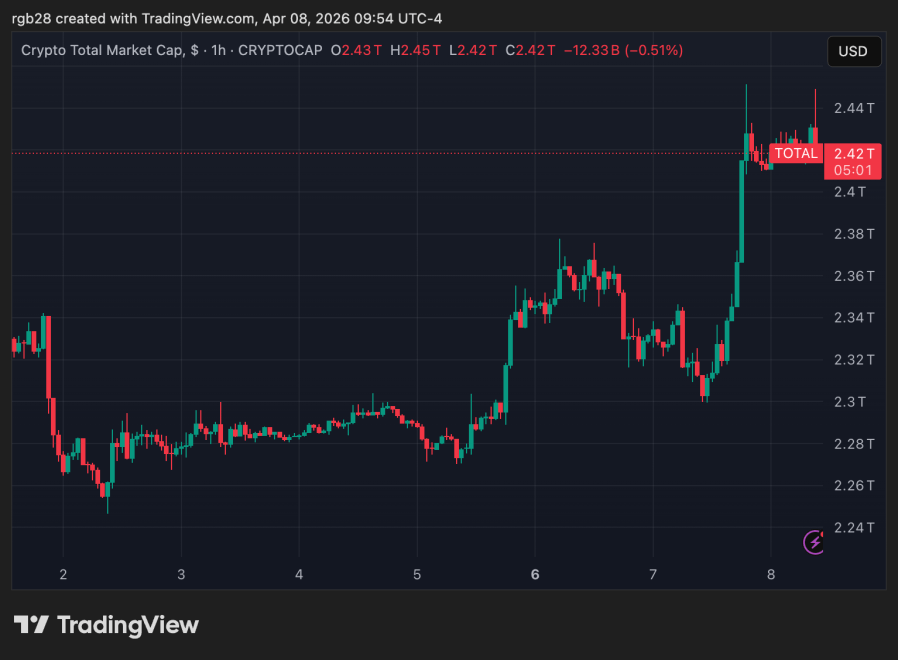
The total crypto market capitalization is at $2.42 trillion in the one-week chart. Source: TOTAL on TradingView


Perguntas relacionadas

QWhat was the main finding of the White House economists' study regarding stablecoin yield and bank lending?

AThe study found that eliminating stablecoin yield would only boost overall bank lending by $2.1 billion, a negligible 0.02% increase, and concluded that prohibiting yield would have only a moderate impact on the banking system.

QAccording to the CEA report, what implausible conditions would be required for a significant $521 billion increase in bank lending?

AIt would require the stablecoin market to grow sixfold as a share of deposits, all reserves to be locked in unlendable cash instead of US Treasuries, and the Federal Reserve to abandon its current monetary framework.

QWhat argument from the banking sector did the CEA study directly contradict?

AThe study contradicted the banking sector's argument that prohibiting stablecoin yield is necessary to protect community banks, showing that even under worst-case scenarios, the impact on their lending would be minimal.

QWhat did Bank of America's CEO claim could happen if interest-bearing stablecoins are not prohibited?

ACEO Brian Moynihan claimed that up to $6 trillion in deposits, roughly 30-35% of all US commercial bank deposits, could flow out of the banking system and into the stablecoin sector.

QWhat did former CFTC chief Chris Giancarlo identify as a greater need for banks than for the crypto industry?

AHe stated that banks require regulatory clarity more than the crypto industry, as they cannot afford regulatory uncertainty and need clear rules to invest billions in new technology to avoid becoming obsolete.

Leituras Relacionadas

Near Returns to the AI Stage: Transformation into a Public Chain Due to 'Payroll Difficulties,' Agent and Privacy Emerge as New Growth Narratives

NEAR Returns to AI Origins: From Payroll Struggles to Blockchain, Now Focusing on AI Agents and Privacy NEAR Protocol's journey began not with grand blockchain ambitions, but from a practical hurdle: its AI startup founders, including Transformer paper co-author Illia Polosukhin, couldn't efficiently pay international developers in 2017. This led them to pivot and build a high-performance, scalable blockchain. After years navigating various crypto narratives like sharding and cross-chain interoperability, NEAR is now leveraging its AI roots to re-enter the AI arena. A key driver is its "NEAR Intents" layer, which abstracts complex cross-chain transactions. Users simply state their goal (e.g., swap BTC for ETH), and a solver network finds the optimal route. This system has processed over $20B in cross-chain volume, generating significant fee revenue. A major growth area is private transactions via "Confidential Intents/Swaps," which hide trade details until settlement to protect against MEV and front-running. Remarkably, private swaps recently accounted for over 40% of NEAR's transaction volume, highlighting strong demand but also potential regulatory scrutiny. With its AI-founder pedigree, NEAR is positioning itself at the intersection of blockchain, AI agents, and privacy, aiming to become infrastructure for the emerging agent economy while navigating the challenges of its rapid adoption.

marsbitHá 31m

Near Returns to the AI Stage: Transformation into a Public Chain Due to 'Payroll Difficulties,' Agent and Privacy Emerge as New Growth Narratives

marsbitHá 31m

From Ethereum to AI's 'CROPS': What Exactly is This Set of 'Slow Variables' That Vitalik Repeatedly Emphasizes?

In recent discussions, Vitalik Buterin has frequently emphasized the concept of "CROPS," a framework defining core values for Ethereum's development. CROPS stands for Censorship Resistance, Capture Resistance, Open Source, Privacy, and Security. Initially outlined in the Ethereum Foundation's "EF Mandate," it represents a commitment to user sovereignty, ensuring that the network resists external control, remains open, protects privacy, and prioritizes security. The relevance of CROPS extends beyond Ethereum's foundational principles, becoming crucial in the context of AI integration. As AI agents begin handling wallet operations and automated transactions, the risk increases that users may cede control over their digital assets, privacy, and intentions to centralized AI service providers. A "CROPS AI" would therefore emphasize local execution where possible, privacy-preserving remote model calls (e.g., using zero-knowledge proofs), and transparent, verifiable processes to maintain user agency. Vitalik highlights a significant convergence between "CROPS Ethereum access layer" and "CROPS AI." Both address the same fundamental challenge: how users can access powerful services—be it blockchain data via RPCs or AI models—without exposing sensitive information or relinquishing ultimate control. This intersection points toward a future digital entry point that is more private, secure, and user-controlled. Ultimately, CROPS is not merely an abstract ideal but a practical guidepost. It steers development—from protocol resilience and wallet design to AI agent safety—towards a future where users retain self-sovereignty even as digital systems grow more complex and powerful. In an era of accelerating AI adoption, these "slow variables" of censorship resistance, openness, privacy, and security may define Ethereum's enduring value.

marsbitHá 41m

From Ethereum to AI's 'CROPS': What Exactly is This Set of 'Slow Variables' That Vitalik Repeatedly Emphasizes?

marsbitHá 41m

Silicon Valley 'Startup Guru' Steve Hoffman: Web3 + AI Could Be a Trap

Silicon Valley investor and "Godfather of Startups" Steve Hoffman warns that combining Web3 with AI is likely a trap, not a promising venture. In an interview, Hoffman argues that while AI is a foundational technology touching all industries, Web3 adds complexity, friction, and regulatory risk without solving mainstream consumer or business needs. He advises founders to focus on deep, specialized applications where startups can out-iterate giants, rather than on generic features easily replicated by large tech companies. Hoffman observes that Silicon Valley will lead foundational AI research, while China excels at rapid, large-scale application and commercialization, particularly in robotics. He stresses that AI-driven autonomous agents capable of collaborative, multi-step tasks are 2-4 years away, which will cause significant job displacement. The solution is not to slow AI but to redesign business models around human-AI collaboration and reform social systems like education and retraining. For startups, Hoffman recommends focusing on vertical, expertise-heavy domains to build defensibility. He sees major opportunities in AI fraud detection and cybersecurity. Key founder mindsets include systemic thinking over feature-focus, relentless customer centricity, building adaptive teams, and deeply understanding AI's capabilities and limits. Hoffman is also leading a non-profit initiative to establish university centers aimed at training future leaders in responsible, human-value-aligned AI innovation.

marsbitHá 2h

Silicon Valley 'Startup Guru' Steve Hoffman: Web3 + AI Could Be a Trap

marsbitHá 2h

Token Inefficient, Economy Tokenless

The article "Tokens Aren't Economical, Economics Aren't Tokenized" analyzes a pivotal shift in the AI industry from a technology-driven narrative to one dominated by capital efficiency. It highlights two concurrent trends: a severe capital shortage due to the exorbitant and recurring costs of compute (e.g., OpenAI's high burn rate) and a wave of corporate spin-offs where major tech companies are separating their AI units (like Kuaishou's Kling and Baidu's Kunlunxin). The core argument is that AI's "anti-internet" business model, where user growth increases costs rather than profits, has created a disconnect between high valuations and actual cash flow. Spin-offs address this by allowing AI assets to be valued independently. Within a parent company, they are seen as cost centers, but as standalone entities, they are priced based on their growth potential and scarcity in the primary market, leading to massive valuation premiums (e.g., Kling's estimated value tripling post-spin-off). The industry is at an inflection point, moving from "model worship" to "value realization." The competition is evolving from a pure compute (GPU) race to a broader focus on systemic efficiency and full-stack engineering (involving CPUs and orchestration) to achieve viable commercialization. The year 2026 is framed as a critical moment where the industry must definitively answer how to economically translate AI capability into tangible business value, reshaping the sector's future power structure.

marsbitHá 2h

Token Inefficient, Economy Tokenless

marsbitHá 2h

Trading

Spot
Futuros

Artigos em Destaque

Como comprar HOUSE

Bem-vindo à HTX.com!Tornámos a compra de Housecoin (HOUSE) simples e conveniente.Segue o nosso guia passo a passo para iniciar a tua jornada no mundo das criptos.Passo 1: cria a tua conta HTXUtiliza o teu e-mail ou número de telefone para te inscreveres numa conta gratuita na HTX.Desfruta de um processo de inscrição sem complicações e desbloqueia todas as funcionalidades.Obter a minha contaPasso 2: vai para Comprar Cripto e escolhe o teu método de pagamentoCartão de crédito/débito: usa o teu visa ou mastercard para comprar Housecoin (HOUSE) instantaneamente.Saldo: usa os fundos da tua conta HTX para transacionar sem problemas.Terceiros: adicionamos métodos de pagamento populares, como Google Pay e Apple Pay, para aumentar a conveniência.P2P: transaciona diretamente com outros utilizadores na HTX.Mercado de balcão (OTC): oferecemos serviços personalizados e taxas de câmbio competitivas para os traders.Passo 3: armazena teu Housecoin (HOUSE)Depois de comprar o teu Housecoin (HOUSE), armazena-o na tua conta HTX.Alternativamente, podes enviá-lo para outro lugar através de transferência blockchain ou usá-lo para transacionar outras criptomoedas.Passo 4: transaciona Housecoin (HOUSE)Transaciona facilmente Housecoin (HOUSE) no mercado à vista da HTX.Acede simplesmente à tua conta, seleciona o teu par de trading, executa as tuas transações e monitoriza em tempo real.Oferecemos uma experiência de fácil utilização tanto para principiantes como para traders experientes.

284 Visualizações TotaisPublicado em {updateTime}Atualizado em 2026.06.02

Como comprar HOUSE

Discussões

Bem-vindo à Comunidade HTX. Aqui, pode manter-se informado sobre os mais recentes desenvolvimentos da plataforma e obter acesso a análises profissionais de mercado. As opiniões dos utilizadores sobre o preço de HOUSE (HOUSE) são apresentadas abaixo.

活动图片












