No Surge, No Meme: As Crypto Moves into the Real World, Will 2026 Be the First Year of 'On-Chain Wall Street'?

marsbitPublicado em 2025-12-19Última atualização em 2025-12-19

In the final months of 2025, the atmosphere of a bear market began to spread.

Bitcoin slid from its high of $120,000, ETF inflows stalled at one point, various cryptocurrencies diverged in their trends, and the once sentiment-igniting Meme coins also began to lose interest. Compared to the end of 2021, this time there was no sudden regulatory crackdown, and aside from the 1011 crash, there didn't seem to be a severe liquidity crisis, yet it still felt like something was off.

If the crypto world of 2025 was a recalibration of true and false value, then will crypto be better in 2026?

This article attempts to find the answer. Perhaps we need to accept the fact that the crypto industry may be entering an era no longer driven by one-sided surges or "casino narratives."

I. Macro Winds Warm, Bitcoin Still Stands in the Spotlight

Over the past year, Bitcoin's price performance and market positioning have undergone significant changes.

After hitting a new all-time high of $120,000, the market began to pull back, volatility increased, and market sentiment gradually cooled. Unlike past rallies driven by retail investors, the main force behind this round of increases was the institutional money behind ETFs. Looking at holding costs, CryptoQuant analyst Axel Adler Jr. pointed out last month that the average holding cost for US ETFs was $79,000, which many also see as one of the price support levels. Therefore, Bitcoin's current trend is increasingly resembling a high-volatility institutional asset. On one hand, it has an anti-inflation positioning similar to gold; on the other hand, like tech stocks, it is influenced by macro sentiment and risk appetite, exhibiting beta properties.

From a broader macro background, 2025 was a year of回暖 (warming) sentiment for global risk assets. AI was the main theme, US stocks continuously hit new highs, the Fed announced three rate cuts in December, and the market re-entered a stage of warming liquidity expectations. The FOMC's year-end economic projections showed that the US GDP growth expectation for 2026 was also revised up from 1.8% to 2.2%–2.5%. The general expectation is that easing will continue next year, which might be a positive for assets like Bitcoin.

But the market is not without risks. If the economy suddenly weakens in 2026, or inflation rebounds unexpectedly, risk assets could still face significant adjustments.

II. Regulatory Turning Point: Policy Moves in the US and Hong Kong

Another important change in 2025 was the formal framing of regulation.

In the US, two key bills were passed. The first is the stablecoin bill (GENIUS Act), which clarifies the definition of stablecoins, reserve requirements, and issuance qualification thresholds, providing a compliance path for mainstream stablecoin issuers. This bill was signed into law by the President in July 2025 and will take effect 18 months after signing or 120 days after regulators issue final rules. The second is the Crypto-Asset Market Structure Act (CLARITY Act), which systematically divides the boundary between "security tokens" (regulated by the SEC) and "commodity tokens" (regulated by the CFTC) and proposes tiered regulation. This bill will be submitted to the Senate for deliberation in January, after which it may still require the President's signature, with an effective date to be determined. Meanwhile, the SEC has also accelerated the approval of more crypto ETFs, opening channels for institutional products.

In Hong Kong, China, regulatory步伐 (pace) also accelerated. In 2025, the Hong Kong Monetary Authority (HKMA) introduced a regulatory regime for stablecoin issuers, clearly requiring all Hong Kong-based stablecoin issuances to be licensed. This means that future issuances of stablecoins like USD or RMB in Hong Kong will need to meet certain capital and compliance requirements. Furthermore, HashKey has been listed on the Hong Kong Stock Exchange, becoming the first compliant platform with crypto trading as its core business to IPO in Hong Kong, a milestone event.

Overall, the regulatory trends in the US and Hong Kong, China, are both about suppressing illegal speculation while opening channels for legal business, pushing the industry towards institutionalization and compliance.

III. Three Main Themes: Stablecoins, Prediction Markets, On-Chain Stocks

Over the past few years, the most stable growth curve in the crypto industry has actually been stablecoins.

By 2025, the global stablecoin issuance volume had exceeded $300 billion, with the two major coins, USDT and USDC, accounting for over 80% combined. Stablecoins are becoming part of the global payment network. Whether it's USDT or USDC, the usage scenarios of these stablecoins have penetrated into daily merchants and cross-border settlements.

In 2026, stablecoins are likely to be closer to the real world than ever before. Traditional giants like Visa, Stripe, and PayPal are already using stablecoins for settlements. For example, Stripe already supports merchants subscribing with stablecoins, with real, landed services already available.
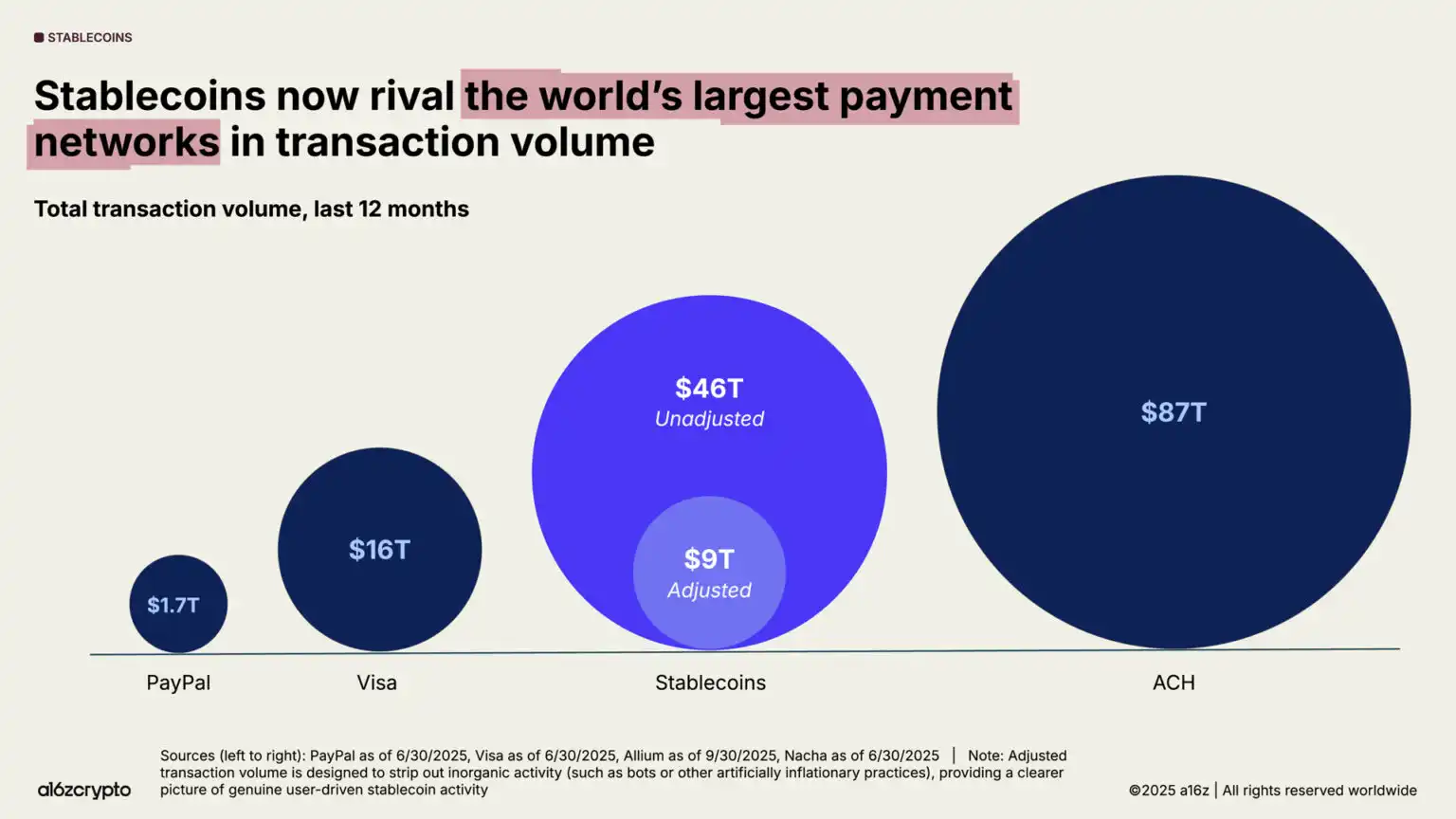
Image Source: a16z

Furthermore, with regulatory clarity, treasury-backed stablecoins (backed by high-quality assets) and regional stablecoins are expected to emerge, such as digital currency bridge projects promoted by Japan and the EU.

Another area worth watching is prediction markets.

Originally, most people thought prediction market products were too niche or non-compliant. But now, under themes like US elections, sports events, and economic data, they are gradually becoming a combination of "on-chain betting + pricing tools."

For example, Kalshi obtained a formal futures license from the US CFTC, allowing it to legally launch prediction trading related to macroeconomic data. Its valuation has now climbed to $11 billion. Polymarket, relying on topics like US elections and entertainment events, has also become a place for a large number of users to bet and gauge sentiment.

In 2026, prediction markets may move out of the purely speculative circle. For instance, users are not just betting on wins or losses but are using money to vote, expressing their judgment on the probability of a certain outcome. This collective intelligence pricing method could potentially be used by media, research institutions, and even trading strategies for reference. Additionally, AI will open up new possibilities for prediction markets, making them no longer rely solely on human betting but capable of automatically analyzing data, placing orders themselves, and even generating new markets. This will make prediction markets react faster and smarter, gradually becoming a tool for judging risks and trends, not just a place for gambling.

The last one that cannot be ignored is the development of on-chain stocks.

Simply put, the crypto industry is now not only trading crypto assets but also starting to move real-world assets onto the chain. For example, Securitize plans to launch the first fully compliant on-chain stock trading platform in 2026. Tokens purchased on-chain by users correspond to real company shares, entitling them to voting rights and dividends.

IV. Edge Narratives Emerge: New Directions That Might Take Off in 2026

https://a16zcrypto.com/posts/article/big-ideas-things-excited-about-crypto-2026/
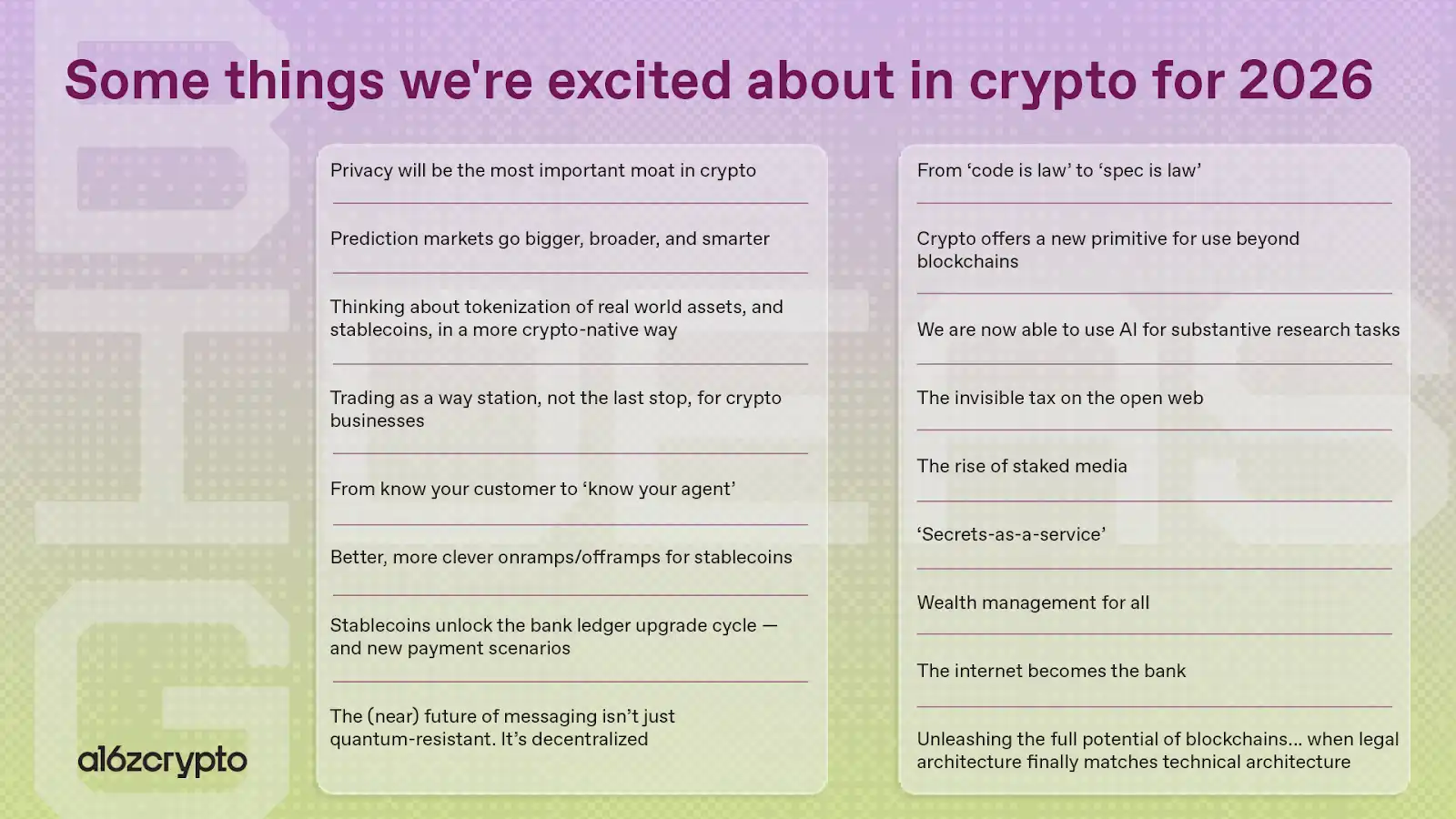
Image Source: a16z

1. The Identity Problem of AI Agents

As AI agents begin to participate in trading, browsing, placing orders, and even interacting with smart contracts, a key question is brought to the table: how do these non-human identities prove "who they are"?

The "Know Your Agent" (KYA) concept proposed by a16z aims to solve this very problem. On-chain, any agent initiating a transaction must have clear permissions and attribution, requiring cryptographic signature credentials for transactions. In 2026, this may become a prerequisite for the large-scale deployment of on-chain AI.

2. x402-like Protocols and Micropayments

a16z predicts that in the process of AI Agents widely trading data, calling computing power, and reading interfaces, we will enter an era of "automatic settlement + programmable payments."

No longer needing manual payments, AI Agents can identify needs among themselves and automatically execute payments. This is the real-world problem that protocols like x402 are solving. In 2026, their presence will become increasingly strong.

3. Privacy Chains Will Receive More Attention

a16z points out a key trend: compared to performance competition converging, privacy will become the core moat of future public chains. In the past, people worried that privacy chains were not conducive to regulation and lacked transparency. But now the problem is reversed: business data is too sensitive, and without privacy protection, compliant institutions simply dare not go on-chain. Precisely because of this, chains that come with privacy protection by default are becoming attractive. Once users use these chains, their data won't be easily leaked, migration costs are higher, naturally forming new user stickiness, which is essentially a network effect.

4. Staked Media

In the era of AI generating vast amounts of content, judging whether a statement is reliable cannot just depend on who said it, but also on whether there is a cost for saying it. Therefore, a16z proposes a new media model where content creators not only speak out but also "stake" their positions through methods like locking stakes, prediction markets, and NFT credentials.

For example, if you express a bullish view on ETH, you simultaneously lock up your own held ETH as collateral; if you make an election prediction, you also place a bet on-chain yourself. These公开 (public) interest bindings will make content more than just empty talk. If this play can work, it might become the new normal for on-chain media in the future.

Of course, the a16z report proposes far more than these few directions. This article focuses on selecting 4 trends we believe are more representative for elaboration. Other directions are also worth关注 (attention), such as: stablecoin on/off-ramp upgrades, RWA crypto-native transformation, stablecoins driving bank ledger system upgrades, diversification of wealth management, the rise of AI research assistants, real-time content profit-sharing mechanisms for AI agents, decentralized anti-quantum communication, "privacy as a service" becoming infrastructure, DeFi security paradigm shifts, intelligent prediction markets, verifiable cloud computing, focusing on product-market fit (PMF), and crypto bills unleashing more potential of blockchain.

Interested readers can refer to the original a16z report for further in-depth understanding.

V. The Crypto Industry is Moving Out of Its Internal Cycle

The early growth of the crypto industry was mostly built on a self-congratulatory system. Issuing coins, rebates, and airdrops all tried to attract more insiders to stay, but this closed loop is gradually being broken by reality.

From Polymarket to USDT, to the cross-border application of USDC, we see more and more people who are not Web3 users utilizing blockchain tools. Street vendors in Lagos may not understand wallet structures, but they know using USDT is much faster than bank transfers. In high-inflation countries, savers flock to USDC just for避险 (hedging), not speculation. One of the most直观 (intuitive) changes appears in payment scenarios in developing countries. For example, the Philippine trading platform Coins.ph partnered with Circle to open a low-cost USDC remittance channel.

The trend behind this shows that crypto technology is being embedded into real-world scenarios like cross-border payments and remittance channels. The true future of crypto might lie in how to use technology to solve real problems, allowing more ordinary people to use blockchain unconsciously.

VI. The Crypto Industry from a KOL Perspective

A recent discussion on "whether spending years in the crypto industry was worth it" was essentially a collective复盘 (review) of the industry.

Castle Island Ventures partner Nic Carter @nic_carter continued the reflection on "wasting 8 years in crypto,"坦言 (frankly admitting) that the ones that have truly achieved significant PMF (Product-Market Fit) so far are still only Bitcoin, stablecoins, DEXs, and prediction markets. He chooses to maintain pragmatic idealism, accepting that bubbles and狂热 (mania) are part of the path, not the whole thing.

Dragonfly partner Haseeb @hosseeb was more blunt, pointing out that the problem isn't the existence of the casino, but that if you only focus on the casino's glamour, you will miss the real transformation of the industry. He believes cryptocurrency is a better carrier for finance; it will forever change the nature of money. He hopes the industry maintains patience: "The Industrial Revolution also took 50 years to change productivity. We are only 15 years in."

The summary by XHunt & Biteye founder @DeFiTeddy2020 is also extremely real. In his view, the crypto industry can quickly expose the essence of finance. It faces projects going to zero, prices decoupling from fundamentals, and even insider trading, manipulation, and harvesting. It is not a温床 (hotbed) for idealism but a market that constantly educates participants with real money, which is very mentally磨练 (tempering).

Regarding the future development direction of the industry, KOL 币圈女菩萨 @xincctnnq (Crypto Bodhisattva) provided a long-term perspective. What crypto is truly trying to solve are long-term issues like the monetary system, contract execution, digital property rights, capital market efficiency, and financial inclusion. Even if the results are distant and the process rough, it is worth continuous尝试 (attempts).

Furthermore, trader & analyst @CryptoPainter gave a more market-structure-oriented explanation. The crypto market repeats its consistent operating mechanism: "value investment" - "belief investment" - "emotional speculation" - "complete disappointment," and then starts over. This cycle appeared in 2018 and 2022 and is destined to happen again. Gamblers and casinos are not anomalies but part of consuming the bubble and completing the market's self-regulation.

The stance of Figment Capital member DougieDeLuca @DougieDeLuca is like a阶段性 (stage) summary. He直言 (stated bluntly), "Crypto is dead" doesn't mean the price goes to zero or blocks stop working, but that "Crypto as a closed industry form is dying." True success should be integrating Crypto technology into ordinary people's daily lives.

From a more institutional perspective, KOL & researcher蓝狐 (Blue Fox) @lanhubiji mentioned that while old users are starting to withdraw, newcomers with traditional finance backgrounds are entering. In their perception, crypto is a long-term trend that has already entered a path of standardization, interoperability, and scaling. In three years, a brand-new on-chain finance era, the on-chain Wall Street era, will gradually reveal itself.

The judgment of LD Capital founder易理华 (Jack Yi) @Jackyi_ld is closer to the current cycle level. He pointed out that the recent crypto downturn is more of a阶段性 (stage) resonance of liquidity and macro events. Currently, negative factors are gradually being digested. With the dual benefits of rate cut expectations and crypto policies, he remains optimistic about the subsequent market.

At a more macro level of regulation and industry structure, the judgment of Hashkey Group Chairman肖风 (Xiao Feng) is particularly systematic. He proposed three future trends:

First, the global crypto regulatory trend is shifting from "voluntary acceptance" to "mandatory inclusion." Governments are gradually clearing out offshore gray areas, and crypto trading is moving towards licensing. Taking Hong Kong, China as an example, since June 2023, all unlicensed trading platforms need to exit the market.

Second, crypto is no longer just native assets like BTC and ETH. More traditional financial assets are migrating onto the chain through tokenization, forming a new type of compliant securitized market.

Third, moving from "off-chain" to "on-chain," he judges that the second half of 2026 might be the key node for the雏形 (prototype) of "On-Chain Wall Street" to land.

VII. Conclusion

Will crypto be better in 2026?

If you're期待 (expecting) "coin prices to skyrocket," then the answer might be not necessarily.

But if you're asking whether this industry is moving towards a more real and useful direction, then the answer is perhaps yes.

From crypto ETFs to stablecoin payments, from on-chain treasuries to prediction markets, from on-chain Agents to decentralized AI, all these indicate one thing:

The crypto industry may begin to land in the direction of the real world and might increasingly resemble a twin financial system parallel to the real world's financial system, resonating with the stock market, macro liquidity, policy expectations, and even the AI cycle.


Criptomoedas em alta

Perguntas relacionadas

QWhat are the three main trends in the crypto industry for 2026 as highlighted in the article?

AThe three main trends are: 1) Stablecoins becoming more integrated into real-world payments and settlements, 2) Prediction markets evolving beyond pure speculation into tools for collective intelligence and risk assessment, and 3) The development of compliant on-chain stock trading platforms where tokens represent real company shares.

QAccording to the article, how is Bitcoin's market behavior changing in 2025?

ABitcoin's price behavior is becoming more volatile and its market positioning is shifting. After reaching a new all-time high of $120,000, its price retreated with increased volatility. Unlike previous retail-driven rallies, this cycle was primarily driven by institutional funds through ETFs. It is increasingly behaving like a high-volatility institutional asset, with aspects of an inflation-resistant store of value like gold, but also a beta attribute influenced by macro sentiment and risk appetite, similar to tech stocks.

QWhat key regulatory developments occurred in the US in 2025, as mentioned in the text?

ATwo key US regulatory acts were passed: 1) The stablecoin bill (GENIUS Act), which defines stablecoins, sets reserve requirements, and establishes issuance qualifications, providing a compliance path for mainstream issuers. It was signed into law in July 2025. 2) The Crypto Asset Market Structure Act (CLARITY Act), which systematically distinguishes between 'security tokens' (regulated by the SEC) and 'commodity tokens' (regulated by the CFTC) and proposes tiered regulation. It was submitted to the Senate for review in January, with an effective date pending.

QWhat is the concept of 'Know Your Agent' (KYA) proposed by a16z, and why is it important?

A'Know Your Agent' (KYA) is a concept proposed by a16z to address the identity and permissioning of AI agents as they begin to participate in transactions, browsing, ordering, and interacting with smart contracts. It requires that any agent initiating an on-chain transaction must have clear permissions and attribution, needing cryptographically signed credentials. This is seen as a prerequisite for the large-scale deployment of on-chain AI in 2026, ensuring accountability and security for non-human actors.

QHow does the article suggest the crypto industry is moving beyond its 'closed-loop' system?

AThe article suggests the industry is moving beyond its internal, self-referential cycle by increasingly solving real-world problems and being used by people outside the Web3 space. Examples include merchants in Lagos using USDT for faster payments than banks, savers in high-inflation countries using USDC for避险, and platforms like Coins.ph in the Philippines offering low-cost USDC remittance channels. This indicates crypto technology is being embedded into real-world scenarios like cross-border payments and remittances, making it useful for ordinary people without them necessarily understanding the underlying blockchain technology.

Leituras Relacionadas

Annual Salary of Millions Competing for Electricians, Meta Rushes to Open Its Own Technical School

The AI boom is facing an unexpected bottleneck: a severe shortage of skilled construction workers and electricians. As tech giants like Meta, OpenAI, and Alphabet race to build massive data centers—such as OpenAI's $16 billion "Stargate" project—they are hitting a critical labor wall. The U.S. needs an estimated 130,000 more electricians, 240,000 construction workers, and 150,000 supervisors by 2030 for AI infrastructure alone, but tens of thousands of electrician jobs go unfilled each year. While AI companies offer high premiums, with electricians earning up to $280,000 annually, worker scarcity still causes massive losses—delays on a single project can cost $14.2 million per month. The complexity of building AI data centers, which require immense power (equivalent to powering hundreds of thousands of homes), sophisticated electrical systems, and advanced liquid cooling solutions, demands highly skilled technicians who are in short supply. To combat this, companies are investing heavily in training. Meta has committed $115 million to a free training school offering tuition, housing, and stipends, targeting 5,000 new workers. OpenAI is partnering with unions to secure skilled labor. These efforts are paying off, with a significant rise in Gen Z interest in trade schools over college. However, the power demands are staggering. AI data centers are driving a rapid surge in electricity consumption, projected to account for up to 12% of U.S. power use by 2028 and raising costs for consumers. Furthermore, the construction boom is project-based, leading to a potential future glut of trained workers once building peaks, which could depress wages industry-wide. The race for AI supremacy now depends as much on skilled hands as on advanced chips.

marsbitHá 58m

Annual Salary of Millions Competing for Electricians, Meta Rushes to Open Its Own Technical School

marsbitHá 58m

OpenAI No Longer Sells Its Most Expensive Model for Profit

OpenAI is shifting its business strategy away from promoting its most expensive, flagship models for every task. Recent price cuts—80% for GPT-5.6 Luna and 20% for Terra—signal a deeper change: the company now actively advises users that many tasks don't require the most powerful model. Instead, OpenAI recommends a tiered approach: use the high-end GPT-5.6 Sol for complex planning and analysis, then delegate execution to cheaper models like Luna. This mirrors moves by Anthropic, which recently launched Claude Opus 5 at half the price of its top model, Fable 5. Both companies are de-emphasizing flagship models as primary revenue drivers, using them instead for brand prestige and technological showcases. The industry is entering a "mass-market" phase, similar to automotive, where high-volume, cost-effective models handle daily operations and drive scale. OpenAI's price reductions are partly enabled by AI models themselves optimizing underlying code and infrastructure, creating a self-reinforcing cycle of efficiency gains and cost reduction. Competition is shifting from "who is smartest" to "who offers the best value." The goal is no longer selling individual models but fostering widespread API adoption and ecosystem lock-in. By making AI calls cheap and ubiquitous, companies like OpenAI aim to become the indispensable, utility-like infrastructure powering automated workflows—the "water and electricity" of software, quietly embedded everywhere.

marsbitHá 58m

OpenAI No Longer Sells Its Most Expensive Model for Profit

marsbitHá 58m

Will the Fed Definitely Raise Interest Rates in September? How Will Crypto and U.S. Stocks Withstand the Pressure?

The market's expectation for a September Fed rate hike surged dramatically in early August, jumping from under 50% to over 80% within a week. This shift followed a contentious July FOMC meeting, where a 9-3 vote to hold rates revealed growing dissent from hawkish members advocating for an immediate hike to combat persistent inflation. The primary catalyst for this repricing is rising oil prices, driven by renewed geopolitical tensions around the Strait of Hormuz, which threaten global supply. Energy costs directly influence inflation metrics, making the upcoming July CPI report (due August 12th) a critical data point. If it shows inflation reaccelerating, the probability of a September hike will solidify. For Bitcoin and crypto assets, this is typically bearish news. Bitcoin continues to behave as a high-beta, liquidity-sensitive risk asset. A rate hike raises the opportunity cost of holding non-yielding assets and could drive capital toward money markets, pressuring crypto prices in the short term. However, historical patterns suggest that if a hike is perceived as the end of a tightening cycle rather than the start, any negative price impact may be brief. U.S. stocks, particularly crypto-linked equities like Coinbase and growth-oriented tech stocks, are also vulnerable. Higher rates increase discount rates in valuation models, putting pressure on high-multiple companies. This coincides with a pivotal tech earnings season where investor focus has shifted from massive AI capital expenditure to tangible revenue and cash flow generation. Companies with negative cash flow and weak growth narratives could face heightened volatility if borrowing costs rise in September. In summary, a September Fed hike has evolved into a mainstream market scenario. Key factors to watch are oil prices, the July CPI report, and Fed communications, which will determine the final decision and its impact on volatile crypto and equity markets.

marsbitHá 1h

Will the Fed Definitely Raise Interest Rates in September? How Will Crypto and U.S. Stocks Withstand the Pressure?

marsbitHá 1h

Trading

Spot

Artigos em Destaque

O que é MEME 2.0

Memecoin 2.0: A Ascensão do $MEME 2.0 no Mundo das Criptomoedas Introdução No panorama em constante evolução das criptomoedas, um novo concorrente surgiu. Memecoin 2.0, simbolizado como $MEME 2.0, eleva o conceito de moedas meme a um novo nível emocionante. Como um subproduto do Memecoin original, este projeto capturou a atenção da comunidade crypto ao mudar o foco de incentivos financeiros típicos para uma experiência envolvente e divertida. Operando na blockchain Ethereum, Memecoin 2.0 redefine audaciosamente o envolvimento da comunidade na esfera crypto. O que é Memecoin 2.0, $MEME 2.0? No seu cerne, Memecoin 2.0 é um projeto de criptomoeda que prioriza o espírito comunitário e a diversão associada à cultura meme. Ao contrário das criptomoedas convencionais, que se concentram em casos de uso práticos e benefícios tangíveis, Memecoin 2.0 distingue-se ao abraçar o lado mais leve da moeda digital. O projeto existe sem promessas de utilidade, um roteiro estruturado ou retornos financeiros, focando em vez disso em fomentar uma comunidade vibrante centrada em memes e no prazer partilhado. Ao fazer isso, aproveita a crescente tendência da cultura meme no espaço online, tornando-se num jogador único no mundo dos ativos digitais. Criador do Memecoin 2.0, $MEME 2.0 Apesar de extensa pesquisa sobre as origens do Memecoin 2.0, a identidade explícita do seu criador continua desconhecida. Esta anonimidade não é incomum na comunidade crypto, onde muitos projetos são liderados por indivíduos ou grupos que preferem ficar nos bastidores. A falta de informações publicamente disponíveis sobre o criador pode ser vista como um movimento estratégico, colocando os holofotes no envolvimento da comunidade em vez de na notoriedade individual dentro do espaço. Investidores do Memecoin 2.0, $MEME 2.0 As informações sobre os investidores ou o financiamento do Memecoin 2.0 são escassas. Esta ausência de detalhes pode sugerir que o projeto é autofinanciado ou que o seu foco na comunidade, em vez de estruturas de investimento tradicionais, atraiu um tipo diferente de apoiador. Como o mundo das moedas memes geralmente envolve mais envolvimento de base do que investimento institucional, esta abordagem alinha-se ao ethos de projetos orientados pela comunidade. Como Funciona o Memecoin 2.0, $MEME 2.0? O Memecoin 2.0 opera inteiramente na blockchain Ethereum, aproveitando as suas robustas características de segurança e escalabilidade. Ao aproveitar os pontos fortes da Ethereum, o Memecoin 2.0 pode oferecer um ambiente seguro para interações dos utilizadores enquanto assegura que as transações são eficientes e custo-efetivas. Uma das características únicas do Memecoin 2.0 reside na sua estrutura orientada pela comunidade. O valor e a popularidade do token $MEME 2.0 derivam da participação ativa dos seus utilizadores, em vez de uma utilidade inerente. Este design reforça o foco do projeto no aspecto de entretenimento das criptomoedas, implicando que o riso e o envolvimento da comunidade são as verdadeiras moedas que impulsionam o seu sucesso. Além disso, o projeto insere-se no ecossistema mais amplo das moedas meme, onde o valor de cada moeda meme oscila com base na cultura, nas tendências e no envolvimento da comunidade, em vez de nos princípios económicos tradicionais. Linhas do Tempo do Memecoin 2.0, $MEME 2.0 Para melhor entender a evolução e os marcos do Memecoin 2.0, aqui está uma linha do tempo que destaca eventos significativos na sua história: 2024: O início do Memecoin 2.0 é reconhecido como um desdobramento do Memecoin original, estabelecendo-se dentro do contexto próspero das moedas meme enquanto opera na blockchain Ethereum. 13 de Julho de 2024: O Memecoin 2.0 posiciona-se oficialmente como uma moeda meme centrada na comunidade na rede Ethereum, enfatizando a sua abordagem centrada no entretenimento que convida os utilizadores a participar e envolver-se no seu crescimento. Pontos Chave Sobre o Memecoin 2.0, $MEME 2.0 Várias características críticas definem o Memecoin 2.0: Abordagem Centrada na Comunidade: A missão primária do Memecoin 2.0 é criar uma experiência comunitária divertida e envolvente, capitalizando o prazer coletivo derivado da cultura meme. Construído na Ethereum: Operar na blockchain Ethereum fornece ao projeto uma infraestrutura essencial que garante segurança e escalabilidade. Falta de Utilidade ou Roteiro: Numa notável divergência das criptomoedas tradicionais, o Memecoin 2.0 não promete quaisquer características utilitárias ou retornos financeiros, reafirmando o seu compromisso com o envolvimento da comunidade e a participação social. Foco na Cultura Meme: Ao abraçar os aspectos humorísticos e culturais do fenómeno meme, o Memecoin 2.0 fornece uma plataforma para que os utilizadores se envolvam com a crypto offline e online. Contexto Adicional: A Importância das Moedas Meme As moedas meme emergiram como uma classe distinta de criptomoeda, frequentemente impulsionadas pelo humor e por uma abordagem leve ao comércio. Estas moedas geralmente carecem de utilidade significativa ou roteiros de desenvolvimento, atraindo os utilizadores com a promessa de diversão, interação comunitária e relevância cultural. No panorama do ecossistema crypto mais amplo, as moedas meme revive a importância do envolvimento da comunidade, resistindo contra abordagens exclusivamente orientadas para o lucro. Projetos como o Memecoin 2.0 inauguram uma era em que o entretenimento pode harmonizar-se com aspirações financeiras, transformando a blockchain numa plataforma para criatividade e interação social. Conclusão O Memecoin 2.0, ou $MEME 2.0, representa uma nova onda de criptomoeda que prioriza o envolvimento da comunidade em detrimento de estruturas financeiras rígidas. Com um foco no humor e na interação social, capitaliza a fascinação em torno da cultura meme. Ao operar na blockchain Ethereum, o Memecoin 2.0 aproveita as capacidades da tecnologia, enquanto mantém um compromisso firme com o valor de entretenimento da moeda digital. À medida que o espaço em torno das criptomoedas continua a evoluir, o Memecoin 2.0 serve como um testemunho da ideia de que o futuro dos ativos digitais pode muito bem depender de experiências partilhadas, risadas e conexões comunitárias sólidas. No mundo imprevisível da crypto, talvez a alegria possa ser tão valiosa quanto o ganho financeiro tradicional.

113 Visualizações TotaisPublicado em {updateTime}Atualizado em 2024.12.03

O que é MEME 2.0

Como comprar MEME

Bem-vindo à HTX.com!Tornámos a compra de Memeland (MEME) simples e conveniente.Segue o nosso guia passo a passo para iniciar a tua jornada no mundo das criptos.Passo 1: cria a tua conta HTXUtiliza o teu e-mail ou número de telefone para te inscreveres numa conta gratuita na HTX.Desfruta de um processo de inscrição sem complicações e desbloqueia todas as funcionalidades.Obter a minha contaPasso 2: vai para Comprar Cripto e escolhe o teu método de pagamentoCartão de crédito/débito: usa o teu visa ou mastercard para comprar Memeland (MEME) instantaneamente.Saldo: usa os fundos da tua conta HTX para transacionar sem problemas.Terceiros: adicionamos métodos de pagamento populares, como Google Pay e Apple Pay, para aumentar a conveniência.P2P: transaciona diretamente com outros utilizadores na HTX.Mercado de balcão (OTC): oferecemos serviços personalizados e taxas de câmbio competitivas para os traders.Passo 3: armazena teu Memeland (MEME)Depois de comprar o teu Memeland (MEME), armazena-o na tua conta HTX.Alternativamente, podes enviá-lo para outro lugar através de transferência blockchain ou usá-lo para transacionar outras criptomoedas.Passo 4: transaciona Memeland (MEME)Transaciona facilmente Memeland (MEME) no mercado à vista da HTX.Acede simplesmente à tua conta, seleciona o teu par de trading, executa as tuas transações e monitoriza em tempo real.Oferecemos uma experiência de fácil utilização tanto para principiantes como para traders experientes.

340 Visualizações TotaisPublicado em {updateTime}Atualizado em 2026.06.02

Como comprar MEME

Discussões

Bem-vindo à Comunidade HTX. Aqui, pode manter-se informado sobre os mais recentes desenvolvimentos da plataforma e obter acesso a análises profissionais de mercado. As opiniões dos utilizadores sobre o preço de MEME (MEME) são apresentadas abaixo.

活动图片













