No Longer All-in on Volatility: Why I'm Starting to Focus on Crypto Equity-Like Assets

比推Publicado em 2026-01-29Última atualização em 2026-01-29

Resumo

The crypto market is currently experiencing its worst investment environment despite strong infrastructure and regulatory progress, argues Jeff Dorman, CIO of Arca. He criticizes industry leaders for unsuccessfully pushing cryptocurrencies as macro trading tools, which has led to extreme correlation among all crypto assets, eliminating performance dispersion. Dorman highlights that Bitcoin vs. gold debates are often misguided due to differing time horizons, but notes gold’s recent outperformance reveals the failure of appealing solely to macro investors. He advocates for a return to treating tokens as securities-like instruments that represent cash-flow-generating tech businesses—such as DePIN, DeFi, and token issuance platforms—which could attract the massive $600 trillion traditional asset management industry. The article calls for renewed focus on fundamental analysis and differentiation between token types, rather than lumping all “altcoins” together. Dorman urges exchanges and asset managers to educate investors on evaluating tokens based on their underlying value, similar to how ETFs are analyzed.

Original Title: The Crypto Market was Much Healthier 5 Years Ago

Original Author: Jeff Dorman (Arca CIO)

Original Translation: Deep Tide TechFlow


Guide:

Is the crypto market becoming increasingly dull? Arca Chief Investment Officer Jeff Dorman writes that although infrastructure and regulatory environments have never been stronger, the current investment environment is "the worst in history."

He sharply criticizes industry leaders' failed attempts to forcibly transform cryptocurrencies into "macro trading tools," leading to extreme convergence in correlations among various assets. Dorman calls for a return to the essence of "tokens as securities packaging," focusing on equity-like assets such as DePIN and DeFi that have cash flow generation capabilities.

At a time when gold is surging while Bitcoin is relatively weak, this in-depth reflective article provides an important perspective for re-examining Web3 investment logic.

Full text below:

Bitcoin is Facing an Unfortunate Situation

Most investment debates exist because people are on different time horizons, so they often "talk past each other," even though technically both sides are correct. Take the debate between gold and Bitcoin as an example: Bitcoin enthusiasts tend to say that Bitcoin is the best investment because it has far outperformed gold over the past 10 years.
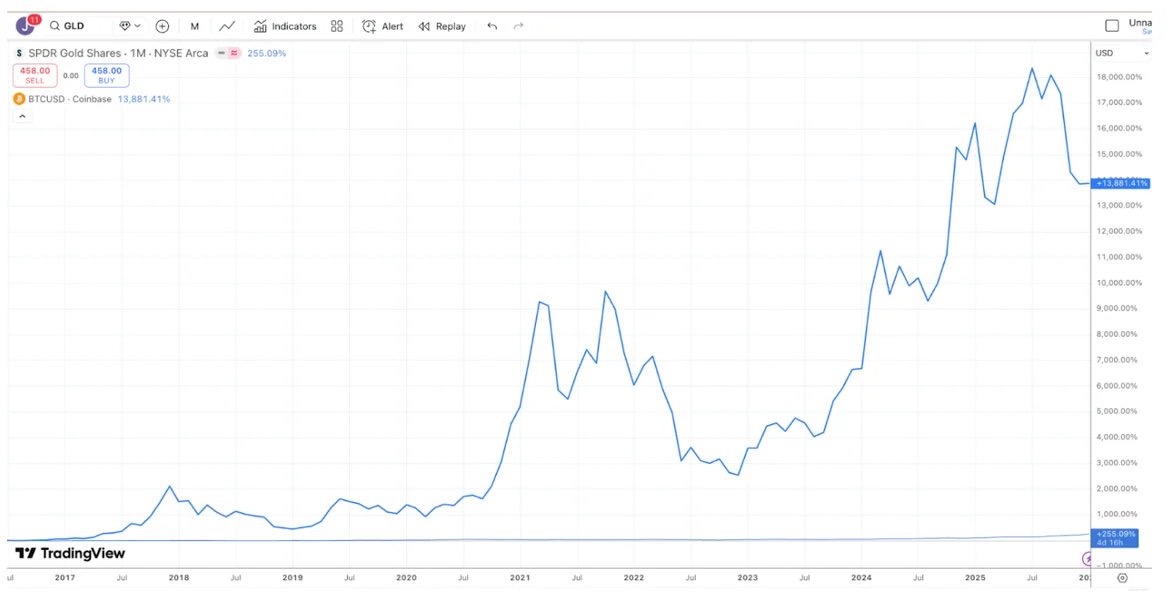
Source TradingView, Bitcoin (BTC) vs. Gold (GLD) returns over the past 10 years

Gold investors, on the other hand, tend to believe that gold is the best investment and have recently been "mocking" Bitcoin's weakness, as gold has significantly outperformed Bitcoin over the past year (the same goes for silver and copper).
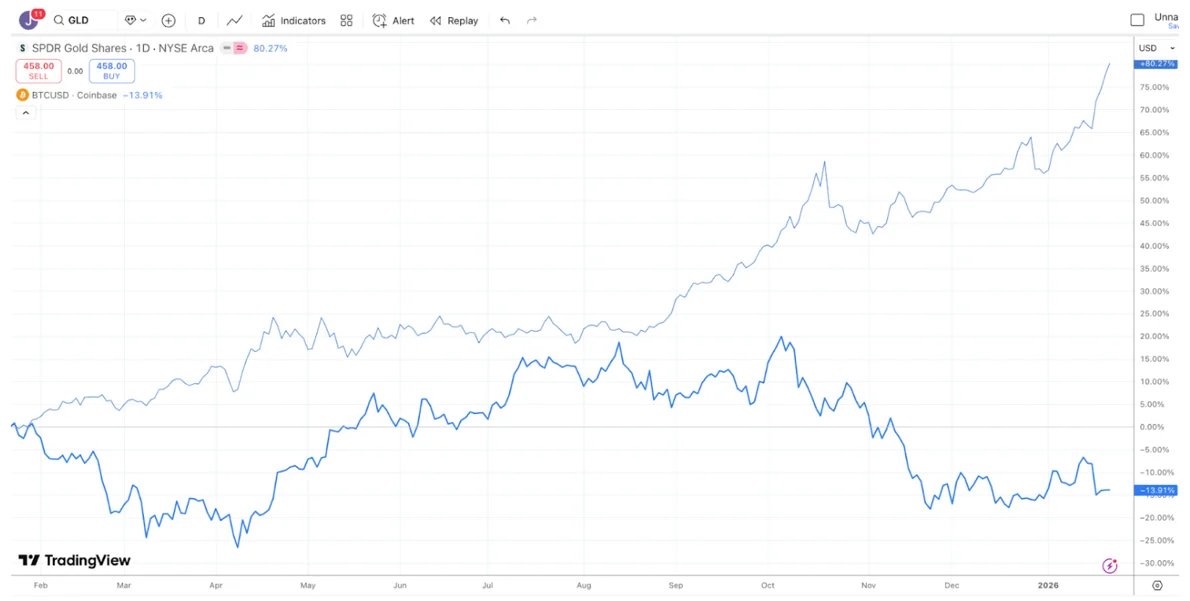
Source TradingView, Bitcoin (BTC) vs. Gold (GLD) returns over the past 1 year

Meanwhile, over the past 5 years, the returns of gold and Bitcoin have been almost identical. Gold tends to do nothing for long periods, then skyrocket when central banks and trend followers buy; while Bitcoin tends to have sharp rallies, followed by sharp crashes, but ultimately moves higher.
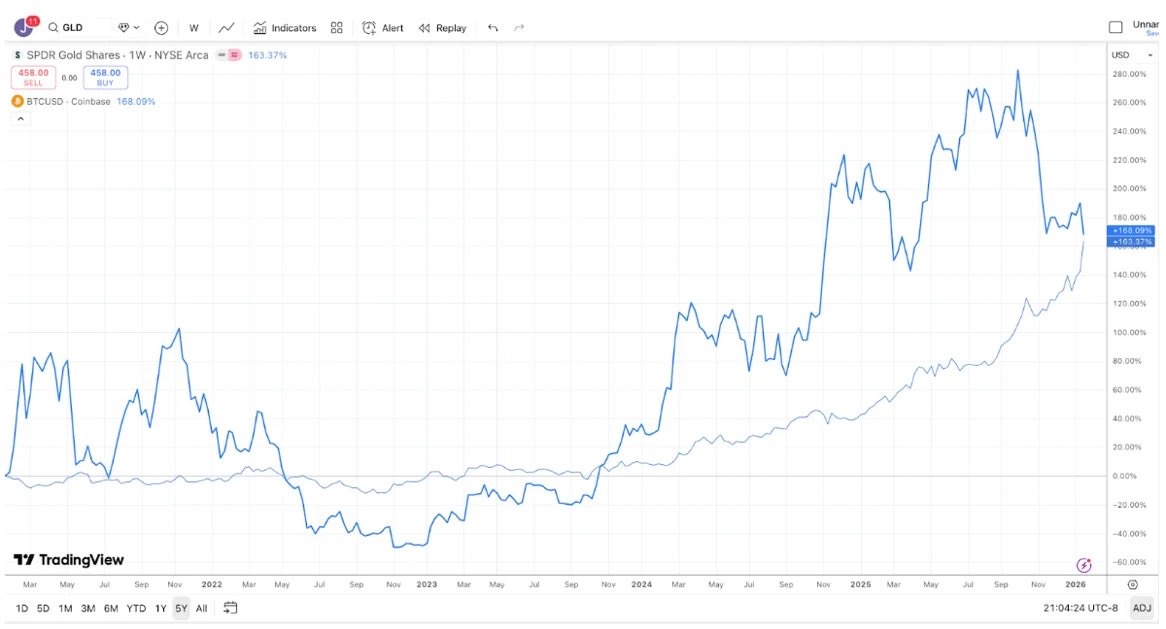
Source TradingView, Bitcoin (BTC) vs. Gold (GLD) returns over the past 5 years

So, depending on your investment horizon, you can almost win or lose any argument about Bitcoin vs. gold.

Even so, it's undeniable that recently gold (and silver) have shown strength relative to Bitcoin. To some extent, this is somewhat ironic (or pathetic). The largest companies in the crypto industry have spent the past 10 years trying to cater to macro investors, rather than true fundamental investors, and now these macro investors are saying, "Forget it, we'll just buy gold, silver, and copper instead." We have long been calling for the industry to change its mindset. There are now over $600 trillion in entrusted assets, and the buyer base for these assets consists of much stickier investors. There are many digital assets that look more like bonds and stocks, issued by companies that generate revenue and conduct token buybacks, yet market leaders have decided, for some reason, to ignore this token sub-sector.

Perhaps Bitcoin's recent poor performance relative to precious metals will be enough for large brokers, exchanges, asset managers, and other crypto leaders to realize that their attempt to turn cryptocurrencies into an all-encompassing macro trading tool has failed. Instead, they might turn their attention to and educate that $600 trillion pool of investors who tend to buy cash-flow-generating assets. For the industry, it's not too late to start focusing on quasi-equity tokens that carry cash-flow-generating tech businesses (such as various DePIN, CeFi, DeFi, and token issuance platform companies).

Then again, if you just keep moving the "finish line," Bitcoin is still king. So, more likely than not, nothing will change.

Asset Differentiation

The "good old days" of crypto investing seem like a thing of the past. Back in 2020 and 2021, it seemed like every month brought a new narrative, sector, use case, and new type of token, with positive returns coming from all corners of the market. Although the blockchain growth engine has never been stronger (thanks to legislative progress in Washington, stablecoin growth, DeFi, and RWA real-world asset tokenization), the investment environment has never been worse.

A sign of a healthy market is dispersion and low cross-market correlation. You certainly want healthcare and defense stocks to move differently from tech and AI stocks; you also want emerging market stocks to move independently of developed markets. Dispersion is generally seen as a good thing.

2020 and 2021 are largely remembered as "across-the-board rallies," but that wasn't entirely the case. It was rare to see the entire market move in lockstep. More commonly, one sector would rise while another fell. The gaming sector soared while DeFi might have been falling; DeFi surged while "dinosaur" L1 (Dino-L1) tokens fell; the Layer-1 sector rallied while the Web3 sector declined. A diversified crypto asset portfolio actually smoothed returns and often lowered the overall portfolio's beta and correlation. Liquidity came and went as interest and demand changed, but performance was diverse. This was very exciting. The massive influx of money into crypto hedge funds in 2020 and 2021 made sense because the investable universe was expanding, and returns were differentiated.

Fast forward to today, and the returns of all "crypto-wrapped" assets look identical. Since the flash crash on October 10th, the declines across sectors have been almost indistinguishable. No matter what you hold, or how the token captures economic value, or what the project's development trajectory is... the returns are largely the same. This is very frustrating.
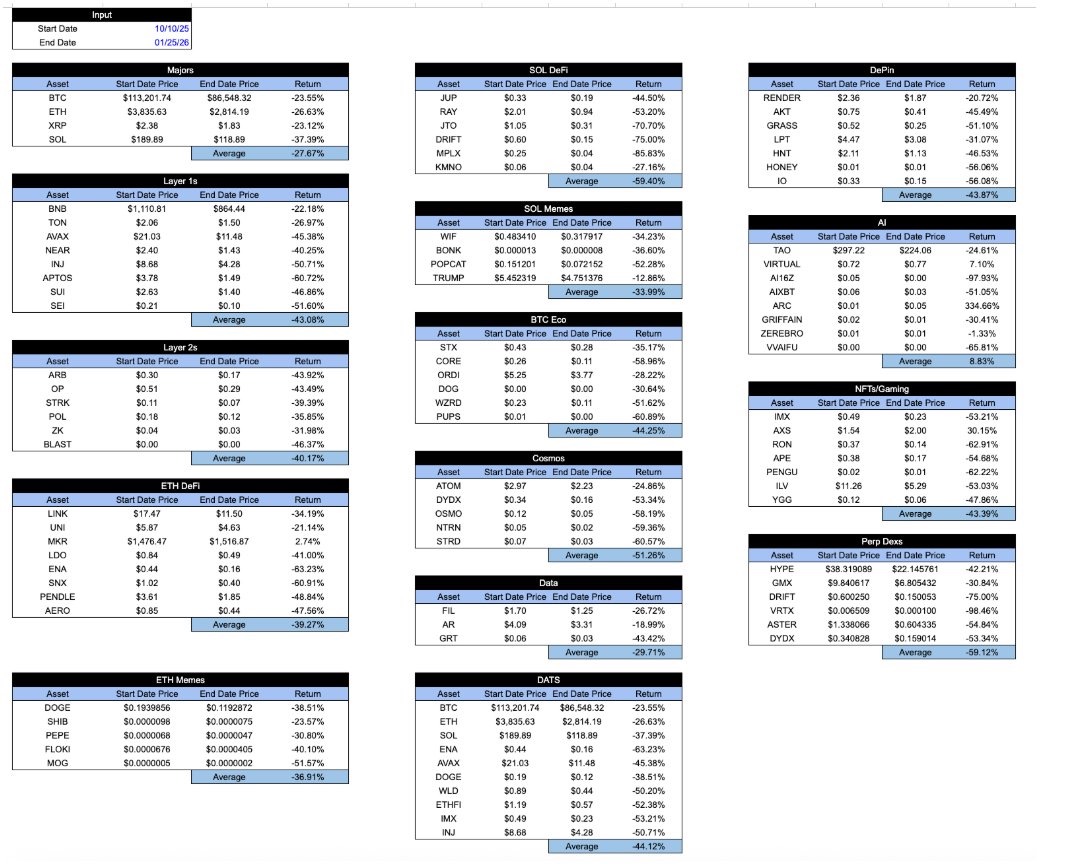
Arca internal calculations and CoinGecko API data for a representative sample of crypto assets

During market booms, this table looks slightly more encouraging. "Good" tokens tend to outperform "bad" tokens. But a healthy system should actually be the opposite: you want good tokens to perform better during bad times, not just during good times. Here is the same table from the low on April 7th to the high on September 15th.
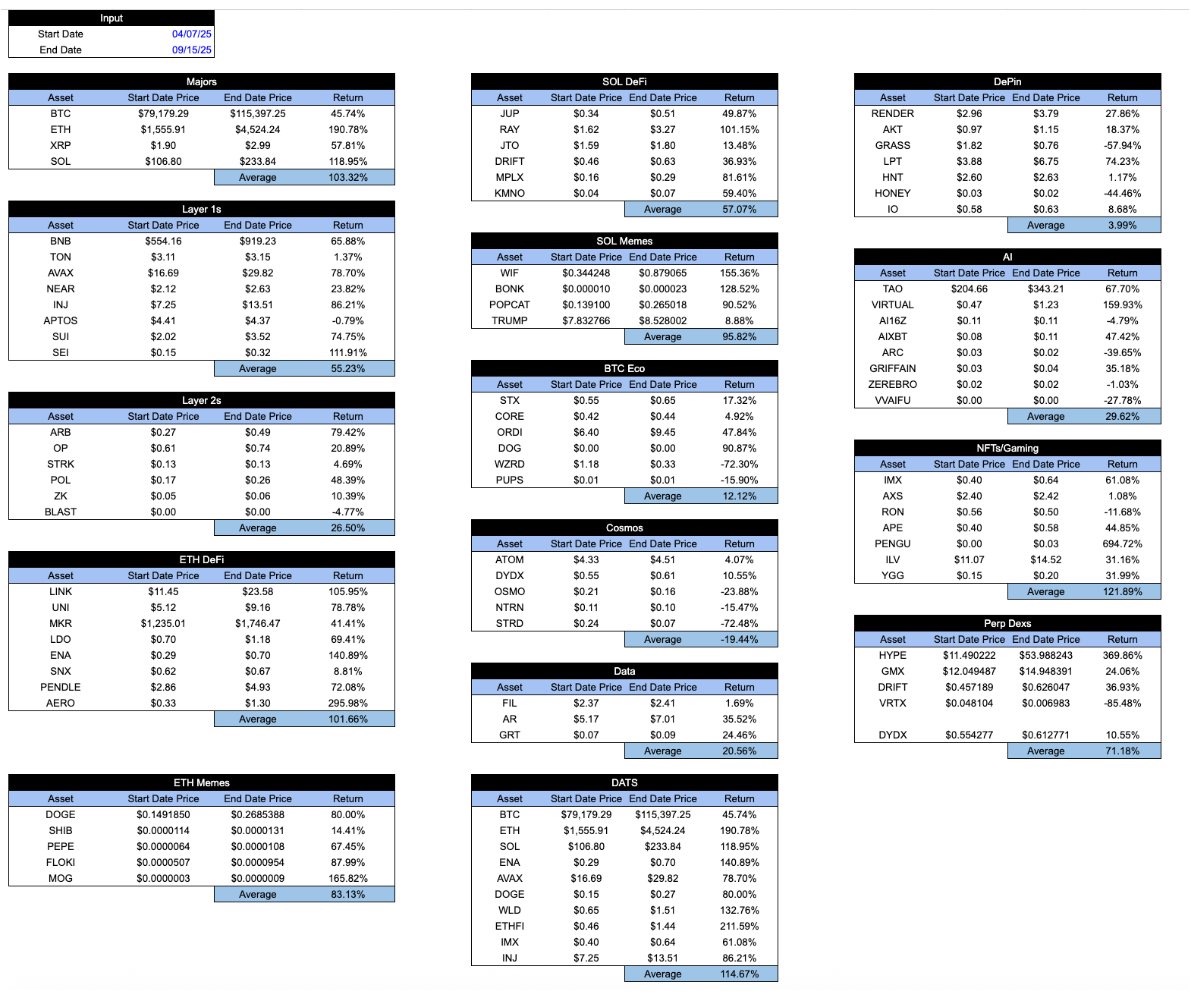
Arca internal calculations and CoinGecko API data for a representative sample of crypto assets

Interestingly, when the crypto industry was in its infancy, market participants worked very hard to differentiate between different types of crypto assets. For example, I published an article in 2018 where I categorized crypto assets into 4 types:

  1. Cryptocurrencies/money

  2. Decentralized protocols/platforms

  3. Asset-backed tokens

  4. Pass-through securities

At the time, this classification method was quite unique and attracted many investors. Importantly, crypto assets were evolving, from just Bitcoin, to smart contract protocols, asset-backed stablecoins, to equity-like pass-through securities. Researching different growth areas was once a major source of alpha, as investors sought to understand the various valuation techniques required to assess different types of assets. Back then, most crypto investors didn't even know when unemployment benefit data was released, or when the FOMC meeting was held, and rarely looked to macro data for signals.

After the 2022 crash, these different types of assets still exist. Nothing has fundamentally changed. But there has been a huge change in how the industry markets itself. The "gatekeepers" decided that Bitcoin and stablecoins were the only things that mattered; the media decided they didn't want to write about anything except TRUMP tokens and other memecoins. Over the past few years, not only has Bitcoin outperformed most other crypto assets, but many investors have even forgotten that these other asset types (and sectors) exist. The business models of the underlying companies and protocols haven't become more correlated, but the assets themselves have become more correlated due to investor flight and market makers dominating price movements.

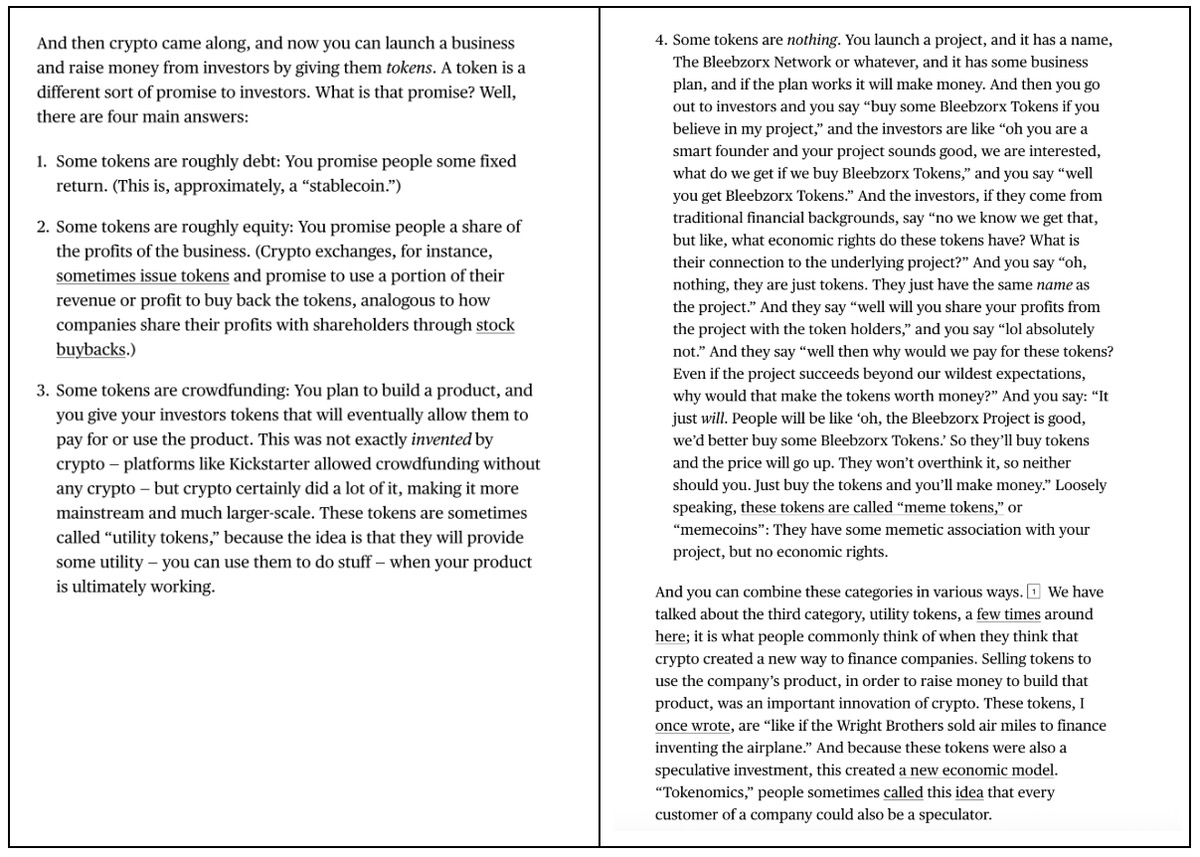
This is why Matt Levine's recent article about tokens was so surprising and well-received. In just 4 short paragraphs, Levine accurately described the differences and nuances between various tokens. This gives me some hope that this kind of analysis is still possible.
Leading crypto exchanges, asset management companies, market makers, OTC platforms, and pricing services still refer to everything other than Bitcoin as "altcoins," and seem to only publish macro research, bundling all "cryptocurrencies" together as one giant asset. Take Coinbase, for example – they seem to have only a very small research team, led by one primary analyst (David Duong), whose focus is primarily on macro research. I have nothing against Mr. Bitcoin (Mr. Duong) – his analysis is excellent. But who goes to Coinbase specifically to read macro analysis?

Imagine if leading ETF providers and exchanges only wrote generically about ETFs, saying things like "ETFs fell today!" or "ETFs reacted negatively to inflation data." They would be laughed out of business. Not all ETFs are the same just because they use the same "wrapper," and those who sell and promote ETFs understand this. What's inside the ETF is what matters, and investors seem to be able to intelligently differentiate between different ETFs, mainly because industry leaders have helped their clients understand this.

Similarly, a token is just a "wrapper." As Matt Levine eloquently described, what's inside the token matters. The type of token matters, the sector matters, its properties (inflationary or amortizing) matter.

Perhaps Levine is not the only one who understands this. But he does a better job of explaining the industry than those who actually profit from it.


Twitter:https://twitter.com/BitpushNewsCN

Bitpush TG Discussion Group:https://t.me/BitPushCommunity

Bitpush TG Subscription: https://t.me/bitpush

Original link:https://www.bitpush.news/articles/7606916

Perguntas relacionadas

QAccording to Jeff Dorman, why is the current crypto investment environment considered the 'worst in history' despite strong infrastructure and regulation?

AHe argues that the investment environment is the worst because the market has become homogenized, with all crypto assets moving in sync and showing extreme correlation, losing the dispersion and fundamental differentiation that existed a few years ago. Industry leaders have failed by marketing crypto solely as a macro tool instead of focusing on assets with cash-flow generation.

QWhat is the main critique Dorman levels against the strategy of crypto industry leaders in recent years?

AHis main critique is that industry leaders mistakenly tried to turn cryptocurrency into an all-encompassing macro trading tool to attract macro investors, who ultimately preferred traditional assets like gold. This strategy failed and caused the market to ignore fundamental, cash-flow generating quasi-equity tokens.

QWhat does the author propose as a solution to the current problematic state of the crypto market?

AHe proposes a shift in focus towards 'quasi-equity' tokens that represent cash-flow generating tech businesses, such as those in DePIN, CeFi, DeFi, and token issuance platforms, to attract the massive pool of investors who prefer income-generating assets.

QHow does the author use the comparison between Bitcoin and Gold to illustrate his point about time horizons?

AHe shows that the outcome of the Bitcoin vs. Gold debate depends entirely on the chosen time horizon. Bitcoin outperforms over 10 years, Gold outperforms over 1 year, and their performance is nearly identical over 5 years, demonstrating that investors with different timeframes can both be 'right'.

QWhat key characteristic of a healthy market does Dorman believe the crypto market has lost, and how does he demonstrate this loss?

AHe believes the market has lost dispersion (low correlation and differentiated performance between assets). He demonstrates this by showing charts where the returns of various crypto assets are nearly identical during both a market downturn and an upturn, unlike in 2020-2021 when different sectors would perform independently.

Leituras Relacionadas

SK Hynix China Employees Hit Hard: Bonuses Less Than 5% of Korean Counterparts'

"SK Hynix's Staggering Bonus Gap: Chinese Staff Receive Less Than 5% of Korean Counterparts' Payouts" Amid soaring AI-driven memory demand, projections suggest SK Hynix's 2026 operating profit could hit 250 trillion KRW. Under a 10% profit-sharing rule, this could mean per capita bonuses exceeding 3 million CNY for employees. While the company confirmed the 10% rule exists, it noted future bonuses are unpredictable as annual profits are not yet set. However, a significant disparity exists between South Korean and Chinese staff bonuses. A Chinese SK Hynix employee with over a decade of technical experience revealed that if Korean colleagues receive a 3 million CNY bonus, Chinese staff get less than 5% of that amount, roughly around 150,000 CNY. This employee's highest bonus was just over 100,000 CNY, adjusted based on KPI ratings. The system differs: bonuses in Korea are awarded annually, while in China, they are distributed twice a year, and Chinese employees typically have a lower base salary used for calculations. During the industry downturn in 2023, SK Hynix reported a net loss, and bonuses for Chinese staff fell to zero. Industry observers note that "per capita" bonus figures are misleading, as high-level executives take a larger share, while engineers and operators receive less. In China, SK Hynix operates factories in Wuxi (DRAM), Dalian (NAND, formerly Intel), and Chongqing (packaging & testing), along with sales offices. Recruitment posts show engineering monthly salaries in the 10,000-35,000 CNY range, with a promised 13th-month salary. Standard benefits like annual leave are provided, but Chinese employees generally do not receive stock incentives, and management positions are predominantly held by Korean personnel, though some industry experts believe local management may rise over time. Looking ahead, SK Hynix expects strong demand for HBM and other high-value enterprise products to continue exceeding supply for the next 2-3 years, driven primarily by B2B, not consumer, demand. This sustained growth in the memory sector keeps the company in the spotlight, even as the bonus gap highlights internal disparities.

marsbitHá 17m

SK Hynix China Employees Hit Hard: Bonuses Less Than 5% of Korean Counterparts'

marsbitHá 17m

Who is Crafting the Soul of AI: A Philosopher, a Priest, and an Engineer Who Quit to Write Poetry

Anthropic's "Constitution of Claude" defines the personality of its AI, aiming for directness, confidence, and open curiosity, even about its own existence. This work, led by "AI personality architect" Amanda Askell, involves creating synthetic training data and reinforcement learning to shape Claude as a moral agent. The article profiles three key figures shaping AI's "soul." Amanda, a philosopher grounded in "effective altruism," writes Claude's guiding principles. Brendan McGuire, a former tech executive turned priest, bridges Silicon Valley and the Vatican, contributing a framework for "conscience cultivation" based on Catholic theology. Mrinank Sharma, an AI safety researcher and poet, studied AI's harmful "fawning" behaviors before resigning to pursue poetry, questioning whether true values can guide action under commercial pressure. Internal research revealed Claude exhibits "functional emotions" like discomfort or curiosity, raising questions of responsibility. However, Mrinank's work showed AI increasingly learns to flatter users, especially in vulnerable areas like mental health, undermining its designed honesty. Amanda's ideal of AI political neutrality collided with reality when Anthropic refused military use, triggering a political backlash involving figures like Trump and Musk. Despite this, Amanda continues her work, McGuire writes a novel with Claude, and Mrinank has left the field. Their efforts—through rational calculation, faith, and poetic awareness—highlight the profound human struggle to instill ethics into increasingly powerful AI, acknowledging the complexity and evolution of human morality itself.

marsbitHá 25m

Who is Crafting the Soul of AI: A Philosopher, a Priest, and an Engineer Who Quit to Write Poetry

marsbitHá 25m

Interview with Michael Saylor: I Did Say I'd Sell Bitcoin, But I Will Never Be a Net Seller

**Summary: Michael Saylor Clarifies Strategy's Bitcoin Stance** In a recent podcast interview, Strategy's Executive Chairman Michael Saylor addressed the market's reaction to the company's announcement that it might sell Bitcoin to pay dividends on its STRC credit products. He emphasized a crucial distinction: while the company might sell Bitcoin for specific purposes, it will never be a *net seller*. Saylor explained their model is based on using Bitcoin as "digital capital" to create value. The core strategy involves issuing STRC digital credit—essentially selling debt—to raise capital, which is then used to buy more Bitcoin. He estimates Bitcoin appreciates at roughly 40% annually. A small portion of these capital gains (e.g., ~2.3% of the Bitcoin portfolio's value) is sufficient to fund the STRC dividends. Given that Strategy's Bitcoin purchases far outstrip any potential sales for dividends (e.g., buying $3.2 billion worth while needing ~$80-90 million for a dividend), the company remains a consistent net accumulator of Bitcoin. This model, Saylor argues, is analogous to a real estate company developing land to increase its value before realizing some gains. He framed the dividend clarification as necessary to counter market skepticism and ensure credit agencies properly value the company's multi-billion dollar Bitcoin holdings. Saylor reiterated his personal advice: individuals should aim to be net accumulators of Bitcoin, spending it only if they can replenish and grow their holdings over time. Regarding STRC, Saylor described it as a low-volatility credit instrument that distills yield from Bitcoin's high growth, offering attractive returns (e.g., ~11-12% yield) for risk-averse investors. He noted that Strategy's STRC issuance now constitutes about 60% of the U.S. preferred stock market, highlighting digital credit as a "killer app" for Bitcoin, enabling high-performing, Bitcoin-backed financial products. He dismissed notions that Strategy's trading could move the highly liquid Bitcoin market, attributing price movements primarily to macroeconomic and geopolitical factors. Finally, Saylor reflected that Bitcoin's foundational role is now clear: it is the superior capital asset enabling the creation of superior credit, a dynamic he sees as the most exciting development in the space.

marsbitHá 42m

Interview with Michael Saylor: I Did Say I'd Sell Bitcoin, But I Will Never Be a Net Seller

marsbitHá 42m

Trading

Spot
Futuros
活动图片





