No Agreement Reached In White House Meeting Between Banks And The Crypto Industry

bitcoinistPublicado em 2026-02-12Última atualização em 2026-02-12

A second White House meeting between major U.S. banks and leading crypto firms ended without a deal on stablecoin yield, leaving one of the most contentious issues in U.S. digital asset regulation unresolved.

The February 10 session, led by Patrick Witt, Executive Director of the President’s Crypto Council, focused on whether stablecoin issuers should be allowed to offer yield or rewards to holders.

While participants described the talks as more detailed than previous discussions, no compromise was reached. The outcome keeps the proposed Digital Asset Market Clarity Act of 2025, known as the CLARITY Act, stalled in the Senate Banking Committee.
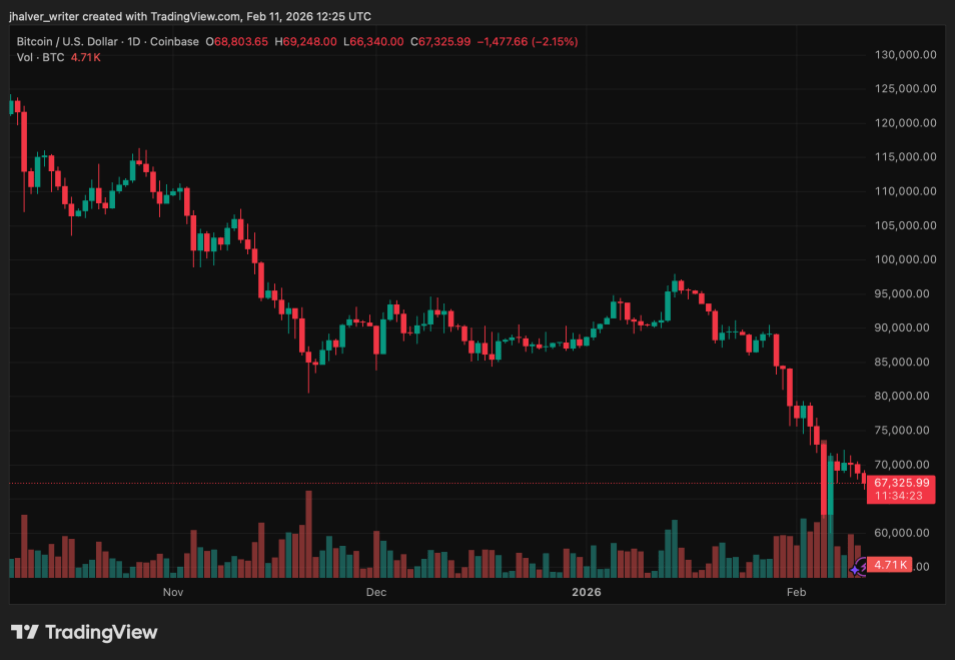
BTC's price trends to the downside on the daily chart. Source: BTCUSD on Tradingview

Stablecoin Yield at the Center of the Dispute

At the heart of the disagreement is whether stablecoin rewards resemble bank interest and, if so, should face similar restrictions.

Banking representatives from Goldman Sachs, JPMorgan, Bank of America, Wells Fargo, Citi, PNC, and U.S. Bank argued that yield-bearing stablecoins could trigger large-scale deposit outflows from traditional banks.

Banks presented a written set of “prohibition principles” calling for a ban on “any form of financial or non-financial consideration” offered to stablecoin holders. They contend that allowing such rewards could undermine lending capacity and disrupt the traditional deposit model.

Crypto firms, including Coinbase, Ripple, a16z, Paxos, and the Blockchain Association, pushed back. They argue that stablecoin rewards are a core feature of on-chain finance and necessary for fair competition with traditional financial products.

Industry representatives also said overly restrictive rules could slow innovation or drive activity outside the United States.

CLARITY Act Remains in Limbo

The debate over stablecoin yield has become a key obstacle for the CLARITY Act, which aims to define regulatory oversight for digital assets and clarify the roles of the SEC and the CFTC. The bill passed the House in 2025 but has not advanced in the Senate due to unresolved concerns around stablecoin regulation.

Although banks maintained a firm stance, participants noted a shift in tone. For the first time, banking representatives signaled limited openness to discussing potential exemptions for transaction-based rewards. However, disagreements over what qualifies as “permissible activities” remain unresolved.

The White House has urged both sides to reach an agreement by March 1 to preserve legislative momentum. Further discussions are expected in the coming days, though it is unclear whether another full-scale meeting will be held before the deadline.

Until a compromise is reached, stablecoin regulation and broader reform of the U.S. crypto market structure remain in a holding pattern.

Cover image in ChatGPT, BTCUSD chart on Tradingview

Perguntas relacionadas

QWhat was the main topic of disagreement in the White House meeting between banks and crypto firms?

AThe main topic was whether stablecoin issuers should be allowed to offer yield or rewards to holders.

QWhich major financial institutions argued against yield-bearing stablecoins?

ARepresentatives from Goldman Sachs, JPMorgan, Bank of America, Wells Fargo, Citi, PNC, and U.S. Bank argued against them.

QWhat is the name of the proposed legislation that is currently stalled due to this disagreement?

AThe proposed legislation is called the Digital Asset Market Clarity Act of 2025, also known as the CLARITY Act.

QWhat was the primary concern expressed by the banking representatives regarding stablecoin rewards?

AThey argued that yield-bearing stablecoins could trigger large-scale deposit outflows from traditional banks and undermine their lending capacity.

QWhat was the deadline given by the White House for the two sides to reach an agreement?

AThe White House urged both sides to reach an agreement by March 1 to preserve legislative momentum.

Leituras Relacionadas

First Day Review of "Musk's WeChat" XChat: Even Worse Than Expected

Elon Musk's much-anticipated "WeChat-like" app, XChat, has officially launched after multiple delays. The initial review reveals a product that falls short of expectations, offering an experience largely similar to X Platform's (formerly Twitter) direct messages, despite being marketed as an encrypted communication tool. Key observations from the first-day test include: 1. The app's promoted "end-to-end encryption" and its claimed relation to Bitcoin's architecture were criticized by experts as a superficial attempt to capitalize on crypto buzz, with no real technical connection. 2. Musk's vision of an ad-free "secure communication system" is technically met, but only because the app is currently extremely basic, featuring only a single chat interface. 3. A promised anti-screenshot feature appears inconsistent; it works in X Platform group chats but fails within the XChat app itself, where screenshots still capture avatars. 4. The app supports 45 languages and has a 16+ age rating, indicating a broader tolerance for content compared to WeChat's 13+ rating. 5. A puzzling login process requires users to verify the email associated with their X account. 6. The touted encryption" feels minimal in practice, with its presence only indicated by a simple "Encrypted - Yes" label on messages. 7. Disappearing message timers for groups can be set from 5 minutes to 4 weeks, with the timer starting upon being read by a user. 8. Group invite links are shared with X Platform groups. 9. Group size limits are planned to be increased, aiming for 1000 members, a move that has drawn user criticism. 10. The app offers 8 different colored icons, and its chat bubbles are notably similar to WeChat's. Message deletion options mimic Telegram's. Crucially, many pre-announced features like importing X contacts, integrating Grok AI, X Money payments, and Cashtags are not yet available. The initial release is seen as a bare-bones and underwhelming first step.

Odaily星球日报Há 51m

First Day Review of "Musk's WeChat" XChat: Even Worse Than Expected

Odaily星球日报Há 51m

Trading

Spot
Futuros

Artigos em Destaque

Como comprar HOUSE

Bem-vindo à HTX.com!Tornámos a compra de Housecoin (HOUSE) simples e conveniente.Segue o nosso guia passo a passo para iniciar a tua jornada no mundo das criptos.Passo 1: cria a tua conta HTXUtiliza o teu e-mail ou número de telefone para te inscreveres numa conta gratuita na HTX.Desfruta de um processo de inscrição sem complicações e desbloqueia todas as funcionalidades.Obter a minha contaPasso 2: vai para Comprar Cripto e escolhe o teu método de pagamentoCartão de crédito/débito: usa o teu visa ou mastercard para comprar Housecoin (HOUSE) instantaneamente.Saldo: usa os fundos da tua conta HTX para transacionar sem problemas.Terceiros: adicionamos métodos de pagamento populares, como Google Pay e Apple Pay, para aumentar a conveniência.P2P: transaciona diretamente com outros utilizadores na HTX.Mercado de balcão (OTC): oferecemos serviços personalizados e taxas de câmbio competitivas para os traders.Passo 3: armazena teu Housecoin (HOUSE)Depois de comprar o teu Housecoin (HOUSE), armazena-o na tua conta HTX.Alternativamente, podes enviá-lo para outro lugar através de transferência blockchain ou usá-lo para transacionar outras criptomoedas.Passo 4: transaciona Housecoin (HOUSE)Transaciona facilmente Housecoin (HOUSE) no mercado à vista da HTX.Acede simplesmente à tua conta, seleciona o teu par de trading, executa as tuas transações e monitoriza em tempo real.Oferecemos uma experiência de fácil utilização tanto para principiantes como para traders experientes.

266 Visualizações TotaisPublicado em {updateTime}Atualizado em 2025.04.27

Como comprar HOUSE

Discussões

Bem-vindo à Comunidade HTX. Aqui, pode manter-se informado sobre os mais recentes desenvolvimentos da plataforma e obter acesso a análises profissionais de mercado. As opiniões dos utilizadores sobre o preço de HOUSE (HOUSE) são apresentadas abaixo.

活动图片













