a16z Founder: In the Agent Era, What Truly Matters Has Changed

marsbitPublicado em 2026-04-25Última atualização em 2026-04-25

Resumo

Founder of a16z Marc Andreessen discusses the transformative shift into the Agent era in a recent podcast. He emphasizes that today’s AI is not an overnight breakthrough but the result of an 80-year evolution, now reaching practical utility. Key developments include the convergence of LLMs, reasoning models, coding capabilities, and agent-based recursive self-improvement. Andreessen describes agents as systems integrating LLMs with shells, file systems, markdown, and schedulers—combining new AI with established software components. This architecture enables introspection, state persistence, and cross-platform execution, moving beyond chatbots toward agent-first interaction. He predicts traditional UIs will fade as agents execute tasks on behalf of users or other bots. He compares the current AI investment cycle to the dot-com bubble but highlights stronger fundamentals, with major tech firms leading scalable, revenue-generating infrastructure expansion. Open source, edge inference, and local AI deployment are critical to global adoption and competition. Andreessen also addresses broader challenges: security risks, identity verification, financial infrastructure for agents, and organizational adoption. He cautions that societal and institutional barriers will shape the pace of AI integration, tempering both utopian and dystopian expectations.

Source:

This is the latest interview with a16z founder Marc Andreessen on the Latent Space podcast.

He is a renowned American internet entrepreneur and a key figure in the early development of the internet; after founding a16z, he has become a representative of top investors in Silicon Valley.

The entire conversation revolves around the history and latest trends of AI development, making it highly worth reading.

1. This Wave of AI Did Not Emerge Out of Nowhere; It Is the First Comprehensive "Start of Work" After an 80-Year Technological Marathon
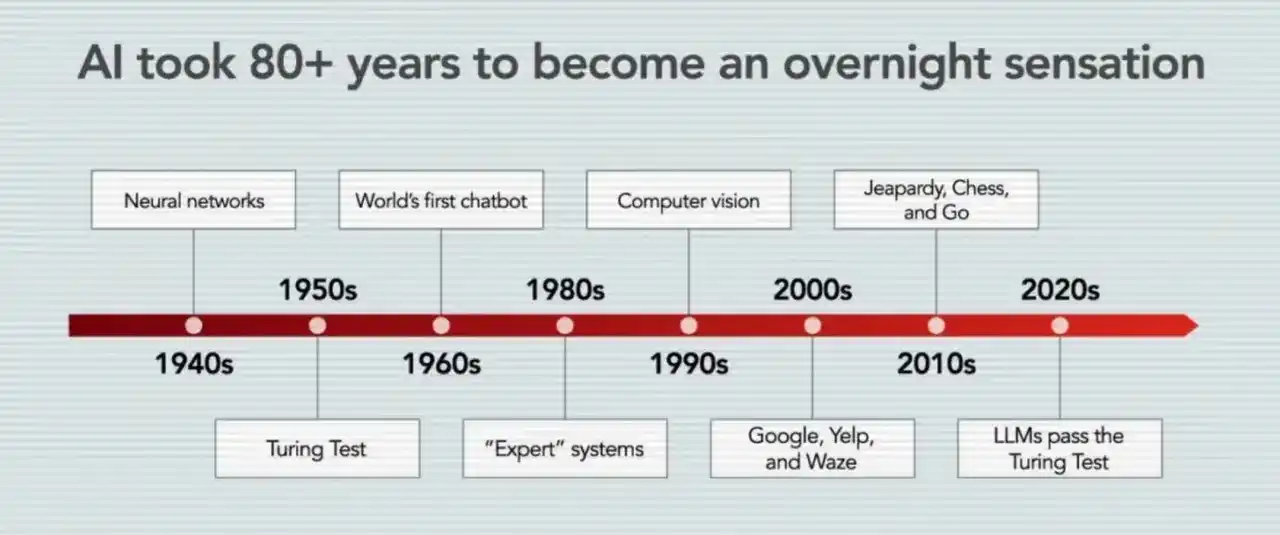
· This wave of AI did not emerge out of nowhere; it is the result of an 80-year technological marathon.

· Marc Andreessen directly refers to the present as an "80-year overnight success," meaning that the sudden explosion in the public eye is actually the concentrated release of decades of technological accumulation.

· He traces this technological lineage back to early neural network research and emphasizes that the industry has now accepted the judgment that "neural networks are the correct architecture."

· In his narrative, the key milestones are not single moments but a series of developments: AlexNet, Transformer, ChatGPT, reasoning models, and then agents and self-improvement.

· He particularly emphasizes that this time, it is not just text generation that has improved; four types of capabilities have emerged simultaneously: LLMs, reasoning, coding, and agents/recursive self-improvement.

· The reason he believes "this time is different" is not because the narrative is more compelling, but because these capabilities have already started to work on real-world tasks.

2. The Agent Architecture Represented by Pi and OpenClaw Is a Deeper Change in Software Architecture Than Chatbot
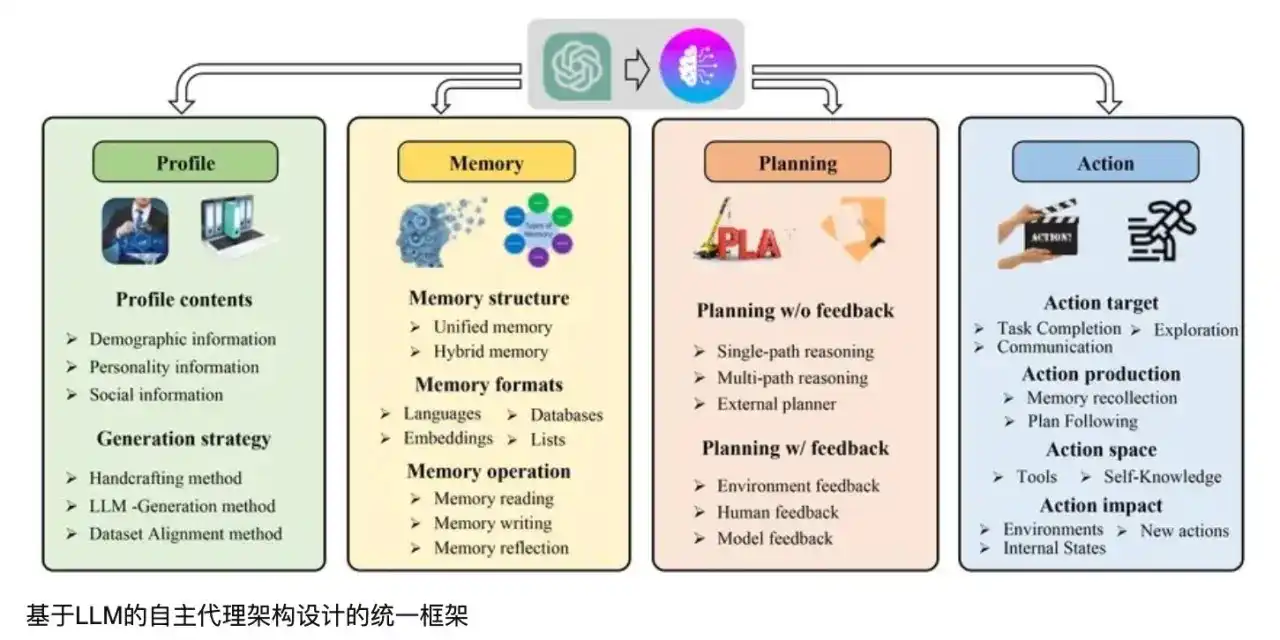
· He describes agents very concretely: essentially, they are "LLM + shell + file system + markdown + cron/loop." In this structure, the LLM is the core for reasoning and generation, the shell provides the execution environment, the file system saves the state, markdown makes the state readable, and cron/loop provides periodic awakening and task progression.

· He believes the importance of this combination lies in the fact that, apart from the model itself being new, all other components are mature, understandable, and reusable parts of the software world.

· The state of the agent is saved in files, allowing it to migrate across models and runtimes; the underlying model can be replaced, but the memory and state remain preserved.

· He repeatedly emphasizes introspection: the agent knows its files, can read its state, and can even rewrite its files and functions, moving toward "extend yourself."

· In his view, the real breakthrough is not just that "the model can answer," but that the agent can leverage existing Unix toolchains to integrate the potential capabilities of the entire computer.

3. Browsers, Traditional GUIs, and the Era of "Human-Clicking Software" Will Gradually Be Replaced by Agent-First Interaction Methods

· Marc Andreessen has explicitly stated that in the future, "you may no longer need a user interface."

· He further pointed out that the primary users of future software may not be humans but "other bots."

· This means that many of today's interfaces designed for human clicking, browsing, and form-filling will degenerate into execution layers called by agents in the background.

· In this world, humans are more like goal-setters: telling the system what they want, and then having agents call services, operate software, and complete processes.

· He connects this change to the broader future of software: high-quality software will become increasingly "abundant," no longer a scarce product handcrafted by a few engineers.

· He also predicts that the importance of programming languages will decline; models will write code across languages, translate between them, and in the future, humans will care more about explaining why the AI organized the code in a certain way rather than rigidly adhering to a specific language.

· He even mentions a more radical direction: conceptually, AI may not only output code but also directly output lower-level binary code or model weights.

4. This AI Investment Cycle Has Similarities to the 2000 Internet Bubble, but the Underlying Supply-Demand Structure Is Different

· Reflecting on 2000, he emphasizes that the crash was largely not because "the internet didn't work," but because of overbuilding in telecommunications and bandwidth infrastructure, with fiber optics and data centers being laid out too early and then taking a long time to be absorbed.

· He believes that today, there are indeed concerns about "overbuilding," but the main investors are large companies with strong cash flows like Microsoft, Amazon, and Google, rather than highly leveraged, fragile players.

· He particularly points out that today, as long as an investment in operable GPUs is made, it can usually be quickly converted into revenue, which is different from the大量闲置 capacity in 2000.

· He also emphasizes that what we are using now is a "sandbagged" version of the technology: due to shortages in GPU, memory, data center, and other supplies, the model's potential has not been fully unleashed.

· In his judgment, the real constraints in the coming years will not only be GPUs but also bottlenecks in the联动 of CPUs, memory, networks, and the entire chip ecosystem.

· He juxtaposes AI scaling laws with Moore's Law, believing that they not only describe规律 but also continuously stimulate capital, engineering, and industry collaboration to advance.

· He mentions a counterintuitive but important phenomenon: as software optimization speeds up, some older-generation chips may even become more economically valuable than when they were first purchased.

5. Open Source, Edge Inference, and Local Operation Are Not Peripheral but Part of the AI Competitive Landscape

· Marc Andreessen clearly believes that open source is very important, not just because it is free, but because it "teaches the world how it is made."

· He describes open-source releases like DeepSeek as a "gift to the world," because code + papers quickly disseminate knowledge and raise the entire industry's baseline.

· In his narrative, open source is not just a technical choice but also a geopolitical and market strategy: different countries and companies will adopt different openness strategies based on their commercial constraints and influence goals.

· He also emphasizes the importance of edge inference: in the coming years, centralized inference costs may not be low enough, and many consumer-level applications cannot bear the long-term high costs of cloud inference.

· He mentions a recurring pattern: what seems "impossible to run on a PC today" often becomes possible on local machines just a few months later.

· Besides cost, factors driving local operation include trust, privacy, latency, and usage scenarios: wearable devices, door locks, portable devices, etc., are more suitable for low-latency, on-site inference.

· His judgment is very direct: almost everything with a chip may come with an AI model in the future.

6. The Real Challenges of AI Lie Not Only in Model Capabilities but Also in Security, Identity, Money Flow, Organizational and Institutional Resistance

· On security, his judgment is very sharp: almost all potential security bugs will be更容易被发现, and there may be a short-term "computer security catastrophe."

· But he also believes that programming intelligences will scale the ability to patch vulnerabilities; in the future, the way to "protect software" may be to have bots scan and fix it.

· On the identity issue, he believes that "proof of bot" is not feasible because bots will become increasingly powerful; the真正可行的方向 is "proof of human," which is the combination of biometrics, cryptographic verification, and selective disclosure.

· He also discusses a frequently overlooked problem: if agents are to truly operate in the real world, they will eventually need money, payment capabilities, and even some form of bank accounts, cards, or stablecoin-like infrastructure. At the organizational level, he uses the framework of managerial capitalism, suggesting that AI may重新强化 founder-led companies, because bots are very good at reports, coordination, paperwork, and大量 "managerial work."

· However, he does not believe that society will quickly and smoothly accept AI: he cites examples like professional licenses, unions, dockworker strikes, government departments, K-12 education, and healthcare to illustrate that there are many institutional speed bumps in the real world.

· His judgment is that both AI utopians and doomsayers tend to overlook one thing: just because something is technologically possible does not mean that 8 billion people will immediately change accordingly.


Criptomoedas em alta

Perguntas relacionadas

QAccording to Marc Andreessen, why is the current AI boom considered an '80-year overnight success'?

ABecause the public sees it as a sudden explosion, but it's actually the concentrated release of decades of technological accumulation, tracing back to early neural network research.

QWhat core components does Marc Andreessen describe as essential for an AI agent's architecture?

AHe describes it as 'LLM + shell + file system + markdown + cron/loop', where the LLM is the reasoning core, the shell provides the execution environment, the file system saves state, markdown ensures readability, and cron/loop enables periodic activation and task progression.

QHow does Marc Andreessen believe software interaction will change in the future with the rise of agents?

AHe believes traditional user interfaces like browsers and GUIs will be gradually replaced by agent-first interaction, where humans specify goals and agents call services and operate software to complete tasks, with software increasingly being used by 'other bots' rather than humans.

QWhat key difference does Marc Andreessen highlight between the current AI investment cycle and the 2000 internet bubble?

AHe points out that while there are concerns about overbuilding today, the current investments are primarily made by cash-rich large companies like Microsoft and Amazon, not highly leveraged fragile players. Furthermore, GPU investments can quickly turn into revenue, unlike the大量闲置容量 (massive idle capacity) of 2000.

QWhat is Marc Andreessen's view on the importance of open source and edge inference in AI?

AHe believes open source is crucial not just for being free, but for allowing the world to learn how AI is made, rapidly spreading knowledge. He also emphasizes the importance of edge inference for cost, trust, privacy, latency, and use cases, stating that almost anything with a chip will likely have an AI model in the future.

Leituras Relacionadas

Analyzing the Impact of AI on Economic Growth and Productivity

**Title: Analyzing AI's Impact on Economic Growth and Productivity** This article examines three contrasting views on AI's influence on economic growth and productivity. **The Optimistic View** posits that AI, especially through automating R&D ("recursive self-improvement"), could dramatically accelerate growth, even triggering a technological "singularity" with explosive, potentially infinite, economic expansion. **The Moderate/Mainstream View** acknowledges AI's productivity benefits but emphasizes significant real-world constraints that could limit its impact. These include: limited cost savings per task, structural ceilings on which jobs and industries are "exposed" to AI, adoption bottlenecks (e.g., compute, energy, regulatory hurdles), and the "weak link" effect where non-automatable tasks cap overall gains. Consequently, the realized AI dividend may be far lower than optimistic projections, with estimates typically ranging from 0.1% to 1.3% annual productivity growth. **The Pessimistic View** stems from two strands. The first aligns with the moderate view but applies extremely conservative assumptions about task exposure and efficiency gains, yielding minimal projected impact. The second introduces a demand-side critique: if AI primarily replaces rather than augments labor, it could depress labor's share of income, weaken consumer demand, and create a "demand trap" that ultimately stifles growth, unless offset by redistribution policies. **The authors' assessment** is nuanced: * **Short-term (1-2 years):** AI will support growth primarily through investment spending, not significant productivity gains. * **Medium-term (3-5 years):** Three potential paths emerge based on AI demand and bottleneck severity: 1. **"Optimistic Path":** High demand, few bottlenecks. Rapid productivity gains but risk of major job displacement and social conflict without redistribution. 2. **"Moderate Path" (most likely):** High demand but significant, surmountable bottlenecks. Leads to moderate productivity gains, financial market volatility (K-shaped returns), and sectoral job losses. 3. **"Pessimistic Path":** Low demand or severe bottlenecks. Minimal productivity and growth impact, triggering financial market corrections but allowing a smoother societal transition with less labor disruption. * **Long-term:** AI holds potential for a major productivity revolution and prosperity. The conclusion stresses that no path is smooth. Technologically "optimistic" outcomes could be socially detrimental, while "pessimistic" technological diffusion might be more socially stable. Policymakers must monitor developments and prepare balanced responses to manage economic, financial, and social sustainability.

marsbitHá 3m

Analyzing the Impact of AI on Economic Growth and Productivity

marsbitHá 3m

The New Cold War is a Tech Stock War

The New Cold War is a Tech Stock War The article argues that the contemporary geopolitical and economic rivalry between the US and China represents a "New Cold War," but one fundamentally fought through technology and financial markets, not physical barriers or conventional trade. Historically, US dominance was secured through financial systems. The Soviet Union, reliant on the rigid "Transferable Ruble," was ultimately undermined by its dependency on the US dollar for oil trade. Later, Japan's semiconductor challenge was countered not just by tariffs (e.g., Plaza Accord, 301 investigations) but by binding it to US Treasury bonds. China presents a more complex, "embedded" challenger. While it holds vast dollar reserves and US debt like Japan, its industrial base is stronger and more diversified than the Soviet Union's. Surviving the initial 2018 trade war phase, the conflict has evolved into a "tech-financial war." The core battlefield is now the stock market. US tech stocks (AI, semiconductors) are treated as sovereign assets, buoyed by bipartisan national will. China is pushing to strengthen its own financial markets to convert industrial strength into financial power and fund its tech ambitions. Companies like ChangXin (semiconductors), Moonshot AI, and DJI compete not just for market share but as financial proxies for their respective systems. The new paradigm is moving from globally efficient monopolies (Apple, Google) towards companies that achieve monopolistic profits within their respective geopolitical spheres. This competition over "pricing power" and financial valuation in segmented markets defines the current era, making the stock market the primary arena for this tech-centric struggle.

marsbitHá 12m

The New Cold War is a Tech Stock War

marsbitHá 12m

RWA Weekly: Ten European Financial Institutions Establish Tokenized Asset Cooperative; Ondo Launches New Execution Network Ondo Network

RWA Weekly: European Banks Form Tokenized Asset Cooperative; Ondo Launches New Execution Network Ondo Network Covering July 24-31, 2026, the RWA sector saw a steady on-chain total value locked (TVL) of $36.8 billion, with holder count hitting a record high. However, stablecoin transfer volumes fell sharply (~30%), indicating low on-chain settlement demand. Key regulatory moves include South Korea advancing stablecoin legislation and a push to scrap crypto taxes, Kenya lowering capital requirements for stablecoin issuers, and Zimbabwe approving seven projects for its crypto sandbox. In project developments, BIS-led Project Agorá successfully tested cross-border payments with tokenized funds across six currencies. Ten major European financial institutions formed the RL1 blockchain cooperative to build tokenized asset infrastructure. Other notable updates: Aviva launched a tokenized dollar liquidity fund on XRPL, POSCO International tokenized commercial invoices on Injective, and a Brazilian farmer used tokenized cattle as collateral for a loan. Additional progress includes BNY Mellon migrating its core transfer agent operations to blockchain, Securitize gaining SEC investment advisor registration, and Tether’s compliant stablecoin USA₮ launching on Celo. Ondo Finance introduced Ondo Network, a new execution layer focused on speed and privacy, moving away from its initial chain plans. An analysis highlights that despite the growing scale of on-chain RWAs (~$32B), approximately 90% remain underutilized in DeFi, pointing to a critical challenge in unlocking liquidity and fostering real-world application beyond mere issuance.

marsbitHá 12m

RWA Weekly: Ten European Financial Institutions Establish Tokenized Asset Cooperative; Ondo Launches New Execution Network Ondo Network

marsbitHá 12m

South Korean Stock Market Sees Sharp Rebound After Forceful De-leveraging, SK Hynix Rises 30%

On July 31, South Korean stocks staged a historic rebound. The benchmark KOSPI index surged 18.27%, with chipmaker SK Hynix hitting a 30% gain limit. This followed a brutal, near-40% decline in the KOSPI over the previous month, driven largely by a deleveraging spiral involving leveraged ETFs. Analysts attributed the sharp sell-off to structural liquidity issues rather than deteriorating corporate fundamentals. The rally was triggered by a confluence of positive catalysts. Firstly, strong earnings from U.S. cloud giants Microsoft and Amazon alleviated fears of an "AI bubble burst," boosting global tech sentiment. Secondly, SK Group Chairman Chey Tae-won made a rare personal purchase of SK Hynix shares, seen as a strong vote of confidence. Thirdly, the South Korean government announced a 20 trillion won ($139 billion) AI investment fund. In response to the market turmoil, South Korean regulators are tightening controls on leveraged ETFs, admitting oversight shortcomings. Measures include raising minimum cash保证金 requirements for散户 investors and suspending new product launches. While the rebound signals eased liquidity pressure, analysts note deep structural issues remain. The market's future stability is seen as dependent on global tech capital expenditure trends and memory chip price cycles, with some viewing the surge as a technical correction rather than a definitive trend reversal.

marsbitHá 33m

South Korean Stock Market Sees Sharp Rebound After Forceful De-leveraging, SK Hynix Rises 30%

marsbitHá 33m

Trading

Spot

Artigos em Destaque

Como comprar ERA

Bem-vindo à HTX.com!Tornámos a compra de Caldera (ERA) simples e conveniente.Segue o nosso guia passo a passo para iniciar a tua jornada no mundo das criptos.Passo 1: cria a tua conta HTXUtiliza o teu e-mail ou número de telefone para te inscreveres numa conta gratuita na HTX.Desfruta de um processo de inscrição sem complicações e desbloqueia todas as funcionalidades.Obter a minha contaPasso 2: vai para Comprar Cripto e escolhe o teu método de pagamentoCartão de crédito/débito: usa o teu visa ou mastercard para comprar Caldera (ERA) instantaneamente.Saldo: usa os fundos da tua conta HTX para transacionar sem problemas.Terceiros: adicionamos métodos de pagamento populares, como Google Pay e Apple Pay, para aumentar a conveniência.P2P: transaciona diretamente com outros utilizadores na HTX.Mercado de balcão (OTC): oferecemos serviços personalizados e taxas de câmbio competitivas para os traders.Passo 3: armazena teu Caldera (ERA)Depois de comprar o teu Caldera (ERA), armazena-o na tua conta HTX.Alternativamente, podes enviá-lo para outro lugar através de transferência blockchain ou usá-lo para transacionar outras criptomoedas.Passo 4: transaciona Caldera (ERA)Transaciona facilmente Caldera (ERA) no mercado à vista da HTX.Acede simplesmente à tua conta, seleciona o teu par de trading, executa as tuas transações e monitoriza em tempo real.Oferecemos uma experiência de fácil utilização tanto para principiantes como para traders experientes.

538 Visualizações TotaisPublicado em {updateTime}Atualizado em 2026.06.02

Como comprar ERA

Discussões

Bem-vindo à Comunidade HTX. Aqui, pode manter-se informado sobre os mais recentes desenvolvimentos da plataforma e obter acesso a análises profissionais de mercado. As opiniões dos utilizadores sobre o preço de ERA (ERA) são apresentadas abaixo.

活动图片