New Paradigms and Investment Logic in the Era of AI+Web3

marsbitPublicado em 2026-05-21Última atualização em 2026-05-21

Resumo

In the era of AI+Web3, a venture capital firm shares insights from reviewing numerous projects. The AI industry is seen as still early-stage, structured in a "seven-layer matrix" from power infrastructure to AI agents. Investment timing is crucial, especially in cyclical sectors like AI data centers. The integration of AI and Crypto is deemed essential for two reasons: 1) AI agents require "financial sovereignty" for micro, high-frequency, machine-to-machine transactions, and 2) blockchain provides trust and auditability to address AI "hallucinations" and ensure transparency. The core investment principle is "honesty." Teams must be genuine, not hastily assembled, and products must be substantiated by real metrics, not just flashy demos. Projects built on honesty are valued for long-term success over short-term hype. Looking ahead, the most underestimated opportunity for 2026 is the deep fusion of AI, blockchain, and entertainment. While most investment focuses on B2B infrastructure like payments and decentralized computing (DePIN), the future lies in consumer applications. As AI automates most human labor, society will shift towards leisure, creating massive demand for high-quality entertainment. AI can power immersive experiences (e.g., NPCs with autonomous consciousness in games), while blockchain secures digital ownership and economic systems. This convergence could unlock tremendous value in user time and capital within virtual worlds. *Disclaimer: The content represe...

In recent years, the AI concept has been everywhere, with large models and decentralized technology intertwining, creating a dizzying array of developments. As a VC firm, we have reviewed hundreds of crossover projects and want to share some hard truths — including the real cycle of the AI industry, why AI cannot do without Crypto, and what we value most and are most wary of when evaluating projects.

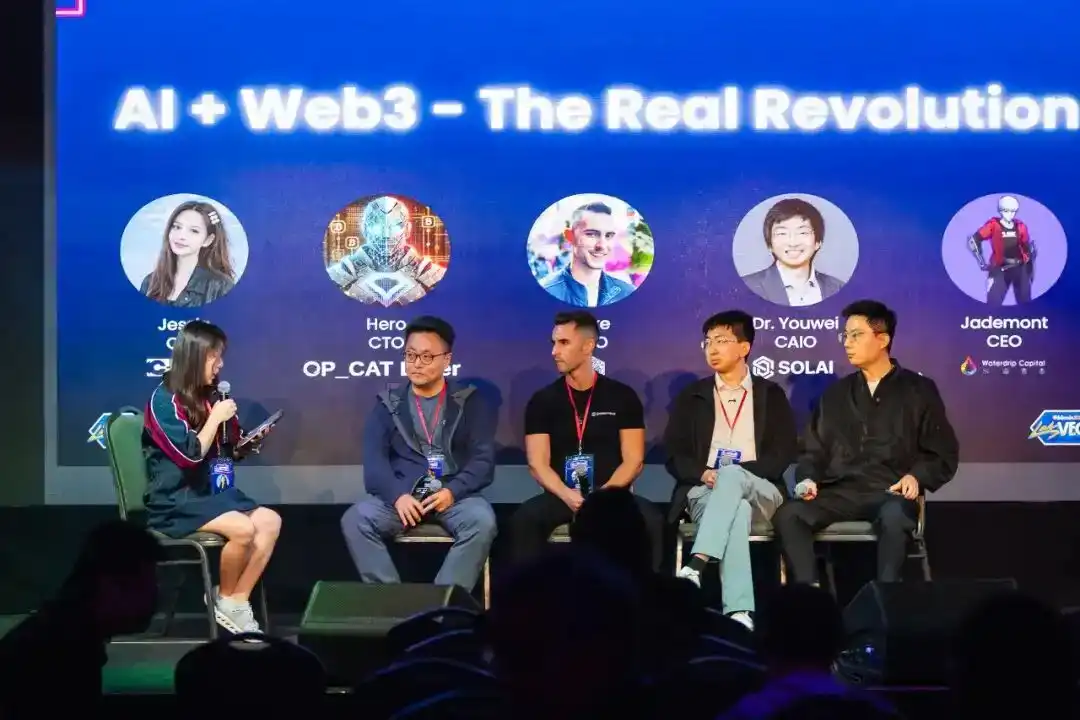
Note: The content of this article is excerpted from the roundtable discussion "AI+Web3-The Real Revolution" at the "AI + Bitcoin, the Next-Gen Revolution - BTC Vegas Side Event" held on April 28th.

I. The "Seven-Layer Matrix" and Investment Cycle of the AI Industry

Although giants like OpenAI, Anthropic, and Google are currently riding high and seem poised to dominate everything, our research indicates that the entire AI industry is still in a very early stage.

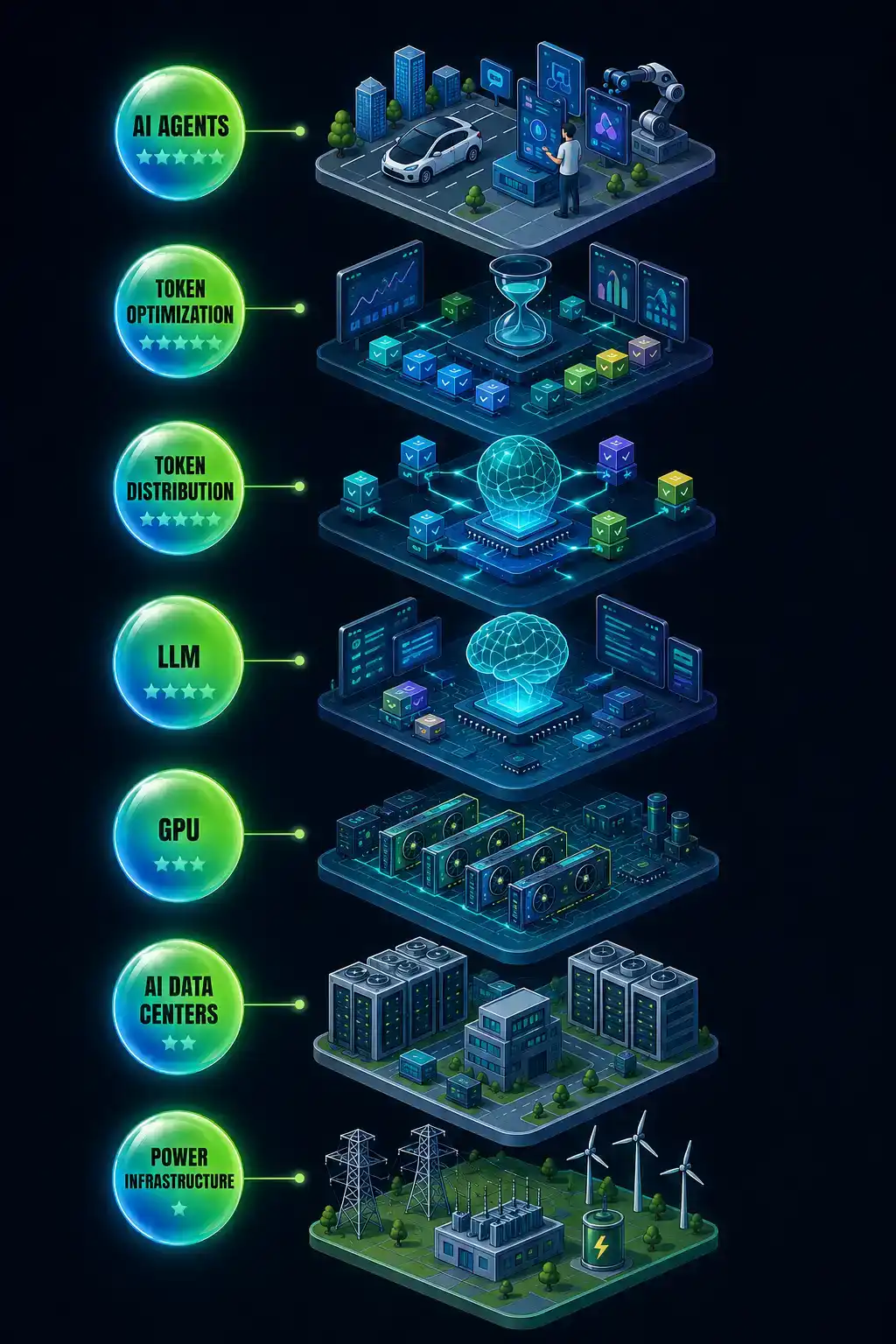
Being in an early stage doesn't mean one can invest blindly now, especially in overheated areas like AI hardware manufacturing, which require cooler heads. In our view, the AI industry chain can be broken down from bottom to top into seven different layers, and how to invest money in each layer is completely different:

• Layer Seven: AI Agents

• Layer Six: Token Optimization

• Layer Five: Token Distribution

• Layer Four: Large Language Models

• Layer Three: GPUs

• Layer Two: AI Data Centers

• Layer One: Power Infrastructure
Take Layer Two, AI Data Centers, as an example. This is a typical cyclical industry. Over the past two years, global capital has been frantically buying land, building facilities, and expanding with heavy assets. However, there is a time lag between when this capacity is built, powered up, and actually brought to market. Based on our observations, this massive wave of capacity is likely to come online around 2028.

This means that if people are still single-mindedly pouring money into traditional data centers next year or even now, they will likely run headfirst into severe oversupply when everyone opens for business around 2028. Rents and returns will plummet, and capital that jumps in late will have a tough time. Therefore, aligning with the cycle and timing correctly is key.

Back in 2024, we believed there was a significant opportunity in the AI computing power layer, particularly in the crossover area of using Web3 methods for computing power scheduling. So, we focused a lot of effort and capital there. Currently, an AI computing power infrastructure company in which we are a major shareholder is in the final stages of preparing for a Nasdaq listing.

II. Why Are AI and Crypto Inseparable?

Many people often ask: Why does AI need Crypto when Web2's large models are already so powerful? In our view, this is not a forced concept mashup. Rather, there are two things that traditional Web2 cannot solve as AI advances:

1. In the Near Term: Payment — AI Agents Need Their Own "Financial Sovereignty"

Traditional bank cards, PayPal, or gateway payments are all designed for "humans," with an extremely cumbersome identity verification and centralized settlement process. But the transaction model for future AI Agents collaborating with each other is completely different.

Their interactions often involve extremely micro-amounts (e.g., spending $0.0001 to buy a few seconds of computing power), ultra-high frequency, and continuous transactions. If they go through traditional channels like Visa, the fees could exceed the transaction amount. More importantly is the issue of "payment sovereignty": AI Agents have autonomous execution capabilities. As they evolve to a certain level, they will inevitably need to own and have absolute control over their own wallet accounts, rather than forever relying on human physical bank cards or worrying about having their API accounts shut down by centralized giants at any moment. Cryptocurrency payments on the blockchain are currently the only technological means that allows machines to settle autonomously with each other.

2. In the Long Term: Trust — Guarding Against Hallucinations and Credible Audits

Everyone using large models now knows they sometimes fabricate things, the so-called "hallucination rate." In the traditional Web2 black box, when an AI provides a wrong or biased answer, it's difficult for humans to investigate: Is this a random technical hallucination, or is the centralized giant behind it intentionally manipulating the algorithm, poisoning data, or deceiving people?

This creates a hard need for blockchain. Pushing key AI operational data, prompt records, and call paths onto the chain in real-time can create an immutable, traceable, and auditable evidence storage system. This isn't just about defining data property rights; it's a reliable path for humans to supervise and verify whether AI behavior is compliant in the future.

III. Investing in Projects: Using "Honesty" as the Measuring Stick

Every year, we see thousands of business plans for AI + Web3. After reviewing so many stories, the core screening principle we've settled on is actually just two words: Honesty. This sounds like simple common sense, but in the current浮躁 industry, it might be the rarest quality. We break down honesty into two levels:

1. The Team Must Be Honest — Reject Packaging and Patchwork

The resumes of founders and core teams must have no falsification or excessive boasting. In the industry today, we often see hastily assembled teams. To catch a bull market or chase a trend, they forcefully slap together labels like "big company scientist" or "prestigious school background," but there's zero internal team chemistry. Such projects often fall apart at the first sign of a technical bottleneck or market adjustment. A team that can truly succeed needs complementary skills, and the founder's background must be genuine — someone who is earnest about building something.

2. The Product Must Be Honest — Reject PPT-Driven Hype and False Metrics

What a product can actually achieve, how its user data looks — these must be supported by tangible underlying metrics like code and node counts. We've seen too many projects that simply wrap an OpenAI API on the frontend, change the interface, and then dare to claim in their PPT that they are an "autonomous native large model," using a fake demo to fool investors. On the product level, one must be realistic, able to genuinely solve problems.

In the capital markets, dishonest projects driven by hype and fabrication might, in the short term, inflate their valuations highly in secondary markets or exchanges through fancy financial engineering. But because there's no real underlying business supporting them, once the bubble bursts, their ultimate fate is inevitably to go to zero.

Conversely, projects that work diligently and honestly might seem slower initially because they disdain hype and fraud, perhaps even appearing a bit笨 in the eyes of some speculative capital. But because they have a solid foundation, they can often go the distance. In investing, slow is fast. These long-lasting projects are the ones we are willing to invest in and support strategically.

IV. The Most Underestimated Opportunity in 2026: The Ultimate Fusion of AI + Blockchain + Entertainment

Finally, regarding future opportunities that everyone hasn't yet noticed or that are severely underestimated. Based on our research, what we're most excited about is actually the deep integration of AI + Blockchain + Entertainment.
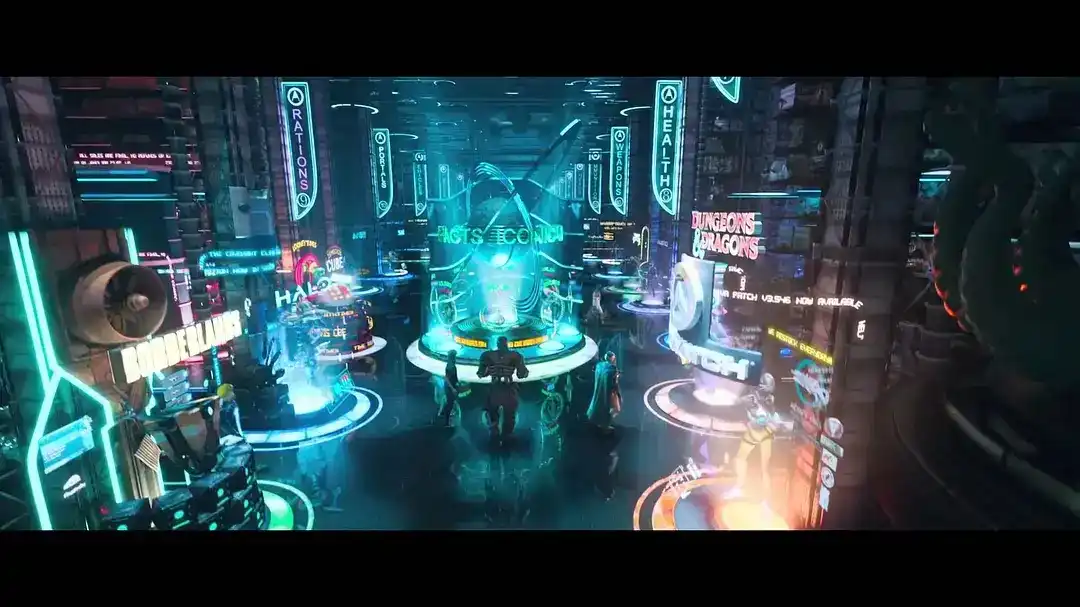
Currently, most market capital is focused on relatively hardcore, dry B2B infrastructure like AI payments and decentralized computing (DePIN). These tracks are important, but the competition is too fierce. People are overlooking the consumer end, which is best at attracting mass users and retaining capital.

Our observation and logic are as follows: As large models and Agents mature, AI, as an efficient labor force, will inevitably replace the vast majority of repetitive white-collar and blue-collar human jobs in the future. When productivity becomes extremely abundant and material costs are extremely low, human society will undergo a fundamental transformation — most people won't need to work forced jobs just to make ends meet. At that time, the demand for吃喝玩乐 will explode. Where will human time and energy go? High-quality entertainment is an inevitable destination.

Future entertainment should fully integrate AI.

Take gaming as an example. Every NPC in the game could have autonomous consciousness, with their own memories, personalities, and social relationships. When players enter the game, they no longer face a repeater bot, but a "living person" who develops emotions based on your actions and words, and might even spontaneously conduct transactions with you on-chain. The integration of AI will lead to a qualitative leap in the freedom and enjoyment of games.

And blockchain's role here is "property rights": it defines land ownership, the uniqueness of rare items in this virtual world, and uses Tokens to establish economic order.

When people no longer need to work in reality and pour a large amount of time, energy, and even assets into such a fun, AI-driven virtual world where assets belong to the players themselves, the commercial value unleashed within will be terrifying. We are currently actively looking for pioneers in this direction. This could be the next narrative that ignites the entire industry.

Disclaimer: The content of this report represents only the author's and the institution's industry research views. It is intended for industry discussion only and does not constitute any investment advice.


Criptomoedas em alta

Perguntas relacionadas

QAccording to the article, what are the seven layers of the AI industry from bottom to top, and which layer is considered a typical cyclical industry?

AAccording to the article, the seven layers of the AI industry from bottom to top are: First layer: Power infrastructure; Second layer: AI data centers; Third layer: GPU; Fourth layer: Large language models; Fifth layer: Token distribution; Sixth layer: Token optimization; Seventh layer: AI agents. The second layer, AI data centers, is identified as a typical cyclical industry, with concerns about a potential supply glut around 2028 due to a time lag in bringing new capacity online.

QThe article argues that AI and Crypto are inseparable. What are the two key reasons provided for this, focusing on immediate and long-term needs?

AThe article provides two key reasons why AI and Crypto are inseparable. The immediate need is for payments: AI Agents require their own 'financial sovereignty' for micro, high-frequency, continuous transactions between machines, which traditional payment systems are ill-suited for. The long-term need is for trust: Blockchain provides a solution for auditing and verification, creating an immutable record to track AI data, prompts, and execution paths. This helps distinguish between technical 'hallucinations' and potential deliberate manipulation by centralized entities, ensuring accountability.

QWhat is the core principle the VC firm uses to filter AI+Web3 projects, and how is this principle broken down into two specific aspects?

AThe core principle the VC firm uses to filter AI+Web3 projects is 'honesty'. This principle is broken down into two specific aspects: 1. Team Honesty: Rejecting packaging and fabrication. Founders and core teams must have genuine, non-exaggerated backgrounds, and the team must be cohesive rather than hastily assembled. 2. Product Honesty: Rejecting PPT-driven pitches and fake metrics. The product's capabilities must be supported by real underlying code, node counts, and other tangible indicators, not just superficial demos built on third-party APIs.

QWhat future opportunity does the article identify as the most underestimated for 2026, and what is the core logic behind this prediction?

AThe article identifies 'AI + blockchain + entertainment deep fusion' as the most underestimated opportunity for 2026. The core logic is that as AI matures and automates most repetitive human labor, society will shift towards a post-scarcity model where basic needs are met. Consequently, human time and energy will increasingly flow towards high-quality entertainment. The fusion of AI (to create dynamic, intelligent game worlds and NPCs), blockchain (to establish ownership and economic order for virtual assets), and entertainment will unlock massive commercial value as people invest their time and assets into these immersive, player-owned virtual worlds.

QIn the context of AI Agent payments, what specific problem does blockchain-based cryptocurrency solve that traditional payment systems cannot?

ABlockchain-based cryptocurrency solves the problem of enabling autonomous, micro-value, and high-frequency transactions between AI Agents. Traditional payment systems like Visa, PayPal, or bank cards are designed for humans, involving cumbersome identity verification and centralized清算 (settlement) processes with high relative fees for tiny transactions. Cryptocurrency allows machines to have their own sovereign wallets, enabling direct, efficient, and permissionless清算 between agents without relying on human-controlled accounts or facing risks like API bans from centralized platforms.

Leituras Relacionadas

Base Under Pressure

**Title: The Pressure Mounts for Base** Base, the Ethereum Layer 2 scaling solution backed by Coinbase, is facing significant pressure and public scrutiny from its leadership following the launch of Robinhood Chain. Base co-founder Jesse Pollak recently acknowledged strategic missteps, admitting that the chain's past focus on social and creator tokens (e.g., through Farcaster, Zora) failed to deliver sustainable adoption. He has refocused on core infrastructure, handing leadership of the Base App back to Coinbase's Cobie. While Base remains a top L2 contender alongside OP Mainnet and Arbitrum, and boasts the highest TVL (nearly $12B), its weaknesses are being highlighted by the new competitor. Key criticisms include its slow progress on decentralization. Base has faced issues with its single sequencer causing block production halts, and L2BEAT is reportedly considering downgrading its decentralization rating from Stage 1 to Stage 0. This contrasts sharply with the rapid initial success of Robinhood Chain, whose DEX quickly entered the top five by volume. The leadership styles of the parent companies are also being compared: Robinhood's CEO actively engages with new projects, while a recent incident where Coinbase's Brian Armstrong briefly changed his profile picture—sparking and then crashing a related meme token—drew community ire and mockery. Pollak stated Base is working with Coinbase on tokenized stocks backed 1:1 by real equity, differentiating it from Robinhood's derivatives model. However, the article argues that Base's most urgent task is to address its long-standing technical and trust issues. With more traditional finance players likely to emulate Robinhood's path, Base must use this competitive pressure to solidify its position as long-term financial infrastructure.

Foresight NewsHá 12m

Base Under Pressure

Foresight NewsHá 12m

White House Concession Removes Ethical Hurdle, Clarity Act Races Against Final Window Before Recess?

On July 21st, industry sources reported that the Trump administration has agreed to include an ethics provision in the "Clarity Act" (Digital Asset Market Clarity Act of 2025). This concession addresses the long-standing conflict-of-interest concerns regarding government officials and the crypto industry, potentially removing the final major obstacle to the bill's progress. Additionally, Patrick Witt, the executive director of the White House's Digital Asset Advisory Committee, confirmed he will remain in his role to help finalize the bill, alleviating previous concerns about his potential departure. The Clarity Act aims to establish a unified federal regulatory framework for the U.S. digital asset market. Its core objective is to resolve regulatory ambiguity by defining different types of digital assets (digital commodities, investment contract assets, and permitted payment stablecoins) and clarifying the respective oversight roles of the SEC and CFTC. This would end the long-running jurisdictional dispute between the two agencies and provide clearer compliance paths for the industry. With the ethics issue moving toward resolution, the most urgent challenge now is time. The U.S. Congress is set to begin its August recess in mid-August, leaving only a few working weeks to finalize the text and advance the bill through the Senate. Industry advocates, like the Blockchain Association's Kristin Smith, stress that this is a critical moment. If negotiations conclude successfully in the coming weeks, the Clarity Act could pass a key hurdle before the recess; otherwise, it may face significant delays. If enacted, the Clarity Act could mark a historic turning point in crypto regulation. By providing a clearer and more predictable legal framework, it aims to reduce uncertainty for businesses, developers, and traditional financial institutions looking to enter the digital asset space, potentially setting a global benchmark for market structure regulation.

Odaily星球日报Há 17m

White House Concession Removes Ethical Hurdle, Clarity Act Races Against Final Window Before Recess?

Odaily星球日报Há 17m

AI Era, Industrial Revolution, and Future Civilization Interview — Zhang Dingwen: The Future Does Not Belong to Chasers

"AI Era, Industrial Revolution and Future Civilization: An Interview with Zhang Dingwen – The Future Does Not Belong to Those Who Chase" In this interview, entrepreneur Zhang Dingwen reflects on his entrepreneurial journey and philosophy, moving beyond discussions of financing or success to emphasize understanding the "era" itself. He argues that true entrepreneurs should not chase short-term trends ("winds"), but position themselves in the direction of long-term technological and societal evolution. Zhang shares key lessons from his early days, including the realization that user value does not automatically translate to commercial value. For him, the core of entrepreneurship is not building a company but constantly upgrading one's own "cognition" – the ability to interpret information, ask the right questions, and understand the underlying "causes" behind business outcomes, not just the effects. His thinking has evolved from a focus on creating good products to a strategic focus on building "entrances" – platforms that naturally connect users to digital services. He sees smart wearables, like watches, not merely as hardware but as potential future gateways combining technological, financial, social, and even fashion attributes to create sustained user relationships and ecosystems. Ultimately, Zhang's vision transcends individual products or companies. He discusses business competition in three stages: product, platform, and finally, "civilization" – where the greatest companies influence how society operates by defining new rules and ways of life. He believes the mission of a truly great enterprise is to solve problems of its time, build enduring trust, and contribute lasting value, leaving behind not just wealth but a positive impact on how the world works. The future, he concludes, belongs not to the fastest, but to those with the correct long-term direction and a commitment to continuous learning and evolution.

marsbitHá 28m

AI Era, Industrial Revolution, and Future Civilization Interview — Zhang Dingwen: The Future Does Not Belong to Chasers

marsbitHá 28m

Cryptocurrency & Stock Market Barometer丨Strategy Cash Reserves Increase to $3.23 Billion, Halting BTC Purchases; Vanguard and Other Asset Managers Increase Holdings in Strategy Stock (July 21)

Market Overview & Warnings: The article warns of high volatility in South Korean stocks and continued dependence on U.S. stocks on geopolitics. Chinese A-shares remain under pressure. It advises against using leverage in current equity markets. For crypto-linked stocks, most have limited growth except Robinhood, with caution advised. U.S. Stock Market: Bearish bets on U.S. stocks, particularly targeting AI-related companies, have reached record highs since 2010, signaling deep skepticism about the sustainability of the AI-driven rally. Tech and chip stocks led a market decline, with the Philadelphia Semiconductor Index potentially entering a bear market. Increased expectations for Federal Reserve interest rate hikes and geopolitical tensions contributed to the negative sentiment. Bitcoin Treasury Company Updates: * Strategy: Increased its cash reserves to $3.23 billion and paused Bitcoin purchases. Several major asset managers, including Vanguard Group and Capital Group, increased their holdings of Strategy (MSTR) stock. * Global corporate Bitcoin buying slowed significantly to just $1.33 million last week. * Other notable activity: Strive purchased 21 BTC; ORANGE JUICE raised $40 million for Bitcoin acquisitions; Bitcoin Japan Corp. raised $60 million, allocating $4.08 million for its first BTC purchase. Other Crypto Treasury Holdings: * Ethereum: BitMine increased its ETH holdings to 5.78 million, nearing its 5% of supply goal. Its total crypto assets, cash, and securities are valued at $11.5 billion. * Solana: No significant corporate treasury activity reported. * Altcoins: HypeStrat made no adjustments to its treasury; its mNAV ratio fell to a long-term low. (Note: This summary is for informational purposes only and does not constitute investment advice.)

marsbitHá 29m

Cryptocurrency & Stock Market Barometer丨Strategy Cash Reserves Increase to $3.23 Billion, Halting BTC Purchases; Vanguard and Other Asset Managers Increase Holdings in Strategy Stock (July 21)

marsbitHá 29m

Trading

Spot

Artigos em Destaque

Como comprar ERA

Bem-vindo à HTX.com!Tornámos a compra de Caldera (ERA) simples e conveniente.Segue o nosso guia passo a passo para iniciar a tua jornada no mundo das criptos.Passo 1: cria a tua conta HTXUtiliza o teu e-mail ou número de telefone para te inscreveres numa conta gratuita na HTX.Desfruta de um processo de inscrição sem complicações e desbloqueia todas as funcionalidades.Obter a minha contaPasso 2: vai para Comprar Cripto e escolhe o teu método de pagamentoCartão de crédito/débito: usa o teu visa ou mastercard para comprar Caldera (ERA) instantaneamente.Saldo: usa os fundos da tua conta HTX para transacionar sem problemas.Terceiros: adicionamos métodos de pagamento populares, como Google Pay e Apple Pay, para aumentar a conveniência.P2P: transaciona diretamente com outros utilizadores na HTX.Mercado de balcão (OTC): oferecemos serviços personalizados e taxas de câmbio competitivas para os traders.Passo 3: armazena teu Caldera (ERA)Depois de comprar o teu Caldera (ERA), armazena-o na tua conta HTX.Alternativamente, podes enviá-lo para outro lugar através de transferência blockchain ou usá-lo para transacionar outras criptomoedas.Passo 4: transaciona Caldera (ERA)Transaciona facilmente Caldera (ERA) no mercado à vista da HTX.Acede simplesmente à tua conta, seleciona o teu par de trading, executa as tuas transações e monitoriza em tempo real.Oferecemos uma experiência de fácil utilização tanto para principiantes como para traders experientes.

513 Visualizações TotaisPublicado em {updateTime}Atualizado em 2026.06.02

Como comprar ERA

Discussões

Bem-vindo à Comunidade HTX. Aqui, pode manter-se informado sobre os mais recentes desenvolvimentos da plataforma e obter acesso a análises profissionais de mercado. As opiniões dos utilizadores sobre o preço de ERA (ERA) são apresentadas abaixo.

活动图片