Mysticism Takes Over Crypto: When Candlestick Charts Give Way to Bazi and Feng Shui

比推Publicado em 2025-12-25Última atualização em 2025-12-25

Resumo

In the crypto world, traditional technical analysis is increasingly being overshadowed by metaphysical practices like astrology and feng shui. The author describes encountering well-known crypto figures—KOLs, traders, and VCs—praying at temples for wealth, highlighting a cultural shift where beliefs in destiny and supernatural forces are becoming mainstream. Some investors and funds now prioritize checking founders' facial fortunes or project name compatibility over conventional due diligence. Anecdotes include a listed company CEO who reportedly earned hundreds of millions by following feng shui advice, while others suffered losses after ignoring such guidance. The trend is framed not as mere superstition but as a psychological response to extreme market volatility and uncertainty. In an environment where tweets from influencers or politicians can trigger 50% price swings, metaphysical practices serve as emotional anchors—much like ocean-faring cultures relying on divine protection during unpredictable voyages. Ultimately, when rationality reaches its limits, belief fills the void.

Author: Xiaobing, Deep Tide TechFlow

Original Title: Satoshi Nakamoto Would Have to Kowtow to the God of Wealth


Every year on the fifth day of the Lunar New Year, Xiaobing wakes up early to go to the Number One Temple of Wealth at Beigao Peak in Hangzhou.

I thought I would be jostling with aunties and uncles, but when I arrived, the scene was filled with familiar faces amidst the swirling incense smoke.

On the left was a well-known爆料KOL, on the right was someone involved in community schemes, and a few tech elites who usually preach "decentralization" were devoutly kowtowing with loud thuds. In that moment, algorithmic consensus and Federal Reserve movements were no match for the three sticks of incense in their hands.

Over the past two years, mysticism has become the "prominent study" in the crypto world. If you're still looking at candlestick charts, you're a classical rookie. The real veterans are now reading Bazi (Eight Characters).

A crypto trader familiar with various macroeconomic indicators eventually turned to mysticism, recently calculating BTC's Bazi—and the outlook is grim: fire clashes with the wealth repository, making 2026 (Bing Wu Year) Bitcoin's darkest hour. I quickly checked my wallet; luckily, it was already empty.
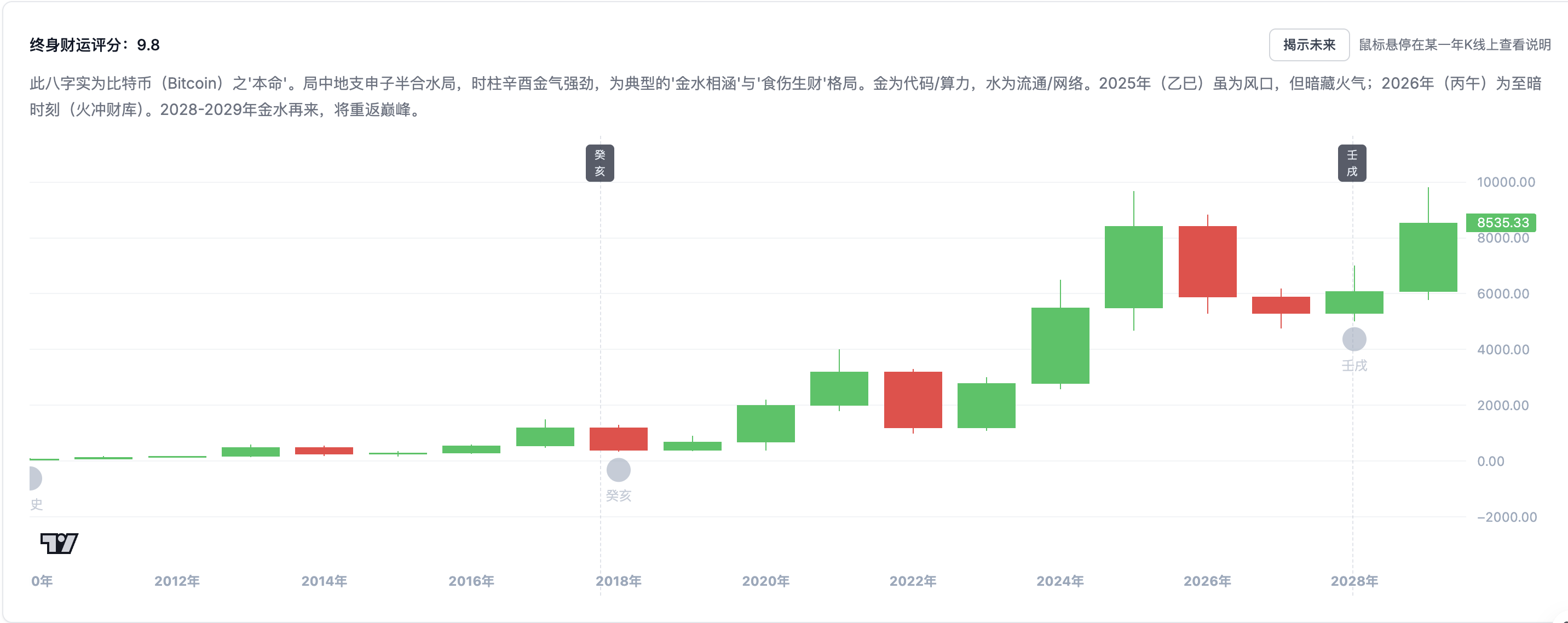
Remember, Alen, a partner at crypto VC y2z Ventures, once stated bluntly that one of their fund's core competencies was "reading faces." In the past, due diligence (DD) involved code audits and business models. Now, it's different: first, check if the founder has a "wealth-losing face," then see if the project's name clashes with Feng Shui.

During a recent trip to Shenzhen, I noticed that traders and KOLs' standard setup isn't data terminals; they all have a "Feng Shui consultant" behind them.

Don't laugh—this approach really works in crypto. Xiaobing knows a boss of a Hong Kong-listed company who is a devout believer in Feng Shui, donating real money to temples—possibly more than the company's R&D budget.

And the result? Feng Shui brought help from noble patrons. Starting in 2023, he bought Bitcoin, earning hundreds of millions of dollars by hoarding it. Later, he caught the wave of the DAT (Crypto Treasury Reserve) narrative, and the company's stock price doubled... Although everyone knows this is "survivorship bias," you can't argue with the fact that he really made a fortune.

There are counterexamples too. A爆料KOL with a frog avatar also had a Feng Shui consultant who advised him not to make moves recently. He couldn't resist and played with contracts, resulting in a neat and tidy liquidation.

About this phenomenon, it's not entirely superstition.

Our traditional land-based civilization emphasizes farming—"sow one grain in spring, reap ten thousand in autumn"—focusing on certainty. But what does maritime civilization face? Storms and unknown waters.

Why do people in the southeastern coastal areas worship Mazu? Not because of ignorance, but because on the vast ocean, besides experience and technology, you need something else.

The crypto world is essentially a modern version of the "Age of Exploration." It faces bottomless seas and sudden storms. This is human nature: the greater the randomness and volatility, the more we seek supernatural spiritual anchors.

When candlestick charts fail, and a single tweet from Musk, Trump, or CZ can sway the market, Feng Shui becomes the last psychological defense. This isn't ignorance; it's an instinctive stress response to massive wealth fluctuations.

After all, when your assets can swing 50% in a day, you need to believe in something to sleep at night. As for whether the God of Wealth understands blockchain, does it really matter?


Twitter:https://twitter.com/BitpushNewsCN

Bitpush TG Discussion Group:https://t.me/BitPushCommunity

Bitpush TG Subscription: https://t.me/bitpush

Original Link:https://www.bitpush.news/articles/7598323

Perguntas relacionadas

QWhat is the main theme of the article '玄学接管币圈:当K线图让位于八字与风水'?

AThe article discusses how metaphysical practices like astrology, fortune-telling, and feng shui are becoming increasingly influential in the cryptocurrency circle, replacing traditional methods like analyzing K-line charts for investment guidance.

QAccording to the article, what did the crypto VC y2z Ventures partner claim as one of their core competencies?

AAlen, a partner at y2z Ventures, stated that one of their fund's core competencies is 'reading facial features' (面相) to evaluate founders and projects, rather than relying solely on technical or business due diligence.

QWhy does the article compare the cryptocurrency market to the 'Age of Exploration'?

AThe article compares the crypto market to the Age of Exploration because both involve navigating high uncertainty and volatility, similar to sailors facing unpredictable storms at sea, leading people to seek supernatural or spiritual anchors for psychological comfort.

QWhat example does the article provide to show the effectiveness of feng shui in crypto investments?

AThe article cites a Hong Kong-listed company老板 who heavily donated to temples and followed feng shui practices, which allegedly helped him earn hundreds of millions by buying Bitcoin in 2023 and benefiting from market trends, though it acknowledges this could be survivorship bias.

QHow does the article explain the shift from traditional analysis to玄学in crypto trading?

AThe article attributes the shift to the extreme randomness and influence of factors like tweets from figures such as Elon Musk or Donald Trump, which make traditional charts unreliable, leading traders to adopt玄学as a psychological defense mechanism against high volatility.

Leituras Relacionadas

Gensyn AI: Don't Let AI Repeat the Mistakes of the Internet

In recent months, the rapid growth of the AI industry has attracted significant talent from the crypto sector. A persistent question among researchers intersecting both fields is whether blockchain can become a foundational part of AI infrastructure. While many previous AI and Crypto projects focused on application layers (like AI Agents, on-chain reasoning, data markets, and compute rentals), few achieved viable commercial models. Gensyn differentiates itself by targeting the most critical and expensive layer of AI: model training. Gensyn aims to organize globally distributed GPU resources into an open AI training network. Developers can submit training tasks, nodes provide computational power, and the network verifies results while distributing incentives. The core issue addressed is not decentralization for its own sake, but the increasing centralization of compute power among tech giants. In the era of large models, access to GPUs (like the H100) has become a decisive bottleneck, dictating the pace of AI development. Major AI companies are heavily dependent on large cloud providers for compute resources. Gensyn's approach is significant for several reasons: 1) It operates at the core infrastructure layer (model training), the most resource-intensive and technically demanding part of the AI value chain. 2) It proposes a more open, collaborative model for compute, potentially increasing resource utilization by dynamically pooling idle GPUs, similar to early cloud computing logic. 3) Its technical moat lies in solving complex challenges like verifying training results, ensuring node honesty, and maintaining reliability in a distributed environment—making it more of a deep-tech infrastructure company. 4) It targets a validated, high-growth market with genuine demand, rather than pursuing blockchain integration without purpose. Ultimately, the boundaries between Crypto and AI are blurring. AI requires global resource coordination, incentive mechanisms, and collaborative systems—areas where crypto-native solutions excel. Gensyn represents a step toward making advanced training capabilities more accessible and collaborative, moving beyond a niche controlled by a few giants. If successful, it could evolve into a fundamental piece of AI infrastructure, where the most enduring value in the AI era is often created.

marsbitHá 9h

Gensyn AI: Don't Let AI Repeat the Mistakes of the Internet

marsbitHá 9h

Why is China's AI Developing So Fast? The Answer Lies Inside the Labs

A US researcher's visit to China's top AI labs reveals distinct cultural and organizational factors driving China's rapid AI development. While talent, data, and compute are similar to the West, Chinese labs excel through a pragmatic, execution-focused culture: less emphasis on individual stardom and conceptual debate, and more on teamwork, engineering optimization, and mastering the full tech stack. A key advantage is the integration of young students and researchers who approach model-building with fresh perspectives and low ego, prioritizing collective progress over personal credit. This contrasts with the US culture of self-promotion and "star scientist" narratives. Chinese labs also exhibit a strong "build, don't buy" mentality, preferring to develop core capabilities—like data pipelines and environments—in-house rather than relying on external services. The ecosystem feels more collaborative than tribal, with mutual respect among labs. While government support exists, its scale is unclear, and technical decisions appear driven by labs, not state mandates. Chinese companies across sectors, from platforms to consumer tech, are building their own foundational models to control their tech destiny, reflecting a broader cultural drive for technological sovereignty. Demand for AI is emerging, with spending patterns potentially mirroring cloud infrastructure more than traditional SaaS. Despite challenges like a less mature data industry and GPU shortages, Chinese labs are propelled by vast talent, rapid iteration, and deep integration with the open-source community. The competition is evolving beyond a pure model race into a contest of organizational execution, developer ecosystems, and industrial pragmatism.

marsbitHá 11h

Why is China's AI Developing So Fast? The Answer Lies Inside the Labs

marsbitHá 11h

3 Years, 5 Times: The Rebirth of a Century-Old Glass Factory

Corning, a 175-year-old glass company, is experiencing a dramatic revival as a key player in AI infrastructure, driven by surging demand for high-performance optical fiber in data centers. AI data centers require vastly more fiber than traditional ones—5 to 10 times as much per rack—to handle high-speed data transmission between GPUs. This structural demand shift, coupled with supply constraints from the lengthy expansion cycle for fiber preforms, has created a significant supply-demand gap. Nvidia has invested in Corning, along with Lumentum and Coherent, in a $4.5 billion total commitment to secure the optical supply chain for AI. Corning's competitive edge lies in its expertise in producing ultra-low-loss, high-density, and bend-resistant specialty fiber, which is critical for 800G+ and future 1.6T data rates. Its deep involvement in co-packaged optics (CPO) with partners like Nvidia further solidifies its position. While not the largest fiber manufacturer globally, Corning's revenue from enterprise/data center clients now exceeds 40% of its optical communications sales, and it has secured multi-year supply agreements with major hyperscalers including Meta and Nvidia. Financially, Corning's optical communications revenue has surged, doubling from $1.3 billion in 2023 to over $3 billion in 2025. Its stock price has risen nearly 6-fold since late 2023. Key future catalysts include the rollout of Nvidia's CPO products and the scale of undisclosed customer agreements. However, risks include high current valuations and potential disruption from next-generation technologies like hollow-core fiber. The company's long-term bet on light over electricity, maintained even through the telecom bubble crash, is now being validated by the AI boom.

marsbitHá 11h

3 Years, 5 Times: The Rebirth of a Century-Old Glass Factory

marsbitHá 11h

Trading

Spot
Futuros
活动图片





