Moscow Exchange Set to Launch $XRP Indices and Futures Contracts

bitcoinistPublicado em 2026-02-03Última atualização em 2026-02-03

Resumo

The Moscow Exchange (MOEX), Russia's largest financial marketplace, is preparing to launch indices and futures contracts for XRP, marking a significant shift in the country's approach to digital assets. This move is seen as a pragmatic step toward using cryptocurrencies for cross-border liquidity outside the SWIFT system, particularly given XRP's institutional settlement utility. The introduction of futures will allow Russian institutional investors to hedge crypto exposure without direct token ownership. In contrast, the retail market is showing increased interest in high-risk, high-reward projects like Maxi Doge ($MAXI), an Ethereum-based token that promotes a high-leverage trading culture. It features gamified trading competitions and a staking system offering 68% APY to incentivize long-term holding. The project has raised $4.5M in its presale, targeting traders seeking aggressive returns in the current bull market.

Sanctions evasion and digital asset adoption have reached a critical flashpoint in Russia.

The Moscow Exchange (MOEX), the country’s largest financial marketplace, is reportedly finalizing the infrastructure to launch indices and futures contracts for $XRP, according to local media outlet RBC. That milestone marks a sharp pivot from the Kremlin’s historical skepticism regarding cryptocurrencies.

It signals a pragmatic shift toward assets that facilitate cross-border liquidity outside the SWIFT system.

Why $XRP? It’s long been positioned by Ripple Labs as a bridge currency for institutional settlement. (The irony of a U.S.-based blockchain firm becoming a liquidity rail for a sanctioned economy isn’t lost on anyone.)

The introduction of futures contracts on MOEX allows domestic institutional investors to hedge exposure to crypto assets without holding the underlying tokens directly, a massive step for integrating digital assets into the broader Russian economy. The choice of $XRP over other altcoins stems from its speed and established utility in global banking pilots.

While Bitcoin remains the primary store of value, $XRP’s lower transaction costs and sub-second finality make it a more attractive vehicle for the high-frequency nature of futures trading. The move effectively institutionalizes volatility, transforming what was once a speculative retail playground into a regulated derivative market.

But while institutions build compliant rails for $XRP, the retail sector is looking elsewhere. Traders are gravitating toward assets that embody the raw, unbridled energy of the current bull cycle. As traditional finance adopts crypto utility, the ‘degen’ economy is doubling down on high-leverage culture, seeking projects that mirror the relentless grind of market speculation. Projects like Maxi Doge ($MAXI).

Maxi Doge brings ‘Leverage King’ Culture to Ethereum

As the Moscow Exchange prepares to formalize crypto trading for the elite, the retail market is witnessing the rise of Maxi Doge ($MAXI), a project that arguably captures the current market zeitgeist better than any institutional derivative. Built on the Ethereum network, Maxi Doge positions itself as the ‘heavier,’ more aggressive cousin to the original Dogecoin, specifically targeting traders who live for high-leverage environments.
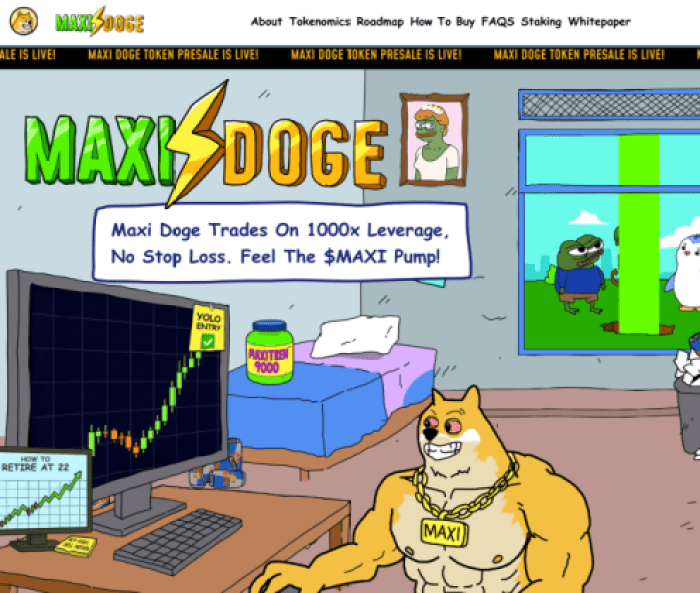
The project plans to differentiate itself through a gamified ‘Leverage King’ culture. Rather than relying solely on passive holding, Maxi Doge integrates holder-only trading competitions where participants vie for leaderboard rewards. It’s a shift that transforms the community from passive spectators into active participants.

This answers a specific behavioral shift in the market: retail traders aren’t satisfied with slow gains anymore; they’re seeking outsized returns and the social validation that comes with high-stakes trading.

By gamifying the grind of the bull market, Maxi Doge creates a sticky ecosystem that rewards conviction, a stark contrast to the sterile, regulated environment being built by traditional exchanges like MOEX.

FIND OUT MORE IN OUR ‘WHAT IS MAXI DOGE?’ GUIDE

Presale Momentum and Dynamic Staking Rewards

While the narrative drives the community, the numbers underpinning Maxi Doge reveal a financial structure designed for sustainability. The project has moved well beyond the conceptual phase, with the official presale already raising $4.5M.

This capital injection is being directed toward the ‘Maxi Fund’ treasury, which supports liquidity provision and future partnership developments (potentially even integrations with futures platforms down the line).

At the current presale price of $0.0002802, the token offers an accessible entry point for retail investors who missed the early days of legacy meme coins. But frankly, the protocol’s staking mechanism is where the long-term value proposition becomes clear.

Maxi Doge employs a dynamic APY system (currently offering 68% rewards), planning to distribute rewards daily from a dedicated 5% staking allocation pool. This smart contract-governed distribution is designed to incentivize lock-ups for up to one year, reducing circulating supply pressure while rewarding those with the ‘diamond hands’ mentality the project espouses.

The security of the ERC-20 standard provides the technical backbone, but the economic model is distinctively modern. By combining the viral appeal of ‘gym bro’ humor, ‘Never skip leg-day, never skip a pump,’ with hard-coded financial incentives, Maxi Doge attempts to solve the liquidity flight often seen in meme tokens.

It creates a feedback loop where staking reduces sell pressure, potentially amplifying price action when market volatility spikes.

BUY $MAXI NOW FROM ITS OFFICIAL PRESALE SITE.

The content provided in this article is for informational purposes only and does not constitute financial advice. Cryptocurrency markets, including derivatives on the Moscow Exchange and meme tokens like Maxi Doge, are highly volatile and carry significant risk. Always conduct your own due diligence before investing.


Perguntas relacionadas

QWhat is the Moscow Exchange planning to launch for $XRP, and why is this significant?

AThe Moscow Exchange is finalizing the infrastructure to launch indices and futures contracts for $XRP. This is significant because it marks a major shift from Russia's historical skepticism of cryptocurrencies and represents a pragmatic move toward using digital assets for cross-border liquidity outside the SWIFT system.

QAccording to the article, what are the two main reasons $XRP was chosen over other altcoins for this initiative?

A$XRP was chosen for its speed and its established utility in global banking pilots, making it more attractive for the high-frequency nature of futures trading due to its lower transaction costs and sub-second finality.

QHow does the article contrast the institutional adoption of $XRP with the current trend in the retail crypto market?

AThe article contrasts the institutional, compliant rails being built for $XRP with the retail trend of gravitating towards high-leverage, speculative projects like Maxi Doge ($MAXI), which embodies the 'degen' economy and raw energy of the current bull cycle.

QWhat is the core concept behind Maxi Doge's 'Leverage King' culture?

AMaxi Doge's 'Leverage King' culture is a gamified system that features holder-only trading competitions where participants compete for leaderboard rewards, transforming the community from passive holders into active participants seeking outsized returns and social validation.

QWhat are two key features of Maxi Doge's ($MAXI) financial structure mentioned in the article?

ATwo key features are its dynamic APY staking system (currently 68%), which rewards users daily from a dedicated pool to incentivize long-term lock-ups, and its 'Maxi Fund' treasury, which uses presale funds to support liquidity and future development.

Leituras Relacionadas

How Does Codex Use a Computer? Three Entry Points and Permission Boundaries

This article explains the three primary methods for Codex to interact with a computer, each with distinct use cases, permission boundaries, and trust levels. **1. Computer Use:** This offers the broadest access, allowing Codex to visually control and interact with the graphical user interface of authorized macOS/Windows apps, system settings, and even iOS simulators. It's ideal for tasks lacking APIs or structured tools, such as operating legacy software or multi-app workflows. However, it's the slowest method and has the widest permission scope, requiring careful supervision for sensitive actions. **2. Chrome Extension:** This grants Codex access to the user's logged-in Chrome browser state, including cookies, profiles, and open tabs. It's best for tasks requiring user identity across websites like Gmail, LinkedIn, Salesforce, or internal dashboards. Its key advantage is multi-tab control for complex workflows. While more powerful for browser-based tasks than Computer Use, it carries higher sensitivity as actions are performed under the user's identity. **3. In-App Browser:** This is a browser isolated within the Codex thread, separate from the user's personal browsing data. It excels in web development and debugging scenarios—previewing local servers, testing responsive layouts, or annotating designs directly on the page. Its isolation is a strength for development but a limitation for tasks requiring login sessions. The core principle is to choose the narrowest, safest, and most structured interface for the task. Use plugins or MCPs first, resort to visual control (Computer Use) only for GUI-dependent tasks, employ the Chrome extension for identity-reliant browser work, and prefer the In-App Browser for isolated development. **Appshots** are clarified as a fourth, complementary tool for *inputting* context—capturing a screenshot of a window to point Codex to something—rather than a method for Codex to *act*. Together, this layered approach highlights a key to AI agent productization: not granting unlimited permissions, but constraining them within clear boundaries for specific tasks while preserving user oversight.

marsbitHá 34m

How Does Codex Use a Computer? Three Entry Points and Permission Boundaries

marsbitHá 34m

The "Iron Rule" of Chip Equipment Is Being Broken

For years, the semiconductor equipment industry followed an unwritten "iron rule": suppliers offered steep discounts for new tool introductions (Design-in) and faced consistent price pressure during repeat orders, especially during market downturns. This long-standing buyer's market dynamic is now being upended. Recently, SK Hynix's primary equipment suppliers have reportedly requested a 3-4% price *increase*, a nearly unprecedented move. This shift is driven by a severe supply-demand imbalance fueled by the AI compute boom. Securing equipment has become an urgent arms race as chipmakers' expansion speed dictates their ability to fulfill massive AI chip orders. Key areas feeling the strain include: **TCB (Thermal Compression Bonding) Equipment:** Demand is exploding, driven by the simultaneous needs of HBM4 memory stacking, AI chip Chip-on-Substrate (C2S), and logic Chiplet Chip-on-Wafer (C2W) packaging. Players like Hanmi Semiconductor, Hanwha Semitech, and ASMPT are receiving major orders. While hybrid bonding is seen as the future, TCB remains the pragmatic choice for HBM4 mass production, with its lifecycle extended by relaxed specifications and ongoing technological upgrades. **Test Equipment Bottlenecks:** Ironically, AI-driven shortages are now crippling test equipment manufacturing. Critical components like FPGAs, Driver ICs, and CPUs face severe shortages and extended lead times (up to 52 weeks for FPGAs), as AI data center and server vendors prioritize supply. This creates a paradoxical cycle: AI chip shortages drive fab expansion, which requires more test equipment, whose production is delayed because its key parts are diverted to make AI chips. The industry is entering a broad, AI-powered upcycle. SEMI forecasts global semiconductor equipment sales to hit a record $156 billion by 2027, fueled by investment in advanced logic/foundry, HBM-driven DRAM, and advanced packaging (like CoWoS). Major players like TSMC, SK Hynix, and Micron are aggressively ramping capital expenditure. In conclusion, leading equipment vendors are no longer just selling tools; they are selling the critical capability to deliver AI-era capacity. Pricing power is shifting decisively to those with indispensable technology in key process nodes like advanced logic, HBM, and advanced packaging, rewriting the industry's traditional power structure.

marsbitHá 47m

The "Iron Rule" of Chip Equipment Is Being Broken

marsbitHá 47m

Trading

Spot
Futuros
活动图片