Morgan Stanley Files For Ethereum ETF Amid Major Crypto Push

bitcoinistPublicado em 2026-01-08Última atualização em 2026-01-08

Resumo

Morgan Stanley has filed an S-1 form with the SEC for a spot Ethereum ETF, named the Morgan Stanley Ethereum Trust. The proposed fund aims to track the price of ETH and generate returns, including through staking a portion of the trust's assets. This filing follows the bank's recent submissions for spot Bitcoin and Solana ETFs, which also include staking plans for the Solana fund. This move is part of the firm's broader expansion into crypto, which includes offering crypto ETFs to its wealth management clients and enabling cryptocurrency access through its E-Trade platform. The push aligns with a wider regulatory shift in the U.S. towards embracing digital assets.

Wall Street behemoth Morgan Stanley is expanding its recent push into crypto Exchange-Traded Funds (ETFs) and has filed a registration statement for an Ethereum (ETH) Trust with the US Securities and Exchange Commission (SEC).

Morgan Stanley Files For Ethereum Trust

On Tuesday, banking giant Morgan Stanley submitted an S-1 form with the US SEC for its Morgan Stanley Ethereum Trust, which seeks to generate returns for investors by tracking the price of ETH and to “reflect rewards from staking a portion of the Trust’s ether.”

The SEC Filing shows that the bank “plans to engage one or more Staking Services Providers to conduct such Staking Activities,” using a staking model that “aims to maximize the portion of the Trust’s ether available for staking while controlling for liquidity and redemption risks.
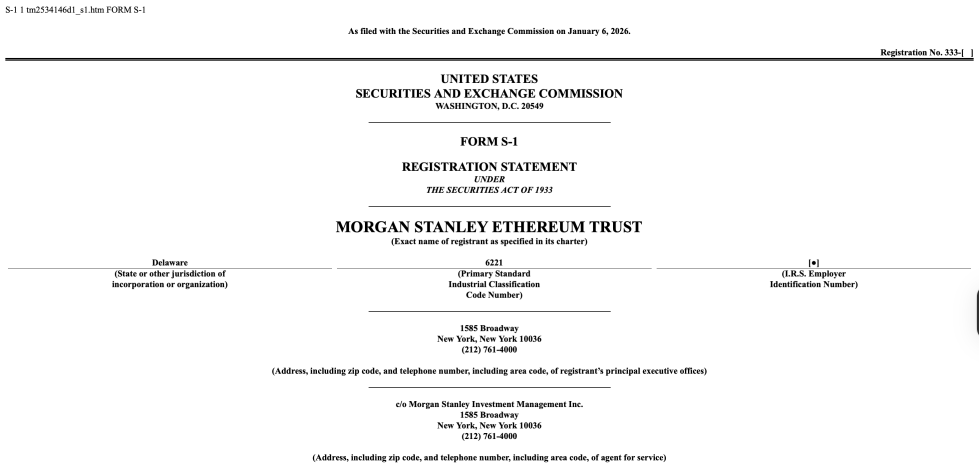
Morgan Stanley files S-1 form for Ethereum ETF. Source: sec.gov

Nonetheless, the document doesn’t address key details, such as the exchange on which the fund will be listed, the Trust’s custodian, or the ticker. Morgan Stanley’s Ethereum ETF filing follows recent efforts to launch other investment products based on some of the largest cryptocurrencies by market capitalization.

As reported by Bitcoinst, the Wall Street giant announced that it had submitted preliminary filings for spot Bitcoin (BTC) and Solana (SOL) Trusts on Tuesday, seeking to hold and generate returns by tracking these two cryptocurrencies.

In a January 6 statement, the bank detailed that “Morgan Stanley Bitcoin Trust and Morgan Stanley Solana Trust are pending regulatory approval and would be passive investment vehicles that seek to track the performance of the price of the relevant cryptocurrency.”

Similar to its submitted Ethereum ETF, the Solana fund will include an allocation for staking, and plans to engage one or more third-party staking service providers to conduct these activities.

A Broader Crypto Push

Notably, Morgan Stanley’s crypto ETF move is part of a broader shift toward a more welcoming approach that expands the presence of traditional institutions in the digital assets industry.

This pivot follows US regulatory efforts led by the Trump administration to turn the country into the “crypto capital of the world.” Amid this major push, the SEC has published new generic listing standards for crypto-based ETFs, which have seen a successful run since their initial launch nearly two years ago.

In 2024, Morgan Stanley, which had built one of the most significant Bitcoin ETF holdings in the US, allowed its managers to offer the products as an investment option for its wealthy customers. This enabled access to individuals with a minimum of $1.5 million in assets and an aggressive risk tolerance.

In October 2025, it expanded its access to crypto fund investments for all clients, including those with retirement accounts, moving away from its previous customer restrictions. The shift allowed its financial advisors to present crypto funds to any client.

It also announced last year that it would enable trading of the largest cryptocurrencies, Bitcoin, Ethereum, and Solana, through its E-Trade subsidiary.
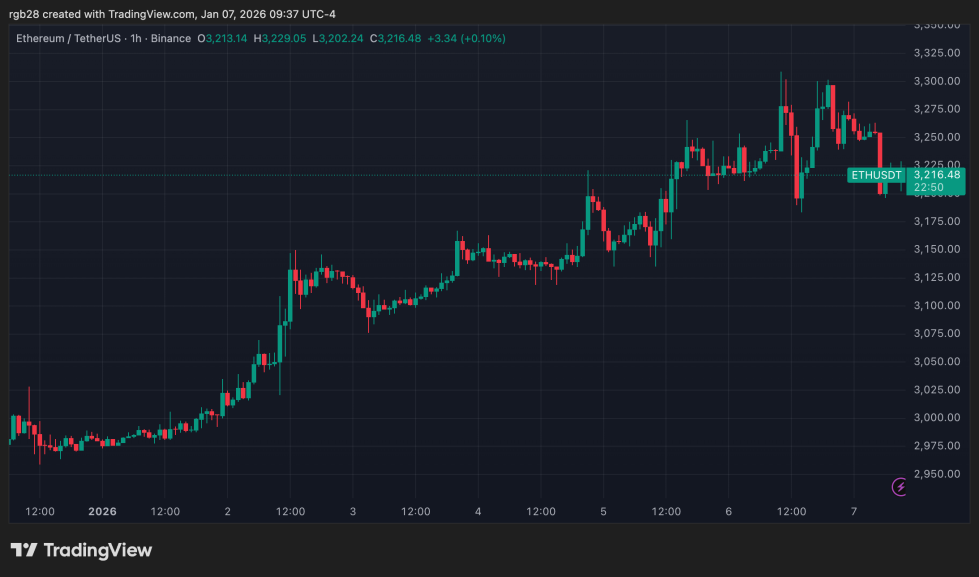
Ethereum trades at $3,216 in the one-week chart. Source: ETHUSDT on TradingView


Perguntas relacionadas

QWhat type of financial product has Morgan Stanley filed for with the SEC, and which cryptocurrency does it track?

AMorgan Stanley has filed an S-1 form for a Morgan Stanley Ethereum Trust, an Exchange-Traded Fund (ETF) that seeks to generate returns by tracking the price of Ethereum (ETH).

QBeyond price tracking, what additional feature does the proposed Morgan Stanley Ethereum Trust include to generate returns?

AThe Trust also aims to reflect rewards from staking a portion of its ether holdings, and it plans to engage one or more Staking Services Providers to conduct these staking activities.

QBesides an Ethereum ETF, what other two cryptocurrency-based investment products did Morgan Stanley file for on the same day?

AOn the same day, Morgan Stanley also submitted preliminary filings for a spot Bitcoin (BTC) Trust and a Solana (SOL) Trust.

QHow has Morgan Stanley's policy on offering crypto investments to its clients evolved since 2024?

AIn 2024, it allowed managers to offer Bitcoin ETFs only to wealthy customers with at least $1.5M in assets. By October 2025, it expanded access to crypto funds for all clients, including those with retirement accounts, and allowed financial advisors to present them to any client.

QThrough which subsidiary did Morgan Stanley announce it would enable direct trading of Bitcoin, Ethereum, and Solana?

AMorgan Stanley announced it would enable trading of these major cryptocurrencies through its E-Trade subsidiary.

Leituras Relacionadas

Yang Ge Gary: Agent Economy and AI Sub-Microeconomics

"Agent Economy and AI Submicroeconomics" by Gary Yang discusses the evolution of AI Agent economies, written from Singapore in June 2026. The author observes a significant "civilizational generational gap" in AI development, particularly highlighted by events in Silicon Valley. The article identifies a current bottleneck in the transition from Human-to-Agent (H2A) economies to true Agent-to-Agent (A2A) ecosystems. While AI Payment protocols are rapidly emerging, many implementations remain non-AI-native, focusing on traditional human decision-making models rather than leveraging autonomous Agent decision-making. A core thesis is the inevitable formation of an **Agent Economy**, defined as a system where autonomous AI Agents create, exchange, and capitalize value independently. This requires new infrastructure: **AI Protocols**, which are the foundational rules and standards for Agent interaction. The piece explores the relationship and current gap between AI Protocols and Crypto Protocols, suggesting political and regulatory factors from traditional finance are temporarily constraining development. However, a future fusion into a mature Digital Protocol system is deemed inevitable based on first principles. The author introduces **AI Agent Submicroeconomics**, contrasting it with human economics. Key differences include higher transaction frequency, lower value per transaction, efficiency-driven (not emotion-driven) decisions, task-oriented (not consumption-oriented) behavior, and near-zero organizational and communication costs. A biological analogy is drawn, comparing an Agent to a cell, its LLM to a nucleus, and its protocol stack to a cell membrane. The rise of **AIFi** (AI Finance) is presented as a natural consequence, where value originates from AI-native activities and is subsequently tokenized and financialized. This contrasts with DeFi/TradFi, where finance is the source of value. The concept of a **Financial Chip (FinChip)**—an autonomous AI Agent integrated with a crypto smart contract—is highlighted as key infrastructure for this new economy. The conclusion emphasizes that **AI-Native** thinking represents a paradigm shift distinct from "Internet+" upgrades. It requires reasoning from first principles, focusing on energy-value shortest paths and maximum efficiency, which presents a steep learning curve and significant challenge for all participants in this rapidly evolving field.

marsbitHá 45m

Yang Ge Gary: Agent Economy and AI Sub-Microeconomics

marsbitHá 45m

ViaBTC CEO Haipo Yang: Looking Back at the Decade, Re-understanding the Value of Crypto

In "A Decade in Retrospect: Re-evaluating the Value of Crypto," ViaBTC & CoinEx CEO Haipo Yang reflects on the cryptocurrency industry's evolution since founding ViaBTC in 2016. Initially a niche interest, Crypto has fundamentally transformed key financial infrastructures like market making, trading, settlement, and issuance through open protocols, as seen with Uniswap and GMX, and enabled efficient cross-border transfers via stablecoins. While acknowledging speculation's role in fueling innovation and liquidity, Yang warns it often overshadows real demand. He distinguishes between blockchain (a trust-minimizing technology), Web3 (an application model requiring genuine utility), and Crypto assets. The latter's value derives from block space as a commodity (e.g., gas fees) and "sovereign liquidity premium" (e.g., Bitcoin's censorship resistance), with most tokens lacking such dual support. Looking ahead, Yang argues the next decade's focus should shift from "open participation" to "sustainable participation," emphasizing reliable infrastructure. He predicts consolidation towards networks with strong security and liquidity (like Bitcoin and Ethereum), and sees DeFi becoming a specialized tool rather than a mass replacement for traditional finance. Crypto will integrate into traditional finance (e.g., via Bitcoin ETFs) but may sacrifice some decentralization for mainstream adoption. Real future demand may come from AI agents and machine economies needing permissionless settlement. Ultimately, Yang believes Crypto's enduring value lies not in hype or replacing everything, but in verifiably reducing trust costs, increasing efficiency, and providing stable, transparent services across market cycles.

marsbitHá 45m

ViaBTC CEO Haipo Yang: Looking Back at the Decade, Re-understanding the Value of Crypto

marsbitHá 45m

Trading

Spot
Futuros

Artigos em Destaque

Como comprar PUSH

Bem-vindo à HTX.com!Tornámos a compra de Push Protocol (PUSH) simples e conveniente.Segue o nosso guia passo a passo para iniciar a tua jornada no mundo das criptos.Passo 1: cria a tua conta HTXUtiliza o teu e-mail ou número de telefone para te inscreveres numa conta gratuita na HTX.Desfruta de um processo de inscrição sem complicações e desbloqueia todas as funcionalidades.Obter a minha contaPasso 2: vai para Comprar Cripto e escolhe o teu método de pagamentoCartão de crédito/débito: usa o teu visa ou mastercard para comprar Push Protocol (PUSH) instantaneamente.Saldo: usa os fundos da tua conta HTX para transacionar sem problemas.Terceiros: adicionamos métodos de pagamento populares, como Google Pay e Apple Pay, para aumentar a conveniência.P2P: transaciona diretamente com outros utilizadores na HTX.Mercado de balcão (OTC): oferecemos serviços personalizados e taxas de câmbio competitivas para os traders.Passo 3: armazena teu Push Protocol (PUSH)Depois de comprar o teu Push Protocol (PUSH), armazena-o na tua conta HTX.Alternativamente, podes enviá-lo para outro lugar através de transferência blockchain ou usá-lo para transacionar outras criptomoedas.Passo 4: transaciona Push Protocol (PUSH)Transaciona facilmente Push Protocol (PUSH) no mercado à vista da HTX.Acede simplesmente à tua conta, seleciona o teu par de trading, executa as tuas transações e monitoriza em tempo real.Oferecemos uma experiência de fácil utilização tanto para principiantes como para traders experientes.

518 Visualizações TotaisPublicado em {updateTime}Atualizado em 2026.06.02

Como comprar PUSH

Discussões

Bem-vindo à Comunidade HTX. Aqui, pode manter-se informado sobre os mais recentes desenvolvimentos da plataforma e obter acesso a análises profissionais de mercado. As opiniões dos utilizadores sobre o preço de PUSH (PUSH) são apresentadas abaixo.

活动图片