Moreno Indicates Negotiations on 'Transparency Act' Have Concluded Ahead of Vote to End Debate

cryptonews.ruPublicado em 2026-08-08Última atualização em 2026-08-08

Resumo

Debates in the U.S. Senate regarding the "Digital Asset Market Clarity Act" (CLARITY Act) are concluding ahead of a crucial procedural vote. Senator Bernie Moreno announced that negotiations between Republicans and Democrats are finished, stating there is nothing left to settle and that all parties are expected to fulfill an agreement reached weeks ago. He framed the upcoming cloture vote on the bill as a choice for senators between supporting American industry or ceding dominance to China. While Moreno anticipates support from all 53 Senate Republicans, some within his party, including Senators Jerry Moran and Josh Hawley, have expressed opposition. Their concerns center on the bill's potential negative impact on small-town banks and the availability of agricultural loans in their states. Even with full Republican support, passing the CLARITY Act requires 60 votes, meaning at least 7 Democrats would need to vote in favor. Analysts view this as unlikely, citing ongoing ethics discussions with the White House related to President Donald Trump's cryptocurrency initiatives as a major obstacle.

Debates ahead of the U.S. Senate's consideration of the Digital Asset Market Clarity Act are drawing to a close.

Senator Bernie Moreno did not wait for further negotiations between Democrats and Republicans, stating that the negotiation phase has concluded.

On social media, Moreno emphasized that "there is nothing 'to settle,'" explaining that an agreement was reached several weeks ago and that "all parties to this agreement are expected to fulfill their obligations."

"Eleven months of negotiations between Republican senators and Democratic senators have officially concluded, and every senator will have the opportunity to vote," he noted, referring to the cloture motion filed by Senate Majority Leader John Thune on September 15 regarding the motion to proceed to consideration of the CLARITY Act.

Moreno placed the blame for the CLARITY Act's potential failure on Senate Democrats, stating they will have to choose between ceding the industry to China and supporting American exceptionalism to preserve the dominant position of U.S. industry.

"If you love America, the choice is obvious!" he concluded.

While Moreno believes all 53 Republican senators will vote for the bill, some have expressed concerns about the implications of the CLARITY Act for local banks.

Senators Jerry Moran and Josh Hawley, both Republicans, have publicly stated they will oppose the CLARITY Act in its current form.

In statements given to Politico, Hawley noted that his constituents in Missouri are very concerned. "Specifically, farmers and ranchers are extremely worried that the outflow of deposits from small towns could completely deprive them of the opportunity to obtain agricultural loans," he stated.

Moran also raised similar arguments against the CLARITY Act, citing "consequences for people who rely on banks in small towns across Kansas" as the reason for his recent opposition.

Even with full support from all Republican senators, passing the CLARITY Act would require 60 votes, meaning the Republican Party would need to sway at least 7 Democrats to their side. Some analysts consider this goal unlikely, as the ethics provision, still being negotiated with the White House, is a stumbling block for CLARITY's success due to President Donald Trump's cryptocurrency initiatives.


Perguntas relacionadas

QAccording to Senator Bernie Moreno, what is the status of negotiations for the Digital Asset Market Clarity Act?

AAccording to Senator Bernie Moreno, the negotiation stage is over. He stated that an agreement was reached weeks ago and that the negotiating phase between Democratic and Republican senators has officially concluded after eleven months.

QWhat did Senator Moreno imply is at stake for the U.S. if the CLARITY Act fails, and who does he blame for this potential failure?

ASenator Moreno implied that if the CLARITY Act fails, the U.S. risks losing its industry's dominant position to China. He placed the responsibility for the act's potential failure on Senate Democrats, stating they would have to choose between handing the industry to China or supporting American exceptionalism.

QWhat procedural step did Majority Leader John Thune take on September 15 regarding the CLARITY Act, as mentioned by Senator Moreno?

AOn September 15, Majority Leader John Thune filed a cloture motion regarding the motion to proceed to consideration of the CLARITY Act. This motion seeks to end debate and advance to a vote on the bill.

QWhich Republican senators have publicly stated they will oppose the CLARITY Act in its current form, and what are their primary concerns?

ARepublican Senators Jerry Moran and Josh Hawley have publicly stated they will oppose the CLARITY Act. Their primary concerns center on the potential negative impact on local banks and communities in their states, such as the outflow of deposits from small towns affecting agricultural loans and hurting people who rely on small-town banks.

QWhat are the two main obstacles, as mentioned in the article, that the CLARITY Act must overcome to be passed in the Senate?

AThe two main obstacles for the CLARITY Act are: 1) Gaining enough votes for cloture to end debate and proceed, which requires 60 votes. With all 53 Republicans supporting it, the bill would still need at least 7 Democratic votes. 2) An ongoing ethics provision discussion with the White House, which is a sticking point related to President Donald Trump's cryptocurrency initiatives and complicates Democratic support.

Leituras Relacionadas

Bitcoin's ECX Hard Fork to Introduce Three New Versions Throughout October

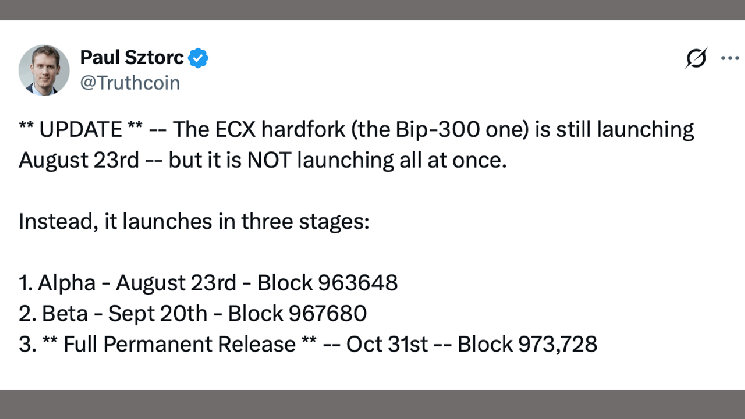
Bitcoin developer Paul Stortz, behind the Drivechain and BIP 300 proposals, has announced a hardfork for a new blockchain called ECX. Scheduled for October 31st (the 18th anniversary of the Bitcoin whitepaper), ECX will copy Bitcoin's full transaction history at a specific block height, crediting nearly all Bitcoin holders with an equal amount of ECX coins without altering the Bitcoin network itself. The launch will be executed in three phases. An "alpha" version is set for August 23rd (block 963,648), followed by a "beta" version on September 20th (block 967,680). The final mainnet launch is planned for October 31st (block 973,728). Coins accumulated during the alpha and beta phases can later be burned or swapped for real ECX. Stortz cites several reasons for the phased rollout: to address potential software bugs (including those possibly found by AI), allow an early market price to form for ECX before mining difficulty stabilizes, and let traders test and speculate. He described it as a "safety net" to manage any major issues and to demonstrate the chain's functionality. A key detail is that replay protection—a mechanism to prevent a transaction from being valid on both the Bitcoin and ECX chains—will remain optional, not automatic. The official ECX wallet software will apply this protection and warn users; Stortz warned that transactions ignoring this warning will be replayed on ECX, effectively tracking a user's spent bitcoins to their new owner unless a deliberate split is made. Stortz has given holders and exchanges 12 weeks from the alpha launch to prepare, during which they must decide on practical matters like running the wallet software to split their BTC and ECX holdings and how exchanges will credit the new asset to clients. The announcement comes as Bitcoin also faces another potential fork related to BIP-110.

cryptonews.ruHá 2h

Bitcoin's ECX Hard Fork to Introduce Three New Versions Throughout October

cryptonews.ruHá 2h

Trading

Spot
活动图片