More Than One Person Has Wasted Three Years on Base

比推Publicado em 2026-01-14Última atualização em 2026-01-14

Resumo

A developer known as tuna, co-founder of Pandemic Labs, publicly criticized Base, the Ethereum L2 network backed by Coinbase, for failing to support builders despite initial promises. After nearly three years of developing 10 different products—including games, AI agents, and prediction markets—on Base, tuna received no meaningful support, even after creating the hit game *Infected*, which gained 50,000 users. In contrast, within 48 hours of launching a game on Solana, *Addicted*, it generated $4 million in revenue. Tuna expressed frustration that Base appears to prioritize certain projects like Farcaster and Zora while ignoring independent developers. Other builders, such as Shivam Tandon of zkCross Network and Jacek from the DEGEN project, shared similar experiences, citing ignored outreach and a lack of engagement from Base and its lead, Jesse. Despite bringing significant traffic and value, these teams felt overlooked, with DEGEN even choosing to expand to Solana, where they received immediate support and recognition. Critics argue that Base operates with a top-down, “narrative-driven” approach aligned with Coinbase’s interests, rather than fostering an open, community-oriented ecosystem like Solana. While Base’s 2026 roadmap focuses on asset tokenization and the Base App, many developers question whether it truly intends to serve the broader community or mainly functions as an extension of Coinbase.

Author: Eric, Foresight News

Original Title: More Than One Person Has Wasted Three Years on Base


At 1:13 AM Beijing time on January 13, the co-founder of game studio Pandemic Labs, a user with the X handle "tuna," published an article criticizing Base for its inaction.
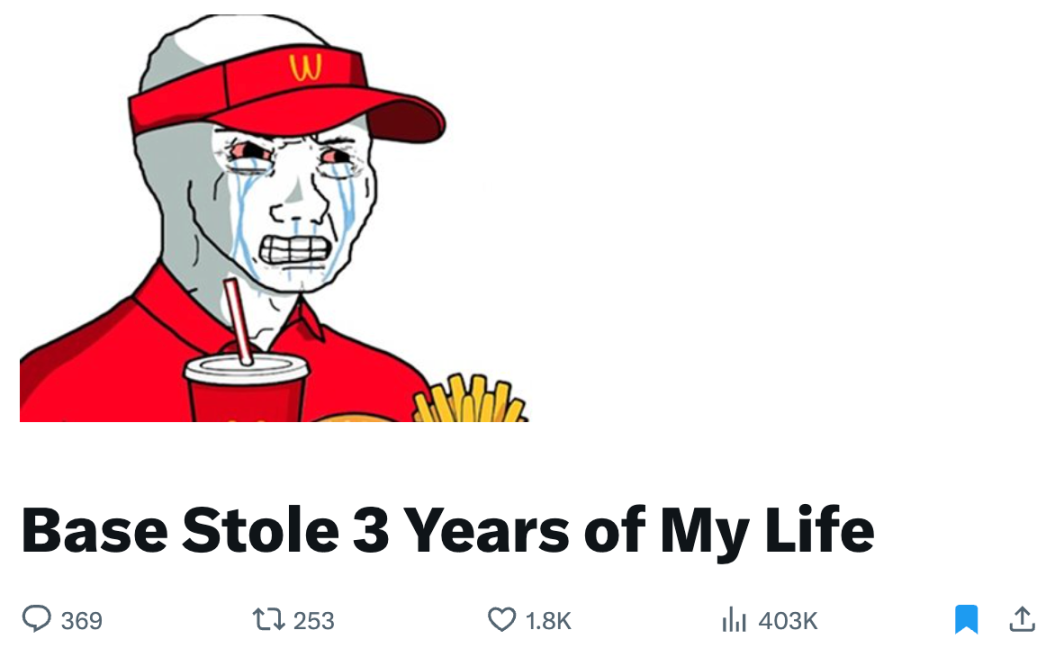
In the article, Tuna stated that Jesse's philosophy of Base being "application-first" rather than focusing on infrastructure attracted him to develop products on Base. However, after "three years" (Base's mainnet has only been live for about two and a half years) of developing 10 products including games, AI Agents, prediction markets, and zkTLS, the promised support from Base never materialized.

After launching the hit game Infected and gaining 50,000 followers in a month, Base proactively contacted tuna and promised support, but ultimately nothing came of it. Tuna mentioned that before Infected, they tried to reach Base officials through X, Discord, and Telegram but received no response.

Disheartened, tuna switched to Solana and developed the game Addicted, which generated $4 million in revenue within 48 hours of its launch on Solana. The stark contrast of earning $4 million in 2 days versus achieving nothing in nearly 3 years led tuna to lament that, compared to Base, which constantly promotes Farcaster and Zora, he had finally found an "organization" that treats developers like human beings.

Shivam Tandon, founder of zkCross Network, had a similar experience. He also initially believed in Jesse's story of prioritizing products and builders. However, after developing Surf on Base, their efforts to contact Base via email and private messages similarly went unanswered. Shivam Tandon stated that he doesn't mind if Base wants to support projects invested in by Coinbase, but he wishes they would be upfront about it and not waste developers' time.

Although some pragmatic users believe Base has its own preferences and that project failures shouldn't be blamed on this, most people expressed support for tuna.

Developer criticism of Base didn't start this year. In February 2025, a user with the X handle Lamboland felt that Base's approach seemed insufficiently "degen." Coinbase offered no support for a high-traffic project like Virtuals but listed the VVV token on its launch day. Lamboland mentioned that many projects were considering migrating to Solana, primarily because Base's marketing was out of touch, lacking "seasoned veterans" who understand CT culture to build a good community environment.

Similarly, just two weeks ago, Jacek, a member of DEGEN—which airdropped $50 million in tokens to Farcaster users and once had a market cap exceeding $1 billion—also posted a long thread expressing disappointment with Base.

Jacek stated that developers choose Base largely because of its connection to Coinbase, hoping to gain support or brand endorsement. However, as the previous two mentioned, Base devoted significant effort to projects like Zora, while even the official Base Twitter account didn't follow or retweet projects like DEGEN that brought massive traffic to Base. In Jacek's view, to Base, anything outside the mainstream narrative simply doesn't exist.

Furthermore, DEGEN's proposal for a $1 million airdrop on Base and the Base App was ignored. Jacek noted that when DEGEN announced plans to cross-chain to Solana, they immediately received attention and support from Solana. At offline events, Solana officials were eager to interact with ecosystem projects, even giving out Bonk keychains. It's these small, seemingly insignificant details that demonstrate official respect for developers and participants. In contrast, Jacek expressed that he doesn't mind Base promoting Zora, but the attitude of completely ignoring other projects is disappointing.

Interestingly, despite such severe public criticism, neither Base nor Jesse offered any explanation or proposed solutions in the replies to these tweets. On the 9th of this month, Jesse retweeted a post from Base product manager Nick, expressing Base's willingness to assist developers, but the comments were filled with skepticism, with the most common question being: How exactly do you plan to help?

Over the past year, Base has indeed been a gold rush destination, but it almost experienced "sudden death" after its flagship projects fizzled out. Unlike Solana, Base is part of the Coinbase ecosystem, an extension of the exchange, born with the attribute of serving stakeholders. Clearly, the unhealthy tendencies existing within the already large Coinbase have also affected Base's operations. Perhaps Base's sudden popularity was indeed supported by Coinbase's strong resources, but the core contributors to its brief success were still the talented developers in the community.

Coinbase's plans for Base in 2026 primarily revolve around on-chain assets and the Base App. Coinbase plans to gradually evolve into a comprehensive exchange in the future, with aspects like stock tokenization and commodity tokenization mainly being handled by Base. Additionally, the Base App is planned to be developed into a Web3 traffic入口 (entry point) integrating trading, social features, and a wallet. This indicates that Base will likely continue to adhere to its recognized "mainstream narrative," and its functional role in assisting Coinbase will remain stronger than being an open community itself.

Over the past year, Base wanted to use its influence to strongly promote projects like Farcaster and Zora, which have capital backing and "orthodox" narratives, but misjudged the "crazy" mainstream style of this market cycle. For Coinbase, it needs to clarify whether Base is merely a tool to serve the exchange and Coinbase Ventures, or a truly open network for the entire world. If it's the latter, it must adopt an operational philosophy like Solana's—"from the masses, to the masses."


Twitter:https://twitter.com/BitpushNewsCN

BitPush TG Discussion Group:https://t.me/BitPushCommunity

BitPush TG Subscription: https://t.me/bitpush

Original article link:https://www.bitpush.news/articles/7602760

Criptomoedas em alta

Perguntas relacionadas

QWhat was the main complaint of the game studio Pandemic Labs' co-founder (tuna) against Base?

ATuna complained that despite Base's initial promise of an 'application-first' approach and support for developers, after nearly three years of developing 10 different products (including games, AI Agent, prediction markets, zkTLS) on Base, the promised support never materialized. Even after creating a hit game 'Infected' that gained 50,000 followers, Base's offer of support ultimately came to nothing.

QWhat contrasting result did tuna experience after switching from Base to Solana?

AAfter switching to Solana and developing the game 'Addicted', tuna generated $4 million in revenue within just 48 hours of its launch. This starkly contrasted with nearly three years of achieving nothing on Base, leading him to feel that Solana was an organization that treated developers with respect.

QAccording to the article, what is a common criticism from developers like Shivam Tandon (zkCross Network) and Jacek (DEGEN) regarding Base's support?

ADevelopers like Shivam Tandon and Jacek criticized Base for ignoring their attempts to make contact via emails and private messages, and for showing preferential support to projects like Zora and those backed by Coinbase Ventures, while neglecting other developers who brought significant traffic and value to the ecosystem, such as DEGEN which airdropped $50 million to users.

QHow did the article characterize Base's relationship with Coinbase and its potential future focus?

AThe article characterized Base as an extension of the Coinbase exchange, born with the attribute of serving its stakeholders. Its future planning for 2026 is focused primarily on on-chain assets and the Base App, aiming to develop into a comprehensive exchange handling stock tokenization, commodity tokenization, and acting as a Web3 traffic entry point. Its functional role in assisting Coinbase is seen as stronger than being a truly open community.

QWhat key difference in community engagement did Jacek highlight between Solana and Base?

AJacek highlighted that when DEGEN announced plans to bridge to Solana, they immediately received attention and support from Solana. At offline events, Solana's official staff were eager to interact with ecosystem projects, even giving out small gifts like Bonk keychains. This demonstrated a respect for developers and participants that was lacking in Base's approach, which largely ignored projects outside its 'mainstream narrative'.

Leituras Relacionadas

The "Impossible Triad" Is Fundamentally a Pseudo-Problem

The article argues that blockchain's fundamental limitation is not the scalability trilemma (decentralization, scalability, security), which has been largely solved, but the lack of **privacy** and, until recently, clear **legitimacy**. Blockchain is described as a slow, expensive, globally shared computer whose core value is censorship resistance and verifiability. While ideal for native digital assets like money (e.g., stablecoins), its default transparency acts as a **tax**, exposing all transactions and enabling MEV extraction, which deters serious institutional capital. Simultaneously, its permissionless nature created regulatory ambiguity. The piece contends that **privacy** is the missing critical feature. It rejects the false choice between total transparency and complete anonymity. Modern cryptography (like zero-knowledge proofs) enables **compliant privacy**: users can prove facts (solvency, KYC status, compliance) without revealing the underlying sensitive data (specific holdings, identities). This preserves auditability for regulators and eliminates the leak of financial information. With recent regulatory progress (e.g., the GENIUS Act) addressing legitimacy, adding default, provably compliant privacy becomes a pure upgrade. It transforms blockchain from a costly, public ledger into a confidential settlement layer, finally bridging the gap to mainstream institutional and individual adoption of on-chain finance.

链捕手Há 4h

The "Impossible Triad" Is Fundamentally a Pseudo-Problem

链捕手Há 4h

Optical Chips: Collective Capacity Expansion

The global optical chip industry is experiencing a massive wave of expansion driven by surging AI data center demand. Major players across the US, Japan, Europe, and China are aggressively investing to ramp up production capacity. In the US, Coherent is expanding its 6-inch Indium Phosphide (InP) semiconductor fab in Texas, supported by CHIPS Act funding and a $2 billion strategic investment from NVIDIA. Lumentum is building a new factory for InP optical devices, and Nokia is scaling its advanced photonic chip packaging and testing capabilities. NVIDIA's investments aim to secure future supply of critical lasers and optical interconnect products for AI infrastructure. Japan's JX Advanced Metals, a leading InP substrate supplier, plans a multi-billion yen investment to increase its capacity 7-10 times, strengthening its grip on the crucial upstream materials market. In Europe, IQE and Tower Semiconductor settled a patent dispute and signed a multi-year InP epitaxial wafer supply agreement, highlighting that next-generation silicon photonics platforms will integrate high-performance InP components. STMicroelectronics and Sivers Semiconductors are also expanding silicon photonics production and partnerships. China is rapidly building out its domestic supply chain. Dongshan Precision's subsidiary, Source Photonics, announced a $12 billion project to expand optical chip and module production. Companies like Sanan Optoelectronics and Yunnan Germanium are scaling up InP chip manufacturing and substrate production, moving towards vertical integration from materials to modules. While debate continues around the exact future architecture—whether CPO (Co-Packaged Optics), NPO, or pluggables will dominate—analysts like Morgan Stanley argue the underlying driver is unchangeable: the explosive growth in bandwidth demand. This will inevitably increase the volume of optical engines, lasers, and related content per GPU, regardless of the final technical path. The competition for "more light" in the AI era has intensified into a global, full-chain capacity race.

marsbitHá 6h

Optical Chips: Collective Capacity Expansion

marsbitHá 6h

Stablecoins Finally Find Real Yield: An In-Depth Look at On-Chain Reinsurance Re | A Conversation with Re Founder Karan Saroya

Stablecoin Real Yield Found: A Deep Dive into On-Chain Reinsurance with Re's Karan Saroya As stablecoin supply exceeds $170 billion, the search for sustainable, non-speculative yield intensifies. Re, an on-chain reinsurance platform, provides an answer: connecting stablecoin capital to the trillion-dollar traditional reinsurance market. Re operates as a regulated reinsurer, accepting stablecoin deposits as collateral to back US insurance companies. These insurers pay premiums, generating yield that flows back to on-chain depositors. Currently supporting 35 insurers and underwriting $500 million, Re projects scaling to over $1 billion soon. Key insights from a Bankless podcast with founder Karan Saroya and investor Avichal of Electric Capital: 1. **Uncorrelated, Real-World Yield:** Re offers stablecoin holders access to reinsurance returns (targeting 12-14%+), an asset class entirely separate from crypto or equity markets. 2. **Operational Efficiency via Smart Contracts:** Re replaces traditional, labor-intensive capital fundraising with smart contracts, allowing a ~12-person team to compete with industry giants. 3. **Regulatory Leverage:** For every $1 of collateral, regulations allow backing $5-7 in written premiums. This leverage amplifies returns from the underlying risk-free rate. 4. **DeFi Integration:** Depositors receive receipt tokens, which can be used in protocols like Morpho for "looping," potentially pushing yields to 18-20%+. 5. **The "DeFi Mullet" Model:** A compliant front-end (regulated reinsurer) paired with a decentralized back-end (smart contracts, DeFi capital markets). 6. **RE Governance Token:** Modeled on Lloyd's of London, the token governs the central capital pool's allocation, counterparty acceptance, and parameters. 7. **Real Economic Impact:** Capital funds real-world productivity (factories, clinics, businesses) via insurance, moving beyond crypto's internal loops. The discussion highlights a pivotal moment: DeFi's supply-side infrastructure is now met by real demand for productive yield, potentially kickstarting a flywheel where vast on-chain stablecoin capital seeks these real-world returns.

链捕手Há 7h

Stablecoins Finally Find Real Yield: An In-Depth Look at On-Chain Reinsurance Re | A Conversation with Re Founder Karan Saroya

链捕手Há 7h

1996 or 1999? Walsh's First Test is 'How to View AI'

"1996 or 1999? Wall's First Big Test Is 'How to View AI'" Federal Reserve Chairman Wall's initial challenge is not whether to raise or cut rates, but a more fundamental judgment: what kind of boom is the current AI boom? This will determine the Fed's policy path and define his legacy. Economics is split between two opposing views, according to reporter Nick Timiraos. One sees imminent productivity gains that will increase supply and cool inflation, allowing the Fed to hold steady. The other argues that while productivity benefits are distant, demand shocks are here now, and waiting for data confirmation risks missing the intervention window, forcing sharper rate hikes later. Wall has signaled a leaning toward the first view, echoing 1996-era Alan Greenspan, who embraced strong, productivity-driven growth without fear of inflation. However, Wall faces a different macro environment than Greenspan did, with tariff pressures, expanding fiscal deficits, and diminishing globalization benefits, which could force more significant inflation pressures even if AI benefits materialize. Wall's logic, expressed before taking office, is that AI-driven productivity gains won't show in official data for years. If the Fed waits for confirmation, it might mistakenly tighten policy and choke off the very growth that could suppress inflation. This argues for using forward-looking narratives over lagging data. Chicago Fed President Austan Goolsbee presents a key counter-argument. He distinguishes between expected and unexpected productivity booms. A widely anticipated boom, like the current AI wave, can cause people to spend future wealth gains in advance, overheating the economy before productivity actually rises, thus requiring preemptive rate hikes. He cites rising costs for AI data centers as evidence of such overheating. Fed Governor Christopher Waller offers a rebuttal to Goolsbee, noting the "expected spending" mechanism only works if people can borrow against future income, which many households cannot do due to borrowing constraints. Wall also faces a paradox related to his desire to reduce the Fed's use of "forward guidance" (pre-announcing policy moves). This practice was established in 1999 when Greenspan began signaling hikes to avoid market shocks. If the economy follows a less optimistic path, Wall may be forced to choose between using the guidance he wants to abolish or risking market volatility by staying silent. The ultimate question defining Wall's first major test remains: Is this 1996 or 1999?

marsbitHá 8h

1996 or 1999? Walsh's First Test is 'How to View AI'

marsbitHá 8h

Trading

Spot
Futuros

Artigos em Destaque

Como comprar ONE

Bem-vindo à HTX.com!Tornámos a compra de Harmony (ONE) simples e conveniente.Segue o nosso guia passo a passo para iniciar a tua jornada no mundo das criptos.Passo 1: cria a tua conta HTXUtiliza o teu e-mail ou número de telefone para te inscreveres numa conta gratuita na HTX.Desfruta de um processo de inscrição sem complicações e desbloqueia todas as funcionalidades.Obter a minha contaPasso 2: vai para Comprar Cripto e escolhe o teu método de pagamentoCartão de crédito/débito: usa o teu visa ou mastercard para comprar Harmony (ONE) instantaneamente.Saldo: usa os fundos da tua conta HTX para transacionar sem problemas.Terceiros: adicionamos métodos de pagamento populares, como Google Pay e Apple Pay, para aumentar a conveniência.P2P: transaciona diretamente com outros utilizadores na HTX.Mercado de balcão (OTC): oferecemos serviços personalizados e taxas de câmbio competitivas para os traders.Passo 3: armazena teu Harmony (ONE)Depois de comprar o teu Harmony (ONE), armazena-o na tua conta HTX.Alternativamente, podes enviá-lo para outro lugar através de transferência blockchain ou usá-lo para transacionar outras criptomoedas.Passo 4: transaciona Harmony (ONE)Transaciona facilmente Harmony (ONE) no mercado à vista da HTX.Acede simplesmente à tua conta, seleciona o teu par de trading, executa as tuas transações e monitoriza em tempo real.Oferecemos uma experiência de fácil utilização tanto para principiantes como para traders experientes.

315 Visualizações TotaisPublicado em {updateTime}Atualizado em 2026.06.02

Como comprar ONE

Discussões

Bem-vindo à Comunidade HTX. Aqui, pode manter-se informado sobre os mais recentes desenvolvimentos da plataforma e obter acesso a análises profissionais de mercado. As opiniões dos utilizadores sobre o preço de ONE (ONE) são apresentadas abaixo.

活动图片