Monero, Zcash, and Canton Network: Who is the True King of Privacy?

marsbitPublicado em 2026-01-13Última atualização em 2026-01-13

Resumo

Blockchain transparency poses risks for institutions by exposing sensitive corporate and financial data. While Monero offers complete anonymity by hiding all transaction details, it lacks KYC/AML compliance, making it unsuitable for regulated entities. Zcash provides selective privacy through shielded addresses, allowing users to encrypt transactions but only in an all-or-nothing manner. In contrast, Canton Network enables granular, selective disclosure—allowing institutions to share only specific transaction components with authorized parties (e.g., regulators) while keeping other details private. This aligns with institutional needs for both privacy and compliance. Canton’s adoption by DTCC and over 400 institutions highlights its practical design for real-world financial workflows, positioning it as a leading privacy solution for the institutional era.

Written by: Tiger Research

Key Points

  • The core advantage of blockchain—transparency—can expose corporate trade secrets and investment strategies, posing substantial risks to businesses.
  • Fully anonymous privacy models like Monero do not support KYC or AML, making them unsuitable for regulated institutions.
  • Financial institutions require selective privacy, which protects transaction data while remaining compatible with regulatory compliance.
  • Financial institutions must determine how to connect with open Web3 markets for expansion.

1. Why is Blockchain Privacy Necessary?

One of the core features of blockchain is transparency. Anyone can inspect on-chain transactions in real-time, including who sent the funds, to whom, the amount, and when it was sent.

However, from an institutional perspective, this transparency presents obvious problems. Imagine a scenario where the market can observe how much NVIDIA transferred to Samsung Electronics, or precisely when a hedge fund deployed its funds. Such visibility would fundamentally alter competitive dynamics.

The level of information disclosure tolerable for individuals differs from what businesses and financial institutions can accept. A company's transaction history and the timing of institutional investments constitute highly sensitive information.

Therefore, expecting institutions to operate on a blockchain where all activities are fully exposed is unrealistic. For these participants, a system without privacy is less of a practical infrastructure and more of an abstract ideal with limited real-world application.

2. Forms of Blockchain Privacy

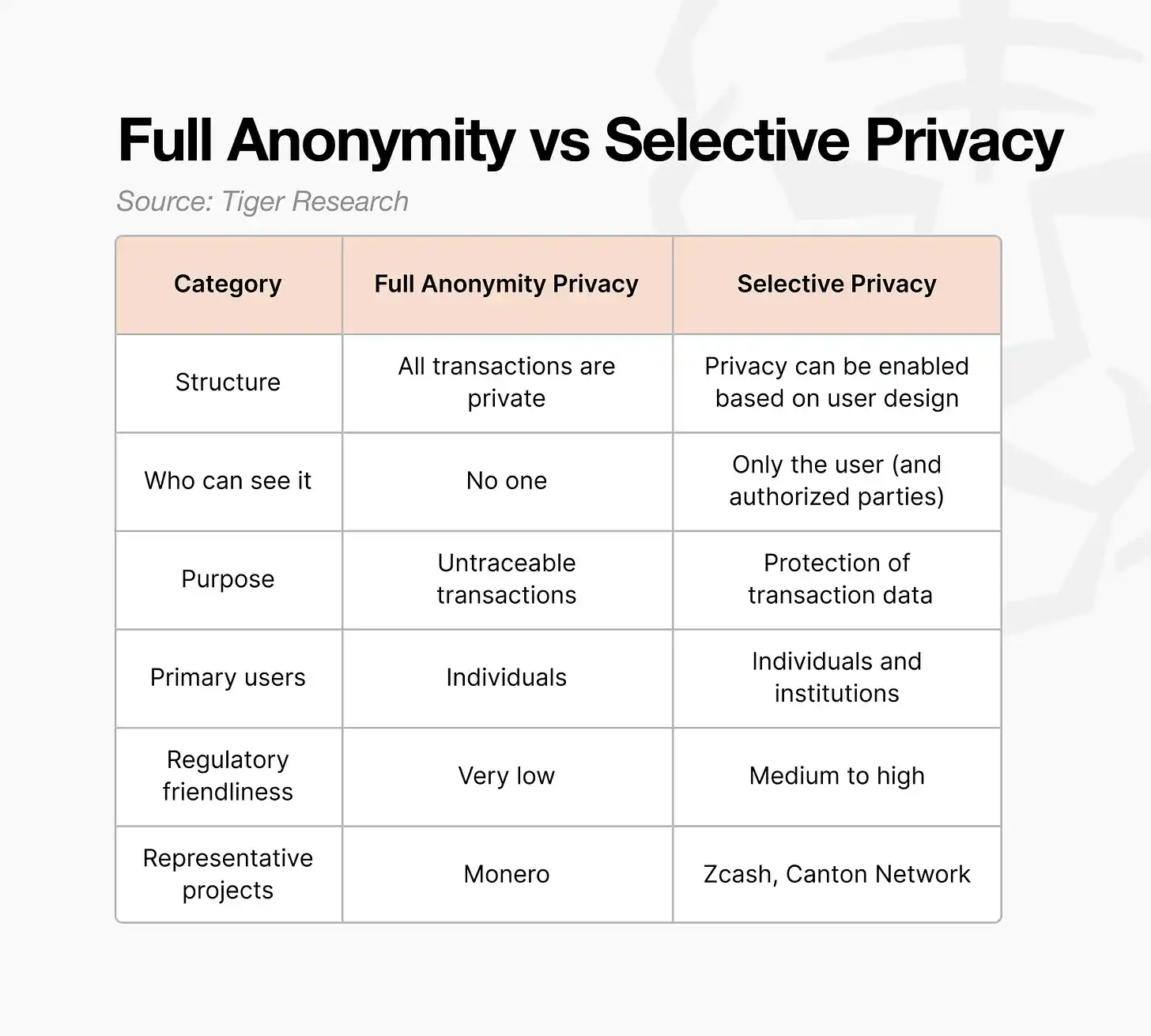
Blockchain privacy is generally divided into two categories:

  • Fully Anonymous Privacy
  • Selective Privacy

The key difference lies in whether information can be disclosed when another party requires verification.
2.1. Fully Anonymous Privacy

Fully anonymous privacy, simply put, hides everything.

The sender, receiver, and transaction amount are all hidden. This model stands in direct opposition to traditional blockchains, which prioritize transparency by default.

The primary goal of fully anonymous systems is to prevent third-party surveillance. Rather than enabling selective disclosure, they aim to completely prevent external observers from extracting meaningful information.
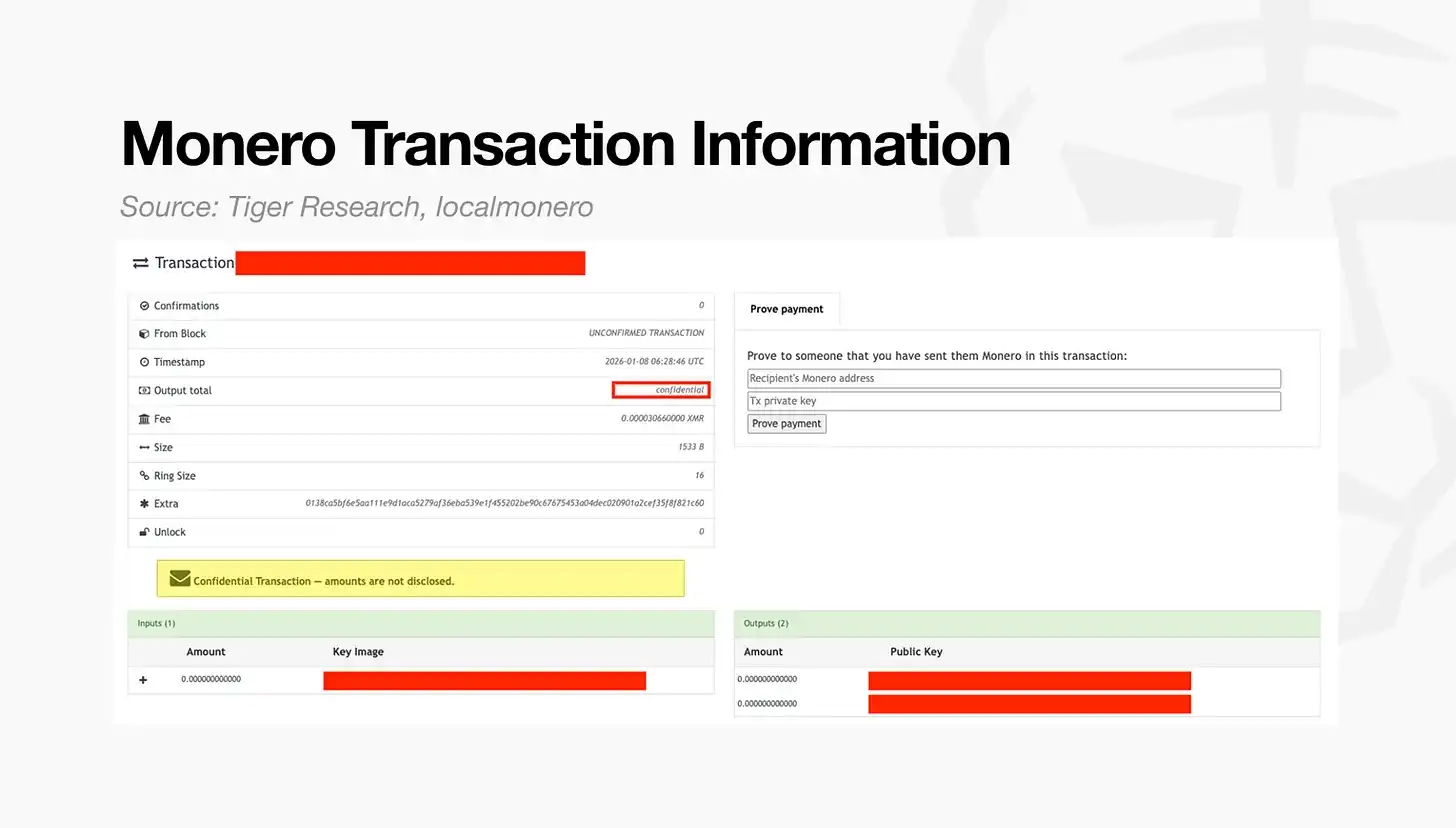
Source: Tiger Research

The above image shows a Monero transaction record, a representative example of fully anonymous privacy. Unlike transparent blockchains, details such as the transfer amount and counterparty are not visible.

Two characteristics illustrate why this model is considered fully anonymous:

  • Output Totals: The ledger does not display specific numbers but shows values as "confidential." Transactions are recorded, but their content cannot be interpreted.
  • Ring Signature Size: Although a single sender initiates the transaction, the ledger mixes it with multiple decoys, making it appear as if multiple parties are sending funds simultaneously.

These mechanisms ensure that transaction data remains opaque to all external observers without exception.

2.2. Selective Privacy

Selective privacy operates on a different assumption. Transactions are public by default, but users can choose to make specific transactions private by using designated privacy-enabled addresses.

Zcash provides a clear example. When initiating a transaction, users can choose between two address types:

  • Transparent Addresses: All transaction details are publicly visible, similar to Bitcoin.
  • Shielded Addresses: Transaction details are encrypted and hidden.
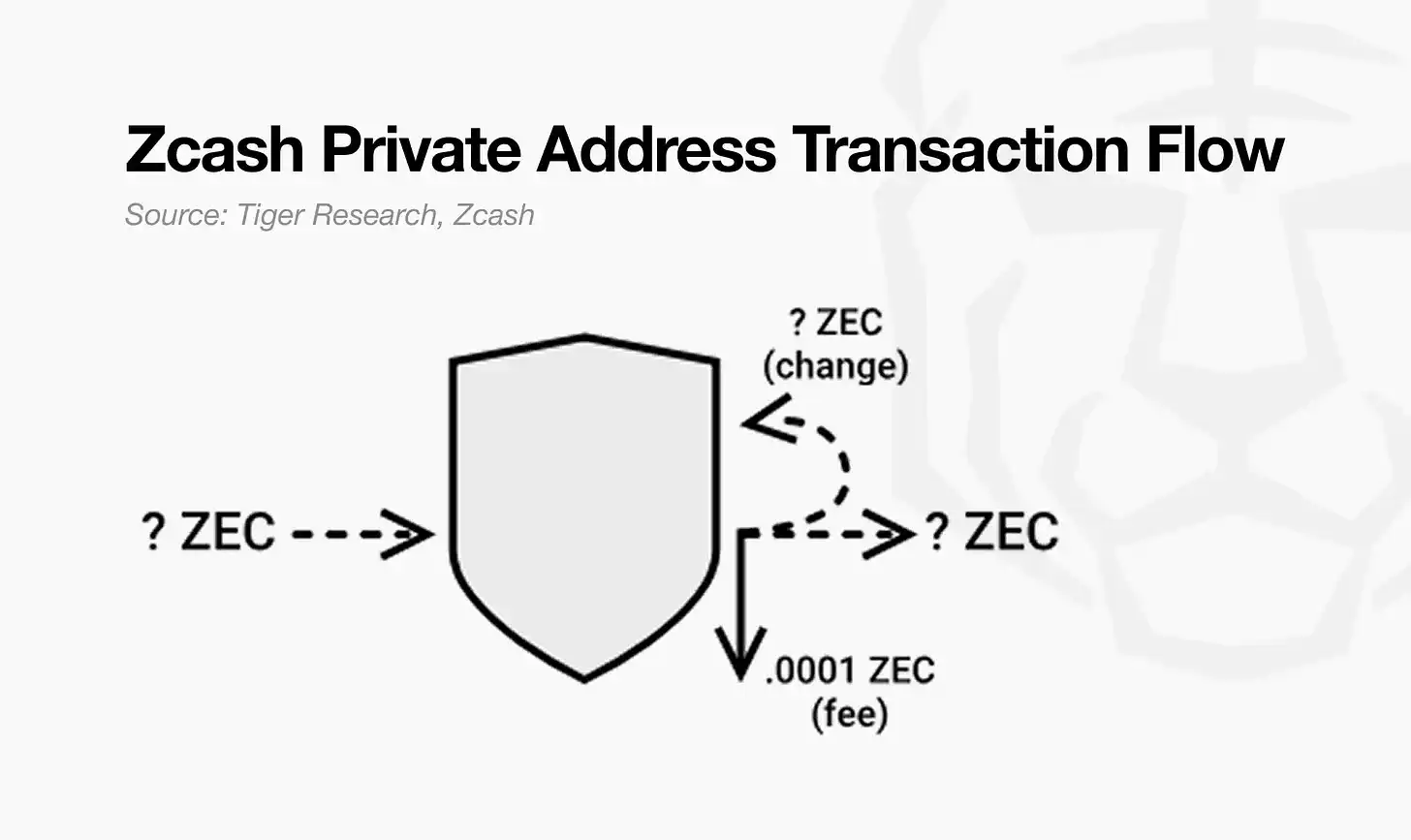
Source: Tiger Research

The above image illustrates which elements Zcash can encrypt when using shielded addresses. Transactions sent to shielded addresses are recorded on the blockchain, but their content is stored in an encrypted state.

While the existence of the transaction remains visible, the following information is hidden:

  • Address Type: Shielded (Z) addresses are used instead of transparent (T) addresses.
  • Transaction Record: The ledger confirms that a transaction occurred.
  • Amount, Sender, Receiver: All are encrypted and cannot be observed externally.
  • Viewing Rights: Only parties granted a viewing key can inspect the transaction details.

This is the core of selective privacy. Transactions remain on-chain, but users control who can view their content. When necessary, users can share a viewing key to prove transaction details to another party, while all other third parties remain unable to access that information.

3. Why Financial Institutions Prefer Selective Privacy

Most financial institutions have Know Your Customer (KYC) and Anti-Money Laundering (AML) obligations for every transaction. They must retain transaction data internally and respond immediately to requests from regulators or supervisory bodies.

However, in an environment built on fully anonymous privacy, all transaction data is irreversibly hidden. Because the information cannot be accessed or disclosed under any conditions, institutions are structurally unable to fulfill their compliance obligations.

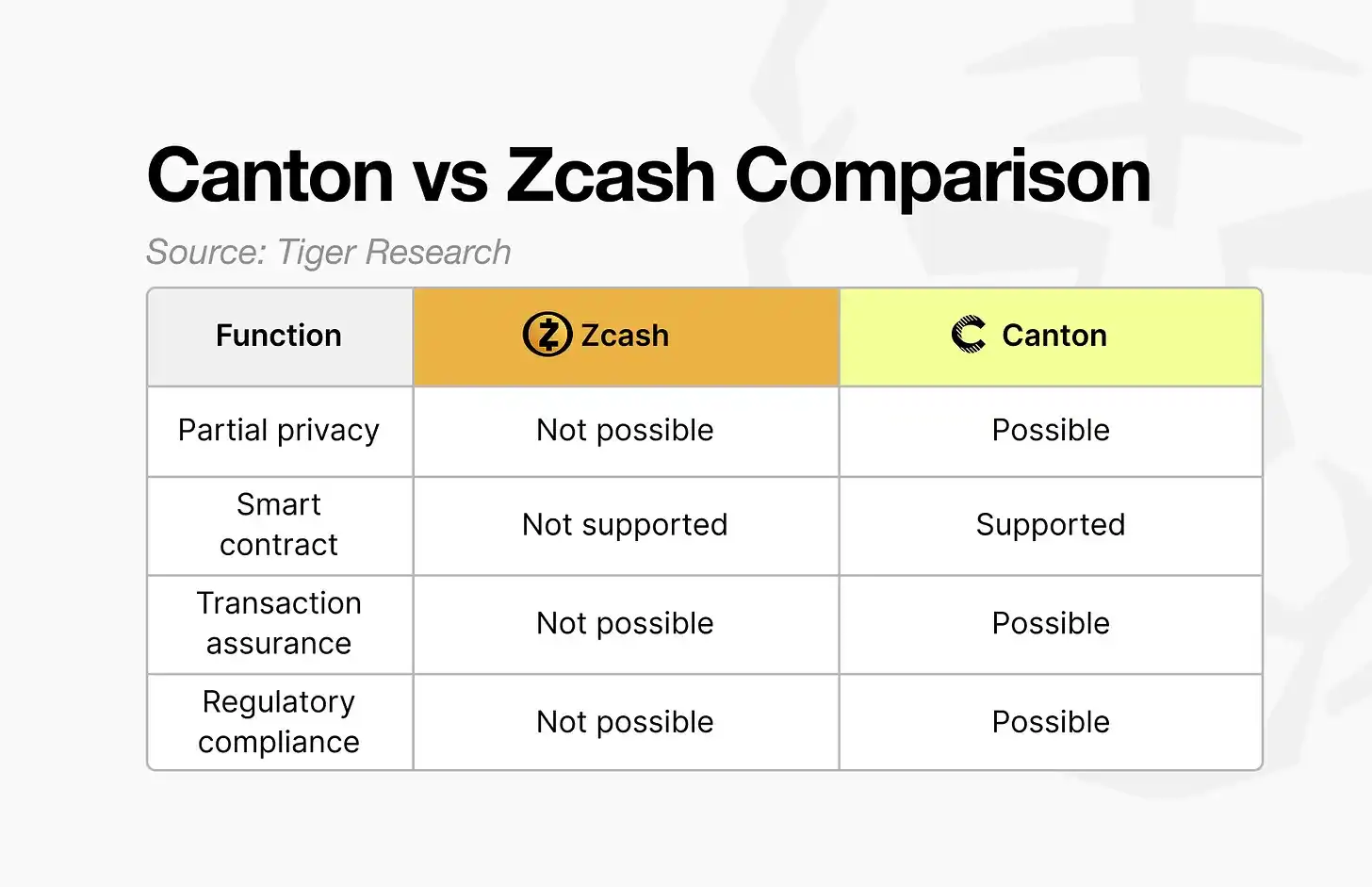
A representative example is the Canton Network, which has been adopted by the Depository Trust & Clearing Corporation (DTCC) and is currently used by over 400 companies and institutions. In contrast, Zcash, although also a selective privacy project, has seen limited real-world institutional adoption.

What is the reason for this difference?
Source: Tiger Research

Zcash offers selective privacy, but users cannot choose which information to disclose. Instead, they must choose whether to disclose the entire transaction.

For example, in a transaction where "A sends $100 to B," Zcash does not allow only the amount to be hidden. The transaction itself must be either fully hidden or fully disclosed.

In institutional transactions, different participants require different information. Not all participants need access to all data in a single transaction. However, Zcash's structure forces a binary choice between full disclosure and full privacy, making it unsuitable for institutional transaction workflows.

In contrast, Canton allows transaction information to be divided into separate components for management. For example, if a regulator only requires the transaction amount between A and B, Canton enables the institution to provide only that specific information. This functionality is achieved through Daml, the smart contract language used by the Canton Network.

Other reasons for institutional adoption of Canton are covered in more detail in previous Canton research.

4. Privacy Blockchains in the Institutional Era

Privacy blockchains evolve as demands change.

Early projects like Monero aimed to protect individual anonymity. However, as financial institutions and corporations began entering the blockchain environment, the meaning of privacy shifted.

Privacy is no longer defined as making transactions invisible to everyone. Instead, the core goal has become protecting transactions while still meeting regulatory requirements.

This shift explains why selective privacy models like the Canton Network have gained traction. Institutions need more than just privacy technology; they need infrastructure designed to match real-world financial transaction workflows.

In response to these demands, more institution-oriented privacy projects continue to emerge. Looking ahead, the key differentiator will be how effectively privacy technology can be applied to practical transaction environments.

Alternative forms of privacy that run counter to the current institution-driven trend may emerge. However, in the short term, privacy blockchain is likely to continue evolving around institutional transactions.


Perguntas relacionadas

QWhy is blockchain privacy necessary for institutions according to the article?

ABlockchain transparency can expose corporate trade secrets and investment strategies, posing substantial risks. Institutions require privacy that protects sensitive transaction data while remaining compatible with regulatory compliance, as full transparency is unrealistic for their operations.

QWhat is the key difference between fully anonymous privacy and selective privacy in blockchain?

AFully anonymous privacy hides all transaction details (sender, receiver, amount) from everyone, while selective privacy allows users to encrypt transactions but grant access to specific parties (e.g., regulators) via view keys when necessary.

QWhy are fully anonymous privacy models like Monero unsuitable for regulated financial entities?

AThey irreversibly hide all transaction data, making it impossible for institutions to fulfill KYC and AML obligations or respond to regulatory requests, as no information can be disclosed under any conditions.

QHow does Canton Network address the limitations of Zcash's selective privacy for institutional use?

ACanton allows granular control over transaction data disclosure using Daml smart contracts, enabling institutions to share specific information (e.g., only amount) with authorized parties, unlike Zcash's all-or-nothing binary approach.

QWhat shift in privacy needs does the article highlight as institutions adopt blockchain technology?

APrivacy is no longer about complete anonymity for all; instead, the focus is on protecting transactions while meeting regulatory requirements, leading to the rise of selective privacy models like Canton Network tailored for real-world financial workflows.

Leituras Relacionadas

KOL's Perspective: Why Is SOL Set to Rise from This Point?

**Summary: Why SOL is Positioned for Growth at This Level** The article argues that SOL is poised for an upward move from its current price point, citing several key factors. Primarily, SOL has just broken out of a 4-month consolidation phase. This breakout signals a return of risk appetite to the broader crypto market, as SOL is seen as a key indicator of overall crypto health. The token's ownership has reportedly shifted from short-term traders and tourists to long-term accumulators, leading to low volume. Any meaningful increase in trading activity could thus trigger significant upward momentum. Fundamental strengths include strong institutional adoption, integration with DeFi and RWAs (Real-World Assets), and the potential benefits from the Clarity Act. Despite its high volatility—having dropped 70% from its all-time high but still up 12x from its bear market low—SOL is highlighted as one of the few tokens from the last cycle to reach new highs. It boasts a robust ecosystem of applications, users, and protocols. Future catalysts include the expected influx of AI developers following the Miami Accelerate conference, which focused on AI on Solana. Furthermore, Solana is positioned as the premier chain for memecoin activity, a trend expected to continue and drive network usage and fees. The article concludes that recent price action reflects a healthy transfer to long-term holders, setting the stage for growth.

marsbitHá 36m

KOL's Perspective: Why Is SOL Set to Rise from This Point?

marsbitHá 36m

Those Pre-Bitcoin PoW Protocols Have Recently Been Reimplemented

This article details a recent surge in replicating pre-Bitcoin Proof-of-Work (PoW) protocols, specifically focusing on Hal Finney's 2004 RPOW (Reusable Proofs of Work). Within five days in May 2026, multiple independent builders in the Bitcoin/cypherpunk community launched projects inspired by this early electronic cash proposal. The initiative began with Fred Krueger's `rpow2.com`, a centralized but auditable system that replaced RPOW's original IBM 4758 hardware with Ed25519 signatures. Initially a faithful replica, it later adopted Bitcoin-like features (21M supply cap, difficulty adjustment) and a controversial 5.24% founder allocation. This sparked rapid forks, including `rpow4.com` which incorporated full Bitcoin parameters, a prediction market (`rpowmarket.com`), and a DEX (`rpow2swap.com`). Concurrently, Mike In Space created a prototype of Wei Dai's 1998 b-money proposal (`b-money.replit.app`), pushing the historical exploration even further back. The article contrasts these centralized, server-dependent experiments with Bitcoin's core innovation of decentralized, trustless consensus. It also highlights a parallel development: the `HASH` project on Ethereum, which uses smart contract hooks to enable a purely fair-launch, browser-mineable PoW token with 0% allocations to team or VCs. The collective activity is framed as a meme-driven, educational exploration of cypherpunk history rather than a serious financial movement, with all projects heavily disclaiming any investment value.

marsbitHá 41m

Those Pre-Bitcoin PoW Protocols Have Recently Been Reimplemented

marsbitHá 41m

South Korean Exchanges 'Battle' Regulators, Challenging the Boundaries of Enforcement and Legislation

South Korea's cryptocurrency industry is engaged in a rare, direct confrontation with regulators. The Financial Intelligence Unit (FIU), the primary anti-money laundering (AML) watchdog, has recently imposed heavy penalties on major exchanges like Upbit and Bithumb for alleged violations involving unregistered overseas VASPs and AML procedures. However, exchanges are now actively challenging these actions in court and through industry associations. In a significant shift, the Seoul Administrative Court ruled in favor of Upbit's operator, Dunamu, overturning part of an FIU-ordered business suspension. The court found the FIU's penalty criteria and justification insufficiently clear. Similarly, the court suspended the enforcement of a six-month business suspension against Bithumb pending a final ruling, citing potential irreversible harm to the exchange. Beyond legal battles, the industry is contesting proposed legislative amendments. The Digital Asset eXchange Alliance (DAXA) strongly opposes a draft rule that would mandate Suspicious Transaction Reports (STRs) for all crypto transfers over 10 million KRW (~$6,800). DAXA argues this "poison pill" clause violates legal principles and would overwhelm the STR system, increasing reports from 63,000 to an estimated 5.45 million annually for major exchanges, thereby crippling effective AML monitoring. This conflict highlights a structural tension in South Korea's crypto governance: comprehensive digital asset laws are still developing, while regulators rely heavily on AML enforcement. The industry's move from passive compliance to active legal and legislative challenges signifies a new phase, pressing for clearer rules and more proportionate enforcement. While short-term disputes may intensify, this clash could ultimately lead to a more mature and sustainable regulatory framework for South Korea's vibrant crypto market.

marsbitHá 1h

South Korean Exchanges 'Battle' Regulators, Challenging the Boundaries of Enforcement and Legislation

marsbitHá 1h

After 50x Storage Surge, Justin Sun Always Looks to the Next Decade

Sun Yuchen, known for his controversial stunts like a $30 million lunch with Warren Buffett (canceled due to a kidney stone) and eating a $6.2 million duct-taped banana, is often overshadowed by a significant fact: his decade-long track record of spotting major investment trends. In 2016, he famously advised young people to invest in Bitcoin, Nvidia, Tesla, and Tencent instead of buying property. A hypothetical $20,000 investment in Nvidia and Tesla from that list would now be worth over 50 million RMB. His latest major call was on November 6, 2025, predicting a "50x storage opportunity" tied to the AI boom, which materialized with Sandisk's stock surging nearly 50-fold by 2026. Looking ahead, Sun now focuses on the next frontier: Physical AI. He identifies four key areas: 1. **Embodied AI/Robotics**: He sees this reaching its "iPhone moment," with companies like UBTech and Galaxy General leading in commercialization. 2. **Drones**: Viewed as the first commercially viable form of Physical AI, revolutionizing sectors from warfare (e.g., AeroVironment's Switchblade) to logistics. 3. **Spatial Computing**: Beyond VR, it's about AI understanding physical space, a foundational technology for robotics and autonomous systems, exemplified by Apple's Vision Pro. 4. **Space Exploration**: After a 2025 suborbital flight with Blue Origin, Sun advocates for space as the ultimate frontier, discussing blockchain's potential role in space asset management and data transactions. His investment philosophy involves betting on entire, inevitable trends rather than single companies. For robotics, he sees Tesla (the body/manufacturer) and Nvidia (the brain/AI platform) as complementary plays. In defense drones, he highlights companies making tanks obsolete (AeroVironment) and those augmenting fighter jets (Kratos). For space, he participated in Blue Origin's flight and anticipates SpaceX's potential IPO to redefine the sector's valuation. Sun Yuchen's vision frames the next two decades not as a revolution in information flow (like the internet), but in the fundamental operation of the physical world through AI-powered robots, autonomous systems, and spatial intelligence, ultimately extending human and AI activity into space. While many still focus on conventional assets, he continues to look toward the next technological horizon.

marsbitHá 2h

After 50x Storage Surge, Justin Sun Always Looks to the Next Decade

marsbitHá 2h

Trading

Spot
Futuros

Artigos em Destaque

Como comprar CORE

Bem-vindo à HTX.com!Tornámos a compra de CORE (CORE) simples e conveniente.Segue o nosso guia passo a passo para iniciar a tua jornada no mundo das criptos.Passo 1: cria a tua conta HTXUtiliza o teu e-mail ou número de telefone para te inscreveres numa conta gratuita na HTX.Desfruta de um processo de inscrição sem complicações e desbloqueia todas as funcionalidades.Obter a minha contaPasso 2: vai para Comprar Cripto e escolhe o teu método de pagamentoCartão de crédito/débito: usa o teu visa ou mastercard para comprar CORE (CORE) instantaneamente.Saldo: usa os fundos da tua conta HTX para transacionar sem problemas.Terceiros: adicionamos métodos de pagamento populares, como Google Pay e Apple Pay, para aumentar a conveniência.P2P: transaciona diretamente com outros utilizadores na HTX.Mercado de balcão (OTC): oferecemos serviços personalizados e taxas de câmbio competitivas para os traders.Passo 3: armazena teu CORE (CORE)Depois de comprar o teu CORE (CORE), armazena-o na tua conta HTX.Alternativamente, podes enviá-lo para outro lugar através de transferência blockchain ou usá-lo para transacionar outras criptomoedas.Passo 4: transaciona CORE (CORE)Transaciona facilmente CORE (CORE) no mercado à vista da HTX.Acede simplesmente à tua conta, seleciona o teu par de trading, executa as tuas transações e monitoriza em tempo real.Oferecemos uma experiência de fácil utilização tanto para principiantes como para traders experientes.

291 Visualizações TotaisPublicado em {updateTime}Atualizado em 2025.03.21

Como comprar CORE

Discussões

Bem-vindo à Comunidade HTX. Aqui, pode manter-se informado sobre os mais recentes desenvolvimentos da plataforma e obter acesso a análises profissionais de mercado. As opiniões dos utilizadores sobre o preço de CORE (CORE) são apresentadas abaixo.

活动图片