Ministry of Finance Doubles Long-Term Bond Buyback Volume Amid Bitcoin and US Stock Rally

cryptonews.ruPublicado em 2026-08-19Última atualização em 2026-08-19

Resumo

The U.S. Treasury Department has doubled the purchase limit for long-term bond buybacks aimed at supporting liquidity in the 10-to-20-year and 20-to-30-year Treasury segments. The new rules, effective from September 9, will be in place for the current refunding quarter ending November 4. This move responds to sustained high activity and high-quality market offerings for longer-dated securities. The program targets older, less liquid "off-the-run" bonds to improve secondary market trading without significantly reducing overall debt, as the Treasury continues issuing new debt to fund the government. The expansion follows a sharp rise in long-term Treasury yields, with the 30-year yield recently exceeding 5.33%, a level not seen since 2007. In immediate reaction, the 10-year yield fell about 6 basis points to around 4.647%, and the 30-year yield dropped roughly 9 basis points to around 5.196%. Market observers quickly termed the larger buybacks a "mini-QE," noting their potential to reduce the supply of long-term bonds that private investors must absorb. Amid the yield decline, U.S. stock indices like the Dow Jones and S&P 500 traded higher, while Bitcoin rebounded to trade around $65,000, supported by spot ETF inflows and derivatives market dynamics. Lower yields can reduce the appeal of safe dollar assets, potentially supporting Bitcoin, though it faces resistance near $65,600-$66,000. The Treasury will decide on November 4 whether to maintain, expand, or scale back the inc...

The higher limit applies to buyback operations aimed at supporting liquidity in Treasury bond segments with maturities of 10 to 20 years and 20 to 30 years. The new set of rules from the U.S. Department of the Treasury will take effect on September 9 and will be in force for the current refinancing quarter, which ends on November 4.

The Treasury Department stated that this change reflects consistently high participant activity in operations with longer-dated maturities. Market participants have submitted significant volumes of high-quality offers, giving the Treasury Department reason to increase the amount it is willing to purchase.

An updated buyback schedule will be published later. The Treasury Department plans to provide more detailed information about the volumes of future operations during the next quarterly refinancing announcement on November 4. This news comes as long-term government bonds, not just in the US, are showing warning signals not seen for several decades.

Treasury Targets Older Bonds

The program is designed to ease trading in older Treasury securities. These bonds, known as "off-the-run," were issued before the newest benchmark bonds and may be less liquid, meaning they can be harder to buy or sell without affecting prices.
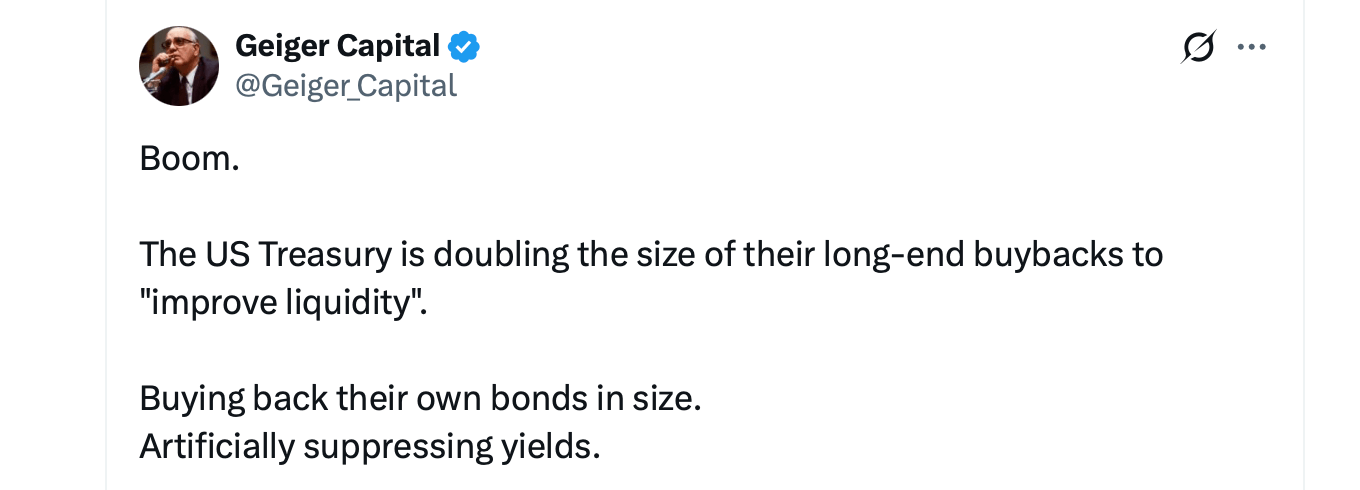
Image Source: X

The U.S. Treasury Department resumed regular buybacks in May 2024 after a long hiatus. Its cash management operations primarily target short-term securities and help regulate fluctuations in the government's cash balance. Liquidity support operations are designed to improve trading in the secondary market across the Treasury yield curve.

The Treasury can buy back older securities from dealers and other market participants and then retire them. It continues to issue new debt to finance the federal government, so these operations are more about altering the debt structure and supporting market functioning than leading to a significant reduction in outstanding debt volume.

The Department does not acquire newly issued benchmark bonds, securities that are particularly scarce in the repo market, or bonds used for delivery against Treasury futures contracts. It also remains a price-sensitive buyer and may purchase less than the stated maximum if the submitted offers are not attractive.

Yield Rise Prompted Swift Response

The expansion of the program followed a sharp rise in long-term Treasury yields. The yield on 30-year bonds recently exceeded 5.33%—the highest level since 2007—while 10-year yields climbed as investors priced in a significant volume of government borrowing, budget concerns, and a shift in the buyer base. The military conflict in the Middle East is only exacerbating the situation.
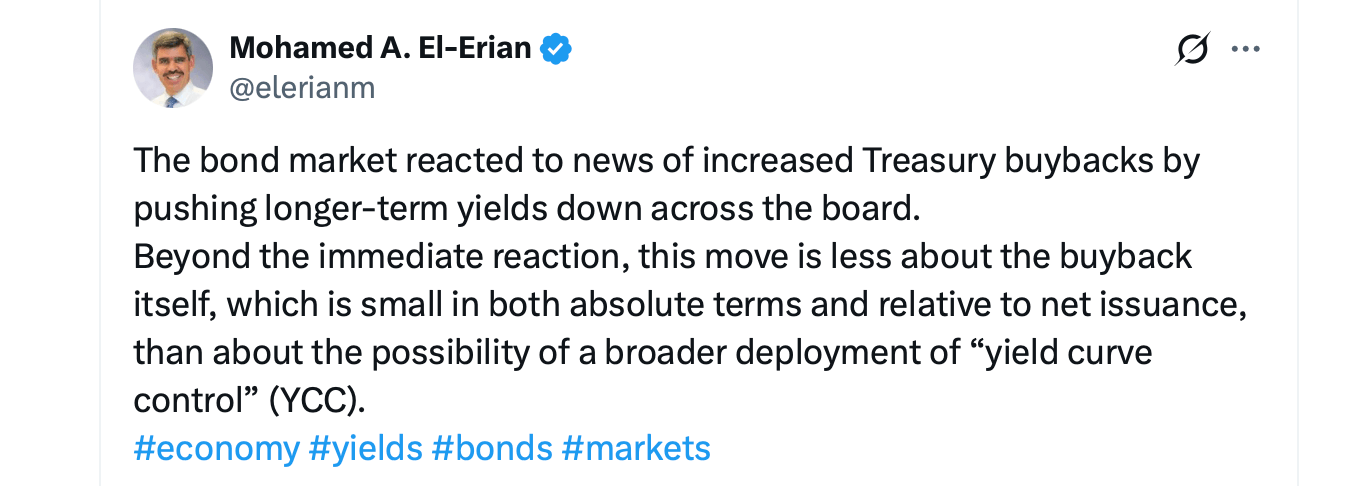
Image Source: X

The rise in long-term yields affects far more than just bond investors. It can lead to higher U.S. mortgage rates and borrowing costs for companies, while simultaneously reducing the real value of future profits in today's dollars. This pressure may particularly impact technology and other high-growth company stocks.

The initial market reaction was swift. The yield on 10-year Treasury bonds fell by about 6 basis points to around 4.647%, and the yield on 30-year bonds decreased by about 9 basis points to around 5.196%.

Market observers quickly characterized these larger-scale purchases as "mini-QE"—a term reflecting the timing of the decision: The U.S. Treasury Department increased demand for long-term bonds just as their yields approached multi-year highs. This characterization also reflects the potential of buyback operations to reduce the volume of long-term bonds that private investors must purchase.

"The U.S. Treasury Department is at least doubling the size of liquidity support buyback operations for long-term nominal coupon securities; the current maximum of $2 billion per operation will be increased to at least $4 billion per operation," wrote the X account managed by the financial publication Zerohedge on Wednesday.

They also added:

"Yields are falling, USDJPY is plummeting. Well, this settles the debate once and for all on whether Treasury buyback operations are 'mini-QE.'"

Stocks and Bitcoin Join the Rally

Amid the decline in yields, U.S. stock markets traded higher. However, the Nasdaq Composite was at 26,251.49, down 38.22 points. The New York Stock Exchange Index was at 24,779.71, up 150.57 points at 10:00 AM ET on Wednesday morning.

The Dow Jones Industrial Average rose 145.50 points to 53,488.90. The S&P 500 gained 28.12 points, reaching 7,719.88. Falling yields typically ease pressure on stock valuations and provide short-term relief for stocks sensitive to borrowing costs and discount rates.

Bitcoin was also trading in the $65,000 range after briefly returning to that price zone at the time of writing. This rise followed a hold of the $62,000 to $63,000 zone and occurred against the backdrop of recent inflows into U.S. spot Bitcoin exchange-traded funds (ETFs).

Short covering in derivatives markets also fueled the BTC rebound, accelerating a modest rise. The actions of the U.S. Treasury were not the sole driver of this move, but the decline in yields may support Bitcoin by reducing the appeal of safer dollar-denominated assets. Bitcoin still faces resistance in the $65,600 to $66,000 range, where sellers have recently emerged. The higher the price rises, the stronger the resistance.

November Presents the Next Test

On November 4, the Treasury Department will decide whether to maintain, expand, or scale back the increased volume of long-term bond buybacks. Investors will be watching to see if high-quality offerings in the bond market persist, if the yield on 30-year bonds continues to decline, and if the rally in U.S. stocks and Bitcoin solidifies.

end-content

Perguntas relacionadas

QWhy has the U.S. Treasury Department doubled the limit for its long-term bond buyback operations, and which specific bond segments are affected?

AThe U.S. Treasury Department doubled the limit for its long-term bond buyback operations due to persistently high activity from market participants in the longer-dated maturity sectors and significant volumes of high-quality offers received. The higher limit applies to buyback operations supporting liquidity in Treasury bond segments with maturities of 10 to 20 years and 20 to 30 years.

QWhat is the primary goal of the Treasury's buyback program targeting 'off-the-run' securities?

AThe primary goal of the Treasury's buyback program targeting 'off-the-run' securities (older Treasury securities issued before the newest benchmark bonds) is to improve their trading liquidity. These bonds can be less liquid and harder to buy or sell without impacting prices, so the program aims to ease trading in these older securities on the secondary market.

QHow did the financial markets initially react to the Treasury's announcement of expanded buybacks, particularly regarding bond yields and the U.S. dollar?

AThe financial markets reacted swiftly to the announcement. The yield on the 10-year Treasury note fell by approximately 6 basis points to around 4.647%, and the 30-year yield dropped by about 9 basis points to around 5.196%. Concurrently, the USD/JPY exchange rate declined sharply. Market observers quickly characterized the larger purchases as 'mini-QE' (quantitative easing).

QAccording to the article, what are two potential consequences of rising long-term Treasury yields for the broader U.S. economy?

ATwo potential consequences of rising long-term Treasury yields for the broader U.S. economy are: 1) It can push up U.S. mortgage rates and borrowing costs for companies. 2) It can reduce the present value of companies' future earnings, which can put particular pressure on the stock prices of technology and other high-growth companies.

QWhat key date will be important for investors to watch regarding the future of the Treasury's expanded buyback program, and what factors will influence the decision on that date?

AThe key date is November 4th. On this date, during its next quarterly refunding announcement, the U.S. Treasury Department will decide whether to maintain, expand, or reduce the increased size of its long-term bond buybacks. Investors will be monitoring factors such as whether high-quality bond market offerings persist, if 30-year bond yields continue to decline, and if the rally in U.S. stocks and Bitcoin is sustained.

Leituras Relacionadas

Latest: Korean QFI Has Bought Changxin Technology

Latest Data Shows Korean QFI Has Purchased Changxin Technology According to data from SEIBro (under Korea Securities Depository, KSD), Korean investors, acting as Qualified Foreign Investors (QFI), have been actively purchasing shares of Changxin Technology (stock code 688825), a company recently listed on China's Sci-Tech Innovation Board (STAR Market). Over the past month until August 18, they made a net purchase of this stock worth approximately $45.32 million (around CNY 307 million), making it the top A-share by net purchase volume for Korean investors during that period. This activity has significantly boosted overall Korean net buying in A-shares. As Changxin Technology is not yet included in the Stock Connect schemes, QFI is currently the only channel for overseas investors like these Koreans to access its shares. SEIBro data indicates Korean buying began as early as July 28, the stock's second trading day. The stock appeared in Korean investor purchase lists using a temporary virtual ISIN code in settlement instructions, as its official international code had not yet been assigned. The listing has garnered significant international attention. On its first trading day (July 27), the actively managed U.S. ETF Tema Memory ETF (DISK) swiftly added Changxin Technology to its portfolio, giving it a substantial 10.56% weighting. Another active ETF, Roundhill Memory ETF (DRAM), also quickly included the stock. Furthermore, global index provider MSCI has added Changxin Technology to its MSCI China All Shares Index, prompting passive fund inflows. Analysts highlight Changxin Technology's unique position to serve China's rapidly growing AI ecosystem amid a global semiconductor memory supply shortage driven by AI demand. Besides Changxin Technology, other A-shares heavily bought by Korean investors recently include Weichai Power, Demingli, Changdian Technology, and CSOP China STAR Chip ETF.

marsbitHá 35m

Latest: Korean QFI Has Bought Changxin Technology

marsbitHá 35m

China Pinches the Vital Point of CPO

The article "China Grips the Achilles' Heel of CPO" details how China holds a strategic position in the global indium phosphide (InP) supply chain, a critical material for high-speed optical modules and CPO (Co-Packaged Optics) technology used in AI data centers. China controls over 70% of global indium reserves and produces more than half of the world's primary indium, primarily as a by-product of zinc/tin smelting. It further refines 70-80% of the globe's refined indium. This upstream dominance is compounded by the fact that key InP wafer producer AXT operates its primary production through its Chinese subsidiary, Beijing Tongmei. Adding to this leverage are China's export controls, first on InP products and later extending to high-purity indium (6N+ grade). These restrictions have created supply bottlenecks and uncertainty, straining foreign manufacturers like Japan's Sumitomo and Dowa, who rely heavily on Chinese materials. The resulting shortage has led to intense demand, with industry figures like Lumentum's CEO warning of severe constraints and companies like Coherent seeking direct assurances from China. This situation benefits Chinese InP supply chain companies. Firms like Yunnan Chihong Zinc & Germanium (a leading domestic InP wafer producer) and Zhuzhou Keneng (high-purity indium) report surging domestic revenues and orders. They are also making progress in high-end product validation and capacity expansion. However, challenges remain, including lengthy customer qualification cycles and a significant capacity gap compared to foreign leaders. The article frames the current AI-driven demand surge as a pivotal moment for China's InP industry. It references a historical lesson where China, despite controlling indium resources, once ceded value-add and pricing power to Japanese processors. The current scenario is seen as an opportunity to leverage upstream resource control to develop advanced manufacturing capabilities and secure greater influence in the global semiconductor materials market.

marsbitHá 45m

China Pinches the Vital Point of CPO

marsbitHá 45m

Russian Suspected of Stealing Cryptocurrency from Cold Wallet Worth Almost 10 Million Rubles

Russian authorities are investigating a suspect accused of stealing nearly 10 million rubles worth of cryptocurrency from a cold wallet. According to investigators, the wallet belonged to an unnamed commercial company executive's assistant. In March, the suspect allegedly gained access to the victim's wallet by "an unidentified method" and transferred the digital assets to another address. During a search of the suspect's home, police seized three computers and three mobile phones for forensic examination, as they may contain important digital evidence. The case is being investigated as grand larceny under the Russian Criminal Code, carrying a potential sentence of up to ten years in prison. Police are also checking the suspect's possible involvement in other cryptocurrency thefts and identifying potential accomplices. The article notes that while cold wallets (hardware wallets storing private keys offline) are considered more secure against remote hacking, they remain vulnerable if a perpetrator gains physical or direct access to the keys. In a related case earlier in June, a court in Tomsk sentenced two men to 8 and 9.5 years in a strict-regime colony for a robbery and cryptocurrency theft. They forced an acquaintance at knifepoint to log into a crypto exchange account and transfer over 85 bitcoins, valued at approximately $5.1 million at the time.

cryptonews.ruHá 1h

Russian Suspected of Stealing Cryptocurrency from Cold Wallet Worth Almost 10 Million Rubles

cryptonews.ruHá 1h

Trading

Spot
活动图片