MicroStrategy's Bitcoin Flywheel: How Long Can It Last?

比推Publicado em 2025-12-23Última atualização em 2025-12-23

Resumo

MicroStrategy, now rebranded as Strategy Inc., has transformed from a business intelligence software provider into a global Bitcoin-focused holding company, with approximately 670,000 BTC—about 3.2% of the total supply—as of mid-December 2025. Its core strategy relies on a "Bitcoin flywheel" effect: leveraging the premium of its stock (MSTR) over its Bitcoin holdings to fund further Bitcoin acquisitions through equity and debt issuances. The company employs three primary funding methods: an At-The-Market (ATM) equity program to capitalize on stock premiums, perpetual preferred shares attracting tax-advantaged investors, and an ambitious "42/42 Plan" aiming to raise $84 billion by 2027 to buy more Bitcoin. Despite rumors of Bitcoin sales, recent large transfers were confirmed as security-related wallet rotations, not liquidations. However, significant risks threaten this model. MSCI index may reclassify MicroStrategy as an "investment vehicle" rather than an operating company, potentially triggering massive institutional sell-offs. If MSTR’s premium over NAV disappears, the funding mechanism would stall. Additionally, the company carries substantial debt and preferred dividend obligations, though it maintains a $1.44 billion USD reserve as a buffer. While its software business continues modest growth, it operates at a cash flow loss. MicroStrategy’s future hinges on maintaining investor confidence, navigating regulatory classifications, and sustaining financial innovation a...

Author: Clow

Original Title: MicroStrategy: The Life-and-Death Game of the World's Largest Bitcoin Whale


670,000 Bitcoins, accounting for approximately 3.2% of the global total supply.

This is the number of Bitcoins held by MicroStrategy (now renamed Strategy Inc.) as of mid-December 2025. As the world's first publicly listed company to adopt Bitcoin as its primary reserve asset, this former business intelligence software provider has completely transformed into an "operating company that designs structured financial products around Bitcoin."

The renaming is not just a brand-level change but the ultimate declaration of its complete strategic shift to a "Bitcoin standard."

However, entering the fourth quarter of 2025, with increased market volatility and potential changes to index compiler rules, this model—hailed by founder Michael Saylor as a "revolutionary financial innovation"—faces its most severe test since its inception in 2020.

So, where does MicroStrategy's money actually come from? Is its business model sustainable? And where do the biggest risks lie?

From Software Company to "Bitcoin Bank"

In 2025, MicroStrategy officially changed its name to Strategy Inc., a move marking its complete transformation.

The company's core logic is not complex: leverage the premium of its stock price relative to the net asset value (NAV) of its Bitcoin holdings to continuously raise funds and acquire more Bitcoin, thereby achieving sustained growth in Bitcoin per share.

In simple terms: as long as the market is willing to value MSTR stock higher than the Bitcoin it holds, the company can issue new shares to buy more Bitcoin, increasing the amount of Bitcoin backing each existing shareholder's stock.

Once this "flywheel effect" starts, it creates a positive feedback loop: stock price rises → issue shares to buy BTC → BTC holdings increase → stock price continues to rise.

But this flywheel has one fatal prerequisite: the stock price must consistently trade above the Bitcoin NAV. Once this premium disappears, the entire model grinds to a halt.

Where Does the Money Come From? The "Three Axes" of Financing

There is much curiosity about the source of MicroStrategy's continuous Bitcoin purchases. An analysis of the company's 8-K filings with the U.S. Securities and Exchange Commission (SEC) clearly shows its financing model has evolved from early simple convertible bonds to a diversified capital matrix.

First Axe: ATM Program – The Premium-Capturing Money Printer

MicroStrategy's core funding source is its At-the-Market (ATM) offering program for its Class A common stock (MSTR).

The operating logic is simple: when MSTR stock trades at a price higher than the NAV of its Bitcoin holdings, the company sells new shares into the market and uses the proceeds to buy Bitcoin.

During the week of December 8 to December 14, 2025, the company sold over 4.7 million MSTR shares, obtaining approximately $888.2 million in net proceeds.

The beauty of this financing method is: as long as the stock price is above the Bitcoin NAV, each share issuance is "accretive" rather than dilutive for existing shareholders.

Second Axe: Perpetual Preferred Stock Matrix

In 2025, MicroStrategy took a significant step in capital instrument innovation by launching a series of perpetual preferred stocks to attract investors with different risk appetites.
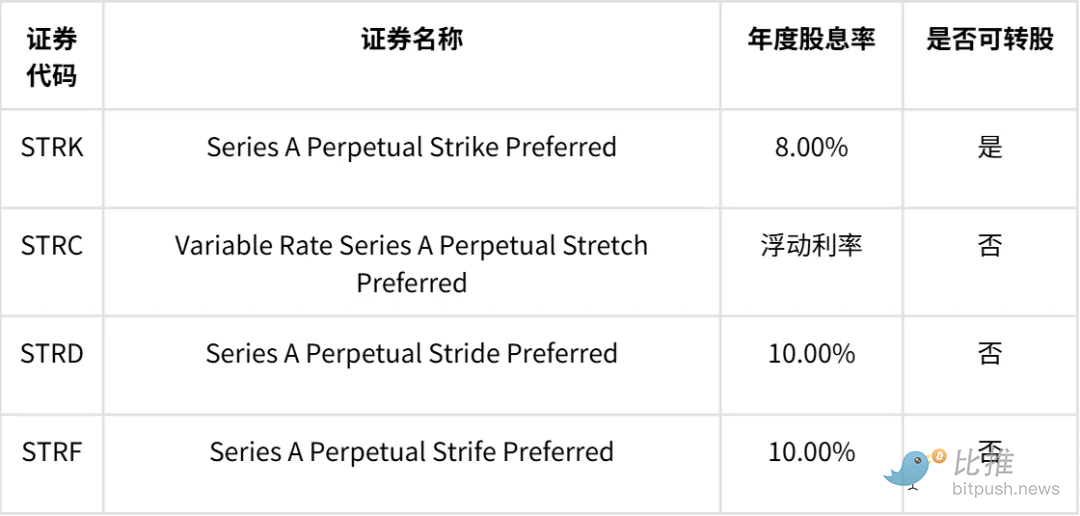
In a single week in December, these preferred stocks raised $82.2 million from STRD.

These preferred shares are often structured with "return of capital" dividends, which are tax-advantageous for investors as they allow for the deferral of tax liabilities for at least ten years.

Third Axe: The "42/42 Plan" – An $84 Billion Ambition

MicroStrategy is currently in the execution phase of its ambitious "42/42 Plan."

The plan aims to raise $42 billion through equity offerings and another $42 billion through fixed-income securities from 2025 to 2027, totaling $84 billion, all to be used for purchasing Bitcoin.

This plan is an upgraded version of the previous "21/21 Plan," reflecting management's extreme confidence in the capital market's ability to absorb its securities. This large-scale capital operation effectively turns MicroStrategy into a leveraged Bitcoin closed-end fund, but its operating company shell gives it financing flexibility unavailable to traditional funds.

The Truth Behind the "Selling Bitcoin" Rumors

Recent market rumors suggesting MicroStrategy might be selling Bitcoin appear unfounded in light of financial data and on-chain evidence.

In mid-November and early December 2025, on-chain data monitoring tools (like Arkham Intelligence) observed large-scale asset movements from wallets controlled by MicroStrategy. Data showed approximately 43,415 Bitcoins (worth about $4.26 billion) were moved from known addresses to over 100 new addresses. This caused panic on social media, briefly driving the Bitcoin price below $95,000.

However, subsequent professional audits and management clarification indicated this was not a divestment but a routine "custodian and wallet rotation." To reduce single-custodian credit risk and improve security, MicroStrategy分散ed its assets from traditional platforms like Coinbase Custody to more defensive addresses. Arkham analysis noted that such operations typically involve security needs for address refreshment, not asset liquidation.

Executive Chairman Michael Saylor repeatedly publicly debunked the rumors, stating clearly on Twitter and in a CNBC interview in December: "We are buying, and buying significantly."

In fact, the company acquired 10,645 additional Bitcoins in the second week of December at an average price of $92,098 per coin, directly disproving the selling speculation.

Furthermore, the company's recently established $1.44 billion USD Reserve further demonstrates it does not need to liquidate Bitcoin to pay dividends or debt interest, as this reserve can cover at least 21 months of financial expenses.

The Overlooked Software Business

Despite Bitcoin dominating the headlines, MicroStrategy's software business remains the crucial foundation for maintaining its public company status and covering daily financial expenses.

In Q3 2025, total software revenue was $128.7 million, a year-on-year increase of 10.9%, exceeding market expectations.
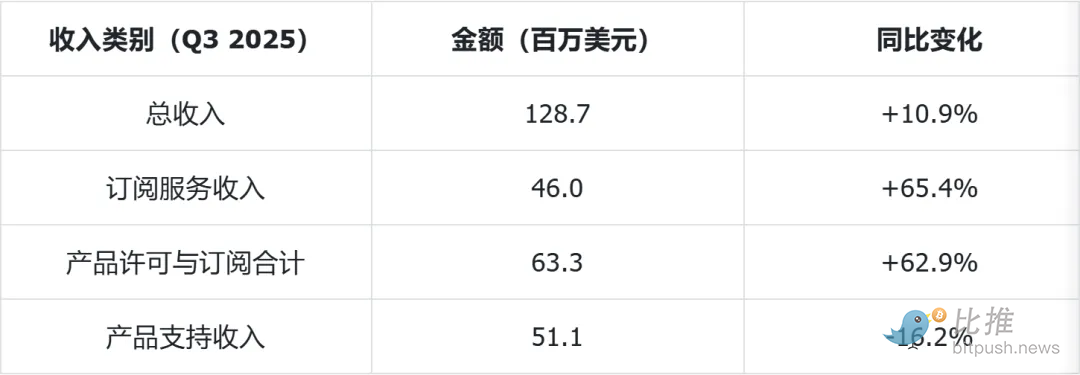
Although subscription revenue grew significantly, the business did not generate positive operating cash flow in the first half of 2025 due to continued investment in AI R&D and cloud infrastructure. Q3 free cash flow was negative $45.61 million, meaning the company is still operating at a loss, and its continuous Bitcoin accumulation relies entirely on external financing.

Starting January 1, 2025, MicroStrategy adopted the ASU 2023-08 accounting standard, which requires Bitcoin holdings to be measured at fair value with changes recognized in current net income. This change makes the company's book earnings highly volatile. In Q3 2025, due to the rising Bitcoin price, the company recorded $3.89 billion in unrealized gains, leading to a quarterly net profit of $2.8 billion.

Three Swords of Damocles Hanging Overhead

Despite reducing short-term forced liquidation risk through complex financial engineering, MicroStrategy still faces several systemic risks that could shake its foundation.

Risk One: MSCI Index Exclusion

The most immediate risk currently facing MicroStrategy comes from index provider MSCI's review.

MSCI has initiated a formal consultation proposing to reclassify companies with digital assets exceeding 50% of total assets as "investment vehicles" rather than "operating companies." Given Bitcoin constitutes the vast majority of MicroStrategy's assets, this rule change, if adopted, would lead to its removal from the MSCI Global Standard Index (GIMI).

Such an exclusion could force passive funds to sell between $2.8 billion and $8.8 billion worth of stock. This large-scale forced selling would directly pressure its share price, thereby compressing MSTR's NAV premium. If the NAV premium disappears or even turns into a discount, the "flywheel" of issuing shares to buy Bitcoin would completely stall.

Risk Two: NAV Premium Compression & Financing Stall

MicroStrategy's entire accumulation logic is built on the market's willingness to pay a premium above its net asset value.

By the end of 2025, this premium showed extreme instability. In early December, due to index exclusion fears, MSTR briefly traded at an 11% discount to the value of its Bitcoin holdings.

When the stock trades at a discount, any new equity financing dilutes the Bitcoin per share for existing shareholders, forcing the company to halt asset accumulation and potentially face creditor concerns about asset integrity. MicroStrategy paused its ATM program for the first time in September 2025, reflecting management's high sensitivity to valuation multiples.

Risk Three: Debt Pressure & Theoretical Liquidation Price

As of the end of Q3 2025, MicroStrategy's total debt was approximately $8.24 billion, requiring about $36.8 million in annual interest payments, while preferred stock dividend payments amount to a hefty $638.7 million per year.

Although its convertible bonds do not include Bitcoin collateral clauses, reducing the direct "blow-up" risk from market declines, the company's debt-servicing ability would be tested if Bitcoin prices experience an extreme drop.

Summary

MicroStrategy's situation at the end of 2025 vividly illustrates the opportunities and challenges a company faces when attempting to redefine corporate financial boundaries.

Its intention to continue accumulating remains unchanged, and by establishing a $1.44 billion dollar reserve, the company has built a defensive wall against a potential liquidity winter.

However, MicroStrategy's greatest risk does not come from Bitcoin price volatility itself, but from its connection points with the traditional financial system—namely, its index status and NAV premium.

If institutions like MSCI ultimately decide to exclude it from traditional equity categories, MicroStrategy must find a way to demonstrate to investors that it retains growth vitality as a "Bitcoin-backed structured financing platform" independent of passive index inflows.

Whether the future "42/42 Plan" can proceed as scheduled will depend on its ability to continuously create yield products attractive to institutional investors during the Bitcoin financialization process, while maintaining minimal financial dignity through the growing pains of its software business's cloud transition.

This is not just an experiment by one company; it is an microcosm of the entire crypto industry's integration process with the traditional financial system.

In this unprecedented gamble, the only certainty is: no one knows how this story will end.


Twitter:https://twitter.com/BitpushNewsCN

Bitpush TG Discussion Group:https://t.me/BitPushCommunity

Bitpush TG Channel: https://t.me/bitpush

Original link:https://www.bitpush.news/articles/7597894

Criptomoedas em alta

Perguntas relacionadas

QWhat is the core business model of MicroStrategy (now Strategy Inc.) and how does its 'flywheel effect' work?

AMicroStrategy's core business model has shifted from a software provider to a 'structured financial operating company' for Bitcoin. The 'flywheel effect' works as follows: as the company's stock price (MSTR) rises above the net asset value (NAV) of its Bitcoin holdings, it issues new shares to raise capital, uses the proceeds to buy more Bitcoin, which increases the Bitcoin per share for existing shareholders, potentially driving the stock price higher and perpetuating the cycle.

QWhat are the three main financing methods MicroStrategy uses to acquire more Bitcoin?

AMicroStrategy uses three main financing methods: 1. The At-the-Market (ATM) equity offering program, selling MSTR stock when it trades at a premium to NAV. 2. A series of perpetual preferred shares designed to attract different risk appetites. 3. The ambitious '42/42 Plan,' aiming to raise $84 billion ($42B in equity and $42B in fixed-income securities) from 2025 to 2027 to purchase Bitcoin.

QWhat was the real reason behind the large Bitcoin transfers from MicroStrategy's wallets that caused market concern in late 2025?

AThe large Bitcoin transfers were not sales but a routine 'custodian and wallet rotation' for enhanced security. The company moved approximately 43,415 BTC to over 100 new addresses to reduce single-custodian risk and improve the defensive posture of its holdings, as confirmed by subsequent audits and management statements.

QWhat is the most immediate systemic risk threatening MicroStrategy's business model according to the article?

AThe most immediate systemic risk is the potential reclassification and removal from the MSCI Global Investable Market Index (GIMI). MSCI classifies companies with over 50% of assets in digital assets as 'investment vehicles' rather than 'operating companies.' If MicroStrategy is removed, it could trigger forced selling by passive funds, crushing its stock premium and halting its equity-based acquisition flywheel.

QHow does MicroStrategy's software business perform, and what role does it play in the overall company strategy?

AIn Q3 2025, the software business generated $128.7 million in revenue, growing 10.9% year-over-year. However, it operated at a loss with negative free cash flow due to heavy investment in AI and cloud infrastructure. Its primary role is to maintain the company's public listing status and help cover operational expenses, while the massive Bitcoin accumulation is entirely funded by external capital raises.

Leituras Relacionadas

Must-Watch Events Next Week|CLARITY Act Could Face Senate Vote; SpaceX, Circle to Report Earnings (8.3-8.9)

**Summary: Key Events and Developments to Watch (August 3-9)** The upcoming week is marked by significant financial disclosures, key legislative deadlines, and notable product updates. **Major Financial Events:** Several companies are scheduled to release their Q2 2026 earnings. American Bitcoin (ABTC) will report on August 3, followed by SpaceX and Hut 8 Mining Corp. on August 4, and Circle on August 5. Notably, a significant portion of SpaceX shares (up to 12% of total shares) will be unlocked on August 6 following their earnings release. **Key Legislative Deadline:** The U.S. Senate faces an August 7 deadline to secure 60 votes for the CLARITY Act, a bipartisan bill aiming to establish a federal regulatory framework for cryptocurrencies. The Senate may hold a full vote on the bill during the week. **Economic Data:** The U.S. July Non-Farm Payrolls report will be released on August 7, providing crucial labor market data. **Technology & Product Updates:** * **Shutdowns:** DeFi portfolio tracker Zapper and wallet app Ctrl Wallet will cease operations on August 3. * **Upgrades:** LayerZero will deprecate its v1 relayers on August 3. XRP Ledger's new version 3.3.0, featuring five new functions, is expected next week. * **AI:** Elon Musk announced that the advanced Grok 4.6 AI model is set for release around August 7. * **Bitcoin:** The BIP-110 forced signaling for a potential Bitcoin network change is scheduled to begin around August 8. **Other Notable Events:** Chinese robotics firm Unitree Tech has set its preliminary price inquiry for its IPO for August 5. South Korean exchange Upbit will delist AQT and AERGO tokens on August 3.

marsbitHá 38m

Must-Watch Events Next Week|CLARITY Act Could Face Senate Vote; SpaceX, Circle to Report Earnings (8.3-8.9)

marsbitHá 38m

Stocks Are Plummeting More Sharply Than Cryptocurrencies. Where Has the Money Gone?

Stock Markets Plunge Deeper Than Cryptocurrencies: Where Did the Money Go? In late July, Seoul's Kospi index triggered circuit breakers for two consecutive days, plummeting over 40% from its June high. The collapse was led by heavyweight stocks like SK Hynix, whose record profits still disappointed investors, and devastating leveraged ETFs, with one major product losing over 83% of its value. This signaled a global, forced deleveraging targeting the most crowded trades. Interestingly, while stocks exhibited extreme volatility akin to crypto markets, Bitcoin rose nearly 15% in July after a prior steep drop. Analysis shows the money fleeing equities did not flow into Bitcoin. Instead, Bitcoin had already absorbed its sell-off in May-June, when U.S. spot Bitcoin ETFs saw historic outflows. The true safe-haven beneficiary was gold, whose price rose over 20% year-on-year, highlighting a decoupling between Bitcoin and gold as "digital gold." The sell-off was a targeted unwinding of leveraged positions in tech and semiconductors, accelerated by broker-dealer risk management and shifts in the AI narrative, including new competition from Chinese memory chipmakers. The retreat path was clear: from high-valuation tech stocks to cash and U.S. Treasuries, then to gold. For Bitcoin to attract sustained institutional inflows, conditions like eased global liquidity pressure, a "soft-landing" Fed rate cut, and U.S. regulatory clarity via legislation like the stalled CLARITY Act are needed. Currently, Bitcoin is not a safe haven but an already-cleared asset. Its low correlation with tech stocks, however, makes it a potential diversification play for institutional portfolios once the storm passes. The money isn't here yet, but the positioning is underway.

marsbitHá 38m

Stocks Are Plummeting More Sharply Than Cryptocurrencies. Where Has the Money Gone?

marsbitHá 38m

In Conversation with Ray Dalio: We Are Currently in an AI Bubble, with 1% of My Portfolio in Bitcoin

Ray Dalio, founder of Bridgewater Associates, warns in an interview that the current AI boom shows classic bubble characteristics, which could lead to significant economic downturns as seen in past cycles like 1929 or 2000. He explains that speculative enthusiasm, fueled by debt and overvaluation, often precedes a crash when rising rates or taxation force asset sales, causing widespread losses and recession. Dalio also outlines his "Big Cycle" theory, describing an approximate 80-year pattern where widening wealth gaps, massive government deficits, and shifting geopolitical power (like China's rise) create internal conflict and global instability. He emphasizes that we are in a late-cycle, transitional phase where traditional powers like the US and UK face decline. For personal wealth protection, Dalio advises diversification beyond cash into assets like stocks, bonds, real estate, and particularly gold, which he prefers over Bitcoin. While he holds about 1% of his portfolio in Bitcoin as a non-printable hard asset, he views gold as more secure from technological or governmental threats. Regarding AI's impact, Dalio believes it will disproportionately benefit capital owners, worsening inequality by replacing both physical and cognitive labor. He suggests that human intuition and emotional intelligence, combined with AI, will be key for future workers. On taxation, Dalio argues that wealth taxes are impractical and risk triggering asset sell-offs, reducing productive investment. He points to the UK as a cautionary example of debt, low productivity, and political strife. Geopolitically, Dalio foresees a more regionalized world, with the US showing weakness in prolonged conflicts like with Iran, akin to past imperial declines. The ideal outcome, he suggests, is coexisting powerful blocs (e.g., Americas, China-Asia Pacific) without major war.

marsbitHá 4h

In Conversation with Ray Dalio: We Are Currently in an AI Bubble, with 1% of My Portfolio in Bitcoin

marsbitHá 4h

Daily 7.2 Trillion KRW: Foreign Capital's Record Net Buying on Friday! Wall Street Says Headwinds for Korean Stock Fund Flows Have Subsided

South Korean stock market sees a dramatic shift in fund flows. On July 31, foreign investors made a record net purchase of approximately KRW 7.2 trillion in KOSPI stocks, marking a fundamental reversal from the persistent large-scale net outflows seen in previous months. This contributed to a significant narrowing of foreign net selling in July to KRW 9.8 trillion, down sharply from KRW 48.4 trillion in June and KRW 44.5 trillion in May. Simultaneously, domestic institutional pressure eased. South Korean pension funds and asset managers turned to a net buying position in July, purchasing KRW 1.0 trillion worth of KOSPI shares, contrasting with net sales in May and June. Market volatility is expected to be dampened by new financial regulations. Effective July 31, the Financial Services Commission tightened access for retail investors to single-stock leveraged ETFs by raising the minimum cash deposit requirement. Trading volumes for these products subsequently dropped to about 50% of their monthly average. Citigroup Research maintains its year-end KOSPI target of 10,000 points. The firm cites several supportive factors: the substantial easing of headwinds from capital outflows, a robust fundamental outlook for the semiconductor sector, historically low market valuations, strong economic fundamentals, and the potential for policy support from financial authorities if needed.

marsbitHá 4h

Daily 7.2 Trillion KRW: Foreign Capital's Record Net Buying on Friday! Wall Street Says Headwinds for Korean Stock Fund Flows Have Subsided

marsbitHá 4h

Trading

Spot

Artigos em Destaque

O que é $S$

Compreender o SPERO: Uma Visão Abrangente Introdução ao SPERO À medida que o panorama da inovação continua a evoluir, o surgimento de tecnologias web3 e projetos de criptomoeda desempenha um papel fundamental na formação do futuro digital. Um projeto que tem atraído atenção neste campo dinâmico é o SPERO, denotado como SPERO,$$s$. Este artigo tem como objetivo reunir e apresentar informações detalhadas sobre o SPERO, para ajudar entusiastas e investidores a compreender as suas bases, objetivos e inovações nos domínios web3 e cripto. O que é o SPERO,$$s$? O SPERO,$$s$ é um projeto único dentro do espaço cripto que procura aproveitar os princípios da descentralização e da tecnologia blockchain para criar um ecossistema que promove o envolvimento, a utilidade e a inclusão financeira. O projeto é concebido para facilitar interações peer-to-peer de novas maneiras, proporcionando aos utilizadores soluções e serviços financeiros inovadores. No seu núcleo, o SPERO,$$s$ visa capacitar indivíduos ao fornecer ferramentas e plataformas que melhoram a experiência do utilizador no espaço das criptomoedas. Isso inclui a possibilidade de métodos de transação mais flexíveis, a promoção de iniciativas impulsionadas pela comunidade e a criação de caminhos para oportunidades financeiras através de aplicações descentralizadas (dApps). A visão subjacente do SPERO,$$s$ gira em torno da inclusão, visando fechar lacunas dentro das finanças tradicionais enquanto aproveita os benefícios da tecnologia blockchain. Quem é o Criador do SPERO,$$s$? A identidade do criador do SPERO,$$s$ permanece algo obscura, uma vez que existem recursos publicamente disponíveis limitados que fornecem informações detalhadas sobre o(s) seu(s) fundador(es). Esta falta de transparência pode resultar do compromisso do projeto com a descentralização—uma ética que muitos projetos web3 partilham, priorizando contribuições coletivas em vez de reconhecimento individual. Ao centrar as discussões em torno da comunidade e dos seus objetivos coletivos, o SPERO,$$s$ incorpora a essência do empoderamento sem destacar indivíduos específicos. Assim, compreender a ética e a missão do SPERO é mais importante do que identificar um criador singular. Quem são os Investidores do SPERO,$$s$? O SPERO,$$s$ é apoiado por uma diversidade de investidores que vão desde capitalistas de risco a investidores-anjo dedicados a promover a inovação no setor cripto. O foco desses investidores geralmente alinha-se com a missão do SPERO—priorizando projetos que prometem avanço tecnológico social, inclusão financeira e governança descentralizada. Essas fundações de investidores estão tipicamente interessadas em projetos que não apenas oferecem produtos inovadores, mas que também contribuem positivamente para a comunidade blockchain e os seus ecossistemas. O apoio desses investidores reforça o SPERO,$$s$ como um concorrente notável no domínio em rápida evolução dos projetos cripto. Como Funciona o SPERO,$$s$? O SPERO,$$s$ emprega uma estrutura multifacetada que o distingue de projetos de criptomoeda convencionais. Aqui estão algumas das características-chave que sublinham a sua singularidade e inovação: Governança Descentralizada: O SPERO,$$s$ integra modelos de governança descentralizada, capacitando os utilizadores a participar ativamente nos processos de tomada de decisão sobre o futuro do projeto. Esta abordagem promove um sentido de propriedade e responsabilidade entre os membros da comunidade. Utilidade do Token: O SPERO,$$s$ utiliza o seu próprio token de criptomoeda, concebido para servir várias funções dentro do ecossistema. Esses tokens permitem transações, recompensas e a facilitação de serviços oferecidos na plataforma, melhorando o envolvimento e a utilidade gerais. Arquitetura em Camadas: A arquitetura técnica do SPERO,$$s$ suporta modularidade e escalabilidade, permitindo a integração contínua de funcionalidades e aplicações adicionais à medida que o projeto evolui. Esta adaptabilidade é fundamental para manter a relevância no panorama cripto em constante mudança. Envolvimento da Comunidade: O projeto enfatiza iniciativas impulsionadas pela comunidade, empregando mecanismos que incentivam a colaboração e o feedback. Ao nutrir uma comunidade forte, o SPERO,$$s$ pode melhor atender às necessidades dos utilizadores e adaptar-se às tendências do mercado. Foco na Inclusão: Ao oferecer taxas de transação baixas e interfaces amigáveis, o SPERO,$$s$ visa atrair uma base de utilizadores diversificada, incluindo indivíduos que anteriormente podem não ter participado no espaço cripto. Este compromisso com a inclusão alinha-se com a sua missão abrangente de empoderamento através da acessibilidade. Cronologia do SPERO,$$s$ Compreender a história de um projeto fornece insights cruciais sobre a sua trajetória de desenvolvimento e marcos. Abaixo está uma cronologia sugerida que mapeia eventos significativos na evolução do SPERO,$$s$: Fase de Conceituação e Ideação: As ideias iniciais que formam a base do SPERO,$$s$ foram concebidas, alinhando-se de perto com os princípios de descentralização e foco na comunidade dentro da indústria blockchain. Lançamento do Whitepaper do Projeto: Após a fase conceitual, um whitepaper abrangente detalhando a visão, os objetivos e a infraestrutura tecnológica do SPERO,$$s$ foi lançado para atrair o interesse e o feedback da comunidade. Construção da Comunidade e Primeiros Envolvimentos: Esforços ativos de divulgação foram feitos para construir uma comunidade de primeiros adotantes e investidores potenciais, facilitando discussões em torno dos objetivos do projeto e angariando apoio. Evento de Geração de Tokens: O SPERO,$$s$ realizou um evento de geração de tokens (TGE) para distribuir os seus tokens nativos a apoiantes iniciais e estabelecer liquidez inicial dentro do ecossistema. Lançamento da dApp Inicial: A primeira aplicação descentralizada (dApp) associada ao SPERO,$$s$ foi lançada, permitindo que os utilizadores interagissem com as funcionalidades principais da plataforma. Desenvolvimento Contínuo e Parcerias: Atualizações e melhorias contínuas nas ofertas do projeto, incluindo parcerias estratégicas com outros players no espaço blockchain, moldaram o SPERO,$$s$ em um jogador competitivo e em evolução no mercado cripto. Conclusão O SPERO,$$s$ é um testemunho do potencial do web3 e das criptomoedas para revolucionar os sistemas financeiros e capacitar indivíduos. Com um compromisso com a governança descentralizada, o envolvimento da comunidade e funcionalidades inovadoras, abre caminho para um panorama financeiro mais inclusivo. Como em qualquer investimento no espaço cripto em rápida evolução, potenciais investidores e utilizadores são incentivados a pesquisar minuciosamente e a envolver-se de forma ponderada com os desenvolvimentos em curso dentro do SPERO,$$s$. O projeto demonstra o espírito inovador da indústria cripto, convidando a uma exploração mais aprofundada das suas inúmeras possibilidades. Embora a jornada do SPERO,$$s$ ainda esteja a desenrolar-se, os seus princípios fundamentais podem, de facto, influenciar o futuro de como interagimos com a tecnologia, as finanças e uns com os outros em ecossistemas digitais interconectados.

182 Visualizações TotaisPublicado em {updateTime}Atualizado em 2024.12.17

O que é $S$

O que é AGENT S

Agent S: O Futuro da Interação Autónoma no Web3 Introdução No panorama em constante evolução do Web3 e das criptomoedas, as inovações estão constantemente a redefinir a forma como os indivíduos interagem com plataformas digitais. Um projeto pioneiro, o Agent S, promete revolucionar a interação humano-computador através do seu framework aberto e agente. Ao abrir caminho para interações autónomas, o Agent S visa simplificar tarefas complexas, oferecendo aplicações transformadoras em inteligência artificial (IA). Esta exploração detalhada irá aprofundar-se nas complexidades do projeto, nas suas características únicas e nas implicações para o domínio das criptomoedas. O que é o Agent S? O Agent S é um framework aberto e agente, especificamente concebido para abordar três desafios fundamentais na automação de tarefas computacionais: Aquisição de Conhecimento Específico de Domínio: O framework aprende inteligentemente a partir de várias fontes de conhecimento externas e experiências internas. Esta abordagem dupla capacita-o a construir um rico repositório de conhecimento específico de domínio, melhorando o seu desempenho na execução de tarefas. Planeamento ao Longo de Longos Horizontes de Tarefas: O Agent S emprega planeamento hierárquico aumentado por experiência, uma abordagem estratégica que facilita a decomposição e execução eficientes de tarefas intrincadas. Esta característica melhora significativamente a sua capacidade de gerir múltiplas subtarefas de forma eficiente e eficaz. Gestão de Interfaces Dinâmicas e Não Uniformes: O projeto introduz a Interface Agente-Computador (ACI), uma solução inovadora que melhora a interação entre agentes e utilizadores. Utilizando Modelos de Linguagem Multimodais de Grande Escala (MLLMs), o Agent S pode navegar e manipular diversas interfaces gráficas de utilizador de forma fluida. Através destas características pioneiras, o Agent S fornece um framework robusto que aborda as complexidades envolvidas na automação da interação humana com máquinas, preparando o terreno para uma infinidade de aplicações em IA e além. Quem é o Criador do Agent S? Embora o conceito de Agent S seja fundamentalmente inovador, informações específicas sobre o seu criador permanecem elusivas. O criador é atualmente desconhecido, o que destaca ou o estágio nascente do projeto ou a escolha estratégica de manter os membros fundadores em anonimato. Independentemente da anonimidade, o foco permanece nas capacidades e no potencial do framework. Quem são os Investidores do Agent S? Como o Agent S é relativamente novo no ecossistema criptográfico, informações detalhadas sobre os seus investidores e financiadores não estão explicitamente documentadas. A falta de informações disponíveis publicamente sobre as fundações de investimento ou organizações que apoiam o projeto levanta questões sobre a sua estrutura de financiamento e roteiro de desenvolvimento. Compreender o apoio é crucial para avaliar a sustentabilidade do projeto e o seu impacto potencial no mercado. Como Funciona o Agent S? No núcleo do Agent S reside uma tecnologia de ponta que lhe permite funcionar eficazmente em diversos ambientes. O seu modelo operacional é construído em torno de várias características-chave: Interação Humano-Computador Semelhante: O framework oferece planeamento avançado em IA, esforçando-se para tornar as interações com computadores mais intuitivas. Ao imitar o comportamento humano na execução de tarefas, promete elevar as experiências dos utilizadores. Memória Narrativa: Utilizada para aproveitar experiências de alto nível, o Agent S utiliza memória narrativa para acompanhar os históricos de tarefas, melhorando assim os seus processos de tomada de decisão. Memória Episódica: Esta característica fornece aos utilizadores orientações passo a passo, permitindo que o framework ofereça suporte contextual à medida que as tarefas se desenrolam. Suporte para OpenACI: Com a capacidade de funcionar localmente, o Agent S permite que os utilizadores mantenham o controlo sobre as suas interações e fluxos de trabalho, alinhando-se com a ética descentralizada do Web3. Fácil Integração com APIs Externas: A sua versatilidade e compatibilidade com várias plataformas de IA garantem que o Agent S possa integrar-se perfeitamente em ecossistemas tecnológicos existentes, tornando-o uma escolha apelativa para desenvolvedores e organizações. Estas funcionalidades contribuem coletivamente para a posição única do Agent S no espaço cripto, à medida que automatiza tarefas complexas e em múltiplos passos com mínima intervenção humana. À medida que o projeto evolui, as suas potenciais aplicações no Web3 podem redefinir a forma como as interações digitais se desenrolam. Cronologia do Agent S O desenvolvimento e os marcos do Agent S podem ser encapsulados numa cronologia que destaca os seus eventos significativos: 27 de Setembro de 2024: O conceito de Agent S foi lançado num artigo de pesquisa abrangente intitulado “Um Framework Agente Aberto que Usa Computadores como um Humano”, mostrando a base para o projeto. 10 de Outubro de 2024: O artigo de pesquisa foi disponibilizado publicamente no arXiv, oferecendo uma exploração aprofundada do framework e da sua avaliação de desempenho com base no benchmark OSWorld. 12 de Outubro de 2024: Uma apresentação em vídeo foi lançada, proporcionando uma visão visual das capacidades e características do Agent S, envolvendo ainda mais potenciais utilizadores e investidores. Estes marcos na cronologia não apenas ilustram o progresso do Agent S, mas também indicam o seu compromisso com a transparência e o envolvimento da comunidade. Pontos-Chave Sobre o Agent S À medida que o framework Agent S continua a evoluir, várias características-chave destacam-se, sublinhando a sua natureza inovadora e potencial: Framework Inovador: Concebido para proporcionar um uso intuitivo de computadores semelhante à interação humana, o Agent S traz uma abordagem nova à automação de tarefas. Interação Autónoma: A capacidade de interagir autonomamente com computadores através de GUI significa um avanço em direção a soluções computacionais mais inteligentes e eficientes. Automação de Tarefas Complexas: Com a sua metodologia robusta, pode automatizar tarefas complexas e em múltiplos passos, tornando os processos mais rápidos e menos propensos a erros. Melhoria Contínua: Os mecanismos de aprendizagem permitem que o Agent S melhore a partir de experiências passadas, aprimorando continuamente o seu desempenho e eficácia. Versatilidade: A sua adaptabilidade em diferentes ambientes operacionais, como OSWorld e WindowsAgentArena, garante que pode servir uma ampla gama de aplicações. À medida que o Agent S se posiciona no panorama do Web3 e das criptomoedas, o seu potencial para melhorar as capacidades de interação e automatizar processos significa um avanço significativo nas tecnologias de IA. Através do seu framework inovador, o Agent S exemplifica o futuro das interações digitais, prometendo uma experiência mais fluida e eficiente para os utilizadores em diversas indústrias. Conclusão O Agent S representa um ousado avanço na união da IA e do Web3, com a capacidade de redefinir a forma como interagimos com a tecnologia. Embora ainda esteja nas suas fases iniciais, as possibilidades para a sua aplicação são vastas e cativantes. Através do seu framework abrangente que aborda desafios críticos, o Agent S visa trazer interações autónomas para o primeiro plano da experiência digital. À medida que avançamos mais profundamente nos domínios das criptomoedas e da descentralização, projetos como o Agent S desempenharão, sem dúvida, um papel crucial na formação do futuro da tecnologia e da colaboração humano-computador.

800 Visualizações TotaisPublicado em {updateTime}Atualizado em 2025.01.14

O que é AGENT S

Como comprar S

Bem-vindo à HTX.com!Tornámos a compra de Sonic (S) simples e conveniente.Segue o nosso guia passo a passo para iniciar a tua jornada no mundo das criptos.Passo 1: cria a tua conta HTXUtiliza o teu e-mail ou número de telefone para te inscreveres numa conta gratuita na HTX.Desfruta de um processo de inscrição sem complicações e desbloqueia todas as funcionalidades.Obter a minha contaPasso 2: vai para Comprar Cripto e escolhe o teu método de pagamentoCartão de crédito/débito: usa o teu visa ou mastercard para comprar Sonic (S) instantaneamente.Saldo: usa os fundos da tua conta HTX para transacionar sem problemas.Terceiros: adicionamos métodos de pagamento populares, como Google Pay e Apple Pay, para aumentar a conveniência.P2P: transaciona diretamente com outros utilizadores na HTX.Mercado de balcão (OTC): oferecemos serviços personalizados e taxas de câmbio competitivas para os traders.Passo 3: armazena teu Sonic (S)Depois de comprar o teu Sonic (S), armazena-o na tua conta HTX.Alternativamente, podes enviá-lo para outro lugar através de transferência blockchain ou usá-lo para transacionar outras criptomoedas.Passo 4: transaciona Sonic (S)Transaciona facilmente Sonic (S) no mercado à vista da HTX.Acede simplesmente à tua conta, seleciona o teu par de trading, executa as tuas transações e monitoriza em tempo real.Oferecemos uma experiência de fácil utilização tanto para principiantes como para traders experientes.

1.4k Visualizações TotaisPublicado em {updateTime}Atualizado em 2026.06.02

Como comprar S

Discussões

Bem-vindo à Comunidade HTX. Aqui, pode manter-se informado sobre os mais recentes desenvolvimentos da plataforma e obter acesso a análises profissionais de mercado. As opiniões dos utilizadores sobre o preço de S (S) são apresentadas abaixo.

活动图片














