Meta's Largest-Scale Layoffs in History: Notifications Sent at 4 AM, 7,000 Employees Reassigned to AI

marsbitPublicado em 2026-05-19Última atualização em 2026-05-19

Resumo

Meta is executing its largest-ever restructuring, involving the elimination of approximately 8,000 positions (around 10% of its workforce) alongside a strategic shift toward artificial intelligence. Notifications for affected employees are being sent in three waves, timed for 4 AM local time across global offices this Wednesday. The reorganization is not purely a cost-cutting measure. Concurrently, over 7,000 employees are being redeployed to new AI-focused units, including the Applied AI Engineering (AAI) department, as part of a company-wide push to integrate "AI-native design principles." Management layers are being significantly reduced to create a flatter, faster-moving organizational structure. Internal tensions are rising amid the layoffs. Over a thousand employees have signed a petition protesting the company's installation of mouse-tracking software, reflecting strained morale. Meta has indicated that further job cuts beyond this initial 10% are possible. The moves underscore Meta's heavy bet on AI, with capital expenditures projected to reach $125-145 billion by 2026 to fund AI infrastructure.

Meta's largest organizational restructuring in history is progressing hour by hour. This layoff action, involving nearly 8,000 positions, is driven by a comprehensive organizational overhaul centered on AI logic.

According to internal memos obtained by Business Insider and The Information, Meta's head of human resources, Janelle Gale, issued an explanation to employees on Monday, detailing the specific execution plan for this Wednesday's (May 20) layoffs: Notification will be sent at 4 AM local time in each region, affecting approximately 8,000 positions, representing about 10% of Meta's total workforce of nearly 78,000 employees.

Simultaneous with the layoffs is a large-scale redeployment of personnel—Meta will transfer over 7,000 employees to multiple new AI departments while significantly compressing management layers to advance organizational flattening. Concurrently, internal employee friction continues to intensify. Employees have initiated a petition signed by over a thousand people against the company's installation of mouse-tracking software, reflecting the strained labor-management relations under the shadow of layoffs.

Meta has explicitly indicated to employees that this Wednesday's 10% layoff may not be the endpoint, and further cuts cannot be ruled out. In April this year, the company forecasted its 2026 capital expenditures to reach $125-$145 billion, demonstrating an all-in bet on AI.

4 AM, Three Waves of Notifications Cover the Globe

In the memo, Gale specified the execution timeline for this Wednesday down to the hour: Notifications will be sent at 4 AM local time in each region, delivered in three waves across different time zones, covering Meta's global operations.

This means employees from Asia-Pacific to Europe to the Americas will receive notifications in their respective late-night or pre-dawn hours. One employee told Business Insider that everyone is currently in a state of "hanging in the air," waiting to confirm the fate of their positions.

7,000 Employees Reassigned to AI, Restructuring Beyond Layoffs

This personnel change is not merely a cost-cutting measure but is accompanied by a large-scale strategic redeployment.

According to The Information, Gale stated in the memo that productivity gains enabled by AI empowerment allow the company to transfer over 7,000 employees to several brand-new departments, including the Applied AI Engineering (AAI) department, Agent Transformation Accelerator, Central Analytics, and a newly formed enterprise solutions team.

The Information previously reported that Meta has begun pulling top engineers from across the company to bolster the AAI department to enhance its competitiveness in the AI model race. In the memo, Gale noted that leadership across company departments has incorporated "AI-native design principles" into the new organizational structure, and related adjustment plans will be announced simultaneously with the layoffs.

Significant Reduction in Management Layers, Advancing Organizational Flattening

In the memo, Gale clearly stated that management positions will be cut company-wide, with the goal of creating a flatter hierarchy.

"We have now reached a point where many teams can operate within a flatter structure, acting faster and taking more ownership in the form of smaller pods/cohorts," she wrote.

Some teams within Meta's Reality Labs had already begun reorganizing into small pod structures earlier, a move previously reported by Business Insider.

Thousand-Signature Petition Protests Mouse Tracking, Internal Friction Surfaces

Under the cloud of layoffs, another wave of collective employee backlash is brewing. Employees have initiated a petition against the company's installation of mouse-tracking software, signed by over a thousand people, reflecting strong employee resistance to management's increased monitoring measures.

Several current employees told Business Insider that overall company morale is noticeably under pressure.

Further Layoffs Not Ruled Out, AI Investments Continue to Ramp Up

This Wednesday's layoffs are not the final chapter. Business Insider previously reported that Meta management has informed employees that further personnel reductions cannot be ruled out after this 10% round of layoffs.

While undergoing large-scale downsizing, Meta's capital investment in the AI field continues to accelerate. In April this year, the company forecasted its 2026 capital expenditures to be between $125 billion and $145 billion, highlighting its massive bet on AI infrastructure—this is also the most direct footnote for this restructuring centered on AI logic.


Perguntas relacionadas

QWhat is the scale of Meta's recent personnel restructuring and how does AI factor into it?

AMeta's restructuring involves a workforce reduction of approximately 8,000 roles (about 10% of its total) and the strategic redeployment of over 7,000 employees to various new AI-focused departments. This reorganization is described as a comprehensive organizational rebuild centered on AI logic.

QHow and when is Meta communicating the layoff decisions to employees globally?

AMeta is communicating layoff decisions at 4 AM local time on Wednesday, May 20th, in three waves across different global time zones. Notifications will be sent to cover the company's global operations from the Asia-Pacific region to Europe and the Americas.

QWhat are the main new departments to which Meta is redeploying employees as part of its AI shift?

AMeta is redeploying over 7,000 employees to several new AI-focused departments, including the Applied AI Engineering (AAI) department, Agent Transformation Accelerator, Central Analytics, and a newly formed Enterprise Solutions team.

QWhat internal employee friction has emerged in relation to the restructuring?

AInternal friction has surfaced through a petition, signed by over a thousand employees, protesting the company's installation of mouse-tracking software. This reflects employee discontent and strained labor relations under the cloud of layoffs and increased managerial monitoring.

QWhat are Meta's plans regarding future layoffs and its capital expenditure projections for AI?

AMeta has indicated that the upcoming 10% workforce reduction may not be the end and that further cuts are possible. Concurrently, the company projects its capital expenditures for 2026 to be between $125 billion and $145 billion, demonstrating a massive ongoing investment in AI infrastructure.

Leituras Relacionadas

When Hyperliquid Steals Solana's 'Internet Capital Market' Script

The article "When Hyperliquid Steals Solana's 'Internet Capital Markets' Playbook" discusses Solana's struggles to maintain its "internet capital markets" narrative by 2026. Despite its initial success as a high-performance "Ethereum killer," SOL's price has underperformed, dropping significantly compared to other major cryptocurrencies. Solana's vision of a global, on-chain trading network for all assets is being challenged not primarily by Ethereum, but by Hyperliquid. Hyperliquid, evolving from a perpetual contracts platform into a dedicated financial infrastructure Layer 1, has become a major beneficiary of the shift of derivatives trading from centralized exchanges to on-chain. The article argues that for high-frequency financial trading, a specialized, performance-focused chain like Hyperliquid may be more suitable than a general-purpose ecosystem like Solana. Further compounding Solana's issues was a major $200+ million exploit on its key perpetual protocol, Drift, in April, which damaged market confidence. In response, Solana founder Anatoly Yakovenko heavily promoted the protocol Phoenix as a replacement, boosting its visibility but not its trading volume, which remains far behind leading platforms. Solana supporters have launched a public critique of Hyperliquid's decentralization, pointing to its limited validators and closed-source code. Critics, however, note Solana's own declining validator count and centralization metrics. This strategy has also caused internal friction, with developers of other Solana protocols expressing discontent over the foundation's perceived favoritism towards Phoenix. The conclusion is that Hyperliquid's rise represents a challenge to the "general-purpose blockchain" narrative, proving that the core of a capital market might be a specialized trading engine rather than a broad ecosystem. If Solana cannot regain dominance in derivatives, it risks remaining a "meme coin paradise" while its grand "internet capital markets" ambition slips away.

marsbitHá 8m

When Hyperliquid Steals Solana's 'Internet Capital Market' Script

marsbitHá 8m

When Hyperliquid Steals Solana's 'Internet Capital Markets' Playbook

The article discusses how Solana's grand vision of becoming an "Internet Capital Markets" platform is facing significant challenges in 2026, primarily from the unexpected rise of Hyperliquid. Solana's performance has weakened, with its token SOL experiencing the largest price decline among major cryptocurrencies. Its core narrative of building a global, chain-based marketplace for all assets is under pressure both internally and externally. Hyperliquid, originally a perpetual futures exchange, has evolved into a dedicated Layer 1 financial infrastructure network. Its focused, trading-centric approach is attracting capital and challenging the assumption that a "general-purpose" ecosystem like Solana is necessary for a capital market. Hyperliquid's success suggests that for high-frequency trading, superior performance, liquidity, and user experience may be more critical than a broad application ecosystem. Internally, Solana's strategy suffered a blow from a major hack on the Drift Protocol in April, resulting in over $200 million in losses. In response, Solana founder Anatoly Yakovenko has heavily promoted Phoenix as a new decentralized perpetual futures platform on Solana. While this boosted Phoenix's visibility, its trading volume remains far behind leading platforms. Solana's community has launched a rhetorical attack against Hyperliquid, questioning its decentralization due to its limited validator set and closed-source code. Critics, however, point out Solana's own decreasing validator count and increasing centralization of stake. This focus on "decentralization metrics" has also caused internal friction, with other Solana ecosystem developers expressing discontent over the foundation's perceived favoritism towards Phoenix. The article concludes that the rise of Hyperliquid represents a challenge to the "general-purpose blockchain" narrative, proving that an efficient trading engine might be more central to a capital market than a vast ecosystem. If Solana cannot regain dominance in the derivatives space, it risks remaining a "meme coin paradise" rather than achieving its ambition of hosting global assets.

链捕手Há 15m

When Hyperliquid Steals Solana's 'Internet Capital Markets' Playbook

链捕手Há 15m

Samsung Bets on Mobile HBM: AI Moves from Cloud to Palm, a New Frontier in Semiconductor Investment?

Samsung is betting on bringing high-bandwidth memory (HBM) technology from servers to mobile devices, aiming to enable powerful on-device AI features in smartphones and tablets. This move is driven by the booming AI market, where HBM demand from data centers has fueled Samsung's record profits, with HBM4 already in mass production. By integrating mobile HBM, Samsung seeks to transform user AI experiences—making tasks like image generation and real-time translation faster, seamless, and more private by processing data locally. Strategically, this allows Samsung to leverage its vertical integration in memory, advanced packaging, and Exynos processors to differentiate its Galaxy devices against competitors like Apple and Qualcomm. It also opens a new consumer growth avenue, reducing reliance on volatile server HBM demand alone. The initiative is expected to benefit the broader supply chain, boosting demand for advanced packaging materials, thermal solutions, and other components. While promising, risks include potential delays in mobile HBM mass production beyond 2027, high initial costs, and the cyclical nature of the memory market. Nonetheless, Samsung's push signals a broader industry shift toward hybrid cloud-edge AI computing, positioning it as a key player in defining the future of AI-powered devices and presenting a potential long-term investment theme in semiconductors.

marsbitHá 26m

Samsung Bets on Mobile HBM: AI Moves from Cloud to Palm, a New Frontier in Semiconductor Investment?

marsbitHá 26m

Trillion-Dollar Banking Giant Adjusts Portfolio: Buys XRP Heavily, Clears Out Solana

In a significant portfolio rebalancing move, Italian banking giant Intesa Sanpaolo, with $1.1 trillion in assets, has made a notable shift in its cryptocurrency holdings. According to disclosures from Q4 2025 to Q1 2026, the bank's total crypto exposure surged from $100 million to approximately $235 million. The most striking action was its first-time establishment of an XRP position, investing around $18 million through the Grayscale XRP Trust. This marks a milestone as one of the first major European banks to adopt XRP via a regulated investment vehicle. This move is part of a broader, systematic digital asset strategy. The bank also substantially increased its Bitcoin exposure via ETFs and initiated its first Ethereum investment through a staking trust. In a contrasting strategic pivot, Intesa Sanpaolo drastically reduced its Solana holdings by over 99%, nearly exiting its position in a Bitwise Solana staking ETF. This shift is interpreted as reflecting a institutional preference for assets perceived with lower regulatory and operational risk, especially following Solana's network stability issues and improved clarity for XRP after its legal settlements. The bank's actions highlight key drivers for institutional adoption: clearer regulations, the availability of compliant ETF products, and the search for portfolio diversification. This trend signifies crypto's evolving status from a niche experiment to a recognized component of mainstream asset allocation, with institutions favoring gradual, regulated entry points over direct token ownership.

marsbitHá 1h

Trillion-Dollar Banking Giant Adjusts Portfolio: Buys XRP Heavily, Clears Out Solana

marsbitHá 1h

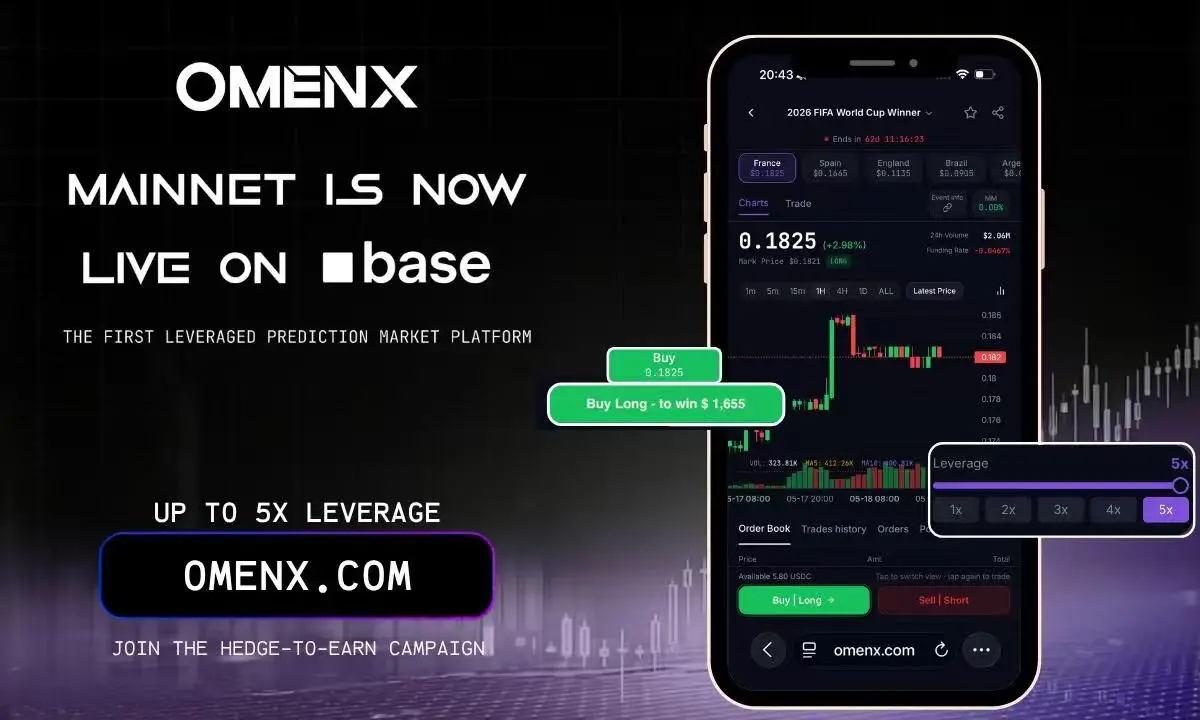
Base Native Leveraged Prediction Market OmenX Officially Launches on Mainnet

Base-native leveraged prediction market platform OmenX has officially launched on mainnet. It currently supports up to 5x leverage, with plans to increase to 10x based on platform liquidity and market conditions. Unlike traditional prediction markets where users fully collateralize YES/NO positions and wait for settlement, OmenX aims to create a trading platform-like experience. Users can open leveraged positions on event outcomes, and actively trade, adjust, or hedge these positions before the event concludes for greater capital efficiency. Alongside the mainnet launch, OmenX introduced a "Hedge-to-Earn" campaign targeting existing users of other prediction markets (initially Polymarket). This initiative allows users to claim incentives or hedging benefits on OmenX based on their existing positions, aiming to introduce them to leveraged trading and active risk management. OmenX positions itself as a derivatives trading platform for prediction market assets. The team believes that as platforms like Polymarket mainstream prediction markets, event outcomes are becoming a new tradable asset class. The next phase of demand will focus on leverage, liquidity, and advanced trading tools. Post-launch, OmenX plans to expand supported market types, optimize liquidity, and develop APIs and additional trading tools. The team is also in discussions with investors and partners to secure resources for further development.

链捕手Há 1h

Base Native Leveraged Prediction Market OmenX Officially Launches on Mainnet

链捕手Há 1h

Trading

Spot
Futuros

Artigos em Destaque

Como comprar 4

Bem-vindo à HTX.com!Tornámos a compra de 4 (4) simples e conveniente.Segue o nosso guia passo a passo para iniciar a tua jornada no mundo das criptos.Passo 1: cria a tua conta HTXUtiliza o teu e-mail ou número de telefone para te inscreveres numa conta gratuita na HTX.Desfruta de um processo de inscrição sem complicações e desbloqueia todas as funcionalidades.Obter a minha contaPasso 2: vai para Comprar Cripto e escolhe o teu método de pagamentoCartão de crédito/débito: usa o teu visa ou mastercard para comprar 4 (4) instantaneamente.Saldo: usa os fundos da tua conta HTX para transacionar sem problemas.Terceiros: adicionamos métodos de pagamento populares, como Google Pay e Apple Pay, para aumentar a conveniência.P2P: transaciona diretamente com outros utilizadores na HTX.Mercado de balcão (OTC): oferecemos serviços personalizados e taxas de câmbio competitivas para os traders.Passo 3: armazena teu 4 (4)Depois de comprar o teu 4 (4), armazena-o na tua conta HTX.Alternativamente, podes enviá-lo para outro lugar através de transferência blockchain ou usá-lo para transacionar outras criptomoedas.Passo 4: transaciona 4 (4)Transaciona facilmente 4 (4) no mercado à vista da HTX.Acede simplesmente à tua conta, seleciona o teu par de trading, executa as tuas transações e monitoriza em tempo real.Oferecemos uma experiência de fácil utilização tanto para principiantes como para traders experientes.

611 Visualizações TotaisPublicado em {updateTime}Atualizado em 2025.10.20

Como comprar 4

Discussões

Bem-vindo à Comunidade HTX. Aqui, pode manter-se informado sobre os mais recentes desenvolvimentos da plataforma e obter acesso a análises profissionais de mercado. As opiniões dos utilizadores sobre o preço de 4 (4) são apresentadas abaixo.

活动图片