Meme Wrapped Contracts: Is alt.fun Real Innovation or a Pseudo-Need?

marsbitPublicado em 2026-05-18Última atualização em 2026-05-18

Resumo

A new platform called alt.fun on Hyperliquid has gained attention by merging meme coin creation with leveraged futures trading. Unlike typical meme platforms like Pump.fun, alt.fun requires creators to select an underlying asset (like HYPE or S&P 500) and a leverage level (2x, 3x, or 5x) to take a long or short position. The issued meme token is directly linked to a corresponding leveraged token (LT) on BounceTech, which represents that perpetual contract position. This means the token's price is driven by both the standard bonding curve (community buying/selling) and the performance of its leveraged underlying asset, allowing value to increase even without new purchases. The platform's "graduation" to a DEX pool requires a市值 of $9,000, achievable through market demand or underlying asset growth. While this mechanism can amplify gains in trending markets, it also introduces significant risks from asset volatility, leverage decay during rebalancing, and potential liquidation during sharp price moves. Despite early traction—with its top token ALT reaching an $8.8M market cap—alt.fun faces challenges. Its limited selection of 14 underlying assets constrains variety, leading to tokens with identical financial profiles. More fundamentally, critics argue it misunderstands the meme coin ethos: its tokens are primarily financial instruments tied to asset performance, lacking the community-driven narratives and cultural appeal essential for sustaining meme coin value. The article co...

Original | Odaily Planet Daily (@OdailyChina)

Author | Golem (@web3_golem)
Last week, a new Meme issuance platform named alt.fun in the Hyperliquid ecosystem garnered significant attention from Meme players. Within just one week of launch, its leading token ALT reached a peak market cap of $8.8 million, with the current price having retraced, maintaining a market cap around $6.7 million.

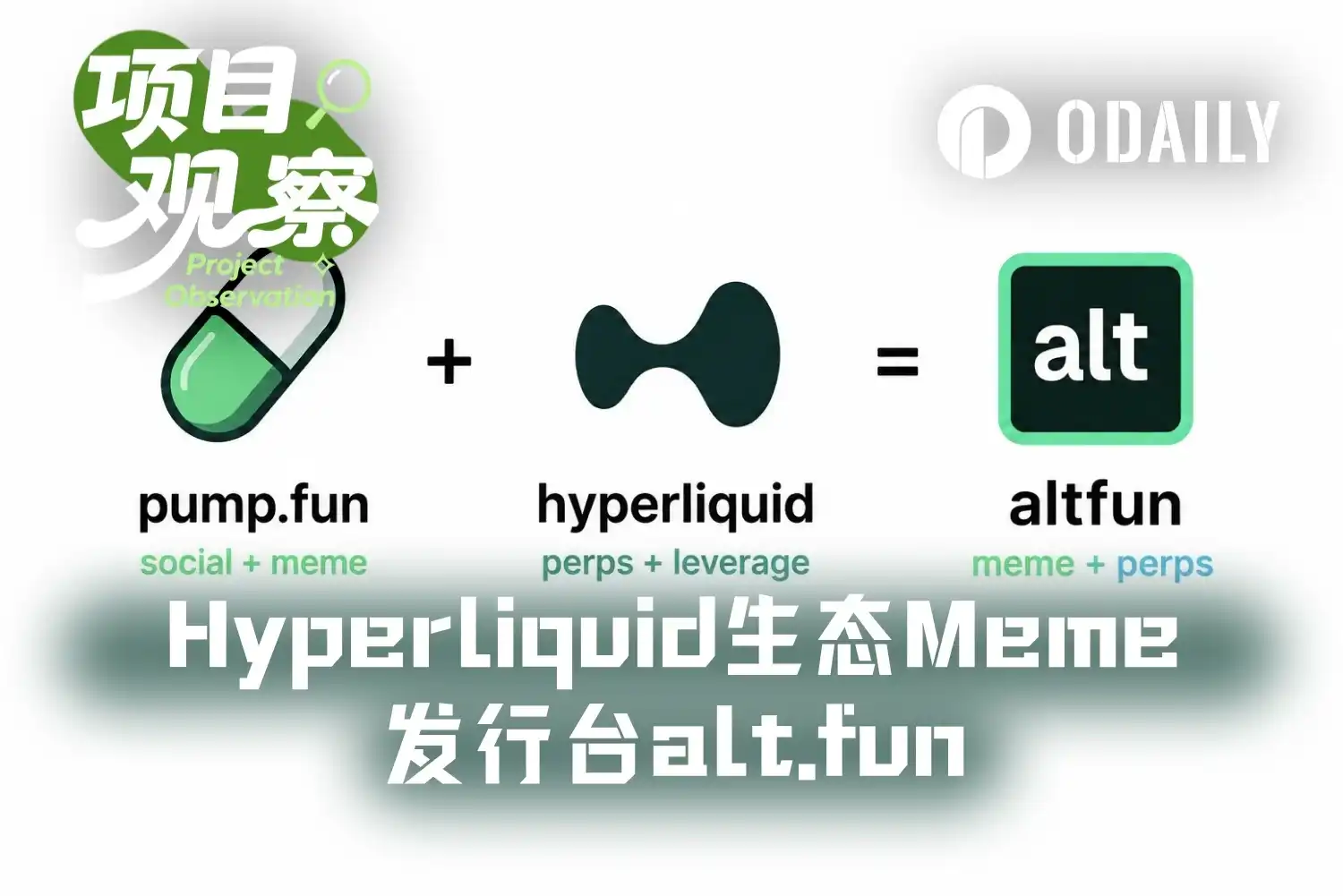
The novelty of alt.fun can be understood as a combination of Pump.fun and Hyperliquid, where users can simultaneously experience the dual thrill of playing with Memes and opening contracts.

Introduction to the alt.fun Platform Mechanism

Specifically, each Meme token issued on alt.fun has a corresponding contract position matched on Hyperliquid at its core.

Similar to Pump.fun, any user can issue a Meme coin with one click on HyperEVM through the alt.fun platform. The token price is still influenced by a bonding curve. The total supply of the created Meme coin is 1 billion tokens, and when 75% of the tokens are sold, the token successfully "graduates" and is migrated to a HyperSwap V2 liquidity pool.

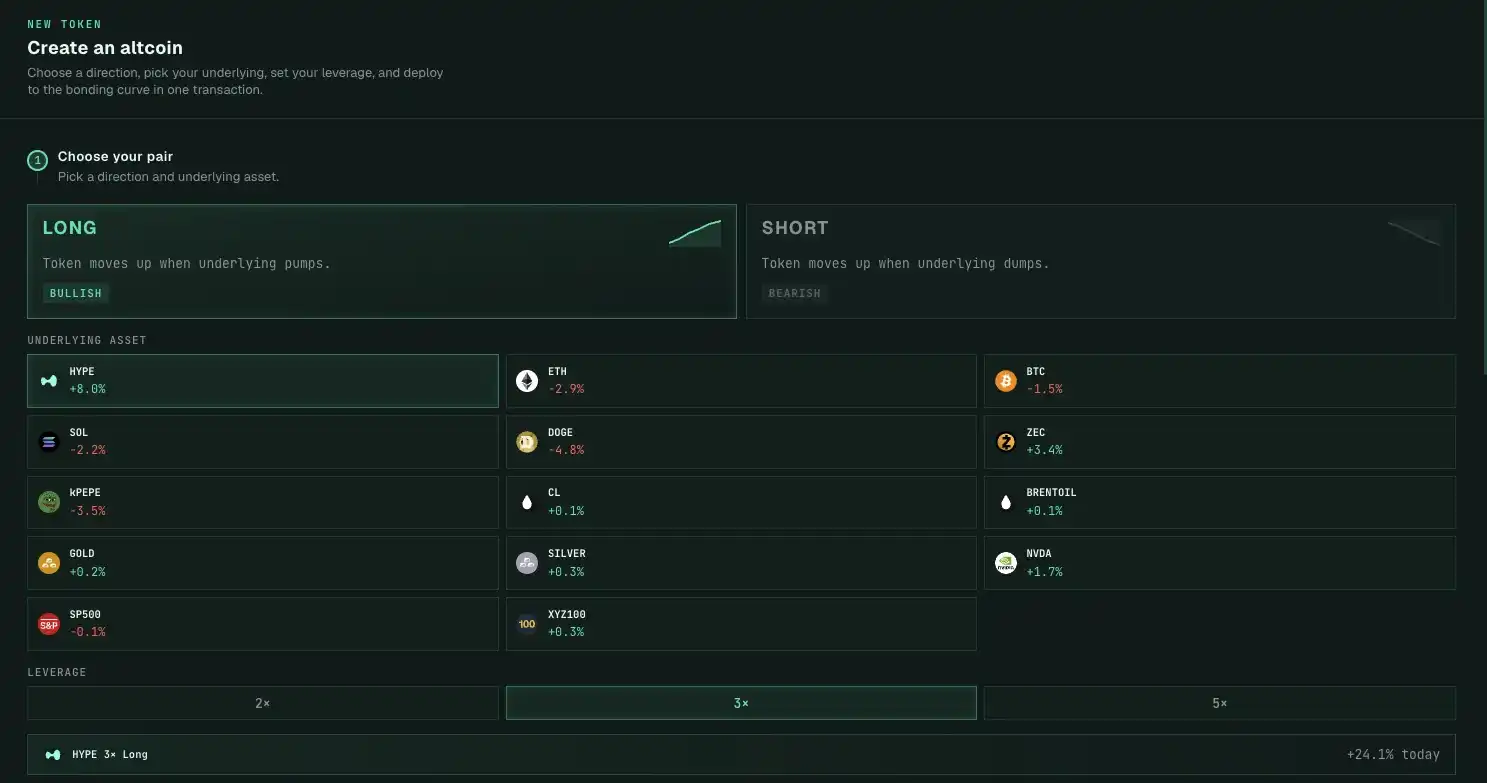
The difference from Pump.fun is that when creating a token on alt.fun, users also need to select an underlying asset and choose a limited leverage multiple (2x/3x/5x) to go short/long. At the same moment of token creation, the platform mints a corresponding amount of leveraged tokens (LT) on BounceTech(Odaily note: a permissionless leveraged token platform on Hyperliquid) and sends them to the user. This leveraged token corresponds to establishing a perpetual contract position on Hyperliquid. For example, if a user chooses to create a token based on a 3x long position on HYPE, what they receive is essentially a leveraged token that tracks the gains of a 3x long HYPE position.

As shown in the figure below, currently on alt.fun, users can choose from 14 types of underlying assets when creating a token. Similarly, when players buy Meme coins on this platform, the platform also mints corresponding leveraged tokens on BounceTech. If a player sells, this process is reversed—the leveraged token is redeemed, and the user receives the corresponding USDC.
This model of packaging and then selling leveraged tokens as underlying assets is similar to the securitization of specific risk exposures like futures and options in traditional finance, such as 3x inverse Nasdaq ETFs or 5x inverse crude oil products. In this process, the alt.fun platform acts like an asset management company, managing the long-term positions behind the leveraged tokens for users.

The price of such financial products primarily follows the net asset value. However, since the token price issued by the alt.fun platform is also simultaneously influenced by the bonding curve mechanism of Meme coins, the graduation mode and price drivers of tokens on this platform are not singular either.

Dual Graduation Modes and Price Drivers

This means that the price of tokens on the alt.fun platform is influenced by two factors: one is market sentiment driven by buying and selling, and the other is the performance of the underlying asset. So now you might understand what alt.fun's slogan "Your token pumps even when nobody's buying" means.

For instance, if a user creates a token based on a 3x long HYPE position with an initial investment of $20 (the platform's minimum buy-in size), and subsequently HYPE rises by 10%, then even if no one buys the token, the user's holding value increases by 30% to $26.

Based on this dual driver of price, the token graduation mode on the alt.fun platform is not limited to one method either. Specifically, its token graduation condition is reaching a market cap of $9,000, which essentially calculates the value of the leveraged token. Besides achieving graduation through buying tokens, if the token itself reaches a market cap of $9,000 due to the rise of its underlying asset, it can also graduate successfully. Therefore, whether a token reaches the graduation threshold is often a combined result of the two pricing mechanisms.

Of course, ideally, a rise in the underlying asset drives up the leveraged token, and combined with the emotional catalysis of the Meme market, the token might soar step by step. But once the underlying asset falls, the value of the leveraged token continuously shrinks, the market might panic-sell, and the token price could potentially crash instantly.

Thus, while alt.fun's mechanism can effectively leverage amplification effects, this only works in a one-sided market trend and requires users to accurately time the trend. If encountering volatile conditions in the underlying asset, users also have to bear leverage decay losses. This is because when the underlying asset price fluctuates, the platform needs to perform "rebalancing" to manage positions to avoid liquidation. This means that even if the underlying asset drops and then recovers, the leveraged token will suffer depreciation due to forced position reduction during the decline.

Moreover, in the case of wick or flash crash events, the platform might fail to react in time, potentially leading the leveraged token value to zero.

Meme or not Meme

Currently, the alt.fun platform has a total of 41 graduated tokens, with only two having a market cap exceeding one million: ALT (based on 5x long HYPE) and STONKS (based on 5x long S&P 500). The total number of users is around over 1,000. Although alt.fun is still in its early stages, we can also discern its current development bottlenecks from this.

First, the platform has too few underlying assets. Based on the current 14 types of underlying assets, there can be at most 84 different combinations of leveraged tokens. alt.fun has already seen leveraged tokens with the same leverage multiple shorting/longing the same underlying asset. For example, the current highest token ALT is based on 5x long HYPE, while another token with the ticker ATH is also based on 5x long HYPE. Apart from the token name and creation time, there is no difference between the two. If so, why wouldn't investors buy the lower market cap ATH?

Although alt.fun may support more underlying assets in the future, its core pain point is its inability to coalesce Meme coin community consensus.

The fundamental reason investors choose to buy leveraged tokens on the alt.fun platform instead of opening leverage directly on Hyperliquid themselves is essentially to gain greater price leverage. Moreover, because the platform manages position rebalancing in the backend for users, individual users can be "hands-off landlords," not having to worry about individual liquidation risks.

But this is also the problem. Investors buying an alt.fun token are essentially still basing their decision on future price expectations for its underlying asset, rather than on narratives, market games, or attention—these "meaningless things" are precisely what support the core value of a Meme. A Meme's ability to rise or gain market recognition is often not due to any practical value backing or financial design behind it; more importantly, it's the community propagation attribute.

As a Meme player, it's difficult for me to develop a love for a leveraged token similar to the affection for a particular Meme's community culture. If one truly has conviction in the underlying asset of a leveraged token, it might be better to issue one's own leveraged token rather than buy an existing one and bear unnecessary premiums.

Therefore, while the mechanism of the alt.fun platform appears novel, in my eyes, it's merely a mechanical innovation. If alt.fun pivots towards developing as a DeFi platform in the future, there might still be opportunities. But if it insists on forcefully entering the Meme issuance platform track, it is destined to be a flash in the pan.


Criptomoedas em alta

Perguntas relacionadas

QWhat is the core innovation of the alt.fun platform as described in the article?

AThe core innovation is combining a Meme token launchpad (similar to Pump.fun) with leveraged perpetual contracts on Hyperliquid. Each Meme token created on alt.fun has an underlying leveraged token position on Hyperliquid, allowing token value to be influenced by both market buying/selling and the performance of the chosen leveraged asset.

QAccording to the article, what is one major drawback or criticism of the alt.fun model?

AA major drawback is its perceived inability to build genuine Meme community consensus. The token's value is fundamentally tied to the performance of a leveraged financial product rather than narrative, culture, or community hype, which are considered the true drivers of Meme value. It risks being a 'mechanical innovation' lacking the social dynamics essential for Meme success.

QHow can a token on alt.fun 'graduate' or be considered successful besides being bought by others?

AA token can graduate if its market capitalization (calculated as the value of the underlying leveraged tokens) reaches $9,000. This can happen not only through direct purchases but also if the value of the underlying leveraged position increases significantly due to favorable price movement of the base asset (e.g., HYPE or S&P 500).

QWhat role does the BounceTech platform play in the alt.fun ecosystem?

ABounceTech is the permissionless leveraged token platform on Hyperliquid. When a user creates or buys a Meme token on alt.fun, the platform mints a corresponding leveraged token (LT) on BounceTech and sends it to the user. This LT represents a perpetual contract position on Hyperliquid. Selling the Meme token reverses the process, redeeming the LT for USDC.

QWhat potential risks does an investor face when holding a token from alt.fun?

AInvestors face several risks: 1) Exposure to the high volatility and potential liquidation of the underlying leveraged position. 2) Leverage decay during volatile or sideways markets due to mandatory 'rebalancing' of the position, which can erode value. 3) The risk of the leveraged token's value going to zero during extreme market events like a flash crash. 4) The premium paid for the Meme token layer on top of the leveraged token's intrinsic value.

Leituras Relacionadas

Base Under Pressure

**Title: The Pressure Mounts for Base** Base, the Ethereum Layer 2 scaling solution backed by Coinbase, is facing significant pressure and public scrutiny from its leadership following the launch of Robinhood Chain. Base co-founder Jesse Pollak recently acknowledged strategic missteps, admitting that the chain's past focus on social and creator tokens (e.g., through Farcaster, Zora) failed to deliver sustainable adoption. He has refocused on core infrastructure, handing leadership of the Base App back to Coinbase's Cobie. While Base remains a top L2 contender alongside OP Mainnet and Arbitrum, and boasts the highest TVL (nearly $12B), its weaknesses are being highlighted by the new competitor. Key criticisms include its slow progress on decentralization. Base has faced issues with its single sequencer causing block production halts, and L2BEAT is reportedly considering downgrading its decentralization rating from Stage 1 to Stage 0. This contrasts sharply with the rapid initial success of Robinhood Chain, whose DEX quickly entered the top five by volume. The leadership styles of the parent companies are also being compared: Robinhood's CEO actively engages with new projects, while a recent incident where Coinbase's Brian Armstrong briefly changed his profile picture—sparking and then crashing a related meme token—drew community ire and mockery. Pollak stated Base is working with Coinbase on tokenized stocks backed 1:1 by real equity, differentiating it from Robinhood's derivatives model. However, the article argues that Base's most urgent task is to address its long-standing technical and trust issues. With more traditional finance players likely to emulate Robinhood's path, Base must use this competitive pressure to solidify its position as long-term financial infrastructure.

Foresight NewsHá 13m

Base Under Pressure

Foresight NewsHá 13m

White House Concession Removes Ethical Hurdle, Clarity Act Races Against Final Window Before Recess?

On July 21st, industry sources reported that the Trump administration has agreed to include an ethics provision in the "Clarity Act" (Digital Asset Market Clarity Act of 2025). This concession addresses the long-standing conflict-of-interest concerns regarding government officials and the crypto industry, potentially removing the final major obstacle to the bill's progress. Additionally, Patrick Witt, the executive director of the White House's Digital Asset Advisory Committee, confirmed he will remain in his role to help finalize the bill, alleviating previous concerns about his potential departure. The Clarity Act aims to establish a unified federal regulatory framework for the U.S. digital asset market. Its core objective is to resolve regulatory ambiguity by defining different types of digital assets (digital commodities, investment contract assets, and permitted payment stablecoins) and clarifying the respective oversight roles of the SEC and CFTC. This would end the long-running jurisdictional dispute between the two agencies and provide clearer compliance paths for the industry. With the ethics issue moving toward resolution, the most urgent challenge now is time. The U.S. Congress is set to begin its August recess in mid-August, leaving only a few working weeks to finalize the text and advance the bill through the Senate. Industry advocates, like the Blockchain Association's Kristin Smith, stress that this is a critical moment. If negotiations conclude successfully in the coming weeks, the Clarity Act could pass a key hurdle before the recess; otherwise, it may face significant delays. If enacted, the Clarity Act could mark a historic turning point in crypto regulation. By providing a clearer and more predictable legal framework, it aims to reduce uncertainty for businesses, developers, and traditional financial institutions looking to enter the digital asset space, potentially setting a global benchmark for market structure regulation.

Odaily星球日报Há 18m

White House Concession Removes Ethical Hurdle, Clarity Act Races Against Final Window Before Recess?

Odaily星球日报Há 18m

AI Era, Industrial Revolution, and Future Civilization Interview — Zhang Dingwen: The Future Does Not Belong to Chasers

"AI Era, Industrial Revolution and Future Civilization: An Interview with Zhang Dingwen – The Future Does Not Belong to Those Who Chase" In this interview, entrepreneur Zhang Dingwen reflects on his entrepreneurial journey and philosophy, moving beyond discussions of financing or success to emphasize understanding the "era" itself. He argues that true entrepreneurs should not chase short-term trends ("winds"), but position themselves in the direction of long-term technological and societal evolution. Zhang shares key lessons from his early days, including the realization that user value does not automatically translate to commercial value. For him, the core of entrepreneurship is not building a company but constantly upgrading one's own "cognition" – the ability to interpret information, ask the right questions, and understand the underlying "causes" behind business outcomes, not just the effects. His thinking has evolved from a focus on creating good products to a strategic focus on building "entrances" – platforms that naturally connect users to digital services. He sees smart wearables, like watches, not merely as hardware but as potential future gateways combining technological, financial, social, and even fashion attributes to create sustained user relationships and ecosystems. Ultimately, Zhang's vision transcends individual products or companies. He discusses business competition in three stages: product, platform, and finally, "civilization" – where the greatest companies influence how society operates by defining new rules and ways of life. He believes the mission of a truly great enterprise is to solve problems of its time, build enduring trust, and contribute lasting value, leaving behind not just wealth but a positive impact on how the world works. The future, he concludes, belongs not to the fastest, but to those with the correct long-term direction and a commitment to continuous learning and evolution.

marsbitHá 30m

AI Era, Industrial Revolution, and Future Civilization Interview — Zhang Dingwen: The Future Does Not Belong to Chasers

marsbitHá 30m

Cryptocurrency & Stock Market Barometer丨Strategy Cash Reserves Increase to $3.23 Billion, Halting BTC Purchases; Vanguard and Other Asset Managers Increase Holdings in Strategy Stock (July 21)

Market Overview & Warnings: The article warns of high volatility in South Korean stocks and continued dependence on U.S. stocks on geopolitics. Chinese A-shares remain under pressure. It advises against using leverage in current equity markets. For crypto-linked stocks, most have limited growth except Robinhood, with caution advised. U.S. Stock Market: Bearish bets on U.S. stocks, particularly targeting AI-related companies, have reached record highs since 2010, signaling deep skepticism about the sustainability of the AI-driven rally. Tech and chip stocks led a market decline, with the Philadelphia Semiconductor Index potentially entering a bear market. Increased expectations for Federal Reserve interest rate hikes and geopolitical tensions contributed to the negative sentiment. Bitcoin Treasury Company Updates: * Strategy: Increased its cash reserves to $3.23 billion and paused Bitcoin purchases. Several major asset managers, including Vanguard Group and Capital Group, increased their holdings of Strategy (MSTR) stock. * Global corporate Bitcoin buying slowed significantly to just $1.33 million last week. * Other notable activity: Strive purchased 21 BTC; ORANGE JUICE raised $40 million for Bitcoin acquisitions; Bitcoin Japan Corp. raised $60 million, allocating $4.08 million for its first BTC purchase. Other Crypto Treasury Holdings: * Ethereum: BitMine increased its ETH holdings to 5.78 million, nearing its 5% of supply goal. Its total crypto assets, cash, and securities are valued at $11.5 billion. * Solana: No significant corporate treasury activity reported. * Altcoins: HypeStrat made no adjustments to its treasury; its mNAV ratio fell to a long-term low. (Note: This summary is for informational purposes only and does not constitute investment advice.)

marsbitHá 30m

Cryptocurrency & Stock Market Barometer丨Strategy Cash Reserves Increase to $3.23 Billion, Halting BTC Purchases; Vanguard and Other Asset Managers Increase Holdings in Strategy Stock (July 21)

marsbitHá 30m

Trading

Spot

Artigos em Destaque

O que é MEME 2.0

Memecoin 2.0: A Ascensão do $MEME 2.0 no Mundo das Criptomoedas Introdução No panorama em constante evolução das criptomoedas, um novo concorrente surgiu. Memecoin 2.0, simbolizado como $MEME 2.0, eleva o conceito de moedas meme a um novo nível emocionante. Como um subproduto do Memecoin original, este projeto capturou a atenção da comunidade crypto ao mudar o foco de incentivos financeiros típicos para uma experiência envolvente e divertida. Operando na blockchain Ethereum, Memecoin 2.0 redefine audaciosamente o envolvimento da comunidade na esfera crypto. O que é Memecoin 2.0, $MEME 2.0? No seu cerne, Memecoin 2.0 é um projeto de criptomoeda que prioriza o espírito comunitário e a diversão associada à cultura meme. Ao contrário das criptomoedas convencionais, que se concentram em casos de uso práticos e benefícios tangíveis, Memecoin 2.0 distingue-se ao abraçar o lado mais leve da moeda digital. O projeto existe sem promessas de utilidade, um roteiro estruturado ou retornos financeiros, focando em vez disso em fomentar uma comunidade vibrante centrada em memes e no prazer partilhado. Ao fazer isso, aproveita a crescente tendência da cultura meme no espaço online, tornando-se num jogador único no mundo dos ativos digitais. Criador do Memecoin 2.0, $MEME 2.0 Apesar de extensa pesquisa sobre as origens do Memecoin 2.0, a identidade explícita do seu criador continua desconhecida. Esta anonimidade não é incomum na comunidade crypto, onde muitos projetos são liderados por indivíduos ou grupos que preferem ficar nos bastidores. A falta de informações publicamente disponíveis sobre o criador pode ser vista como um movimento estratégico, colocando os holofotes no envolvimento da comunidade em vez de na notoriedade individual dentro do espaço. Investidores do Memecoin 2.0, $MEME 2.0 As informações sobre os investidores ou o financiamento do Memecoin 2.0 são escassas. Esta ausência de detalhes pode sugerir que o projeto é autofinanciado ou que o seu foco na comunidade, em vez de estruturas de investimento tradicionais, atraiu um tipo diferente de apoiador. Como o mundo das moedas memes geralmente envolve mais envolvimento de base do que investimento institucional, esta abordagem alinha-se ao ethos de projetos orientados pela comunidade. Como Funciona o Memecoin 2.0, $MEME 2.0? O Memecoin 2.0 opera inteiramente na blockchain Ethereum, aproveitando as suas robustas características de segurança e escalabilidade. Ao aproveitar os pontos fortes da Ethereum, o Memecoin 2.0 pode oferecer um ambiente seguro para interações dos utilizadores enquanto assegura que as transações são eficientes e custo-efetivas. Uma das características únicas do Memecoin 2.0 reside na sua estrutura orientada pela comunidade. O valor e a popularidade do token $MEME 2.0 derivam da participação ativa dos seus utilizadores, em vez de uma utilidade inerente. Este design reforça o foco do projeto no aspecto de entretenimento das criptomoedas, implicando que o riso e o envolvimento da comunidade são as verdadeiras moedas que impulsionam o seu sucesso. Além disso, o projeto insere-se no ecossistema mais amplo das moedas meme, onde o valor de cada moeda meme oscila com base na cultura, nas tendências e no envolvimento da comunidade, em vez de nos princípios económicos tradicionais. Linhas do Tempo do Memecoin 2.0, $MEME 2.0 Para melhor entender a evolução e os marcos do Memecoin 2.0, aqui está uma linha do tempo que destaca eventos significativos na sua história: 2024: O início do Memecoin 2.0 é reconhecido como um desdobramento do Memecoin original, estabelecendo-se dentro do contexto próspero das moedas meme enquanto opera na blockchain Ethereum. 13 de Julho de 2024: O Memecoin 2.0 posiciona-se oficialmente como uma moeda meme centrada na comunidade na rede Ethereum, enfatizando a sua abordagem centrada no entretenimento que convida os utilizadores a participar e envolver-se no seu crescimento. Pontos Chave Sobre o Memecoin 2.0, $MEME 2.0 Várias características críticas definem o Memecoin 2.0: Abordagem Centrada na Comunidade: A missão primária do Memecoin 2.0 é criar uma experiência comunitária divertida e envolvente, capitalizando o prazer coletivo derivado da cultura meme. Construído na Ethereum: Operar na blockchain Ethereum fornece ao projeto uma infraestrutura essencial que garante segurança e escalabilidade. Falta de Utilidade ou Roteiro: Numa notável divergência das criptomoedas tradicionais, o Memecoin 2.0 não promete quaisquer características utilitárias ou retornos financeiros, reafirmando o seu compromisso com o envolvimento da comunidade e a participação social. Foco na Cultura Meme: Ao abraçar os aspectos humorísticos e culturais do fenómeno meme, o Memecoin 2.0 fornece uma plataforma para que os utilizadores se envolvam com a crypto offline e online. Contexto Adicional: A Importância das Moedas Meme As moedas meme emergiram como uma classe distinta de criptomoeda, frequentemente impulsionadas pelo humor e por uma abordagem leve ao comércio. Estas moedas geralmente carecem de utilidade significativa ou roteiros de desenvolvimento, atraindo os utilizadores com a promessa de diversão, interação comunitária e relevância cultural. No panorama do ecossistema crypto mais amplo, as moedas meme revive a importância do envolvimento da comunidade, resistindo contra abordagens exclusivamente orientadas para o lucro. Projetos como o Memecoin 2.0 inauguram uma era em que o entretenimento pode harmonizar-se com aspirações financeiras, transformando a blockchain numa plataforma para criatividade e interação social. Conclusão O Memecoin 2.0, ou $MEME 2.0, representa uma nova onda de criptomoeda que prioriza o envolvimento da comunidade em detrimento de estruturas financeiras rígidas. Com um foco no humor e na interação social, capitaliza a fascinação em torno da cultura meme. Ao operar na blockchain Ethereum, o Memecoin 2.0 aproveita as capacidades da tecnologia, enquanto mantém um compromisso firme com o valor de entretenimento da moeda digital. À medida que o espaço em torno das criptomoedas continua a evoluir, o Memecoin 2.0 serve como um testemunho da ideia de que o futuro dos ativos digitais pode muito bem depender de experiências partilhadas, risadas e conexões comunitárias sólidas. No mundo imprevisível da crypto, talvez a alegria possa ser tão valiosa quanto o ganho financeiro tradicional.

73 Visualizações TotaisPublicado em {updateTime}Atualizado em 2024.12.03

O que é MEME 2.0

Como comprar MEME

Bem-vindo à HTX.com!Tornámos a compra de Memeland (MEME) simples e conveniente.Segue o nosso guia passo a passo para iniciar a tua jornada no mundo das criptos.Passo 1: cria a tua conta HTXUtiliza o teu e-mail ou número de telefone para te inscreveres numa conta gratuita na HTX.Desfruta de um processo de inscrição sem complicações e desbloqueia todas as funcionalidades.Obter a minha contaPasso 2: vai para Comprar Cripto e escolhe o teu método de pagamentoCartão de crédito/débito: usa o teu visa ou mastercard para comprar Memeland (MEME) instantaneamente.Saldo: usa os fundos da tua conta HTX para transacionar sem problemas.Terceiros: adicionamos métodos de pagamento populares, como Google Pay e Apple Pay, para aumentar a conveniência.P2P: transaciona diretamente com outros utilizadores na HTX.Mercado de balcão (OTC): oferecemos serviços personalizados e taxas de câmbio competitivas para os traders.Passo 3: armazena teu Memeland (MEME)Depois de comprar o teu Memeland (MEME), armazena-o na tua conta HTX.Alternativamente, podes enviá-lo para outro lugar através de transferência blockchain ou usá-lo para transacionar outras criptomoedas.Passo 4: transaciona Memeland (MEME)Transaciona facilmente Memeland (MEME) no mercado à vista da HTX.Acede simplesmente à tua conta, seleciona o teu par de trading, executa as tuas transações e monitoriza em tempo real.Oferecemos uma experiência de fácil utilização tanto para principiantes como para traders experientes.

302 Visualizações TotaisPublicado em {updateTime}Atualizado em 2026.06.02

Como comprar MEME

Discussões

Bem-vindo à Comunidade HTX. Aqui, pode manter-se informado sobre os mais recentes desenvolvimentos da plataforma e obter acesso a análises profissionais de mercado. As opiniões dos utilizadores sobre o preço de MEME (MEME) são apresentadas abaixo.

活动图片