Manus Buyback Plan Emerges: Chinese Investors Plan to Repurchase Equity with $2 Billion, Path to Hong Kong IPO Becomes Clearer

marsbitPublicado em 2026-06-19Última atualização em 2026-06-19

Resumo

According to a report by The Information, early Chinese investors of Manus, including Tencent, Sequoia Capital China, and ZhenFund, are planning to repurchase the company from Meta for $2 billion—the same price Meta paid in its acquisition last December. This move is a direct response to the Chinese government's prohibition of the foreign acquisition in April. As part of the repurchase plan, Manus is considering establishing a Sino-foreign joint venture within China. This structure is seen as a way to ensure regulatory compliance for its Chinese investors and to pave the way for a future IPO in Hong Kong. Notably, U.S. investor Benchmark will not participate in the buyback, which will concentrate ownership even more among Chinese capital. Since its acquisition by Meta, Manus's business has grown rapidly, with its annualized revenue run rate reportedly increasing four-to-fivefold to $400-$500 million in roughly six months. This strong growth underpins the investors' willingness to repurchase at the original price. Financially, the forced unwinding of the deal may benefit the early investors, allowing them to regain equity at a cost far below the company's current implied valuation, with the added prospect of an independent future listing. However, specific terms of the repurchase, including funding proportions and the joint venture's equity structure, are still under negotiation. This "repurchase-joint venture-Hong Kong IPO" approach could serve as a reference model for oth...

By | 强调Next

According to a report by The Information on June 18, early Chinese investors of Manus plan to spend $2 billion, approximately 13.5 billion yuan, to buy back the company from Meta. The investors mentioned in the report include Tencent, Sequoia Capital China (formerly Sequoia Capital China Fund), and ZhenFund.

$2 billion was precisely the consideration Meta paid to acquire Manus in December last year. Liu Yuan, a partner at ZhenFund, publicly stated at the time that this was Meta's third-largest acquisition since its founding, only behind WhatsApp and Scale AI. Now history seems to be repeating itself, but with the roles of buyer and seller completely reversed.

1 · From Distributing Proceeds to Buyback

Insiders revealed that institutions such as Sequoia Capital China, ZhenFund, and Benchmark have already distributed the proceeds from the Meta acquisition to their respective limited partners. Tencent is also a party that has secured its gains.

After the acquisition was halted, Sequoia Capital China and ZhenFund did not ask LPs to return the already distributed profits. Instead, they intend to use newly raised funds to repurchase their respective Manus equity at Meta's original acquisition price. Tencent will also participate in this round of buyback.

It is worth noting that Benchmark will not participate in the buyback. An investor told The Information that this means Chinese investors will ultimately hold a larger proportion of Manus shares, and the company's equity structure will be more concentrated in Chinese capital than before the acquisition.

2 · Joint Venture Structure, Paving the Way for HK Listing

As part of the buyback plan, Manus is considering adjusting its corporate structure by establishing a Sino-foreign joint venture registered in mainland China. Foreign media analysis suggests this joint venture structure is designed to allow Chinese investors to continue holding the company's equity in compliance with regulations, while also preparing for a future Hong Kong IPO. The report states that Chinese investors plan to increase their capital in Manus in US dollars.

This buyback is widely interpreted as a direct response to the halt order issued in April this year. At that time, the Foreign Investment Security Review Office under the National Development and Reform Commission issued an announcement, prohibiting the "foreign acquisition of the Manus project" and requiring the parties involved to rescind the transaction and restore the original equity status.

Bloomberg previously reported two details. First, in May this year, Manus's three founders, Xiao Hong, Ji Yichao, and Zhang Tao, discussed raising about $1 billion from external investors to complete the buyback from Meta, with a valuation not less than the original $2 billion. The funding shortfall might be covered by the founding team with their own funds. Second, since June, Meta has severed the data connection between Manus and its internal systems, and notified employees to gradually migrate Manus-related projects to Meta's own systems, with no new Manus-related work to be initiated. The report by The Information is the most specific disclosure about the buyback plan to date.

3 · Business Data: Revenue Quadrupled or Quintupled in Half a Year

Insiders revealed that since being acquired by Meta, Manus's performance has been growing rapidly. Its current annualized revenue run rate has climbed to $400-500 million, approximately 2.7 to 3.4 billion yuan. At the time of the Meta acquisition, this figure was only $100 million, about 680 million yuan.

In other words, from its acquisition in December last year to now, Manus's revenue scale has increased four to fivefold in about half a year. This growth rate is also a key reason investors are willing to repurchase at the original price rather than trying to bargain for a lower price.

4 · Who Wins

From a financial perspective, the rescission of this acquisition might actually benefit Manus's early investors. Two insiders analyzed that the investors essentially get to reclaim the company's equity at a cost far below its current sale valuation. Furthermore, Manus has the opportunity to pursue an independent listing in the future, no longer needing to be part of the Meta ecosystem.

However, details are still being finalized. Both insiders emphasized that specific terms of the buyback transaction, including the funding ratio, equity design of the joint venture company, and the pace of capital increase, are still under negotiation.

Manus's financing journey has been quite legendary. In the Seed round in February 2023, ZhenFund invested about $3 million, resulting in a post-money valuation of $14 million; in the Angel round in August of the same year, the valuation rose to $50 million; in the Series A round in November 2024, Sequoia Capital China, Tencent, ZhenFund, and Wang Huiwen jointly invested, valuing the company at $85 million; in the Series B round in April 2025, led by Benchmark, the valuation approached $500 million. In just over two years, the valuation increased over a hundredfold, only to be acquired by Meta for $2 billion at the end of last year.
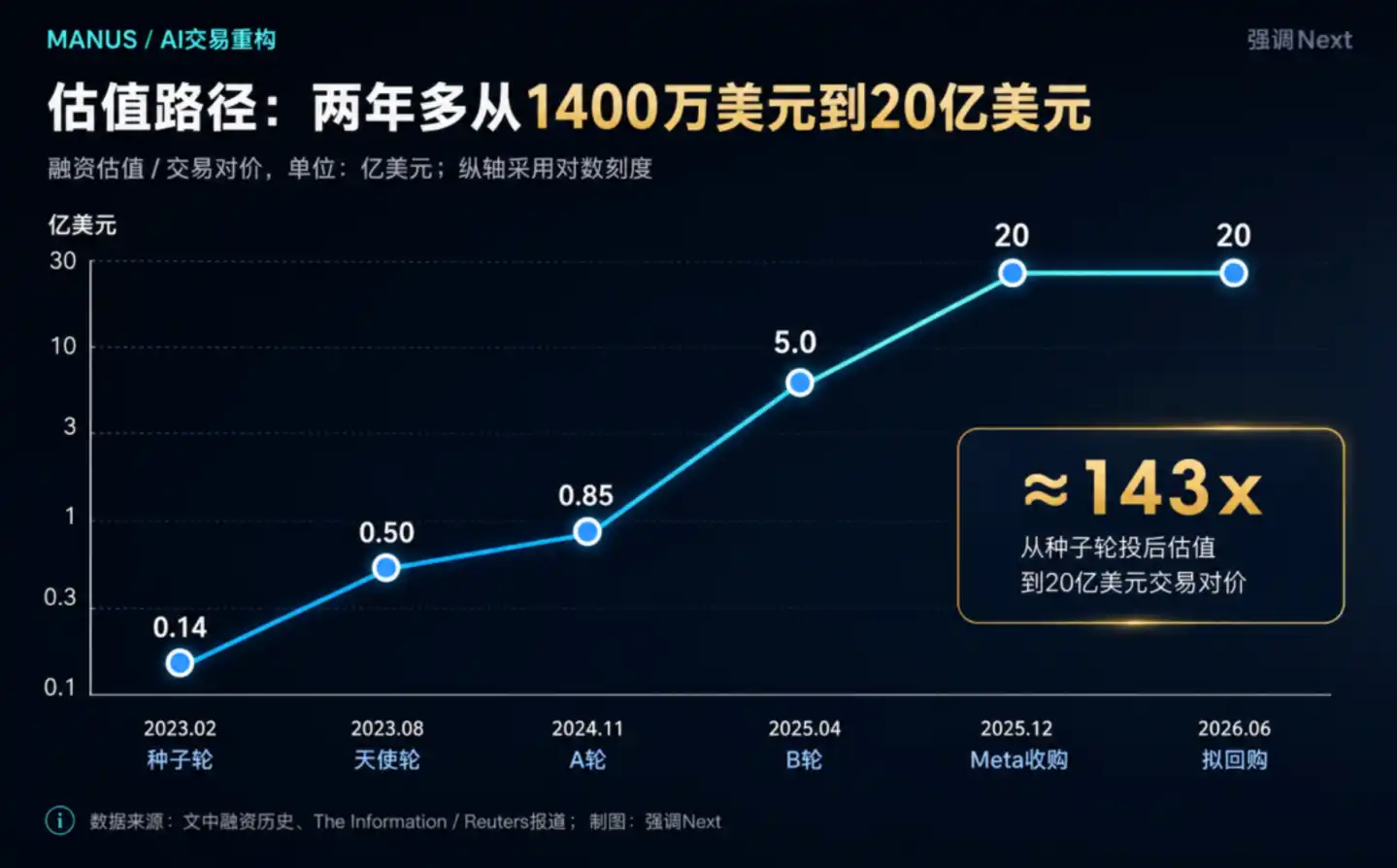
Now, this transaction is being rolled back. For Chinese AI startups, Manus's combination of "buyback + joint venture + Hong Kong IPO" might become a reference case for handling compliance issues in cross-border M&A going forward.


Perguntas relacionadas

QWhat is the reported plan of Manus' early Chinese investors regarding Meta's ownership, and what is the proposed amount?

AThe early Chinese investors, including Tencent, Sequoia Capital China (formerly Sequoia Capital China Fund), and ZhenFund, plan to repurchase Manus from Meta for $2 billion. This is the same amount Meta paid to acquire the company in December of last year.

QAccording to the article, what is the primary reason behind establishing a Sino-foreign joint venture as part of the repurchase plan?

AThe primary reason for considering a Sino-foreign joint venture structure is to allow the Chinese investment parties to compliantly hold equity in the company and, simultaneously, to pave the way for a future initial public offering (IPO) in Hong Kong.

QHow has Manus's business performance changed since its acquisition by Meta, according to the article?

ASince being acquired by Meta, Manus's business has grown rapidly. Its annualized revenue run rate has climbed to $400-$500 million, which is approximately four to five times the $100 million rate at the time of the Meta acquisition around six months prior.

QWhy does the article suggest the forced divestment might be financially beneficial for Manus's early investors?

AThe article suggests it might be a financial benefit because the investors can repurchase their equity at the original acquisition price of $2 billion, which is likely far lower than the company's current valuation given its rapid revenue growth. This allows them to regain ownership at a favorable cost, with the potential for an independent IPO in the future.

QWhich major early investor, mentioned in the article, has decided not to participate in the repurchase plan?

ABenchmark, a major early investor that led Manus's Series B funding round, has decided not to participate in the repurchase plan led by the Chinese investment consortium.

Leituras Relacionadas

9.42 Million Retail Investors Compete for Changxin Technology, Who Got Allotted?

Evergreen Technology's IPO subscription results are now available. On July 20, the domestic memory chip giant announced the offline preliminary allotment results and online lottery results for its IPO. A total of approximately 9.43 million retail investors participated in the online subscription, generating 770,000 winning lots with a final winning rate of about 0.4714%, setting a record for new shares on the STAR Market. After triggering a clawback mechanism from institutional to retail investors, the online retail allocation was significantly increased to 3.851 billion shares. Simultaneously, 285 institutional investors participated in the offline subscription, ultimately receiving 2.173 billion shares at an allotment rate of approximately 0.1756%. Leading insurers and public funds were among the major recipients. Notably, Liang Wenfeng, founder of the major AI model company DeepSeek, through his quantitative investment firms Ningbo Huanfang Quantitative and Zhejiang Jiuzhang Asset, secured the largest share among private funds, with a total allotment worth approximately 175 million yuan. Estimates suggest potential profits could reach 730 million yuan if Evergreen Technology's market capitalization reaches 3 trillion yuan post-listing. The company is expected to list on July 27 and could become the highest-valued tech stock on the A-share market, with various brokerages providing valuations ranging from 1 trillion to over 4 trillion yuan. However, recent significant corrections in global tech stocks may impact its post-listing performance. (Character count: 1,196)

marsbitHá 19m

9.42 Million Retail Investors Compete for Changxin Technology, Who Got Allotted?

marsbitHá 19m

L2 'Recalibration': When L1 Becomes Its Own Rollup, What Is Ethereum's Endgame?

The article discusses the evolving relationship between Ethereum's Layer 1 (L1) and Layer 2 (L2) solutions, moving beyond the initial "L2 for scaling" model. As Ethereum L1 itself scales (increasing Gas Limit, statelessness, zkEVM), the unique value proposition of L2s shifts from merely providing cheap execution to offering differentiated features like application-specific optimization, privacy, and flexible governance. The piece explores three key themes: 1. **L2's New Role:** L2s are transitioning from a pure scaling technology to a spectrum of execution environments with varying degrees of security inheritance from Ethereum L1. 2. **Interoperability as State Trust:** Solving L2 fragmentation is less about cross-chain bridges and more about enabling faster, trust-minimized state verification between environments. This involves initiatives like faster L1 finality, intent-based architectures (Open Intents Framework), and native account abstraction. 3. **Blurring Layers:** With the potential integration of zk-proofs into L1 validation (making L1 akin to its own "Rollup") and the concept of "Native Rollups," the rigid boundary between L1 and L2 may fade. The future could be a unified system with multiple execution domains (for DeFi, gaming, privacy, etc.) sharing a common security, settlement, and state framework. In conclusion, Ethereum's goal is not to abandon L2s or re-centralize everything on L1, but to re-integrate the fragmented user experience—liquidity, accounts, applications—while preserving the scaling benefits of a multi-environment ecosystem. The endgame is a cohesive "one chain" feeling for users, powered by diverse but securely interconnected execution layers.

marsbitHá 1h

L2 'Recalibration': When L1 Becomes Its Own Rollup, What Is Ethereum's Endgame?

marsbitHá 1h

Trading

Spot
活动图片




