‘Make TON great again’ – Block rate rises 6x, blockchain speed is now 10x

ambcryptoPublicado em 2026-04-10Última atualização em 2026-04-10

Resumo

The TON blockchain has increased its speed tenfold and now produces blocks six times faster, resulting in sub-second transaction times. This upgrade, part of the "Make TON Great Again" (MTONGA) framework announced by Telegram founder Pavel Durov, is the first of seven planned steps. The next phase aims to reduce transaction fees by six times. If achieved, lower fees would make TON significantly cheaper than competitors like Solana, potentially positioning it as a more cost-effective option for stablecoin transfers and DeFi applications. Despite currently ranking as the 14th fastest blockchain, TON has experienced a decline in activity since late 2024, with DEX volumes and TVL dropping significantly. However, these trends are partly attributed to broader market conditions. The upgrades are intended to attract new users amid intense competition among Layer 1 blockchains.

The TON blockchain has increased its speed tenfold and now plans to lower fees as top Layer 1 (L1s) compete for users.

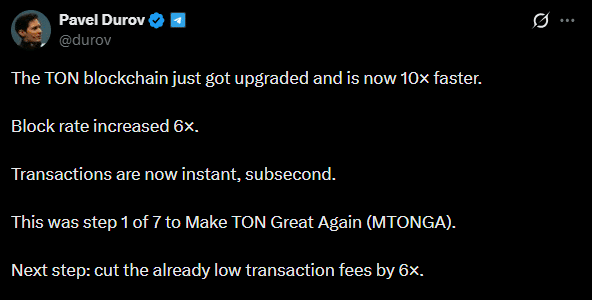
On the 9th of April, Telegram founder Pavel Durov announced that the recent upgrade, Catchain 2.0, was successful. According to him, the blockchain now creates blocks six times faster, and transactions are now ‘instant, subsecond.’
Source: X

Durov added that the 10x faster speed was the first of the seven steps of blockchain’s overhaul plan, dubbed the Make TON Great Again (MTONGA) framework. The second step will cut the transaction cost by 6x.

Will the upgrades improve TON activity?

According to ChainSpect, TON now ranks 14th among the fastest blockchain networks. On the sub-second block times, it only rivals Solana and BNB Chain.

Worth pointing out, BNB Chain also made updates to scale its speed and lower the costs of transactions. The end goal is to attract users seeking faster and cheaper transfers that can also empower other DeFi applications.

This is especially true for stablecoin transfers, which are dominated by Ethereum. However, rising competition from cheaper options like Tron, Solana, BNB Chain, and now TON has slashed its market share in stablecoin settlement.
Source: Token Terminal

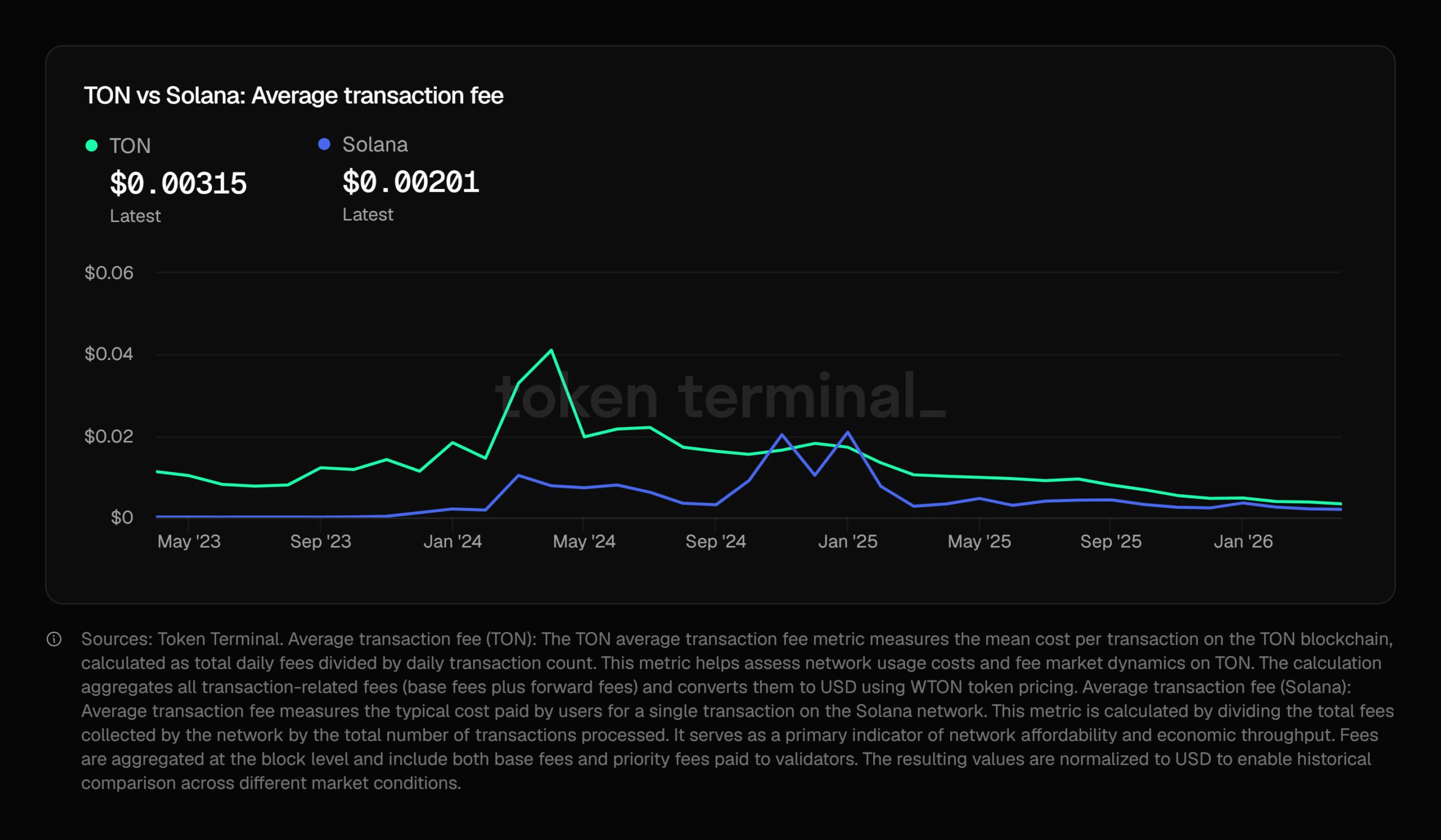
Currently, TON’s average transfer cost is about $0.00315, while Solana charges $0.00201. In other words, Solana is 40% cheaper than TON.

But if the 6x lower fees are achieved, TON would be 3.5x or 72% cheaper than Solana. That would be a competitive advantage, especially for stablecoin transfers.

As of writing, TON was the 13th largest chain in terms of stablecoin liquidity. Even so, the TON blockchain has seen a broader downtrend in activity since late 2024.

The DEX volumes have dropped from 2024 highs of $1.4B to $26M as of April 2026. Similarly, the TVL (total locked value) has decreased from a record high of $766M to $55M.
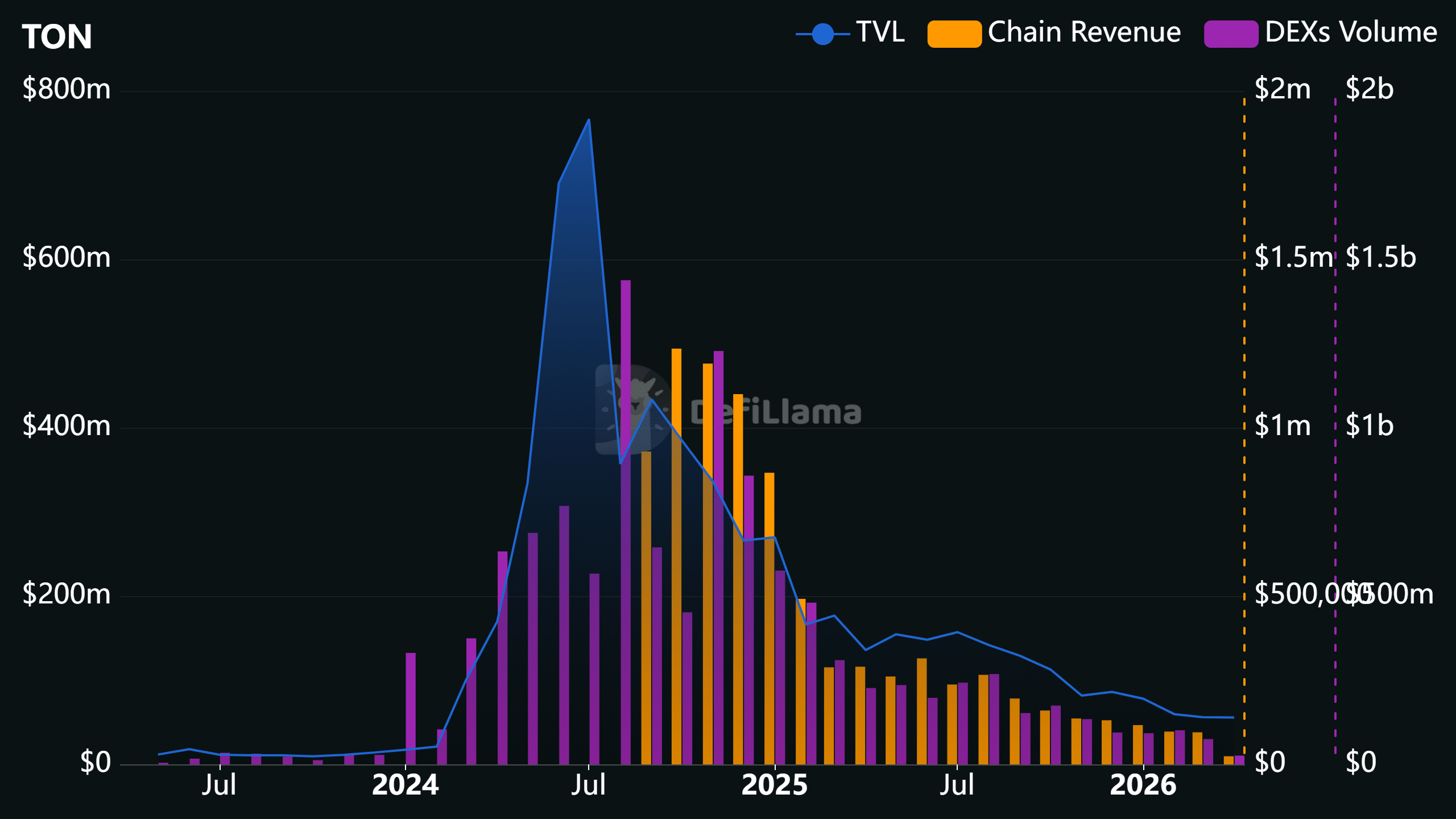
Source: DeFiLlama

But the dropping activity was due to broader market contraction. But it remains to be seen whether the lower fees will attract new users to the chain.


Final Summary

  • TON is now 10x faster and could soon be 3.5x cheaper than Solana amid cutthroat competition for on-chain users.
  • Telegram’s Pavel Durov said the plans are part of the Make TON Great Again (MTONGA) framework as chain activity slows.


Perguntas relacionadas

QWhat is the name of the upgrade that made TON blockchain 10x faster and who announced it?

AThe upgrade is called Catchain 2.0 and it was announced by Telegram founder Pavel Durov.

QAccording to the article, how much faster is TON at creating blocks and what is the new transaction speed?

ATON now creates blocks six times faster, and transactions are now 'instant, subsecond'.

QWhat is the second step in the 'Make TON Great Again' (MTONGA) framework?

AThe second step is to cut the transaction cost by 6x.

QHow does the article suggest TON's potential future fees would compare to Solana's if the 6x reduction is achieved?

AIf the 6x lower fees are achieved, TON would be 3.5x or 72% cheaper than Solana.

QWhat two key metrics (DEX volumes and TVL) have significantly decreased on TON since late 2024?

ADEX volumes dropped from $1.4B to $26M, and the TVL (total value locked) decreased from $766M to $55M.

Leituras Relacionadas

9.42 Million Retail Investors Compete for Changxin Technology, Who Got Allotted?

Evergreen Technology's IPO subscription results are now available. On July 20, the domestic memory chip giant announced the offline preliminary allotment results and online lottery results for its IPO. A total of approximately 9.43 million retail investors participated in the online subscription, generating 770,000 winning lots with a final winning rate of about 0.4714%, setting a record for new shares on the STAR Market. After triggering a clawback mechanism from institutional to retail investors, the online retail allocation was significantly increased to 3.851 billion shares. Simultaneously, 285 institutional investors participated in the offline subscription, ultimately receiving 2.173 billion shares at an allotment rate of approximately 0.1756%. Leading insurers and public funds were among the major recipients. Notably, Liang Wenfeng, founder of the major AI model company DeepSeek, through his quantitative investment firms Ningbo Huanfang Quantitative and Zhejiang Jiuzhang Asset, secured the largest share among private funds, with a total allotment worth approximately 175 million yuan. Estimates suggest potential profits could reach 730 million yuan if Evergreen Technology's market capitalization reaches 3 trillion yuan post-listing. The company is expected to list on July 27 and could become the highest-valued tech stock on the A-share market, with various brokerages providing valuations ranging from 1 trillion to over 4 trillion yuan. However, recent significant corrections in global tech stocks may impact its post-listing performance. (Character count: 1,196)

marsbitHá 57m

9.42 Million Retail Investors Compete for Changxin Technology, Who Got Allotted?

marsbitHá 57m

L2 'Recalibration': When L1 Becomes Its Own Rollup, What Is Ethereum's Endgame?

The article discusses the evolving relationship between Ethereum's Layer 1 (L1) and Layer 2 (L2) solutions, moving beyond the initial "L2 for scaling" model. As Ethereum L1 itself scales (increasing Gas Limit, statelessness, zkEVM), the unique value proposition of L2s shifts from merely providing cheap execution to offering differentiated features like application-specific optimization, privacy, and flexible governance. The piece explores three key themes: 1. **L2's New Role:** L2s are transitioning from a pure scaling technology to a spectrum of execution environments with varying degrees of security inheritance from Ethereum L1. 2. **Interoperability as State Trust:** Solving L2 fragmentation is less about cross-chain bridges and more about enabling faster, trust-minimized state verification between environments. This involves initiatives like faster L1 finality, intent-based architectures (Open Intents Framework), and native account abstraction. 3. **Blurring Layers:** With the potential integration of zk-proofs into L1 validation (making L1 akin to its own "Rollup") and the concept of "Native Rollups," the rigid boundary between L1 and L2 may fade. The future could be a unified system with multiple execution domains (for DeFi, gaming, privacy, etc.) sharing a common security, settlement, and state framework. In conclusion, Ethereum's goal is not to abandon L2s or re-centralize everything on L1, but to re-integrate the fragmented user experience—liquidity, accounts, applications—while preserving the scaling benefits of a multi-environment ecosystem. The endgame is a cohesive "one chain" feeling for users, powered by diverse but securely interconnected execution layers.

marsbitHá 1h

L2 'Recalibration': When L1 Becomes Its Own Rollup, What Is Ethereum's Endgame?

marsbitHá 1h

Trading

Spot
活动图片




