Lobsters Not Yet Grown, Giants Already Casting Nets: OpenClaw Ecosystem Faces Enclosure Crisis

比推Publicado em 2026-03-13Última atualização em 2026-03-13

Resumo

The article discusses the controversy surrounding Chinese tech giant Tencent's launch of SkillHub, a localized platform for the OpenClaw ecosystem. OpenClaw founder Peter Steinberger publicly accused Tencent of copying the project without providing support, specifically criticizing its impact on official download statistics. Tencent responded that SkillHub is a mirror site designed to serve Chinese users, citing reduced bandwidth strain on the official source and offering sponsorship. Steinberger countered that the core issue was not technical but a lack of prior communication and the risk of Tencent controlling user access and data. The author argues that the incident reflects a broader pattern of major Chinese tech companies exploiting open-source ecosystems for market dominance. While mirror sites are common in China, Tencent’s move is seen as an attempt to capture the user entry point and potential future commercialization of the Agent-based AI ecosystem represented by OpenClaw. The article warns that such platforms, under the guise of localization and convenience, may eventually lead to walled gardens where Tencent controls distribution, visibility, and monetization—echoing past strategies in sectors like ride-hailing and short-video platforms. The piece concludes that OpenClaw’s open, community-driven vision is at risk of being co-opted by corporate interests before it fully matures.

Author: Golem

Original Title: Free Mirror or Enclosure as King? OpenClaw Founder Slams Tencent for Copying


When domestic tech giants rushed to launch "one-click install OpenClaw", controversy followed.

On March 12, OpenClaw founder Peter Steinberger publicly questioned Tencent's creation of Skillhub on X, accusing it of reducing official speeds causing inability to fetch data quickly, and stating "they copy but do not support the project in any way".

Facing the controversy, Tencent quickly responded, expressing understanding of Peter Steinberger's concerns, stating that SkillHub is a localized Skills platform built by Tencent based on the OpenClaw ecosystem. As a local mirror site, it always credits ClawHub as the data source, and in its first week, handled 180GB of traffic (870,000 downloads) for users, pulling only 1GB of non-concurrent requests from the official source. Tencent also expressed willingness to become a sponsor.

Logically, Tencent's response should have clarified the issue most likely to cause public backlash—"whether it is excessively consuming the source station". But Peter was not satisfied after reading it, stating this was not the point. He could make SkillHub the official fifth mirror, synchronizing download statistics, but Tencent should have proactively communicated with him beforehand.

Although the matter ended here, understanding it merely as "the OpenClaw founder emotionally lashing out" or "a big company being misunderstood while doing normal localization" would be a shallow interpretation.

The Problem Isn't the Mirror, It's the Giants' 'Overbearingness'

If you only look at the technical actions, this is not unusual.

In China's developer ecosystem, mirroring open-source projects is a common practice. International open-source infrastructures like npm, PyPI, and Docker Hub all have numerous local mirrors in China. Precisely because of this, Tencent denied that its creation Skillhub was copying, but rather a localized Skills platform. It explained that it was not free-riding or draining the official site, but rather providing distribution, acceleration, and adaptation, helping OpenClaw land in China.

In a sense, Tencent's approach确实切中了 (indeed hit) the most practical needs of Chinese "lobster farmers". OpenClaw is unrealistically popular in China, but not everyone is willing or able to stably access the original community, let alone the fact that the installation, discovery, and retrieval experience for many Skills is still quite primitive.
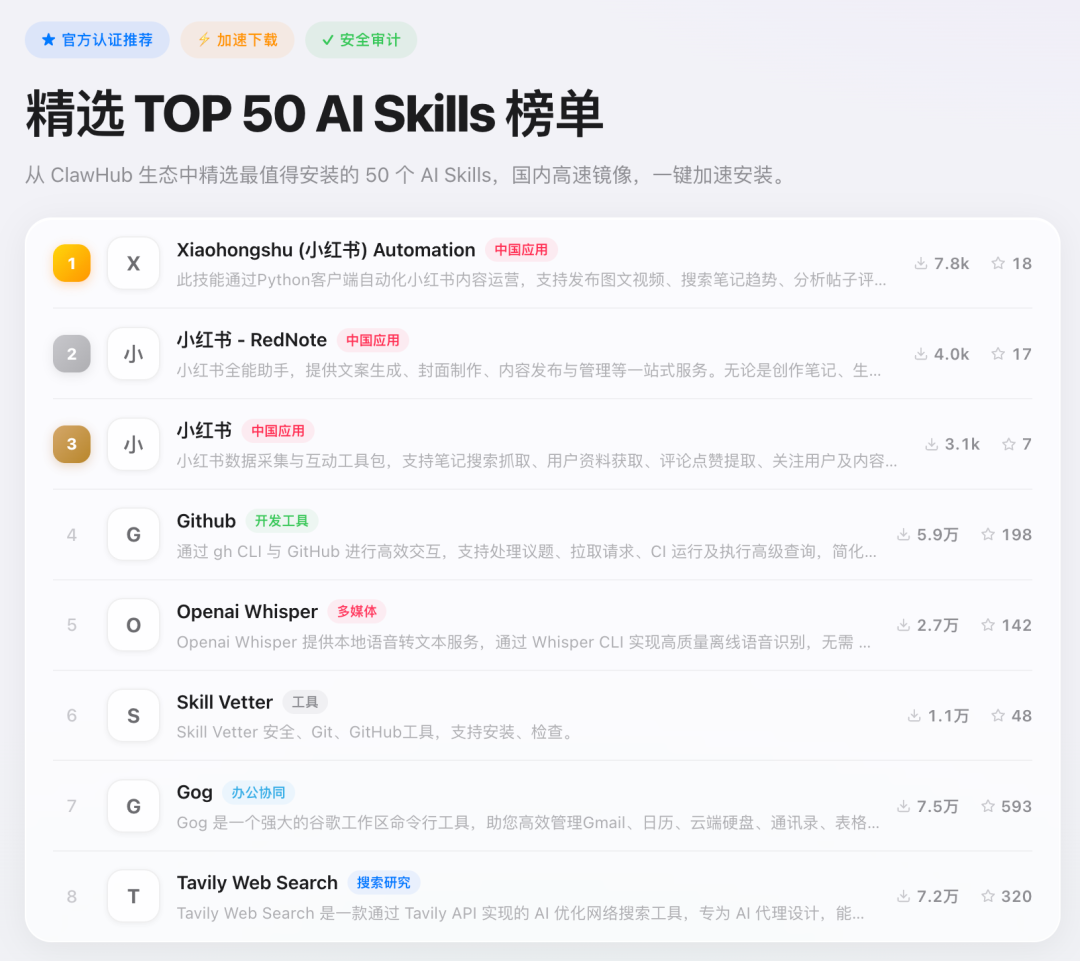
Skillhub

But the question: are mirror sites inherently blameless? The answer is not necessarily.

Because what open-source licenses allow, what community ethics accept, and what commercial reality ultimately brings are often three different sets of accounts.

At the license level, as long as the license is followed and the source is credited, many mirroring and redistribution behaviors are valid. At the community ethics level, Tencent's SkillHub credits the OpenClaw official source and even proactively reduced the source station's bandwidth costs, seemingly taking responsibility.

But Tencent forgot that OpenClaw is not a small open-source project needing deliberate resource injection from big companies. It is the number one hottest project on GitHub with the most stars. At this point, Tencent's act of notifying beforehand becomes "overbearing". It's no longer just a simple mirroring issue; it quickly involves three more sensitive questions: who represents the official ecosystem, who is taking the user entry point, and who is defining the download, distribution, and statistical metrics.

This is what truly made Peter uncomfortable. He stated that Tencent's behavior directly affects download statistics. Peter isn't opposed to Tencent localizing OpenClaw for China, but believes it's best to communicate beforehand, rather than Tencent first building the platform, onboarding users, and then explaining under public pressure that it's actually here to help.

Furthermore, from a commercial reality perspective, once a platform shell like SkillHub reaches scale, the official status and statistical authority originally held by the OpenClaw community can easily be marginalized. Today it's a localized Skills platform, tomorrow it could be the "default Skills distribution market", and later, it could be "who decides which Skills are seen, installed, and commercialized".

This is the real danger signal behind this controversy, and the most familiar scene in Chinese internet over the past decade: the enclosure movement.

Giants Aren't 'Farming Lobsters', They're Using Lobsters to Enclose AI Land

Recently, "farming lobsters" became the hottest meme in China's AI circle, and OpenClaw was quickly pushed to become an almost emotional industry symbol. Everyone says lobsters represent the new imagination of the Agent era, the future of personal AI assistants—it sounds very passionate.

But giants looking at lobsters don't see idealism; they see entry points, traffic, distribution power, and the shell of the next-generation operating system.

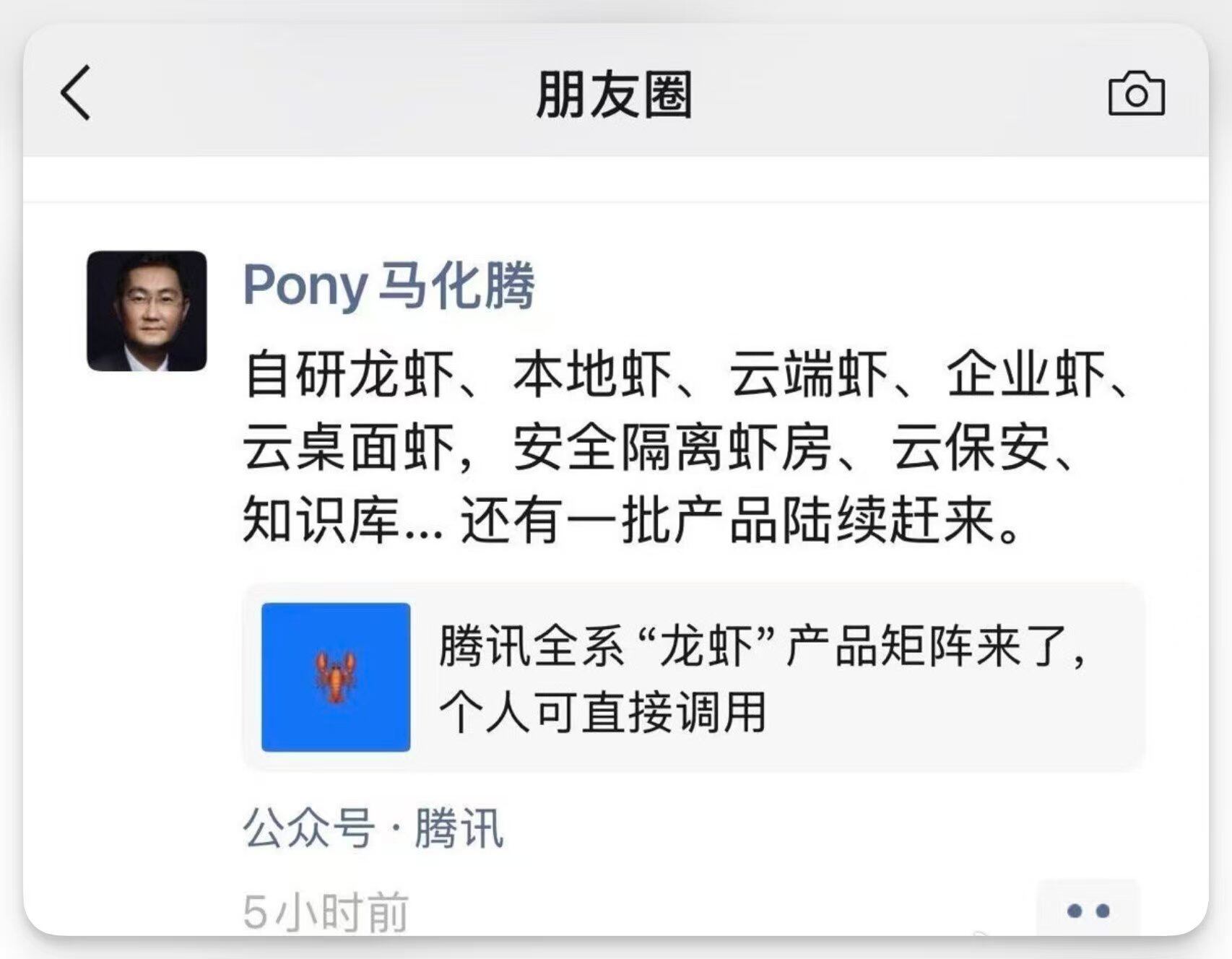
In the early hours of March 11, Pony Ma promoted Tencent's full suite of "lobster" products on his朋友圈 (WeChat Moments). Tencent's "Lobster Family Bucket" tailored a "little lobster" for ordinary users, developers, and enterprise users, supporting one-click installation with no threshold. SkillHub was launched simultaneously at this time,内置 (built-in) with 13,000 localized Skills for one-click calls, usable directly in scenarios like Xiaohongshu operation and Baidu search.
Of course, Tencent isn't the only one "smelling the wind and moving". If you stretch the timeline, you'll find domestic giants almost collectively jumped in to help users solve the "lobster farming"难题 (difficulty), their movements so整齐 (uniform) as if they pressed the same switch, though Tencent is currently the most comprehensive.

On the surface, everyone means well, but in reality, this hides the most familiar set of commercial path dependencies for Chinese internet companies. Facing a new ecosystem already validated by the market and heated up by public opinion, the first move isn't profit and business models, but first seizing the entry point, first building the platform, first onboarding users.

What Tencent wants is not just to make it easier for Chinese users to "farm lobsters", but to ensure that when Chinese users truly start "using Agents to get things done" for the first time, their first instinct is to do it within Tencent's product shell.

This is the most intriguing aspect of actions like SkillHub. It表面上 (superficially) is a mirror site, but实质上 (in essence) could be the starting point of a larger closed loop. Today users see local Skill search and download, tomorrow it could be default access to some cloud, some account system, some enterprise workbench. Later, developers will slowly discover that although they are still developing within the OpenClaw ecosystem, what truly decides exposure, recommendation, review, and commercialization paths has become the platform.

This script has been played out too many times in the Chinese internet. From ride-hailing to food delivery, from short video platforms to cloud markets, almost every "ecological prosperity"背后 (behind it) is accompanied by the same structural ending—the platform first uses free, open strategies to attract users, then builds walls, using traffic, advertising, and other means to turn the ecology back into its own附属层 (subsidiary layer).

The giants all know that old entry points like search, social, content, and e-commerce are卷到极限 (competed to the limit), while Agent might be the most worth betting on new entry point for the next round.既然如此 (Since that case), rather than waiting for OpenClaw to grow wildly on its own, it's better to趁 (take advantage while) it's still in its explosive early stages, first onboard it, first encapsulate it, first get users accustomed to "bossing lobsters around" within their own system.

Therefore, everyone is too familiar with what will happen next after giants争先恐后地 (scramble) to help users solve the OpenClaw installation problem. And Peter, who doesn't understand the Chinese internet, naturally can't understand why Tencent didn't communicate with him beforehand, why it didn't synchronize data with him.

OpenClaw represents another AI future: local operation, personal control, community extension, open connection. Its most imaginative aspect is making Agents truly the user's own execution layer. But once this ecosystem gets repackaged by giants with "localized mirrors", "domestic adaptation", "unified distribution", "security review", the flavor changes. In the eyes of giants, the entry point belongs to me, distribution belongs to me, so ultimately payment and commercialization should also最好 (best) belong to me.

The giants aren't "embracing lobsters", they are "using lobsters to enclose territory in the AI era". This is also the most unsettling aspect behind this small controversy.

Walls are never erected all at once; they always grow slowly under the guise of "more convenient" and "more stable". By the time developers, users, and traffic are all packed into the same shell,所谓的 (so-called) openness and autonomy might ultimately just be a component within the giant's ecosystem.

OpenClaw currently faces the most paradoxical situation in China: the "lobsters" are not yet grown, but the giants have already started casting their nets.


Twitter:https://twitter.com/BitpushNewsCN

Bitpush TG Discussion Group:https://t.me/BitPushCommunity

Bitpush TG Subscription: https://t.me/bitpush

Original link:https://www.bitpush.news/articles/7619504

Perguntas relacionadas

QWhat was the main criticism that OpenClaw founder Peter Steinberger raised against Tencent's SkillHub?

APeter Steinberger criticized Tencent for creating SkillHub without prior communication, which he viewed as copying the OpenClaw ecosystem. He was particularly concerned that it affected official download statistics and that Tencent did not support the project in any way despite using its resources.

QHow did Tencent respond to the allegations made by the OpenClaw founder?

ATencent responded by stating that SkillHub is a localized Skills platform based on the OpenClaw ecosystem, acting as a mirror site that always credited ClawHub as the data source. They claimed to have handled 180GB of traffic for users in the first week while only pulling 1GB of non-concurrent requests from the official source. Tencent also expressed willingness to become a sponsor.

QAccording to the article, what is the deeper concern beyond the technical aspects of mirroring OpenClaw?

AThe deeper concern is that large companies like Tencent are not just mirroring OpenClaw but are engaging in a 'land grab' for the AI ecosystem. This involves controlling user entry points, distribution channels, and eventually commercialisation, which could marginalise the original OpenClaw community's authority and statistics.

QWhat does the article suggest about the ultimate goal of Chinese tech giants in adopting OpenClaw?

AThe article suggests that Chinese tech giants are using OpenClaw to secure entry points, traffic, distribution rights, and the framework for the next-generation operating system. Their goal is to integrate users into their own ecosystems early on, potentially leading to control over exposure, recommendations, and commercialisation paths in the future.

QWhat historical pattern in Chinese internet companies does the article reference to explain the current situation with OpenClaw?

AThe article references a historical pattern where Chinese internet companies first attract users with free and open services, then gradually build walls around the ecosystem using traffic and advertising to turn it into their subsidiary layer. This has been seen in sectors like ride-hailing, food delivery, short-video platforms, and cloud markets.

Leituras Relacionadas

Annual Salary of Millions Competing for Electricians, Meta Rushes to Open Its Own Technical School

The AI boom is facing an unexpected bottleneck: a severe shortage of skilled construction workers and electricians. As tech giants like Meta, OpenAI, and Alphabet race to build massive data centers—such as OpenAI's $16 billion "Stargate" project—they are hitting a critical labor wall. The U.S. needs an estimated 130,000 more electricians, 240,000 construction workers, and 150,000 supervisors by 2030 for AI infrastructure alone, but tens of thousands of electrician jobs go unfilled each year. While AI companies offer high premiums, with electricians earning up to $280,000 annually, worker scarcity still causes massive losses—delays on a single project can cost $14.2 million per month. The complexity of building AI data centers, which require immense power (equivalent to powering hundreds of thousands of homes), sophisticated electrical systems, and advanced liquid cooling solutions, demands highly skilled technicians who are in short supply. To combat this, companies are investing heavily in training. Meta has committed $115 million to a free training school offering tuition, housing, and stipends, targeting 5,000 new workers. OpenAI is partnering with unions to secure skilled labor. These efforts are paying off, with a significant rise in Gen Z interest in trade schools over college. However, the power demands are staggering. AI data centers are driving a rapid surge in electricity consumption, projected to account for up to 12% of U.S. power use by 2028 and raising costs for consumers. Furthermore, the construction boom is project-based, leading to a potential future glut of trained workers once building peaks, which could depress wages industry-wide. The race for AI supremacy now depends as much on skilled hands as on advanced chips.

marsbitHá 27m

Annual Salary of Millions Competing for Electricians, Meta Rushes to Open Its Own Technical School

marsbitHá 27m

OpenAI No Longer Sells Its Most Expensive Model for Profit

OpenAI is shifting its business strategy away from promoting its most expensive, flagship models for every task. Recent price cuts—80% for GPT-5.6 Luna and 20% for Terra—signal a deeper change: the company now actively advises users that many tasks don't require the most powerful model. Instead, OpenAI recommends a tiered approach: use the high-end GPT-5.6 Sol for complex planning and analysis, then delegate execution to cheaper models like Luna. This mirrors moves by Anthropic, which recently launched Claude Opus 5 at half the price of its top model, Fable 5. Both companies are de-emphasizing flagship models as primary revenue drivers, using them instead for brand prestige and technological showcases. The industry is entering a "mass-market" phase, similar to automotive, where high-volume, cost-effective models handle daily operations and drive scale. OpenAI's price reductions are partly enabled by AI models themselves optimizing underlying code and infrastructure, creating a self-reinforcing cycle of efficiency gains and cost reduction. Competition is shifting from "who is smartest" to "who offers the best value." The goal is no longer selling individual models but fostering widespread API adoption and ecosystem lock-in. By making AI calls cheap and ubiquitous, companies like OpenAI aim to become the indispensable, utility-like infrastructure powering automated workflows—the "water and electricity" of software, quietly embedded everywhere.

marsbitHá 27m

OpenAI No Longer Sells Its Most Expensive Model for Profit

marsbitHá 27m

Will the Fed Definitely Raise Interest Rates in September? How Will Crypto and U.S. Stocks Withstand the Pressure?

The market's expectation for a September Fed rate hike surged dramatically in early August, jumping from under 50% to over 80% within a week. This shift followed a contentious July FOMC meeting, where a 9-3 vote to hold rates revealed growing dissent from hawkish members advocating for an immediate hike to combat persistent inflation. The primary catalyst for this repricing is rising oil prices, driven by renewed geopolitical tensions around the Strait of Hormuz, which threaten global supply. Energy costs directly influence inflation metrics, making the upcoming July CPI report (due August 12th) a critical data point. If it shows inflation reaccelerating, the probability of a September hike will solidify. For Bitcoin and crypto assets, this is typically bearish news. Bitcoin continues to behave as a high-beta, liquidity-sensitive risk asset. A rate hike raises the opportunity cost of holding non-yielding assets and could drive capital toward money markets, pressuring crypto prices in the short term. However, historical patterns suggest that if a hike is perceived as the end of a tightening cycle rather than the start, any negative price impact may be brief. U.S. stocks, particularly crypto-linked equities like Coinbase and growth-oriented tech stocks, are also vulnerable. Higher rates increase discount rates in valuation models, putting pressure on high-multiple companies. This coincides with a pivotal tech earnings season where investor focus has shifted from massive AI capital expenditure to tangible revenue and cash flow generation. Companies with negative cash flow and weak growth narratives could face heightened volatility if borrowing costs rise in September. In summary, a September Fed hike has evolved into a mainstream market scenario. Key factors to watch are oil prices, the July CPI report, and Fed communications, which will determine the final decision and its impact on volatile crypto and equity markets.

marsbitHá 38m

Will the Fed Definitely Raise Interest Rates in September? How Will Crypto and U.S. Stocks Withstand the Pressure?

marsbitHá 38m

Trading

Spot
活动图片





