Lighter TGE Imminent: A Complete Overview of the Timeline, On-Chain Signals, and Market Pricing

marsbitPublicado em 2025-12-24Última atualização em 2025-12-24

Resumo

An article titled "Lighter is about to TGE: A Complete Overview of the Timeline, On-Chain Signals, and Market Pricing" discusses the imminent Token Generation Event (TGE) for the Lighter (LIT) project. Key developments include its addition to Coinbase's listing roadmap, a deadline for airdrop address registration, and the launch of pre-launch perpetual contracts on Binance. On-chain data shows the transfer of 250 million LIT (25% of total supply) to a new address, strongly hinting at an upcoming airdrop. Market predictions on Polymarket suggest the TGE is most likely to occur around December 29th. Lighter is a perpetual contract trading platform built on Ethereum L2, leading its sector with $232.3B in trading volume over the past 30 days and a TVL exceeding $1.4B. Its core philosophy is to combine CEX speed with DEX security, opting for a modular L2 approach integrated with Ethereum rather than building an independent L1. Pre-launch trading on Binance values LIT at approximately $3.2, giving Lighter a Fully Diluted Valuation (FDV) of around $3.2 billion. Analyst predictions for the FDV post-TGE range from a bear case of $1.5B ($1.5 per token) to a bull case of $12.5B ($12.5 per token). The article concludes by cautioning users that airdrop rewards are not final until distributed, as the team is currently analyzing data to remove points earned by sybil addresses and wash trading.

Author | Asher(@Asher_ 0210)
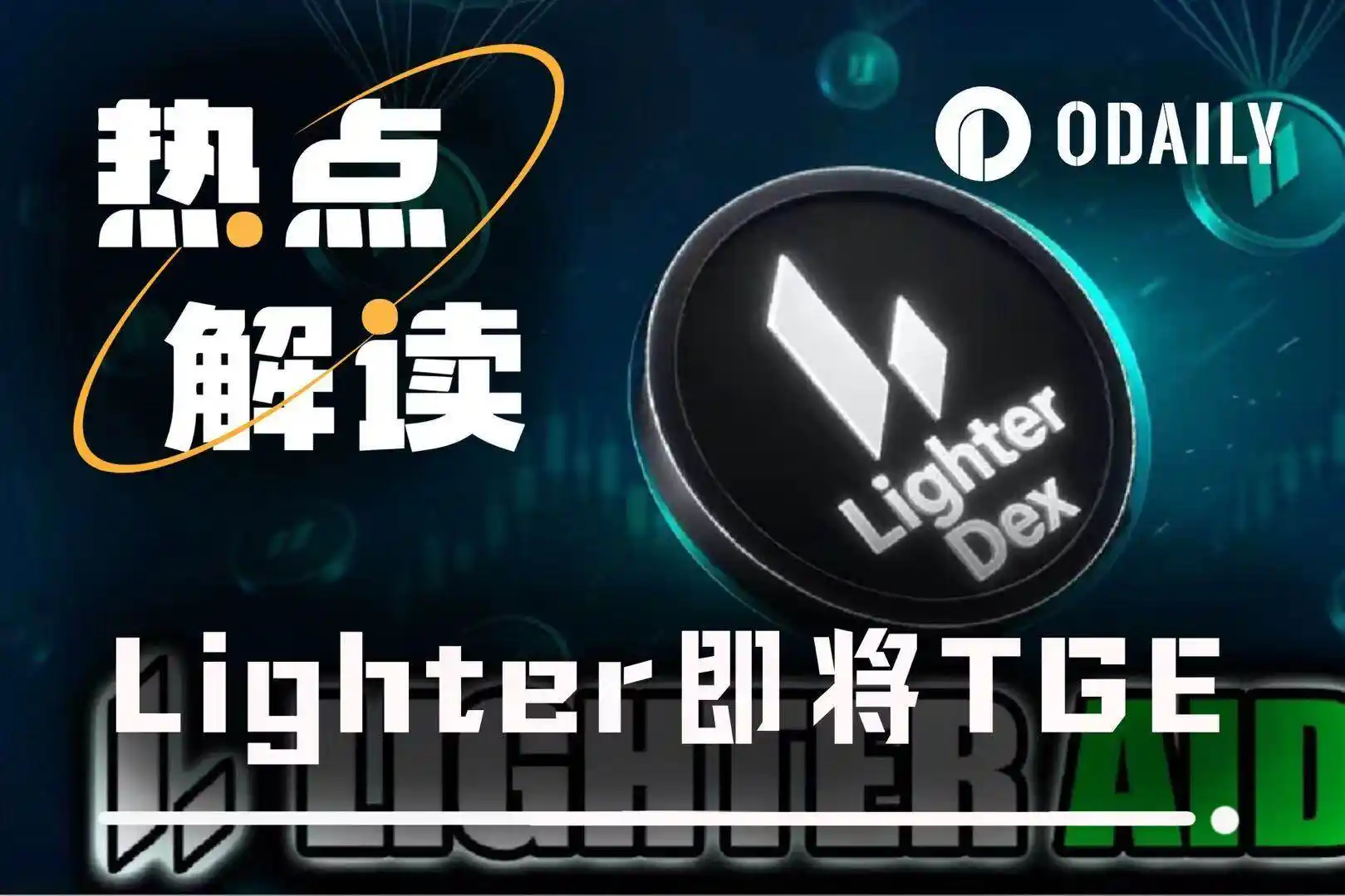
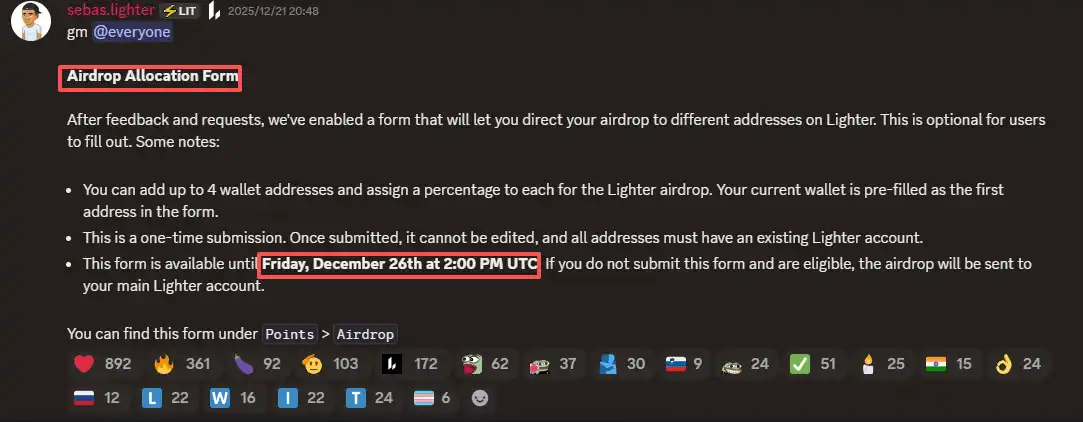
On December 13, Coinbase Markets announced on platform X that Lighter had been added to its listing roadmap; on December 21, Lighter officially announced on Discord that users must complete airdrop address registration by December 26; on December 23, Binance launched pre-market perpetual contract trading for Lighter (LIT). With multiple key milestones landing in quick succession, market expectations for Lighter's imminent Token Generation Event (TGE) have rapidly heated up.
On-chain data further confirms this judgment. On December 20, the Lighter token contract transferred 250 million LIT to a new address (0x98e7769167194A8Cf272B649319676bE84052b5f); this morning, this address has already distributed varying amounts of tokens to 20 addresses, with the single highest transfer being approximately 3.1 million LIT and the lowest about 9,820 LIT. It currently still holds about 230 million LIT. Although the official use for this batch of tokens has not been disclosed, the community widely speculates it is likely for airdrop-related distribution.

It is worth noting that 250 million LIT恰好 accounts for exactly 25% of the total token supply,高度一致 with previous community speculation about "25% allocated for the airdrop," further strengthening the判断 that Lighter is about to complete its TGE.

Lighter token contract transfers 250 million LIT to a new address

Regarding the timing expectation, feedback from participants in Lighter's recent Japanese AMA suggests the TGE might occur in the window from December 24 to January 1 next year; on Polymarket's prediction event for "When will Lighter conduct its TGE?", December 29 currently has the highest probability, around 75%.
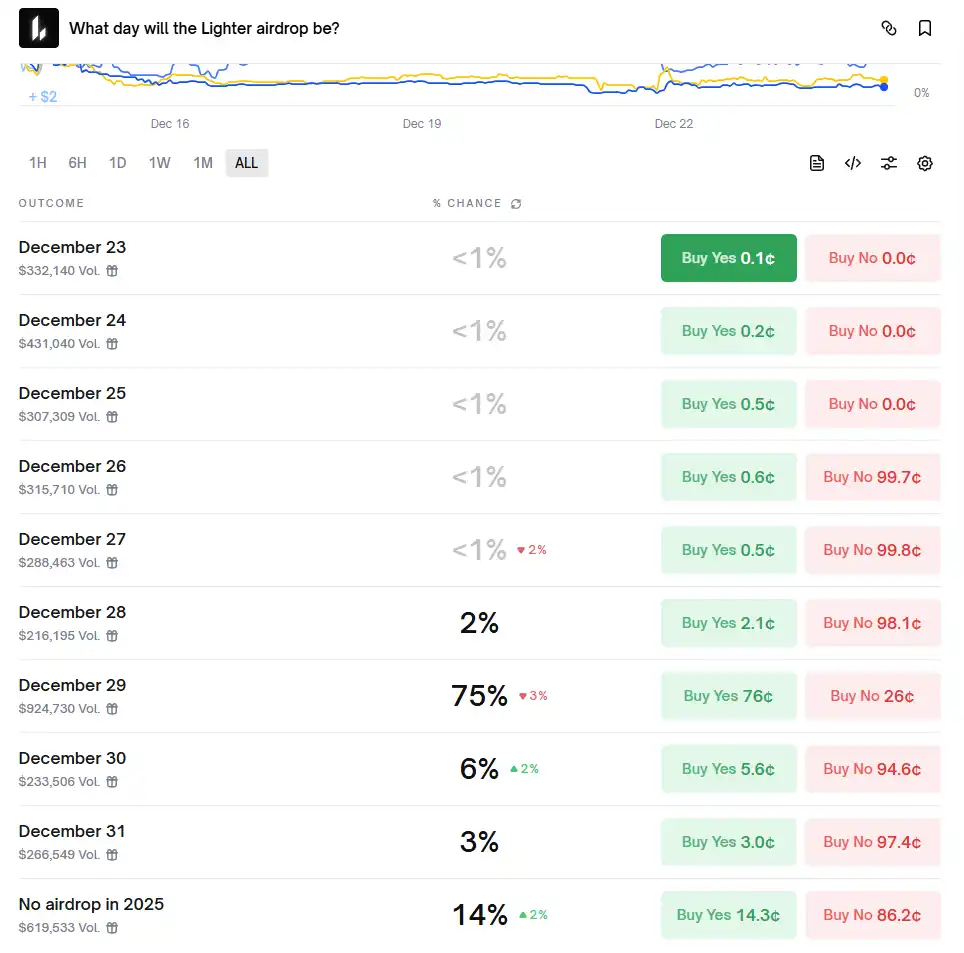
Polymarket prediction event: "On which day will Lighter conduct its TGE?"

Lighter Ranks First in Perp Dex Sector for Perpetual Contract Volume Over Past 30 Days

Lighter is a perpetual contract trading platform built on Ethereum Layer 2 (L2), aiming to combine the speed and liquidity of centralized exchanges (CEX) with the security and transparency of decentralized exchanges (DEX).

According to DeFiLlama data, over the past 30 days, Lighter led the Perp Dex sector with approximately $232.3 billion in perpetual contract trading volume, ahead of Aster ($195.5 billion) and Hyperliquid ($182 billion).

Perp Dex sector perpetual contract trading volume ranking

Furthermore, Lighter's TVL has continued to rise in recent months, currently exceeding $1.4 billion, surpassing Aster ($1.27 billion).
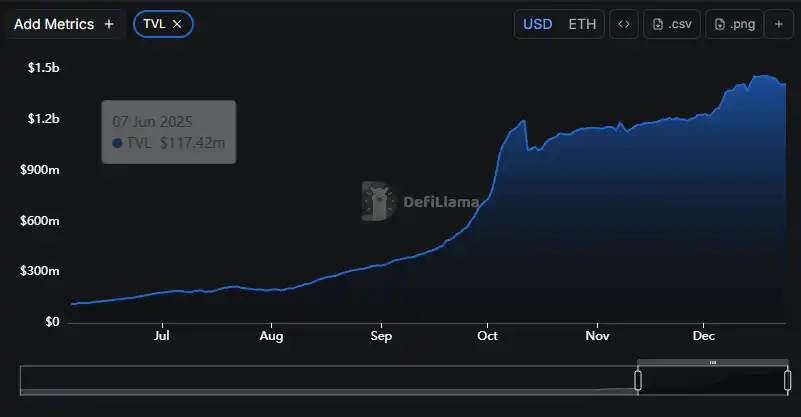
Lighter TVL Data

If Aster's backing is Binance, then Lighter's backing is Ethereum. As Lighter CEO Vladimir Novakovski previously stated in a comment on platform X, “Being an L1 is a bug, not a feature.”
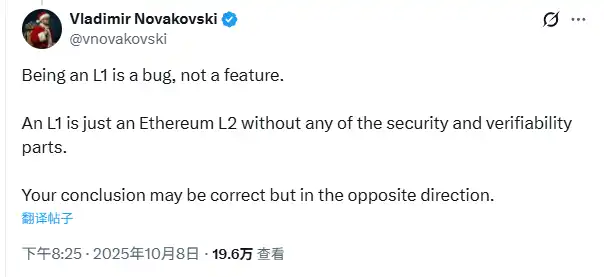
Lighter CEO comments on Lighter's choice of a modular L2 path

Instead of opting for a closed architecture like HyperLiquid's self-built L1, Lighter focuses on an "Ethereum-native composability" core路线: LLP Tokens can circulate on the mainnet and synergize with DeFi protocols like Aave, thus enjoying a low-cost, low-latency, verifiable execution environment within an open ecosystem. In other words, Lighter's goal is to allow any protocol to reuse its matching engine and capital system. Lighter is not meant to replace Ethereum, but to evolve with Ethereum, becoming the underlying engine for high-performance on-chain finance.

Lighter Valuation and Pre-Market Pricing

Based on Binance's pre-market perpetual contract trading, the LIT price has slowly declined from an initial $3.9 to currently around $3.2. At the current price, Lighter's Fully Diluted Valuation (FDV) is approximately $3.2 billion.

If 25% of the total token supply is entirely used for future airdrops, and given a total of 12 million points, then each point corresponds to approximately 20.8 LIT. Estimated at the current pre-market price, each point is worth about $66.

Market Participants' Valuation Range Estimates

Crypto KOL ingalvarez.sol (@ingalvarezsol) predicted Lighter's valuation based on factors including Polymarket, OTC point prices, and the pre-market LIT token price:

  • $1.5 billion: Minimum valuation under pessimistic conditions, corresponding to a token price of ~$1.5;
  • $3–4.2 billion: Bear market baseline range, corresponding to a token price of ~$3 to $4;
  • $7.5–12.5 billion: Optimistic scenario, corresponding to a token price of ~$7.5 to $12.5;

Another early Lighter user, Chuk (@chuk_xyz), also made predictions based on Lighter's TVL, trading volume, revenue, and other data:

  • Bear Market Range ($1.5B – $4.2B FDV): If the price trades in this range post-TGE, it can be seen as an opportunity zone. The psychological pressure on airdrop holders is lowest, and the risk-reward ratio is clearest;
  • Baseline Range ($4.2B – $7.5B FDV): If Lighter can stabilize its TVL and maintain a top-tier operational scale, this range can be considered fair value. After the price enters this range, it's suitable to take staged profits to recoup costs while retaining some position;
  • Bull Market Range ($7.5B – $12.5B+ FDV): This range意味着 core catalysts have been fully priced in by the market, including strengthened RWA momentum and the formation of consensus around the distribution narrative (fintech / broker alignment). This stage is more suitable for continuously reducing positions during the upward trend.

On Polymarket's prediction event for "Lighter FDV one day after opening," the probability of exceeding $1 billion FDV is as high as 88%, and the probability of exceeding $2 billion FDV is also 83%.
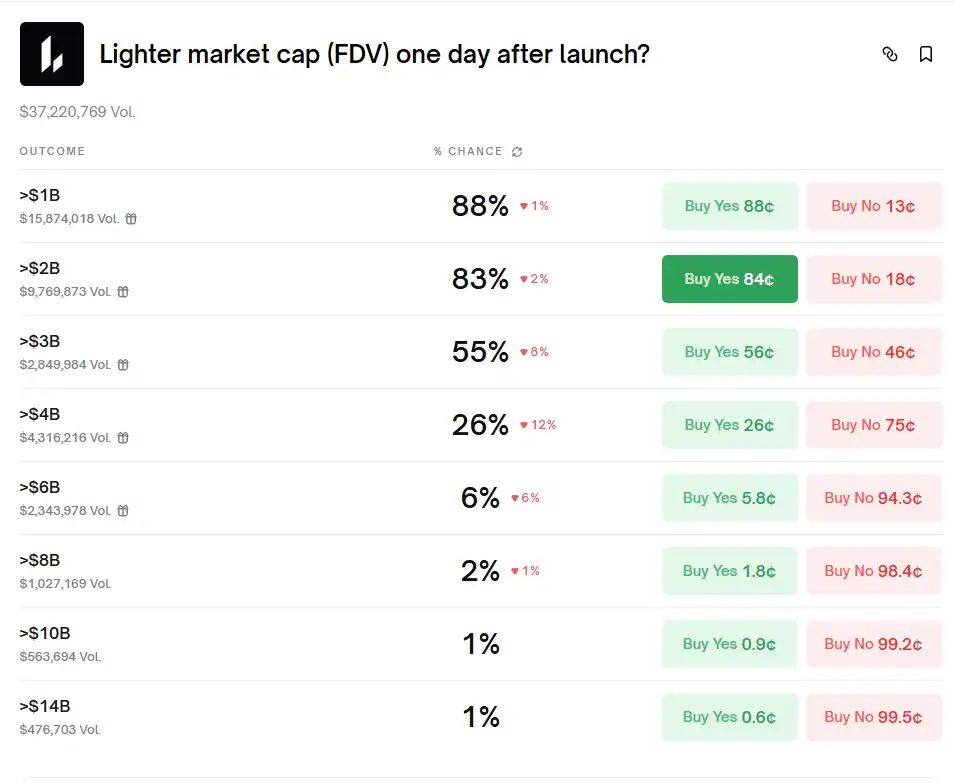
Polymarket event: "Lighter FDV one day after opening"

In summary, the market's minimum expectation for Lighter's opening valuation is around $1.5 billion FDV, corresponding to a token price of $1.5. Therefore, if the opening price experiences a pullback, $1.5 would be an ideal short-term entry price.

Do Not "Open the Champagne at Halftime" – Closely Monitor Official Announcements

Early users who participated in Lighter interactions must not "open the champagne at halftime"; points cannot be considered profit until they are converted into actual LIT tokens. According to the latest announcement from Lighter on their official Discord, "We have entered the final stage of the second season points event. Data analysis is currently underway to remove points obtained by sybil addresses, self-trading, and wash trading. All slashed points (including portions already removed) will be redistributed to the community."

Latest announcement from Lighter on official Discord


Criptomoedas em alta

Perguntas relacionadas

QWhat are the key events that indicate Lighter is approaching its TGE?

AKey events include Coinbase Markets adding Lighter to its listing roadmap on December 13, Lighter's official announcement on Discord for airdrop address registration by December 26, and Binance launching LIT perpetual futures pre-market trading on December 23.

QWhat on-chain activity suggests an airdrop is imminent for Lighter?

AOn December 20, the Lighter token contract transferred 250 million LIT (25% of total supply) to a new address, which then distributed tokens to 20 addresses. This aligns with community speculation of a 25% airdrop allocation.

QWhat is the predicted TGE date range for Lighter based on market signals?

ABased on feedback from a Japanese AMA, the TGE is expected between December 24 and January 1. Polymarket predictions show the highest probability (around 75%) for December 29.

QHow does Lighter's trading volume and TVL compare to competitors in the Perp Dex sector?

AOver the past 30 days, Lighter led the Perp Dex sector with approximately $232.3 billion in perpetual trading volume, ahead of Aster ($195.5B) and Hyperliquid ($182B). Its TVL also surpassed $1.4 billion, exceeding Aster's $1.27 billion.

QWhat are the market's valuation expectations for Lighter at TGE?

AMarket expectations range from a bear case FDV of $1.5 billion ($1.5 per token) to a base case of $3-4.2 billion ($3-4.2 per token) and an optimistic case of $7.5-12.5 billion ($7.5-12.5 per token). Polymarket predicts over $1 billion FDV with 88% probability.

Leituras Relacionadas

L2 'Recalibration': When L1 Becomes Its Own Rollup, What Is Ethereum's Endgame?

The article discusses the evolving relationship between Ethereum's Layer 1 (L1) and Layer 2 (L2) solutions, moving beyond the initial "L2 for scaling" model. As Ethereum L1 itself scales (increasing Gas Limit, statelessness, zkEVM), the unique value proposition of L2s shifts from merely providing cheap execution to offering differentiated features like application-specific optimization, privacy, and flexible governance. The piece explores three key themes: 1. **L2's New Role:** L2s are transitioning from a pure scaling technology to a spectrum of execution environments with varying degrees of security inheritance from Ethereum L1. 2. **Interoperability as State Trust:** Solving L2 fragmentation is less about cross-chain bridges and more about enabling faster, trust-minimized state verification between environments. This involves initiatives like faster L1 finality, intent-based architectures (Open Intents Framework), and native account abstraction. 3. **Blurring Layers:** With the potential integration of zk-proofs into L1 validation (making L1 akin to its own "Rollup") and the concept of "Native Rollups," the rigid boundary between L1 and L2 may fade. The future could be a unified system with multiple execution domains (for DeFi, gaming, privacy, etc.) sharing a common security, settlement, and state framework. In conclusion, Ethereum's goal is not to abandon L2s or re-centralize everything on L1, but to re-integrate the fragmented user experience—liquidity, accounts, applications—while preserving the scaling benefits of a multi-environment ecosystem. The endgame is a cohesive "one chain" feeling for users, powered by diverse but securely interconnected execution layers.

marsbitHá 6m

L2 'Recalibration': When L1 Becomes Its Own Rollup, What Is Ethereum's Endgame?

marsbitHá 6m

The Encryption Bill Clarity's Challenge: A Thorny Path of Bipartisan Compromise in the U.S.

U.S. lawmakers are attempting to advance the Clarity Act, a significant crypto market structure bill, but its path is fraught with partisan hurdles. The process has been rocky since January, when a prior bipartisan deal in the Senate Banking Committee was upended. A key compromise in May on "yield" issues allowed the bill to move forward in committee, but only with the conditional support of two Democratic senators, Angela Alsobrooks and Ruben Gallego. They emphasized that their final vote depends on reaching an agreement on ethics provisions for elected officials. Ultimately, the Senate Agriculture Committee passed its version along party lines without Democratic support. As Republicans push for a full Senate vote in July, the demand for strong ethics language has expanded beyond Democrats. Additional controversies surround provisions related to yields (aligning some Republicans with large banks) and developer protections (opposed by enforcement agencies). Core concerns about illicit finance and consumer protection remain central to the debate. Despite consensus on the need for legislation, achieving the necessary bipartisan compromise is proving difficult. While momentum exists—including recent meetings between senators and White House officials—a reconciled bill text faces skepticism. Senator Gallego has stated that without ethics terms acceptable to Democrats, they will not provide the needed votes. The immediate goals for the crypto community in Congress are unclear: a symbolic Senate vote before the August recess, eventual passage into law by 2026, or forging a final compromise framework. The arduous, vote-by-vote effort to build bipartisan support continues, mirroring the traditional legislative grind the industry must now navigate.

Foresight NewsHá 57m

The Encryption Bill Clarity's Challenge: A Thorny Path of Bipartisan Compromise in the U.S.

Foresight NewsHá 57m

Trading

Spot

Artigos em Destaque

Como comprar O

Bem-vindo à HTX.com!Tornámos a compra de O1 exchange (O) simples e conveniente.Segue o nosso guia passo a passo para iniciar a tua jornada no mundo das criptos.Passo 1: cria a tua conta HTXUtiliza o teu e-mail ou número de telefone para te inscreveres numa conta gratuita na HTX.Desfruta de um processo de inscrição sem complicações e desbloqueia todas as funcionalidades.Obter a minha contaPasso 2: vai para Comprar Cripto e escolhe o teu método de pagamentoCartão de crédito/débito: usa o teu visa ou mastercard para comprar O1 exchange (O) instantaneamente.Saldo: usa os fundos da tua conta HTX para transacionar sem problemas.Terceiros: adicionamos métodos de pagamento populares, como Google Pay e Apple Pay, para aumentar a conveniência.P2P: transaciona diretamente com outros utilizadores na HTX.Mercado de balcão (OTC): oferecemos serviços personalizados e taxas de câmbio competitivas para os traders.Passo 3: armazena teu O1 exchange (O)Depois de comprar o teu O1 exchange (O), armazena-o na tua conta HTX.Alternativamente, podes enviá-lo para outro lugar através de transferência blockchain ou usá-lo para transacionar outras criptomoedas.Passo 4: transaciona O1 exchange (O)Transaciona facilmente O1 exchange (O) no mercado à vista da HTX.Acede simplesmente à tua conta, seleciona o teu par de trading, executa as tuas transações e monitoriza em tempo real.Oferecemos uma experiência de fácil utilização tanto para principiantes como para traders experientes.

167 Visualizações TotaisPublicado em {updateTime}Atualizado em 2026.06.29

Como comprar O

Como comprar PROS

Bem-vindo à HTX.com!Tornámos a compra de Pharos (PROS) simples e conveniente.Segue o nosso guia passo a passo para iniciar a tua jornada no mundo das criptos.Passo 1: cria a tua conta HTXUtiliza o teu e-mail ou número de telefone para te inscreveres numa conta gratuita na HTX.Desfruta de um processo de inscrição sem complicações e desbloqueia todas as funcionalidades.Obter a minha contaPasso 2: vai para Comprar Cripto e escolhe o teu método de pagamentoCartão de crédito/débito: usa o teu visa ou mastercard para comprar Pharos (PROS) instantaneamente.Saldo: usa os fundos da tua conta HTX para transacionar sem problemas.Terceiros: adicionamos métodos de pagamento populares, como Google Pay e Apple Pay, para aumentar a conveniência.P2P: transaciona diretamente com outros utilizadores na HTX.Mercado de balcão (OTC): oferecemos serviços personalizados e taxas de câmbio competitivas para os traders.Passo 3: armazena teu Pharos (PROS)Depois de comprar o teu Pharos (PROS), armazena-o na tua conta HTX.Alternativamente, podes enviá-lo para outro lugar através de transferência blockchain ou usá-lo para transacionar outras criptomoedas.Passo 4: transaciona Pharos (PROS)Transaciona facilmente Pharos (PROS) no mercado à vista da HTX.Acede simplesmente à tua conta, seleciona o teu par de trading, executa as tuas transações e monitoriza em tempo real.Oferecemos uma experiência de fácil utilização tanto para principiantes como para traders experientes.

160 Visualizações TotaisPublicado em {updateTime}Atualizado em 2026.06.29

Como comprar PROS

O que é VERONA

I. Introdução ao Projeto VERONA é uma blockchain construída para todos, em todo o lado, através da abstração da cadeia. Utilizando a sua camada de Abstração Generalizada, a VERONA distingue-se por integrar funcionalidades complexas de blockchain, como contas, assinaturas e interoperabilidade, diretamente ao nível do protocolo. Esta abordagem permite a interação com aplicações de blockchain sem a necessidade de compreender as tecnologias subjacentes.1) Informação Básica Nome: VERONA (VERONA)III. Links Relacionados Link do site oficial: https://xion.burnt.com/ Whitepaper: https://xion.burnt.com/whitepaper.pdf Exploradores: https://explorer.burnt.com/ Mídias Sociais: https://x.com/burnt_xion Nota: A introdução ao projeto provém dos materiais publicados ou fornecidos pela equipa oficial do projeto, que é apenas para referência e não constitui aconselhamento de investimento. A HTX não se responsabiliza por quaisquer perdas diretas ou indiretas resultantes.

778 Visualizações TotaisPublicado em {updateTime}Atualizado em 2026.06.22

O que é VERONA

Discussões

Bem-vindo à Comunidade HTX. Aqui, pode manter-se informado sobre os mais recentes desenvolvimentos da plataforma e obter acesso a análises profissionais de mercado. As opiniões dos utilizadores sobre o preço de A (A) são apresentadas abaixo.

活动图片