Less Than a Year in Office and Leaving Again: Why Are Core Figures of the Ethereum Foundation Departing Once More?

marsbitPublicado em 2026-02-14Última atualização em 2026-02-14

Resumo

Tomasz Stańczak, the co-executive director of the Ethereum Foundation (EF), has announced his resignation, just 11 months after taking the role. He was appointed alongside Hsiao-Wei Wang in March 2025, replacing long-time leader Aya Miyaguchi amid community criticism that EF was too slow and disconnected. Stańczak, founder of core Ethereum client Nethermind, was brought in to make EF more decisive and execution-focused. During his tenure, he streamlined operations, refocused strategy on Layer-1 scaling, accelerated upgrade timelines, and pushed new initiatives in AI integration and privacy. His departure hints at internal tension. In his statement, Stańczak suggested his ability to operate independently within EF diminished as the leadership became more self-sufficient. He expressed a desire to return to hands-on product building, specifically in AI/blockchain convergence, echoing Ethereum’s early experimental spirit. He is replaced by Bastian Aue, a low-profile internal figure focused on "principled" decision-making aligned with "cypherpunk values," signaling a potential shift back towards a coordination-focused rather than execution-driven approach. This leadership change comes at a critical time. EF is preparing to release key proposals on "Lean Ethereum" and future roadmaps, while Ethereum faces intense competition, Layer-2 fragmentation, and market pressure—with its price risk falling below inflation-adjusted 2018 levels.

The Ethereum Foundation (EF) once again finds itself at a crossroads of personnel turmoil.

Tomasz Stańczak, the co-executive director of the Ethereum Foundation, has announced that he will step down at the end of this month. This comes just 11 months after he and Hsiao-Wei Wang jointly succeeded the long-standing leader Aya Miyaguchi in March last year to form a new leadership core.

He will be succeeded by Bastian Aue. There is very little public information about this individual; his X account was registered just eight months ago and has almost no record of posts. He will continue to co-lead this organization, which controls the core resources and direction of the Ethereum ecosystem, alongside Hsiao-Wei Wang.

This seemingly sudden personnel change is actually an inevitable result of the interplay of internal conflicts, external pressures, and strategic transformation within the Ethereum Foundation.

Stepping Up in a Crisis: A Turbulent Year

To understand Stańczak's departure, one must first return to the context of his appointment.

In early 2025, the Ethereum community was in a period of anxiety. At that time, the overall cryptocurrency market was rising after the U.S. election, with Bitcoin repeatedly hitting new highs, and competing chains like Solana gaining strong momentum. However, Ethereum's price performance was relatively weak, and the Ethereum Foundation itself became a target of criticism.

The criticism was directed squarely at then-Executive Director Aya Miyaguchi. The developer community complained that the Foundation was severely disconnected from frontline builders, had conflicting strategic interests, and was insufficiently promoting Ethereum. Some questioned whether the Foundation was too "passive," and in its gentle posture of acting as a "coordinator" rather than a "leader," was letting Ethereum lose its first-mover advantage.

As the "central bank" of Ethereum, the Foundation was being asked not to govern by inaction, but to strike out forcefully.

Amid this storm of public opinion, Miyaguchi stepped back into a board role. Stańczak and Wang were thrust into the spotlight to take charge.

Stańczak was not an outsider. He is the founder of Nethermind, a company that is one of the core execution clients of the Ethereum ecosystem, playing a key role in infrastructure construction. He understands technology, has entrepreneurial experience, and has a firsthand understanding of the community's pain points.

In his own words, the directive he received upon taking office was clear: "The community is calling out—you are too chaotic, you need to be a bit more centralized, a bit faster, to deal with this critical period."

What was done this year?

The combination of Stańczak and Wang did bring visible changes.

First, organizational efficiency. The Foundation laid off 19 employees, streamlined its structure, and attempted to shed its bureaucratic label. The strategic focus shifted from Layer 2 back to Layer 1 itself, with a clear statement prioritizing the scaling of the Ethereum mainnet over letting L2s operate independently. The upgrade pace noticeably accelerated, and the promotion of EIPs became more decisive than before.

Second, an adjustment in posture. The Foundation began publishing series of videos on social media, proactively explaining Ethereum's technical roadmap and development direction to the public. This "outreach" communication style contrasted with its previous relatively closed and mysterious image.

In terms of strategic layout, Stańczak promoted exploration in several new directions: privacy protection,应对量子计算威胁 (responding to quantum computing threats), and the integration of artificial intelligence with Ethereum. Particularly regarding AI, he explicitly stated he saw the trend of "agentic systems" and "AI-assisted discovery" reshaping the world.

Financially, the Foundation began discussing more transparent budget management and fund allocation strategies, attempting to address external doubts about the efficiency of treasury use.

Vitalik Buterin's evaluation of Stańczak was: "He helped greatly improve the efficiency of multiple departments within the Foundation, making the organization more agile in responding to the external world."

Reading Between the Lines of the Resignation Statement

Why leave after less than a year?
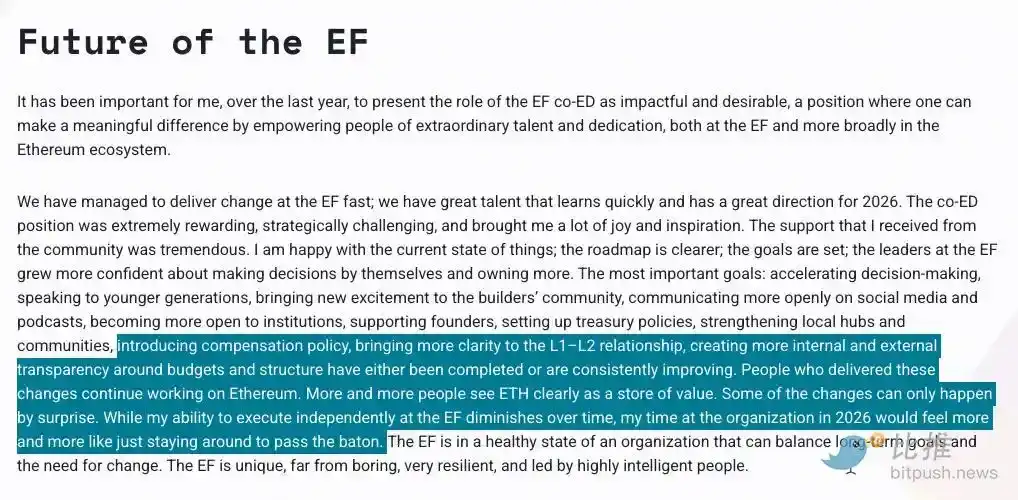
Stańczak's resignation statement was quite candid and somewhat thought-provoking. He provided several key points of information:

First, he believes the Ethereum Foundation and the entire ecosystem are "in a healthy state." The time for handing over the baton has come.

Second, he wants to return to being a "hands-on product builder," focusing on the combination of AI and Ethereum. He said his current mindset is similar to when he founded Nethermind in 2017.

Third, and most intriguingly: "The leadership layer of the Foundation is increasingly confident in making their own decisions and taking control of more matters. Over time, my ability to execute independently within the Foundation has diminished. If I stayed on, in 2026 I would mostly just be 'waiting to hand over the baton.'"

This sentence reveals two layers of meaning: first, the new leadership team has developed self-drive and no longer needs his involvement in everything; second, his actual sphere of influence may have been shrinking. For someone accustomed to getting hands-on and with a strong entrepreneurial temperament, this feeling was clearly not a good fit for him.

He also mentioned, "I know many current ideas about agentic AI might be immature, even useless, but it is this kind of playful experimentation that defined the innovative spirit of early Ethereum."

This statement carries a hint of implicit criticism of the status quo: as the organization becomes more "mature" and decisions become more "stable," will that wild, experimental spirit be lost?

Stańczak's departure,表面上 (on the surface) a personal choice,背后 (behind it) lies the long-standing dilemma faced by the Ethereum Foundation.

Since its inception, this organization has been in an awkward position. Theoretically, Ethereum is decentralized, and the Foundation should not be a command-and-control power center. But in practice, it controls significant funds, core developer resources, and has a coordinating voice in the ecosystem, objectively承担着 (bearing) the dual roles of "central bank" and "economic planning agency."

This identity paradox has long placed the Foundation in a double bind: doing too much draws accusations of centralization; doing too little invites criticism for inaction. The Miyaguchi era leaned towards a "coordinator"定位 (positioning), resulting in criticism of weakness; Stańczak attempted to shift towards an "executor" role, efficiency did improve, but the internal distribution of power within the organization naturally became more concentrated.

Stańczak's resignation statement恰恰暴露了 (precisely exposes) this tension: as the organization became more efficient and decisions more decisive, the personal maneuvering room for founding team members was反而压缩 (instead compressed). For an ecosystem that needs to balance "decentralized spirit" and "market competition efficiency," this internal friction is almost unavoidable.

What kind of person is Bastian Aue, who is replacing Stańczak?

There is extremely little public information. His own description on X is that he was previously responsible for "work that is difficult to quantify but crucial" at the Foundation: assisting management decision-making, communicating with team leaders, budget considerations, strategic梳理 (sorting), priority setting. This low-key style contrasts with Stańczak's distinct entrepreneurial气质 (temperament).

Aue said in his acceptance statement: "My basis for making decisions is a principled insistence on certain properties of what we are building. The mission of the Foundation is to ensure that truly permissionless infrastructure—the core is the cypherpunk spirit—can be built."
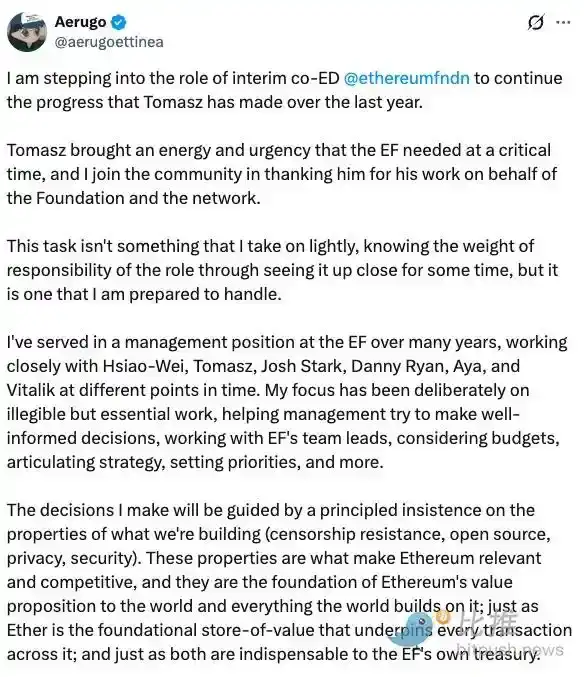
This language sounds more like the style of the Miyaguchi era: emphasizing principles, emphasizing spirit, emphasizing coordination rather than leadership.

Does this mean the Foundation will rebalance its direction, dialing back from "aggressive execution" to "principled coordination"? This remains to be seen.

Ethereum's Confusion

Stańczak's departure comes at a time when Ethereum is discussing a series of major proposals. According to him, the Foundation is about to release several key documents, including specific plans for "Lean Ethereum," the future development roadmap, and DeFi coordination mechanisms.

Among them, the "Lean Ethereum" proposal has been jokingly called "Ethereum's weight loss era" by some community members—intending to simplify the protocol, reduce burdens, and make the mainnet run more efficiently.

These directional documents will profoundly影响 (affect) Ethereum's evolution path in the coming years. Changing the core executive负责人 (person in charge) at this moment undoubtedly adds uncertainty to the implementation of these proposals.

The broader context is that Ethereum is facing challenges from multiple fronts: competition from high-performance chains like Solana, the fragmentation issue with Layer 2s, the new narrative window of AI and blockchain integration, and the impact of overall crypto market sentiment fluctuations on ecosystem funding and attention.

On the same day Stańczak announced his departure, ETH一度跌入 (once fell into) the $1800 range. If it continues to break below this level, an awkward fact will emerge: the comprehensive return on holding ETH may fall below the dollar cash interest rate.

Do the math for a more painful realization: In January 2018, ETH first stood above $1400. That $1400, adjusted for U.S. CPI inflation with compound interest, would be equivalent to approximately $1806 by February 2026.
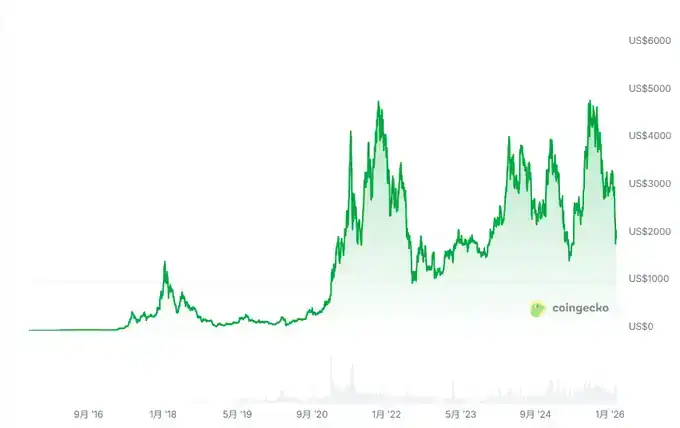
In other words, if an investor bought ETH in 2018 and held it裸持 (naked, meaning without staking) until now, after eight years, they not only made no money but even underperformed U.S. dollars left in a bank earning interest.

For the "Ethereum Guards" (E 卫兵, loyal supporters) who have believed all along, the real拷问 (questioning) might not be "who won the路线之争 (route dispute)," but rather: how much longer can this last?

The only certainty is: this core organization, which controls one of the most important ecosystems in the crypto world, is still searching for its定位 (positioning) in a rapidly changing industry, and this path is注定 (destined) not to be平静 (calm).


Perguntas relacionadas

QWho is leaving the Ethereum Foundation (EF) and after how long in the role?

ATomasz Stańczak, the EF's co-executive director, is leaving after just 11 months in the position.

QWhat were some of the key changes implemented during Tomasz Stańczak's tenure?

AKey changes included organizational streamlining with 19 employees laid off, a strategic refocus on Layer 1 scaling over Layer 2, faster upgrade cycles, more proactive public communication, and exploration of new areas like AI integration and quantum resistance.

QWhat reason did Tomasz Stańczak give for his departure from the Ethereum Foundation?

AHe stated he wanted to return to being a hands-on product builder, focusing on AI and Ethereum. He also implied his ability to execute independently within the foundation was diminishing as the leadership team became more self-sufficient.

QWho is replacing Tomasz Stańczak and what is known about his approach?

ABastian Aue is replacing him. Public information is scarce, but his statements suggest a leadership style that emphasizes principle-based decisions and a focus on 'cryptopunk spirit' and coordination, which contrasts with Stańczak's more execution-focused, entrepreneurial approach.

QWhat broader challenge for Ethereum is highlighted by the ETH price comparison from 2018?

AThe article highlights a significant performance challenge: an ETH bought in January 2018 and held without staking would be worth less in real terms (adjusted for inflation) than if the same amount of USD had been kept in a bank account earning interest, raising questions about long-term value retention for passive holders.

Leituras Relacionadas

Aave Is Surrendering the Throne of DeFi Lending Due to Its Own Stupidity

Aave, a leading DeFi lending protocol, is facing a severe crisis and losing its dominant market position due to its poor handling of a recent security incident. The crisis began when Kelp DAO suffered a hack resulting in a loss of $292 million in rsETH. In the aftermath, approximately $17.2 billion in funds flowed out of Aave as user panic escalated. The article criticizes Aave's crisis management as "extremely foolish." Instead of promptly offering reassurance or committing to cover the potential bad debt—estimated between $123.7 million and $230.1 million, which Aave could have afforded—the protocol initially deflected blame, emphasizing that its code was not at fault. This delay and lack of a clear guarantee led to widespread user anxiety, triggering a bank run-like scenario where users withdrew funds or borrowed aggressively from other pools, causing liquidity shortages. Meanwhile, Aave’s competitor Spark—a fork of Aave’s own code—has benefited significantly. Having removed support for rsETH months earlier, Spark avoided any losses from the incident and has since seen its TVL grow by nearly $2 billion, attracting major deposits such as over $1.24 billion from Justin Sun. Spark has actively capitalized on the situation, publicly criticizing Aave’s security reputation. Although Aave’s founder Stani eventually announced a relief plan named "DeFi United" with several partners and a personal donation, the damage to user trust and capital outflows may be irreversible. The article concludes that Aave is losing its throne in DeFi lending to aggressive competitors like Spark, Morpho, and Jupiter Lend.

Odaily星球日报Há 1h

Aave Is Surrendering the Throne of DeFi Lending Due to Its Own Stupidity

Odaily星球日报Há 1h

Trading

Spot
Futuros

Artigos em Destaque

O que é ETH 2.0

ETH 2.0: Uma Nova Era para o Ethereum Introdução ETH 2.0, amplamente conhecido como Ethereum 2.0, marca uma atualização monumental à blockchain do Ethereum. Esta transição não é meramente uma mudança estética; visa melhorar fundamentalmente a escalabilidade, segurança e sustentabilidade da rede. Com uma mudança do mecanismo de consenso em Proof of Work (PoW), intensivo em energia, para um Proof of Stake (PoS) mais eficiente, o ETH 2.0 promete uma abordagem transformadora ao ecossistema blockchain. O que é ETH 2.0? ETH 2.0 é um conjunto de atualizações distintas e interconectadas focadas na otimização das capacidades e desempenho do Ethereum. Esta reformulação foi projetada para abordar desafios críticos que o mecanismo atual do Ethereum enfrentou, particularmente em relação à velocidade das transações e à congestão da rede. Objetivos do ETH 2.0 Os principais objetivos do ETH 2.0 giram em torno da melhoria de três aspectos centrais: Escalabilidade: Com o objetivo de melhorar significativamente o número de transações que a rede pode manejar por segundo, o ETH 2.0 procura ultrapassar a limitação atual de aproximadamente 15 transações por segundo, alcançando potencialmente milhares. Segurança: Medidas de segurança melhoradas são integrais ao ETH 2.0, especialmente através da resistência aprimorada contra ciberataques e da preservação do ethos descentralizado do Ethereum. Sustentabilidade: O novo mecanismo PoS foi projetado não apenas para melhorar a eficiência, mas também para reduzir drasticamente o consumo de energia, alinhando a estrutura operacional do Ethereum com considerações ambientais. Quem é o Criador do ETH 2.0? A criação do ETH 2.0 pode ser atribuída à Ethereum Foundation. Esta organização sem fins lucrativos, que desempenha um papel crucial no apoio ao desenvolvimento do Ethereum, é liderada pelo co-fundador notável Vitalik Buterin. A sua visão de um Ethereum mais escalável e sustentável tem sido a força motriz por trás desta atualização, envolvendo contribuições de uma comunidade global de desenvolvedores e entusiastas dedicados a melhorar o protocolo. Quem são os Investidores do ETH 2.0? Embora os detalhes sobre os investidores do ETH 2.0 não tenham sido tornados públicos, é sabido que a Ethereum Foundation recebe apoio de várias organizações e indivíduos no espaço da blockchain e tecnologia. Esses parceiros incluem firmas de capital de risco, empresas de tecnologia e organizações filantrópicas que compartilham um interesse mútuo em apoiar o desenvolvimento de tecnologias descentralizadas e infraestrutura de blockchain. Como Funciona o ETH 2.0? ETH 2.0 é notável por introduzir uma série de características chave que o diferenciam do seu predecessor. Proof of Stake (PoS) A transição para um mecanismo de consenso PoS é uma das mudanças de destaque do ETH 2.0. Ao contrário do PoW, que depende da mineração intensiva em energia para a verificação de transações, o PoS permite que os utilizadores validem transações e criem novos blocos de acordo com a quantidade de ETH que apostam na rede. Isso leva a uma maior eficiência energética, reduzindo o consumo em aproximadamente 99,95%, tornando o Ethereum 2.0 uma alternativa consideravelmente mais ecológica. Shard Chains As shard chains são outra inovação crítica do ETH 2.0. Estas cadeias menores operam em paralelo com a cadeia principal do Ethereum, permitindo que várias transações sejam processadas simultaneamente. Esta abordagem melhora a capacidade geral da rede, abordando preocupações de escalabilidade que têm atormentado o Ethereum. Beacon Chain No coração do ETH 2.0 está a Beacon Chain, que coordena a rede e gere o protocolo PoS. Ela atua como uma espécie de organizador: supervisiona os validadores, garante que as shards permaneçam conectadas à rede e monitora a saúde geral do ecossistema blockchain. Linha do Tempo do ETH 2.0 A jornada do ETH 2.0 tem sido marcada por vários marcos chave que traçam a evolução desta atualização significativa: Dezembro de 2020: O lançamento da Beacon Chain marcou a introdução do PoS, preparando o caminho para a migração para o ETH 2.0. Setembro de 2022: A conclusão de “The Merge” representa um momento crucial em que a rede Ethereum fez a transição com sucesso de um quadro PoW para um PoS, anunciando uma nova era para o Ethereum. 2023: O lançamento esperado das shard chains visa melhorar ainda mais a escalabilidade da rede Ethereum, solidificando o ETH 2.0 como uma plataforma robusta para aplicações e serviços descentralizados. Características Chave e Benefícios Escalabilidade Melhorada Uma das vantagens mais significativas do ETH 2.0 é a sua escalabilidade melhorada. A combinação de PoS e shard chains permite que a rede expanda a sua capacidade, permitindo que acomode um volume de transações muito maior em comparação com o sistema legado. Eficiência Energética A implementação do PoS representa um enorme passo em direção à eficiência energética na tecnologia blockchain. Ao reduzir drasticamente o consumo de energia, o ETH 2.0 não só reduz os custos operacionais, mas também se alinha mais estreitamente com os objetivos globais de sustentabilidade. Segurança Aprimorada Os mecanismos atualizados do ETH 2.0 contribuem para uma segurança melhorada em toda a rede. O uso do PoS, juntamente com medidas de controle inovadoras estabelecidas através das shard chains e da Beacon Chain, assegura um maior grau de proteção contra potenciais ameaças. Custos Mais Baixos para os Utilizadores À medida que a escalabilidade melhora, os efeitos sobre os custos de transação também serão evidentes. Aumentada a capacidade e reduzida a congestão, espera-se que isso se traduza em taxas mais baixas para os utilizadores, tornando o Ethereum mais acessível para transações do dia a dia. Conclusão ETH 2.0 marca uma evolução significativa no ecossistema da blockchain do Ethereum. Ao abordar questões fundamentais como a escalabilidade, o consumo de energia, a eficiência das transações e a segurança geral, a importância desta atualização não pode ser subestimada. A transição para o Proof of Stake, a introdução das shard chains e o trabalho fundamental da Beacon Chain são indicativos de um futuro em que o Ethereum pode atender à crescente demanda do mercado descentralizado. Em uma indústria movida pela inovação e progresso, o ETH 2.0 representa um testemunho das capacidades da tecnologia blockchain em pavimentar o caminho para uma economia digital mais sustentável e eficiente.

100 Visualizações TotaisPublicado em {updateTime}Atualizado em 2024.12.03

O que é ETH 2.0

O que é ETH 3.0

ETH3.0 e $eth 3.0: Uma Análise Profunda do Futuro do Ethereum Introdução No ambiente em rápida evolução da criptomoeda e da tecnologia blockchain, o ETH3.0, frequentemente denotado como $eth 3.0, emergiu como um tema de considerável interesse e especulação. O termo abrange dois conceitos principais que merecem esclarecimento: Ethereum 3.0: Esta representa uma potencial atualização futura destinada a aumentar as capacidades da atual blockchain do Ethereum, focando especialmente na melhoria da escalabilidade e desempenho. ETH3.0 Meme Token: Este distinto projeto de criptomoeda procura aproveitar a blockchain do Ethereum na criação de um ecossistema centrado em memes, promovendo o envolvimento na comunidade de criptomoedas. Compreender esses aspectos do ETH3.0 é essencial não apenas para entusiastas de criptomoedas, mas também para aqueles que observam as tendências tecnológicas mais amplas no espaço digital. O que é ETH3.0? Ethereum 3.0 Ethereum 3.0 é promovido como uma atualização proposta para a rede Ethereum já estabelecida, que tem sido a espinha dorsal de muitas aplicações descentralizadas (dApps) e contratos inteligentes desde a sua criação. As melhorias vislumbradas concentram-se principalmente na escalabilidade—integrando tecnologias avançadas como sharding e provas de conhecimento zero (zk-proofs). Essas inovações tecnológicas visam facilitar um número sem precedentes de transações por segundo (TPS), potencialmente alcançando milhões, abordando assim uma das limitações mais significativas enfrentadas pela tecnologia blockchain atual. A melhoria não é meramente técnica, mas também estratégica; visa preparar a rede Ethereum para uma adoção generalizada e utilidade em um futuro marcado por uma maior demanda por soluções descentralizadas. ETH3.0 Meme Token Em contraste com o Ethereum 3.0, o ETH3.0 Meme Token aventura-se por um domínio mais leve e divertido, combinando a cultura dos memes da internet com a dinâmica das criptomoedas. Este projeto permite que os usuários comprem, vendam e negociem memes na blockchain do Ethereum, proporcionando uma plataforma que fomenta o envolvimento da comunidade através da criatividade e interesses compartilhados. O ETH3.0 Meme Token visa demonstrar como a tecnologia blockchain pode interseccionar com a cultura digital, criando casos de uso que são tanto divertidos quanto financeiramente viáveis. Quem é o Criador do ETH3.0? Ethereum 3.0 A iniciativa em direção ao Ethereum 3.0 é impulsionada principalmente por um consórcio de desenvolvedores e pesquisadores dentro da comunidade Ethereum, notavelmente incluindo Justin Drake. Conhecido por suas percepções e contribuições para a evolução do Ethereum, Drake tem sido uma figura proeminente nas discussões sobre a transição do Ethereum para uma nova camada de consenso, referida como “Beam Chain”. Esta abordagem colaborativa ao desenvolvimento significa que o Ethereum 3.0 não é fruto de um único criador, mas sim uma manifestação da engenhosidade coletiva focada no avanço da tecnologia blockchain. ETH3.0 Meme Token Os detalhes sobre o criador do ETH3.0 Meme Token são atualmente indetectáveis. A natureza dos tokens de meme frequentemente leva a uma estrutura mais descentralizada e impulsionada pela comunidade, o que poderia explicar a falta de atribuição específica. Isso alinha-se com a ethos da comunidade de criptomoedas mais ampla, onde a inovação geralmente surge de esforços colaborativos em vez de esforços individuais. Quem são os Investidores do ETH3.0? Ethereum 3.0 O apoio ao Ethereum 3.0 provém principalmente da Fundação Ethereum, juntamente com uma comunidade entusiástica de desenvolvedores e investidores. Esta associação fundacional proporciona um grau significativo de legitimidade e melhora as perspectivas de uma implementação bem-sucedida, uma vez que aproveita a confiança e credibilidade construída ao longo de anos de operações de rede. Em um clima em rápida mudança no mundo das criptomoedas, o apoio da comunidade desempenha um papel crucial no impulso ao desenvolvimento e adoção, posicionando o Ethereum 3.0 como um sério candidato a futuros avanços na blockchain. ETH3.0 Meme Token Embora as fontes atualmente disponíveis não forneçam informações explícitas sobre as fundações ou organizações de investimento que apoiam o ETH3.0 Meme Token, é indicativo do modelo típico de financiamento para tokens de meme, que frequentemente depende de apoio base e engajamento da comunidade. Os investidores em tais projetos costumam consistir em indivíduos motivados pelo potencial de inovação impulsionada pela comunidade e pelo espírito de cooperação encontrado dentro da comunidade cripto. Como Funciona o ETH3.0? Ethereum 3.0 As características distintivas do Ethereum 3.0 residem em sua proposta de implementação de sharding e tecnologia zk-proof. Sharding é um método de partição da blockchain em partes menores e gerenciáveis ou “shards”, que podem processar transações simultaneamente em vez de sequencialmente. Esta descentralização do processamento ajuda a prevenir congestionamentos e garante que a rede permaneça responsiva mesmo sob carga pesada. A tecnologia de prova de conhecimento zero (zk-proof) contribui com outra camada de sofisticação ao permitir a validação de transações sem revelar os dados subjacentes envolvidos. Este aspecto não apenas melhora a privacidade, mas também aumenta a eficiência geral da rede. Há também conversas sobre a incorporação de uma Máquina Virtual Ethereum de conhecimento zero (zkEVM) nesta atualização, amplificando ainda mais as capacidades e utilidade da rede. ETH3.0 Meme Token O ETH3.0 Meme Token distingue-se ao capitalizar sobre a popularidade da cultura dos memes. Estabelece um mercado para que os usuários participem da negociação de memes, não apenas para entretenimento, mas também para potencial ganho econômico. Ao integrar recursos como staking, provisão de liquidez e mecanismos de governança, o projeto fomenta um ambiente que incentiva a interação e participação da comunidade. Ao oferecer uma mistura única de entretenimento e oportunidade econômica, o ETH3.0 Meme Token visa atrair um público diversificado, variando de entusiastas de criptomoedas a conhecedores casuais de memes. Cronologia do ETH3.0 Ethereum 3.0 11 de novembro de 2024: Justin Drake sugere a próxima atualização do ETH 3.0, centrada nas melhorias de escalabilidade. Este anúncio sinaliza o início de discussões formais sobre a futura arquitetura do Ethereum. 12 de novembro de 2024: A proposta antecipada para Ethereum 3.0 deve ser revelada no Devcon em Bangkok, preparando o cenário para um feedback mais amplo da comunidade e potenciais próximos passos no desenvolvimento. ETH3.0 Meme Token 21 de março de 2024: O ETH3.0 Meme Token é oficialmente listado no CoinMarketCap, marcando sua entrada no domínio público das criptomoedas e aumentando a visibilidade de seu ecossistema baseado em memes. Pontos Chave Em conclusão, Ethereum 3.0 representa uma evolução significativa dentro da rede Ethereum, focando em superar limitações quanto à escalabilidade e desempenho através de tecnologias avançadas. As atualizações propostas refletem uma abordagem proativa às futuras demandas e usabilidade. Por outro lado, o ETH3.0 Meme Token encapsula a essência da cultura impulsionada pela comunidade no espaço das criptomoedas, aproveitando a cultura dos memes para criar plataformas envolventes que incentivam a criatividade e participação dos usuários. Compreender os distintos propósitos e funcionalidades do ETH3.0 e $eth 3.0 é fundamental para qualquer pessoa interessada nos desenvolvimentos contínuos dentro do espaço cripto. Com ambas as iniciativas a pavimentar caminhos únicos, elas sublinham coletivamente a natureza dinâmica e multifacetada da inovação em blockchain.

98 Visualizações TotaisPublicado em {updateTime}Atualizado em 2024.12.03

O que é ETH 3.0

Como comprar ETH

Bem-vindo à HTX.com!Tornámos a compra de Ethereum (ETH) simples e conveniente.Segue o nosso guia passo a passo para iniciar a tua jornada no mundo das criptos.Passo 1: cria a tua conta HTXUtiliza o teu e-mail ou número de telefone para te inscreveres numa conta gratuita na HTX.Desfruta de um processo de inscrição sem complicações e desbloqueia todas as funcionalidades.Obter a minha contaPasso 2: vai para Comprar Cripto e escolhe o teu método de pagamentoCartão de crédito/débito: usa o teu visa ou mastercard para comprar Ethereum (ETH) instantaneamente.Saldo: usa os fundos da tua conta HTX para transacionar sem problemas.Terceiros: adicionamos métodos de pagamento populares, como Google Pay e Apple Pay, para aumentar a conveniência.P2P: transaciona diretamente com outros utilizadores na HTX.Mercado de balcão (OTC): oferecemos serviços personalizados e taxas de câmbio competitivas para os traders.Passo 3: armazena teu Ethereum (ETH)Depois de comprar o teu Ethereum (ETH), armazena-o na tua conta HTX.Alternativamente, podes enviá-lo para outro lugar através de transferência blockchain ou usá-lo para transacionar outras criptomoedas.Passo 4: transaciona Ethereum (ETH)Transaciona facilmente Ethereum (ETH) no mercado à vista da HTX.Acede simplesmente à tua conta, seleciona o teu par de trading, executa as tuas transações e monitoriza em tempo real.Oferecemos uma experiência de fácil utilização tanto para principiantes como para traders experientes.

2.9k Visualizações TotaisPublicado em {updateTime}Atualizado em 2025.03.21

Como comprar ETH

Discussões

Bem-vindo à Comunidade HTX. Aqui, pode manter-se informado sobre os mais recentes desenvolvimentos da plataforma e obter acesso a análises profissionais de mercado. As opiniões dos utilizadores sobre o preço de ETH (ETH) são apresentadas abaixo.

活动图片