Large Model Memory Anxiety Solved on a USB Drive?

marsbitPublicado em 2026-07-20Última atualização em 2026-07-20

Resumo

To address the memory and bandwidth challenges of large language model inference, SanDisk and SK Hynix are developing a new technology called High Bandwidth Flash (HBF). This approach adapts the advanced 3D packaging and stacking techniques used for High Bandwidth Memory (HBM) to NAND Flash, which is traditionally seen as slow for compute tasks. The key insight is that while NAND Flash is slow for writes, its read speeds can be significantly enhanced through parallelization. By stacking up to 16 NAND Flash chips, the first-generation HBF aims for capacities up to 512GB and read bandwidths up to 1.6 TB/s, with roadmaps targeting 3.2 TB/s. This positions HBF not as a replacement for HBM, but as a complementary, cost-effective tier in a hierarchical memory system for AI inference. During inference, model weights are largely static and read-intensive, making them suitable for HBF storage. This can alleviate the severe capacity bottleneck of expensive HBM, potentially reducing the number of accelerators needed per server, lowering overall system cost and power consumption. The technology, currently being standardized within the Open Compute Project, signals a shift towards more specialized memory architectures tailored for the specific demands of large-scale AI deployment.

Wait, isn't Flash supposed to be slow? How are SanDisk and SK Hynix using it to feed large models???

The latest publication from IEEE presents a rather counterintuitive new idea: The memory anxiety of large models might be alleviated by the same technology found in USB drives.

That's right, it's NAND Flash.

In many people's minds, Flash's biggest characteristics are being cheap, having large capacity, and retaining data without power. But when it comes to speed, especially for powering large model inference, it doesn't seem like a proper solution.

But now, SanDisk and SK Hynix are promoting a new thing: High Bandwidth Flash, abbreviated HBF.

Its approach is straightforward: apply the advanced packaging and chip stacking methods used in HBM (High Bandwidth Memory) to NAND Flash.

In other words, it's allowing the flash memory originally responsible for storage to also participate in the high-speed data supply for AI inference.
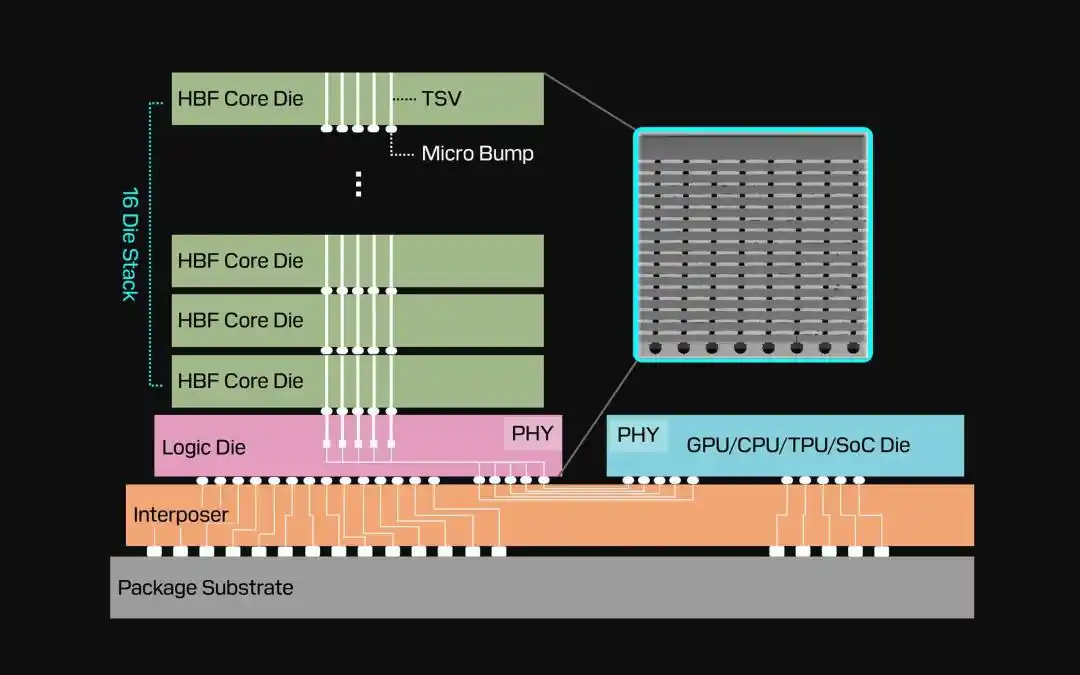
According to SanDisk's public information, HBF is expected to stack up to 16 NAND Flash chips, with a target of up to 512GB capacity per stack and target read bandwidth of up to 1.6TB/s.

In the subsequent second and third-generation roadmaps, read bandwidth will further increase to 2TB/s and 3.2TB/s.

While this number still can't catch up with top-tier HBM, it's no longer in the state of "slow storage" associated with traditional flash memory.

Behind this technological breakthrough might lie the global storage industry's urgent need to resolve supply shortage woes.

Just a few days ago (July 11, Beijing Time), SK Hynix's CEO Koo Joo-sun publicly stated during his debut on the US Nasdaq that the global storage industry is expected to face the most severe supply shortage in history by 2027. This remark quickly ignited capital markets and industry discussions.

Against this backdrop, SK Hynix partnering with SanDisk to launch HBF is perhaps the technical answer they are submitting to alleviate storage supply tension.

Let's take a look.

Isn't Flash Slow? How Can It Be Used for AI?

The question arises: isn't Flash notoriously slow for writes? How can it suddenly be used for AI?

Jim Handy, Director of semiconductor market research firm Objective Analysis, mentioned in an IEEE Spectrum interview, many people's first reaction is also this: how does this make sense? Flash is ridiculously slow.

But the key point is, Flash is slow, mainly in writes.

NAND Flash stores data via charges in floating-gate transistors, organized in blocks and pages. This mechanism allows it to retain data without power, unlike DRAM which requires constant refreshing, thus naturally suitable for long-term storage, combining high density and low cost.

However, the trade-off is that when writing data, charges need to be pushed into or removed from the insulated gate. This process is much slower than charging/discharging a capacitor.

So from a traditional computing perspective, it's hard to discuss Flash at the same table as high-speed memory like DRAM and HBM.

But if you only look at reading, things are different.

According to the latest ONFI 6.0 flash interface standard, a single die's theoretical bandwidth can reach up to 4.8GB/s.

Looking at this number alone, it's indeed not impressive.

But a single DDR5 DIMM can reach up to 70.4GB/s, and a single HBM4E stack can reach 3.6TB/s. Compared to a single NAND flash chip, that's roughly a 750x magnitude difference.

What HBF aims to do is significantly increase total read bandwidth by packaging and vertically stacking multiple NAND Flash dies together using 3D packaging.

Hoshik Kim, Senior Vice President of Memory System Research at SK Hynix, pointed out: "By applying advanced 3D packaging and vertical stacking technologies to NAND flash, HBF can achieve bandwidth far exceeding that of standard NVMe storage."

Just as HBM stacks DRAM chips, HBF builds chips with high storage density by stacking NAND flash dies.

What they want to do is not to suddenly make a single Flash chip faster, but to stack up read channels through stacking and packaging.

HBF Isn't Aiming to Replace HBM; It Has Found Its Niche

The truly interesting thing about HBF isn't that it aims to replace HBM.

It's that it has identified a scenario very suitable for Flash: AI inference.

Training and inference have different memory requirements.

When training a large model, the system constantly needs to read weights, calculate errors, and update weights through backpropagation;

This process requires massive reads and writes, which is very unfriendly to Flash;

Because Flash writes are slow, and heavy writing involves issues like endurance and erase management.

But the inference stage is different.

At this stage, the model is already trained, weights are mostly frozen. Most of the time, the system needs to quickly read out these massive model weights, not frequently rewrite them.

This falls exactly on Flash's relatively strong side.

Kim, SK Hynix's Senior VP of Memory System Research, stated: "In an inference environment, massive, read-intensive data such as static tens-of-billion parameter model weights or precomputed KV cache can be securely stored in the HBF tier."

This way, the expensive and capacity-limited HBM can be freed up to specifically act as a high-speed scratchpad.

This architecture is somewhat like adding a "massive capacity read-only memory pool" for AI.

HBM continues to handle the most urgent, frequent high-speed computing data exchange.

HBF is responsible for holding those massive, rarely changed model parameters.

For current large model inference, this idea is very meaningful.

Because the challenges faced by current large model inference are no longer limited to computing power shortage. Multiple pressures such as insufficient memory, insufficient bandwidth, high energy consumption, and expensive deployment costs are intertwining.

Especially against the backdrop of continuously expanding model sizes, insufficient single-card VRAM capacity and the high cost of HBM are becoming significant constraints on its development.

Often, it's not that the GPU can't compute, but that the model can't fit, or data can't be fed fast enough.

And if HBF can find a balance between capacity, bandwidth, and cost, it may allow larger models to run at a lower cost.

512GB per Stack, AI Servers Might Use Fewer Cards

SanDisk's target parameters for the first-generation HBF are up to 512GB capacity and 1.6TB/s read bandwidth.

This combination is crucial – HBM's advantage is extremely fast speed, but it's expensive and has limited capacity; HBF, while slightly slower, can provide larger capacity and lower unit cost.

This means that when deploying large model inference in the future, AI servers might not necessarily need to stuff all weights into HBM.

Some colder, more static, read-heavy/write-light data can reside in HBF.

The potential benefits of doing this are several:

First, alleviate the HBM capacity bottleneck.

Second, reduce the need to stack more accelerator cards just to fit the model.

Third, lower the overall cost and energy consumption of the inference system.

Kim's assessment is: HBF and HBM are not competitors, but complementary tools.

He pointed out: "HBF can effectively alleviate the severe capacity bottleneck faced by HBM without sacrificing data supply speed, thereby potentially reducing the number of accelerators required to run large-scale models."

On this basis, he expects this solution will also improve energy efficiency and reduce costs, thereby helping data centers further expand their AI inference hardware scale.

This is also the most noteworthy industrial logic of HBF: It's not about turning Flash into HBM, but about letting different data in the AI system reside in positions more suitable for themselves.

Hot data stays in HBM; large-capacity, static, read-intensive data goes to HBF; lower-speed, cheaper data continues to reside in SSD or other storage.

If this hierarchy holds, the memory architecture of AI inference hardware might gain a new tier.

Large-Scale Adoption Still Far Off, but New Signals of Division of Labor in Large Model Memory Systems Emerge

Of course, HBF is not yet a mature product.

According to IEEE Spectrum, HBF will likely need at least another year before possible shipment, with large-scale deployment potentially still years away.

On February 25 this year, SanDisk and SK Hynix jointly held a launch event, announcing the promotion of HBF standardization work under the Open Compute Project (OCP).

As an important open industry organization in the data center hardware field, OCP has led the development of numerous server, rack, power supply, and accelerator specifications, such as the server specification DC-MHS and accelerator specification OAI-OAM.

But currently, the HBF standard is still in progress, with no official release date yet determined – this also means HBF won't immediately change the AI server market in the short term.

It's more like a signal emerging ahead of time: AI inference is forcing a re-division of labor in storage and memory systems.
In the past, the focus of large model hardware was on GPU, HBM, and interconnects.

But as models grow larger and inference requests increase, bottlenecks will expand from "can it compute fast enough" to "can it fit," "can it be read fast enough," and "can the electricity bill be sustained."

HBF is targeting precisely this gap.

The AI Memory War Might Not Belong to HBM Alone

Interestingly, SK Hynix itself is one of the biggest winners in HBM.

HBM is bringing it record revenues. Logically, launching a cheaper alternative technology doesn't seem to align with business intuition.

But from a system perspective, HBF doesn't necessarily take away HBM's market.

What future AI servers need is not a single type of memory, but a tiered memory system.

Let HBM be responsible for ultimate performance, HBF for large-capacity high-bandwidth reads, and SSD for lower-cost large-scale storage.

If this combination succeeds, it would actually make AI inference systems more scalable.

Simply put: Not every piece of model data deserves to live in HBM's "mansion." Some data just needs a location with enough capacity, fast enough reads, and lower cost.

That's the role HBF wants to play.

From NAND Flash in USB drives and SD cards to a high-bandwidth model weight pool in AI servers, the leap sounds large. But the problem with large models is clear: parameters are increasing, inference is becoming more expensive, and HBM supply is tightening.

And the solution might not only come from more expensive memory, but also from repackaging familiar old technology.

Reference links:

[1]https://spectrum.ieee.org/high-bandwidth-flash?itm_source=homepage&itm_medium=hero&itm_campaign=hero-2026-07-15&itm_content=hero6

This article is from the WeChat public account "QbitAI," author: Ge Wenting

Perguntas relacionadas

QWhat is High Bandwidth Flash (HBF) and what problem does it aim to solve in AI systems?

AHigh Bandwidth Flash (HBF) is a new technology being developed by SanDisk and SK hynix. It involves stacking NAND Flash memory dies using advanced 3D packaging techniques to significantly increase total read bandwidth. HBF aims to address the memory capacity and cost bottleneck in large model AI inference. By providing a high-capacity, cost-effective, read-intensive memory pool, it can offload static, large-scale model parameters (like weights and KV caches) from the more expensive and capacity-limited High Bandwidth Memory (HBM), allowing HBM to focus on high-speed computational data exchange.

QWhy is NAND Flash, traditionally considered slow, being considered for AI inference workloads?

AWhile NAND Flash is notoriously slow for write operations, its read performance is considerably better. AI inference is primarily a read-intensive process where the trained model weights are mostly static and require fast retrieval, not frequent updates. This characteristic makes Flash's read capability suitable for this phase. HBF technology amplifies this by stacking multiple Flash dies to achieve much higher aggregate read bandwidth, making it viable for supplying data to AI accelerators during inference.

QHow does HBF compare to HBM in terms of performance and role in an AI system?

AHBF is not intended to replace HBM. HBM remains the fastest memory technology, with current (HBM4E) targets reaching 3.6 TB/s per stack, and is essential for the highest-speed data exchange in AI computation. HBF, with initial targets of 1.6 TB/s read bandwidth and 512GB capacity per stack, is slower but offers much larger capacity at a lower cost. Their roles are complementary: HBM acts as the high-speed scratchpad for active computation, while HBF serves as a high-capacity, high-bandwidth read pool for large, static datasets like model weights, thus alleviating HBM's capacity bottleneck.

QWhat are the potential benefits of using HBF in AI servers for large model inference?

AIntegrating HBF into AI servers for inference offers several potential benefits: 1) It alleviates the severe capacity limitations of HBM. 2) It can reduce the number of expensive accelerator cards needed just to hold a large model's parameters in memory. 3) It lowers the overall system cost and power consumption for running large-scale AI inference. Essentially, it allows for running larger models more cost-effectively by creating a more efficient, tiered memory hierarchy.

QWhat is the current development status and timeline for HBF technology?

AHBF is currently in the development and standardization phase. SanDisk and SK hynix have initiated efforts to standardize HBF within the Open Compute Project (OCP). According to the IEEE Spectrum report, the technology is at least a year away from potential sample shipments, and widespread deployment in AI servers is likely several years away. The final standard release date has not been set, indicating it is not an immediate market solution but a signal of evolving memory architecture for AI.

Leituras Relacionadas

Base Under Pressure

**Title: The Pressure Mounts for Base** Base, the Ethereum Layer 2 scaling solution backed by Coinbase, is facing significant pressure and public scrutiny from its leadership following the launch of Robinhood Chain. Base co-founder Jesse Pollak recently acknowledged strategic missteps, admitting that the chain's past focus on social and creator tokens (e.g., through Farcaster, Zora) failed to deliver sustainable adoption. He has refocused on core infrastructure, handing leadership of the Base App back to Coinbase's Cobie. While Base remains a top L2 contender alongside OP Mainnet and Arbitrum, and boasts the highest TVL (nearly $12B), its weaknesses are being highlighted by the new competitor. Key criticisms include its slow progress on decentralization. Base has faced issues with its single sequencer causing block production halts, and L2BEAT is reportedly considering downgrading its decentralization rating from Stage 1 to Stage 0. This contrasts sharply with the rapid initial success of Robinhood Chain, whose DEX quickly entered the top five by volume. The leadership styles of the parent companies are also being compared: Robinhood's CEO actively engages with new projects, while a recent incident where Coinbase's Brian Armstrong briefly changed his profile picture—sparking and then crashing a related meme token—drew community ire and mockery. Pollak stated Base is working with Coinbase on tokenized stocks backed 1:1 by real equity, differentiating it from Robinhood's derivatives model. However, the article argues that Base's most urgent task is to address its long-standing technical and trust issues. With more traditional finance players likely to emulate Robinhood's path, Base must use this competitive pressure to solidify its position as long-term financial infrastructure.

Foresight NewsHá 9m

Base Under Pressure

Foresight NewsHá 9m

White House Concession Removes Ethical Hurdle, Clarity Act Races Against Final Window Before Recess?

On July 21st, industry sources reported that the Trump administration has agreed to include an ethics provision in the "Clarity Act" (Digital Asset Market Clarity Act of 2025). This concession addresses the long-standing conflict-of-interest concerns regarding government officials and the crypto industry, potentially removing the final major obstacle to the bill's progress. Additionally, Patrick Witt, the executive director of the White House's Digital Asset Advisory Committee, confirmed he will remain in his role to help finalize the bill, alleviating previous concerns about his potential departure. The Clarity Act aims to establish a unified federal regulatory framework for the U.S. digital asset market. Its core objective is to resolve regulatory ambiguity by defining different types of digital assets (digital commodities, investment contract assets, and permitted payment stablecoins) and clarifying the respective oversight roles of the SEC and CFTC. This would end the long-running jurisdictional dispute between the two agencies and provide clearer compliance paths for the industry. With the ethics issue moving toward resolution, the most urgent challenge now is time. The U.S. Congress is set to begin its August recess in mid-August, leaving only a few working weeks to finalize the text and advance the bill through the Senate. Industry advocates, like the Blockchain Association's Kristin Smith, stress that this is a critical moment. If negotiations conclude successfully in the coming weeks, the Clarity Act could pass a key hurdle before the recess; otherwise, it may face significant delays. If enacted, the Clarity Act could mark a historic turning point in crypto regulation. By providing a clearer and more predictable legal framework, it aims to reduce uncertainty for businesses, developers, and traditional financial institutions looking to enter the digital asset space, potentially setting a global benchmark for market structure regulation.

Odaily星球日报Há 15m

White House Concession Removes Ethical Hurdle, Clarity Act Races Against Final Window Before Recess?

Odaily星球日报Há 15m

AI Era, Industrial Revolution, and Future Civilization Interview — Zhang Dingwen: The Future Does Not Belong to Chasers

"AI Era, Industrial Revolution and Future Civilization: An Interview with Zhang Dingwen – The Future Does Not Belong to Those Who Chase" In this interview, entrepreneur Zhang Dingwen reflects on his entrepreneurial journey and philosophy, moving beyond discussions of financing or success to emphasize understanding the "era" itself. He argues that true entrepreneurs should not chase short-term trends ("winds"), but position themselves in the direction of long-term technological and societal evolution. Zhang shares key lessons from his early days, including the realization that user value does not automatically translate to commercial value. For him, the core of entrepreneurship is not building a company but constantly upgrading one's own "cognition" – the ability to interpret information, ask the right questions, and understand the underlying "causes" behind business outcomes, not just the effects. His thinking has evolved from a focus on creating good products to a strategic focus on building "entrances" – platforms that naturally connect users to digital services. He sees smart wearables, like watches, not merely as hardware but as potential future gateways combining technological, financial, social, and even fashion attributes to create sustained user relationships and ecosystems. Ultimately, Zhang's vision transcends individual products or companies. He discusses business competition in three stages: product, platform, and finally, "civilization" – where the greatest companies influence how society operates by defining new rules and ways of life. He believes the mission of a truly great enterprise is to solve problems of its time, build enduring trust, and contribute lasting value, leaving behind not just wealth but a positive impact on how the world works. The future, he concludes, belongs not to the fastest, but to those with the correct long-term direction and a commitment to continuous learning and evolution.

marsbitHá 26m

AI Era, Industrial Revolution, and Future Civilization Interview — Zhang Dingwen: The Future Does Not Belong to Chasers

marsbitHá 26m

Cryptocurrency & Stock Market Barometer丨Strategy Cash Reserves Increase to $3.23 Billion, Halting BTC Purchases; Vanguard and Other Asset Managers Increase Holdings in Strategy Stock (July 21)

Market Overview & Warnings: The article warns of high volatility in South Korean stocks and continued dependence on U.S. stocks on geopolitics. Chinese A-shares remain under pressure. It advises against using leverage in current equity markets. For crypto-linked stocks, most have limited growth except Robinhood, with caution advised. U.S. Stock Market: Bearish bets on U.S. stocks, particularly targeting AI-related companies, have reached record highs since 2010, signaling deep skepticism about the sustainability of the AI-driven rally. Tech and chip stocks led a market decline, with the Philadelphia Semiconductor Index potentially entering a bear market. Increased expectations for Federal Reserve interest rate hikes and geopolitical tensions contributed to the negative sentiment. Bitcoin Treasury Company Updates: * Strategy: Increased its cash reserves to $3.23 billion and paused Bitcoin purchases. Several major asset managers, including Vanguard Group and Capital Group, increased their holdings of Strategy (MSTR) stock. * Global corporate Bitcoin buying slowed significantly to just $1.33 million last week. * Other notable activity: Strive purchased 21 BTC; ORANGE JUICE raised $40 million for Bitcoin acquisitions; Bitcoin Japan Corp. raised $60 million, allocating $4.08 million for its first BTC purchase. Other Crypto Treasury Holdings: * Ethereum: BitMine increased its ETH holdings to 5.78 million, nearing its 5% of supply goal. Its total crypto assets, cash, and securities are valued at $11.5 billion. * Solana: No significant corporate treasury activity reported. * Altcoins: HypeStrat made no adjustments to its treasury; its mNAV ratio fell to a long-term low. (Note: This summary is for informational purposes only and does not constitute investment advice.)

marsbitHá 27m

Cryptocurrency & Stock Market Barometer丨Strategy Cash Reserves Increase to $3.23 Billion, Halting BTC Purchases; Vanguard and Other Asset Managers Increase Holdings in Strategy Stock (July 21)

marsbitHá 27m

Trading

Spot
活动图片