Kospi Index Drops Below 5,600 Mark Amid Record-Breaking Double Trigger of Circuit Breaker, While Bitcoin Price Surpasses $64,000

cryptonews.ruPublicado em 2026-07-29Última atualização em 2026-07-29

Resumo

South Korea's stock market experienced unprecedented volatility as both the Kospi and Kosdaq indices triggered circuit breakers for two consecutive days. The Kospi plunged over 8% on Wednesday, falling below 5,600 points, following an over 8% drop the previous day. This historic dual halt was primarily driven by massive sell-offs in heavyweight semiconductor stocks like Samsung Electronics and SK Hynix. The selling pressure persisted despite SK Hynix reporting a 557% surge in quarterly profit, as the results failed to meet inflated market expectations fueled by AI-driven demand, highlighting a disconnect between stock valuations and fundamentals. In contrast, Bitcoin diverged from the equity market downturn. After initially dipping to around $63,000 amid the Kospi's fall and broader macroeconomic concerns, it rebounded to surpass $64,400 within 24 hours, even as South Korea's second circuit breaker was triggered. This marks a second instance in a week where Bitcoin held ground during an AI-related stock sell-off, suggesting its previously tight correlation with semiconductor and tech stocks may be weakening. Analysts note the relationship is complex and driven by shared investor bases rather than direct causality. The ongoing pressure on chip stocks, which dominate the Kospi index, raises the risk of further market halts before stability can return.

The Korea Exchange halted trading on both the Kospi and the smaller Kosdaq indices for 20 minutes — a mechanism that automatically freezes the entire market for a fixed period once an index falls by a set percentage in a single trading session. The first to trigger the trading halt was the Kosdaq: at 12:19 local time, the index fell by 56.85 points, or 8.05%, to 649.00. Thirteen minutes later, the Kospi followed, dropping 491.33 points, or 8.15%, from Tuesday's closing level (6,023.66), reaching 5,532.33 at 12:32.

This marked the first time in the history of the Korean market that an index triggered the circuit breaker mechanism for two consecutive trading days. This collapse followed the eighth circuit breaker activation of the year on Tuesday, when the Kospi plummeted 8.02% intraday and closed down 10.8% after news broke that a Chinese company had begun mass production of its own deep ultraviolet (DUV) lithography equipment, threatening the dominant position of Samsung Electronics and SK Hynix in the memory chip export market.

Local media attributed Wednesday's continued sell-off to the persistent weakness in shares of major semiconductor manufacturers, active selling by foreign investors, and ongoing concerns about supply and demand pressure from leveraged single-stock exchange-traded funds (ETFs), whose volumes surged sharply earlier this year.

Earnings Beat That Wasn't Enough

The sell-off intensified even as SK Hynix reported record profits. The chipmaker's shares plunged sharply on Wednesday despite a 557% surge in quarterly profit — a result that still failed to meet the elevated expectations investors on Wall Street and in Seoul had built for the stock after months of AI-driven demand for memory chips.
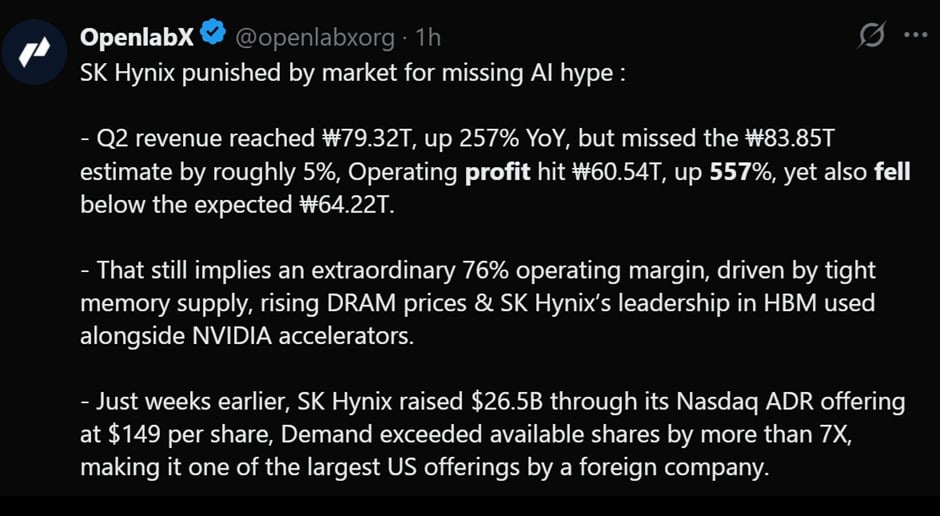
This mismatch once again highlighted how far ahead of fundamentals valuations for semiconductor stocks across Asia have run, leaving little room for the market to be satisfied unless results are simply spectacular.

Bitcoin Bucks the Trend

On Tuesday, bitcoin closely tracked the sell-off in the Korean market, falling roughly 2.7% to around $63,000, as the initial Kospi drop coincided with rising odds of a Federal Reserve rate hike and the delayed passage of the CLARITY Act, contributing to a wave of cryptocurrency liquidations. Subsequently, over the past 24 hours, the asset has climbed above $64,400, even as South Korea triggered its second consecutive 'circuit breaker'.
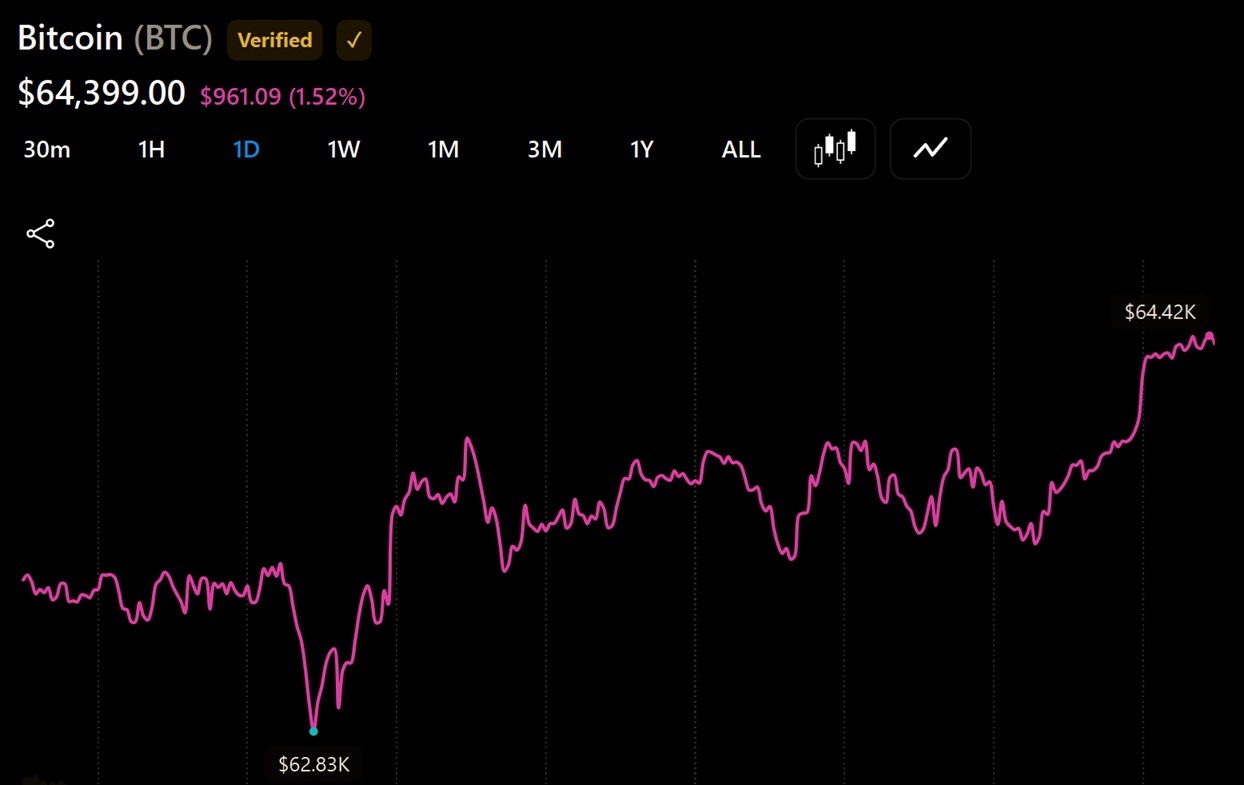
Meanwhile, Senate Majority Leader John Thune made it clear that the CLARITY Act bill would not pass the chamber before the August recess, after which the price recovered along with the broader crypto market.

Wednesday marked the second time in a week that the cryptocurrency held its ground amid a sharp sell-off in AI-related stocks — a trend suggesting the tight correlation bitcoin had with semiconductor and AI company stocks may be weakening. Analysts typically describe the link between KOSPI swings and bitcoin's movements as a correlation driven by a common investor base rather than a causal one — and the divergence seen on Wednesday complicates that picture without providing a complete answer.

Samsung Electronics and SK Hynix remain the two stocks with the highest weighting in the index, meaning another leg down in chipmaker shares could easily trigger another circuit breaker before Korean markets get a chance to stabilize.

end-content

Perguntas relacionadas

QWhat triggered the consecutive trading halts in the Korean stock market, and which indexes were involved?

AThe Korean stock exchange triggered a circuit breaker mechanism for the second consecutive day, halting trading for 20 minutes on both the Kospi and Kosdaq indexes. This occurs when an index falls by a set percentage in a single session. First, the Kosdaq fell 8.05% at 12:19 local time. Thirteen minutes later, the Kospi fell 8.15% from Tuesday's close.

QWhat was the main reason cited for the initial sharp sell-off in the Kospi index on Tuesday?

AThe initial sharp sell-off on Tuesday, where Kospi fell 8.02% intraday, was triggered by news that a Chinese company had begun mass production of its own deep ultraviolet (DUV) lithography equipment, threatening the dominant market position of Samsung Electronics and SK Hynix in memory chip exports.

QWhy did SK Hynix's stock price fall sharply despite reporting a 557% quarterly profit increase?

ASK Hynix's stock price fell sharply because the record 557% quarterly profit increase still failed to meet the exceedingly high expectations investors from Wall Street and Seoul had built up after months of AI-driven demand for memory chips.

QHow did Bitcoin's price action differ from the Korean stock market's performance on Wednesday?

AWhile the Korean stock market experienced a second consecutive day of severe sell-offs triggering circuit breakers, Bitcoin's price recovered, rising above $64,400 in the last 24 hours. This divergence suggests its tight correlation with semiconductor and AI-related stocks may be weakening.

QWhat factor contributed to Bitcoin's recovery mentioned in the article, separate from the Korean market events?

ABitcoin's recovery was partly attributed to comments from Senate Majority Leader John Thune, who indicated the CLARITY Act bill would not pass the House before the August recess. This eased regulatory concerns and supported a broader cryptocurrency market recovery.

Leituras Relacionadas

Bitwise Names Three Mistakes Investors Make When Assessing the Cryptocurrency Market

Bitwise's chief investment officer, Matt Hougan, identifies three common mistakes investors make when evaluating the cryptocurrency market, all stemming from a disconnect between its current perception and potential evolution. First, investors often view crypto applications like Uniswap or Aave solely through the lens of the $2 trillion crypto market. However, with the tokenization of traditional assets (like $150 trillion in equities and $350 trillion in bonds), the potential market for these platforms could become 100 times larger. Second, there's an underestimation of crypto-native companies. Despite entry by major financial firms (e.g., PayPal in stablecoins, Fidelity in custody), native players like Tether, Circle, and Coinbase retain dominant market shares due to speed, focus, and established user bases (though exceptions like BlackRock's Bitcoin ETF success exist). Third, future blockchain transaction volumes are underestimated. Tokenized securities could trade 24/7, not just 33 hours per week, and the rise of AI agents managing portfolios could increase transaction activity by 50-100 times. Hougan concludes that investors assess the sector based on its present state while the underlying infrastructure is rapidly changing through tokenization, expanding use cases, and increased operational scale. This gap between current perception and future potential creates significant investment opportunities.

cryptonews.ruHá 3m

Bitwise Names Three Mistakes Investors Make When Assessing the Cryptocurrency Market

cryptonews.ruHá 3m

Grayscale Submits Fourth Amendment to Agreement for Zcash Trust, Whose Shares Will Be Listed on the NYSE Arca

Grayscale has submitted a fourth amendment to its S-3 registration form for the Grayscale Zcash Trust, a key step toward converting it into a U.S. exchange-traded fund (ETF) listed on NYSE Arca under the ticker ZCSH. This would be the first U.S. ETF providing regulated stock market access to the privacy-focused cryptocurrency ZEC ($ZEC). The amendment details the creation and redemption of shares, primarily through cash, though authorized participants can create shares in-kind by depositing ZEC. The trust is sponsored by Grayscale Investments, with Coinbase as the prime broker and custodian, and Bank of New York Mellon as administrator. The filing also notes non-binding discussions where Digital Currency Group's DCG International Investments could acquire shares by contributing 200,000 ZEC. A ZEC ETF is seen as a breakthrough due to regulatory caution around privacy-enhancing tokens. Following the filing, ZEC's price rose over 9% in 24 hours. Demand for the existing trust product has grown, with its average daily trading volume doubling from March to April, and shielded ZEC balances reaching a record ~30% of the circulating supply. Despite this momentum, Zcash has faced challenges in 2026, including a vulnerability discovered in its shielded Orchard pool that briefly caused its price to drop significantly. Developers quickly patched the issue. A regulated ETF would offer traditional investors exposure to this dual-faceted privacy asset.

cryptonews.ruHá 3m

Grayscale Submits Fourth Amendment to Agreement for Zcash Trust, Whose Shares Will Be Listed on the NYSE Arca

cryptonews.ruHá 3m

Pro-Cryptocurrency PAC Wins Primaries but Loses $2M Race in Florida

A pro-cryptocurrency political action committee (PAC), Fairshake, achieved mixed results in recent U.S. primary elections, spending millions to influence races ahead of the 2026 midterms. Fairshake's affiliated PACs, Protect Progress and Defend American Jobs, supported candidates in Alaska, Florida, and Wyoming, spending approximately $3.6 million. Four out of five candidates backed by their ads won their primaries or advanced. These included Democrat Lois Frankel in Florida, Republican Nick Begich in Alaska, Republican Sydney Gruters in Florida, and Representative Harriet Hageman in Wyoming's Senate race. However, a high-profile $2 million negative ad campaign by Protect Progress failed to defeat Democrat Oliver Gilbert in Florida's 24th District. Gilbert won despite the ads, which he attributed to "Trump's techie-billionaire friends" and "crypto-scammers trying to buy a Democratic primary." A PAC representative defended the ads' factual accuracy. Fairshake, with a reported $193 million war chest, has spent over $130 million in the 2024 cycle supporting pro-crypto candidates and opposing critics. A spokesperson stated the PAC is "just getting started" to build the largest pro-crypto Congress in history. The outcomes could impact future crypto legislation, such as the pending CLARITY Act, as the 2026 elections may shift congressional control and determine which parties advance or block industry-related bills.

cryptonews.ruHá 6m

Pro-Cryptocurrency PAC Wins Primaries but Loses $2M Race in Florida

cryptonews.ruHá 6m

Trading

Spot
活动图片