Korean Stock Market Crashes, Are Koreans Rushing into Crypto Again? This Project Team Got Slammed...

比推Publicado em 2026-03-05Última atualização em 2026-03-05

Resumo

Amid a significant downturn in the South Korean stock market, there is growing discussion about Korean retail investors shifting heavily into cryptocurrency as an alternative. Observers note that Koreans have a strong cultural tendency toward leverage and speculative investment, which may be driving renewed interest in crypto assets like Bitcoin, seen as a potential safe haven during economic instability. Bitcoin’s price recovery and increased institutional buying are also highlighted, with price targets such as $87,000 and even $100,000 being discussed. Some attribute Bitcoin’s strength to its perceived reliability during times of geopolitical tension. Additionally, former U.S. President Donald Trump is mentioned as pushing for clearer cryptocurrency regulation, which could bring more certainty to the market—though some express skepticism about his motives. The article also covers controversy around the project "Opinion" on the BSC chain, which has drawn criticism for its handling of user rewards and airdrops, leading to broader discussions about the sustainability of airdrop models and the need for genuine user engagement rather than speculative farming. The content is compiled from social media platforms and does not constitute investment advice.

Hello dear readers~

What were the crypto KOLs talking about in the past 24 hours?

Note: The following content is compiled from the X platform and represents personal opinions. It does not represent the stance of this platform and certainly does not constitute investment advice.

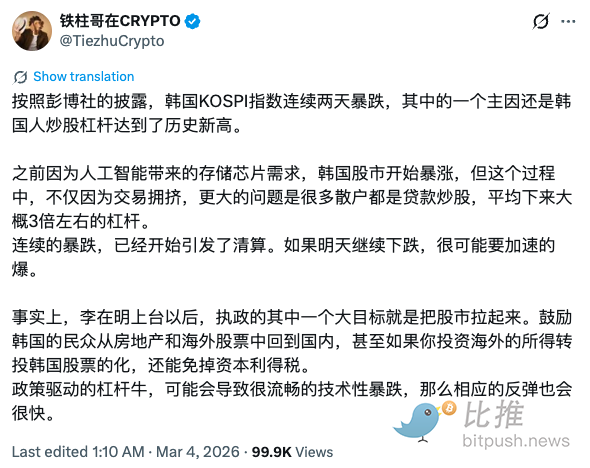
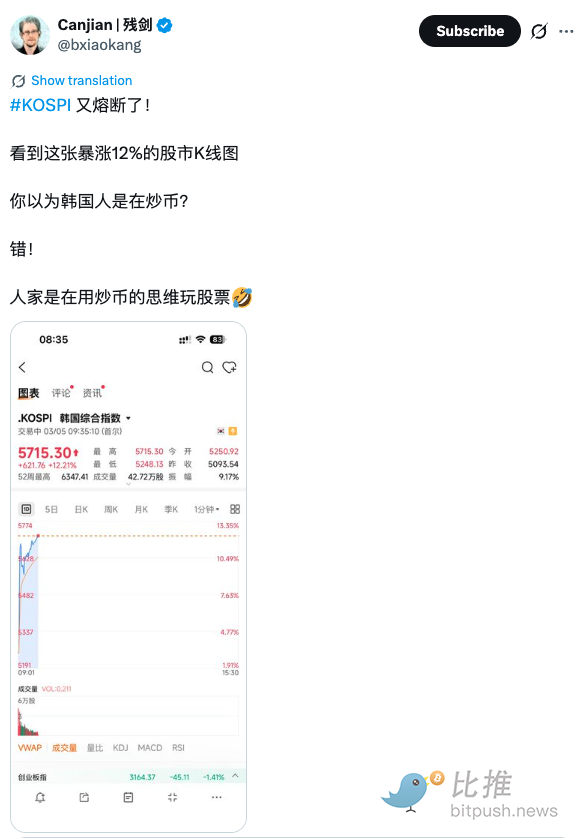
Koreans' Love for Leverage is in Their DNA

Popular Replies:

Koreans' love for leverage is in their DNA. The stock market crashes, the crypto market picks up the slack.

Addicted to gambling. Koreans' speculative nature is number one in Asia.

South Korea's household debt level has always been high. The impact of the past few major deleveraging operations has been very significant.

This wave of Korean Won depreciation + stock market爆仓 (liquidation), BTC's safe-haven属性 (attribute) has been verified again, Koreans are rushing in.

Koreans should already be on their way, Upbit trading volume is about to explode, right?

FOMO indiscriminately, classic Korean retail investor style.

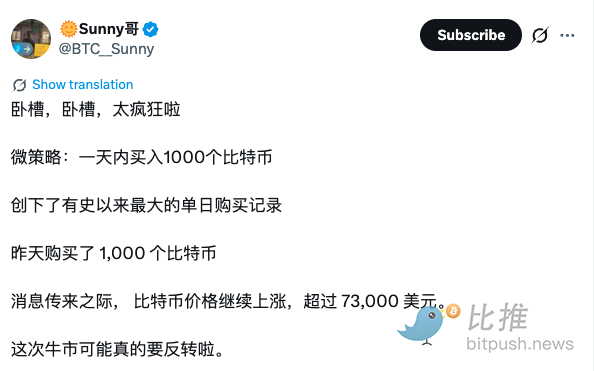
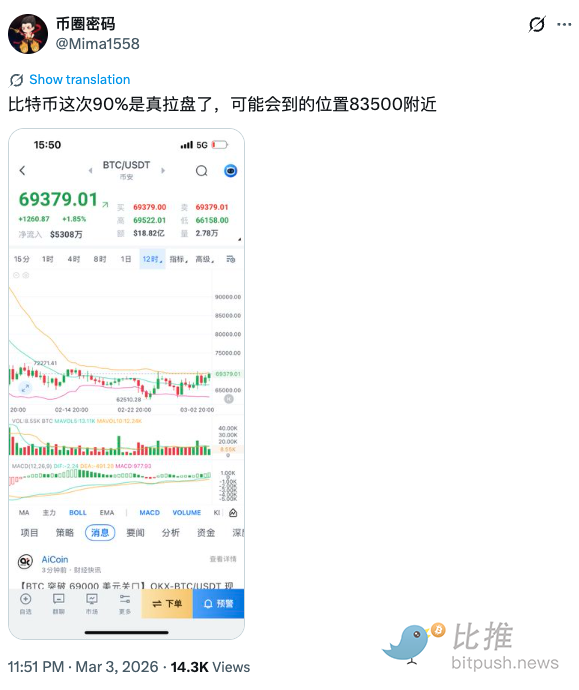
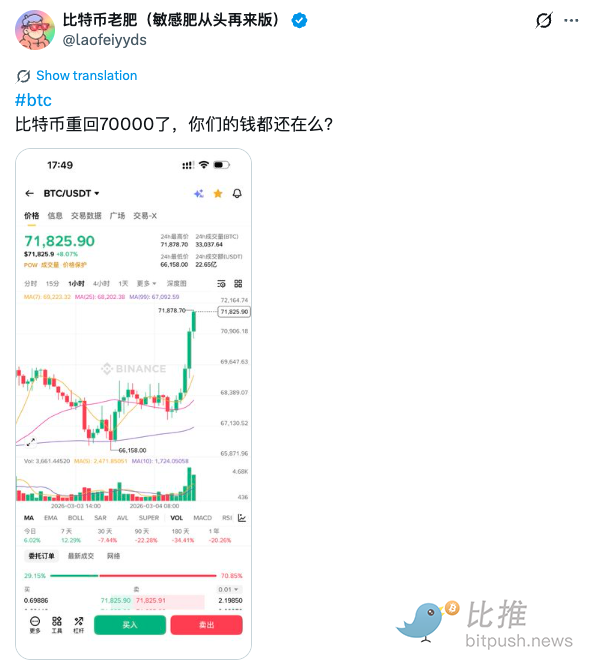
BTC Price Rebounds, Institutions Buying
Popular Replies:

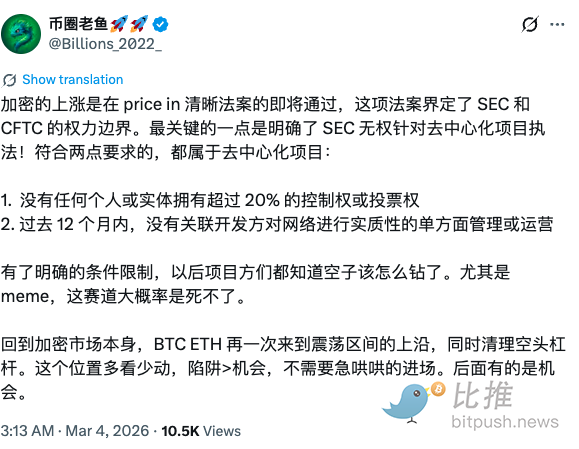
71000—78000—87000, these are all key points if it rallies.

First break 73500, if that happens, next is 83300.

Money in, people in, target $100k,绝对不提前下车 (absolutely not getting off early this time)!

War has made people understand that Bitcoin is reliable.

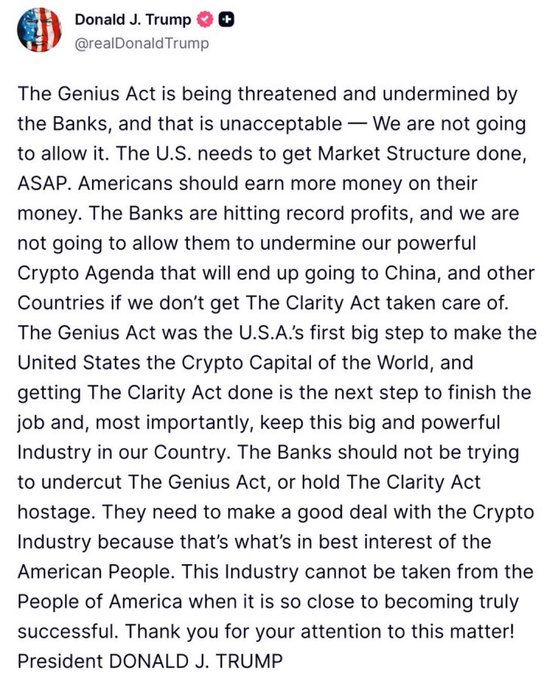
Trump Personally Pushing Crypto Bill!

Popular Replies:

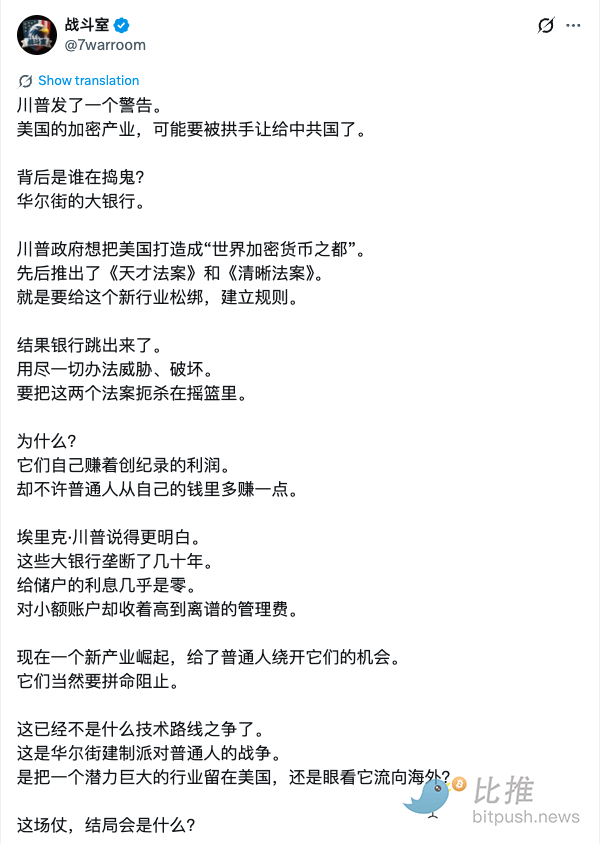
If a clear bill isn't pushed forward, the market might徘徊 (linger) for a long time again. The crypto industry is actually welcoming the most friendly president now. If it's not pushed during Trump's term, there's a high probability of getting beaten up again later.

Feels like Trump's tweet means the talks broke down, seems like a negative?

不会是缺军费,再来收割一波把? (Could it be lacking military funds, coming to harvest another wave?)

Opinion Controversy

Popular Replies:

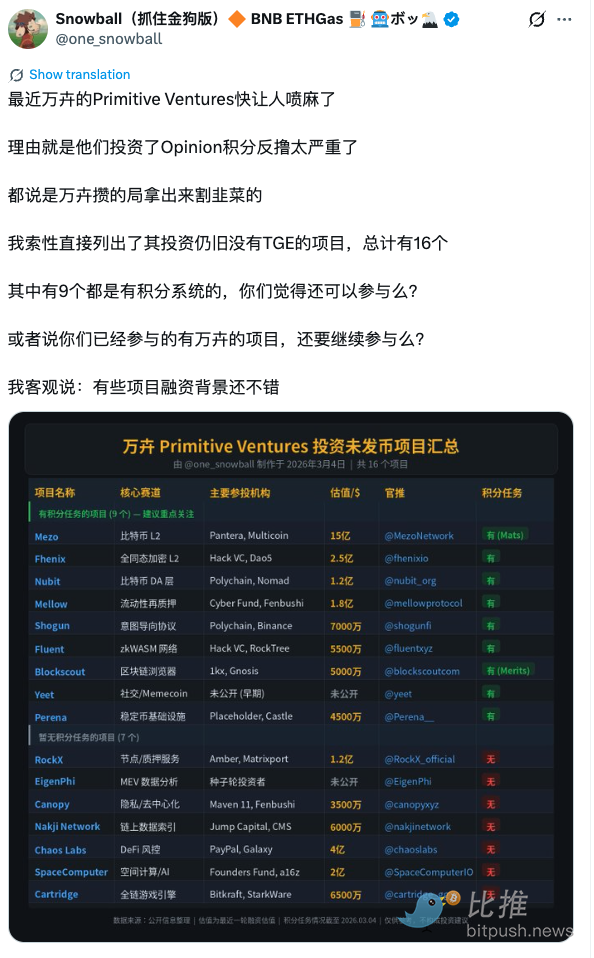
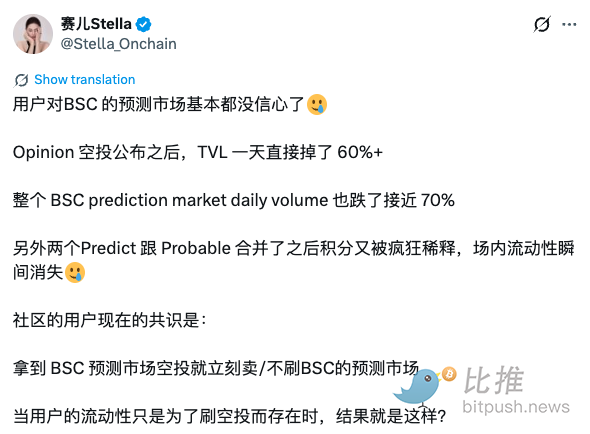
Opinion ruined the prediction track on BSC, who dares to touch BNB Chain prediction projects in the future;

Learn from River, they compensated for二级 (secondary market) losses, Opinion directly反撸 (screwed people over);

I actually think there's no need to骂 (curse) the investment institutions:

  1. These were all the project's decisions

  2. Couldn't get on bn without前期数据 (early data)

  3. Tokens given out were basically picked up by the secondary market, no one is picking them up now

  4. The logic of airdrops has changed, those bringing data without real cash flow will be淘汰 (eliminated), and no one will use them either

  5. The farming era has ended, what's next is real payment for tokens


Twitter:https://twitter.com/BitpushNewsCN

Bitpush TG Discussion Group:https://t.me/BitPushCommunity

Bitpush TG Subscription: https://t.me/bitpush

Original article link:https://www.bitpush.news/articles/7616877

Perguntas relacionadas

QWhat is the main reason discussed in the article for Koreans turning to the cryptocurrency market?

AThe article suggests that Koreans are turning to the cryptocurrency market as a safe haven after the Korean stock market crash, leveraging their inherent tendency for high-risk investments and speculation.

QHow did the community react to the Opinion project mentioned in the article?

AThe community criticized the Opinion project for mismanaging the BSC prediction track, accusing it of exploiting users without compensation, unlike other projects that offered reimbursements for losses.

QWhat role is former President Trump playing in the cryptocurrency space according to the article?

AThe article states that former President Trump is personally advancing cryptocurrency legislation, which is seen as a positive development for the industry, though some speculate it might be a tactic to raise funds.

QWhat are the key Bitcoin price levels mentioned by traders in the article?

ATraders identified key Bitcoin price levels at $71,000, $78,000, and $87,000, with $73,500 and $83,300 being critical resistance points to watch for further gains.

QWhat is the article's perspective on the changing dynamics of airdrops and token distribution?

AThe article notes that the era of meaningless airdrops is ending, and future token distributions will require genuine user engagement and financial contributions, rather than just data farming.

Leituras Relacionadas

a16z: AI's 'Amnesia', Can Continuous Learning Cure It?

The article "a16z: AI's 'Amnesia' – Can Continual Learning Cure It?" explores the limitations of current large language models (LLMs), which, like the protagonist in the film *Memento*, are trapped in a perpetual present—unable to form new memories after training. While methods like in-context learning (ICL), retrieval-augmented generation (RAG), and external scaffolding (e.g., chat history, prompts) provide temporary solutions, they fail to enable true internalization of new knowledge. The authors argue that compression—the core of learning during training—is halted at deployment, preventing models from generalizing, discovering novel solutions (e.g., mathematical proofs), or handling adversarial scenarios. The piece introduces *continual learning* as a critical research direction to address this, categorizing approaches into three paths: 1. **Context**: Scaling external memory via longer context windows, multi-agent systems, and smarter retrieval. 2. **Modules**: Using pluggable adapters or external memory layers for specialization without full retraining. 3. **Weights**: Enabling parameter updates through sparse training, test-time training, meta-learning, distillation, and reinforcement learning from feedback. Challenges include catastrophic forgetting, safety risks, and auditability, but overcoming these could unlock models that learn iteratively from experience. The conclusion emphasizes that while context-based methods are effective, true breakthroughs require models to compress new information into weights post-deployment, moving from mere retrieval to genuine learning.

marsbitHá 2h

a16z: AI's 'Amnesia', Can Continuous Learning Cure It?

marsbitHá 2h

Can a Hair Dryer Earn $34,000? Deciphering the Reflexivity Paradox in Prediction Markets

An individual manipulated a weather sensor at Paris Charles de Gaulle Airport with a portable heat source, causing a Polymarket weather market to settle at 22°C and earning $34,000. This incident highlights a fundamental issue in prediction markets: when a market aims to reflect reality, it also incentivizes participants to influence that reality. Prediction markets operate on two layers: platform rules (what outcome counts as a win) and data sources (what actually happened). While most focus on rules, the real vulnerability lies in the data source. If reality is recorded through a specific source, influencing that source directly affects market settlement. The article categorizes markets by their vulnerability: 1. **Single-point physical data sources** (e.g., weather stations): Easily manipulated through physical interference. 2. **Insider information markets** (e.g., MrBeast video details): Insiders like team members use non-public information to trade. Kalshi fined a剪辑师 $20,000 for insider trading. 3. **Actor-manipulated markets** (e.g., Andrew Tate’s tweet counts): The subject of the market can control the outcome. Evidence suggests Tate’sociated accounts coordinated to profit. 4. **Individual-action markets** (e.g., WNBA disruptions): A single person can execute an event to profit from their pre-placed bets. Kalshi and Polymarket handle these issues differently. Kalshi enforces strict KYC, publicly penalizes insider trading, and reports to regulators. Polymarket, with its anonymous wallet-based system, has historically been more permissive, arguing that insider information improves market accuracy. However, it cooperated with authorities in the "Van Dyke case," where a user traded on classified government information. The core paradox is reflexivity: prediction markets are designed to discover truth, but their financial incentives can distort reality. The more valuable a prediction becomes, the more likely participants are to influence the event itself. The market ceases to be a mirror of reality and instead shapes it.

marsbitHá 3h

Can a Hair Dryer Earn $34,000? Deciphering the Reflexivity Paradox in Prediction Markets

marsbitHá 3h

Trading

Spot
Futuros
活动图片