Kalshi's Pre-IPO Stock Price Soars, Is It Still Time to Buy?

marsbitPublicado em 2026-01-29Última atualização em 2026-01-29

Resumo

Kalshi, a leading US-regulated prediction market platform, has seen its pre-IPO stock price surge by 21.7% in the past 30 days, significantly outperforming major cryptocurrencies like BTC and ETH. The prediction market sector is experiencing explosive growth, with total trading volume exceeding $50 billion in 2025. Kalshi reported a record $23.8 billion in annual trading volume for 2025, a 12x year-over-year increase, and is projected to reach a monthly trading volume of $9.1 billion in January 2026. The platform's rapid growth has attracted significant capital, including a $1 billion funding round led by Paradigm, valuing the company at $11 billion. Pre-IPO share prices for Kalshi vary across platforms, ranging from $307 on Nasdaq Private Market to $450 on crypto-native marketplaces. The article analyzes whether investing in Kalshi's pre-IPO shares remains a viable opportunity given its meteoric rise and market dominance.

Original|Odaily Planet Daily(@OdailyChina)

Author|Wenser(@wenser 2010)

The scale, trading volume, and other data of the prediction markets continue to grow rapidly. The pre-IPO markets of leading platforms like Kalshi and Polymarket have also attracted significant market attention and liquidity. According to data from the PreStocks platform, Kalshi's pre-IPO stock price has surged 21.7% in the past 30 days, far exceeding the gains of mainstream cryptocurrencies like BTC and ETH over the past month.

Before the IPO cake is served, the Pre-IPO sector might be the battleground suitable for more people to participate in early. This article by Odaily Planet Daily will analyze whether the pre-IPO market for prediction market stocks is worth a heavy bet from the perspectives of industry track, platform data, and capital valuation.

Behind the Judgment "Prediction Markets Still Have 100x Upside Potential": Total Trading Volume Exceeds $50 Billion in 2025

Last August, 1confirmation founder Nick Tomaino boldly claimed that "prediction market trading volume will grow 100 times."

At that time, the "twin stars of prediction markets," Polymarket and Kalshi, had not yet secured financing above the $1 billion level, their valuations were far from the $10 billion scale, and the overall trading volume of prediction markets in July was less than $2 billion, nearly halved compared to the historical high of over $4 billion in October 2024. The judgment of 100x growth space seemed like nonsense.

But soon, in October 2025, Polymarket officially announced a $20 billion investment from ICE Group, the parent company of the NYSE, skyrocketing its valuation to $9 billion, and later sought a new round of financing at $12-15 billion; Kalshi completed 2 rounds of financing between October and December, with the latest round reaching $1 billion, surging its valuation to $11 billion, led by Paradigm, with participation from Sequoia, a16z, Meritech Capital, IVP, ARK Invest, Anthos Capital, CapitalG, and Y Combinator.

Behind the capital's fervent pursuit is the rapid and vigorous development of prediction markets.

According to data from our previously published article "2025 Prediction Market Review: Total Trading Volume Exceeds $50 Billion, Dual Giants Account for Over 97.5% Market Share":

  1. In September 2025, the combined trading volume of Kalshi and Polymarket reached $1.44 billion;
  2. In October 2025, prediction market trading volume reached $8.7 billion, with Kalshi leading and Polymarket following;
  3. In November 2025, the combined trading volume of Kalshi and Polymarket approached $10 billion, with Kalshi's trading volume reaching $5.8 billion, a 32% month-on-month increase; Polymarket's trading volume reached $3.74 billion, a 23.8% month-on-month increase.
  4. In December 2025, analyst Patrick Scott stated that prediction market trading volume exceeded $13 billion in November 2025, more than three times the trading volume during the peak of the 2024 election.

Thus, in just a few months, the overall monthly trading volume of prediction markets increased about 6 times. From this perspective, 100x growth is not out of reach.

After all, 100 times $2 billion is only $200 billion. Compared to the total trading volume of over $50 billion in prediction markets in 2025, it only requires a 4x growth. Behind such rapid growth is the frenzied advancement of Kalshi, this US-compliant prediction market platform.

Kalshi Aims to Become the "Leading Stock in Prediction Markets": 2025 Trading Volume Nearly $24 Billion, January Volume Expected to Reach $9 Billion

The emphasis on Kalshi's "compliant status in the US market" is because, based on its various licenses and compliance preparations, the door to an IPO is easier for Kalshi to push open. Furthermore, as a pioneer in the prediction market platform founded in 2018 (Odaily Planet Daily Note: The platform officially launched in July 2021, slightly later than Polymarket), Kalshi's business growth in recent years has been extremely impressive.

Kalshi's 2025 Report Card: Annual Trading Volume $23.8 Billion, Number of Trades Reached 97 Million

KalshiData previously stated that in 2025, all of Kalshi's metrics achieved record growth.

  • In terms of nominal trading volume, the annual total reached $23.8 billion, a year-on-year increase of 1108%, approximately 12.1 times. December set a monthly historical high of $6.38 billion, the 4th week of December set a weekly historical high of $1.7 billion, and December 21st set a daily historical high of $381.7 million.
  • In terms of the number of trades, the annual total reached 97 million, a year-on-year increase of 1680%, approximately 17.8 times. December saw 27.67 million trades, the 4th week of December had 7.6 million trades, and December 21st had 1.5 million trades, all setting historical highs.

As we entered 2026, the growth of Kalshi's business data can be described as terrifying.

Kalshi's Business Surge: January 2026 Nominal Trading Volume Expected to Exceed $9 Billion

On December 16, 2025, Kalshi CEO Tarek Mansour stated that with the launch of the Combo feature, the platform's single-day trading volume hit a historical high of $340 million;

On January 12, 2026, the single-day trading volume of prediction markets grew to approximately $702 million, setting a new historical high; among which, Kalshi accounted for approximately $465 million, about two-thirds of the total, while Polymarket and Opinion collectively contributed about $100 million in trading volume.

On January 26, KalshiData stated that as of January 23, Kalshi's monthly nominal trading volume was approximately $6.7 billion, with a daily average trading volume of approximately $293 million. If the current pace is maintained, Kalshi's nominal trading volume in January is expected to reach approximately $9.1 billion.

It is worth mentioning that last October, the overall trading volume of prediction markets was $8.7 billion, with Kalshi's market share around 45%-55% ; now, the monthly trading volume of just the Kalshi platform exceeds the overall market size at that time. This reflects both the红利期 (dividend period) of the prediction market整体 being in a时代风口 (era wind vent), and also shows the可怕 (terrifying) business growth rate of Kalshi.
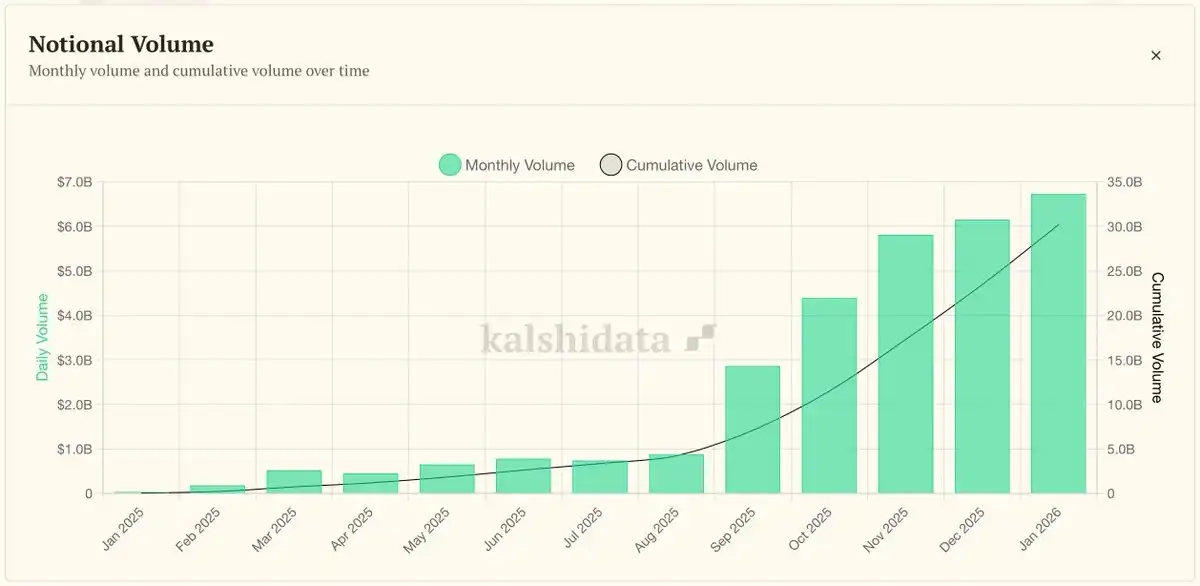
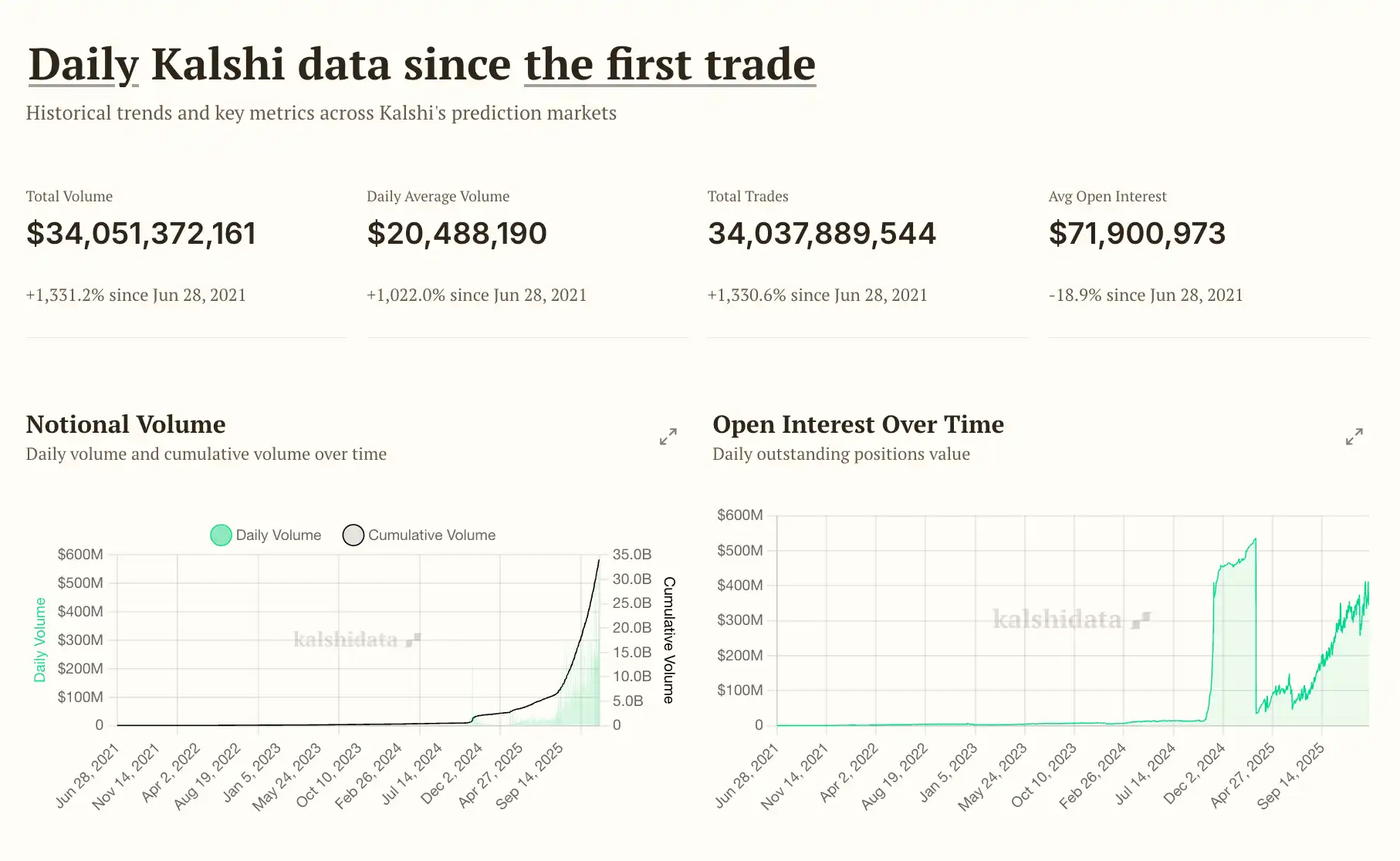
According to data from the KalshiData website, as of January 29, Kalshi's historical total trading volume exceeded $34.05 billion, with a daily average trading volume exceeding $20.48 million; looking at its nominal trading volume K-line chart, it has grown almost exponentially since September 2025.
Capital Market Pricing Range: Kalshi Single Share Price is $300-$450

Finally, as the current number one prediction market platform, although Kalshi's specific IPO time and number of shares issued have not been determined,结合 (combining) its previous financing news and external statements, an IPO is a certainty. Currently, there are many divergences in the pre-IPO market pricing of its stocks between traditional financial markets and cryptocurrency markets:

The pre-IPO market in traditional financial markets prices Kalshi's stock relatively lower——

  • On Nasdaq Private Market, Kalshi's single share is priced around $307;
  • On Hiive, Kalshi's single share is priced around $357.

The pre-IPO market in cryptocurrency markets prices Kalshi's stock relatively higher——

  • On PreStocks, Kalshi's implied market capitalization is approximately $14 billion, with a single share price of about $407;
  • On Jarsy, Kalshi's market valuation is $11 billion, with a单独 (separate) pricing of $450 per share.

In the next article, Odaily Planet Daily will analyze in detail the price range worth buying for Kalshi's pre-IPO stock market, dissecting the investment opportunities in prediction market stocks from the perspective of the pre-IPO market.


Perguntas relacionadas

QWhat is the recent pre-market stock price performance of Kalshi, and how does it compare to major cryptocurrencies?

AAccording to PreStocks platform data, Kalshi's pre-market stock price has surged by 21.7% in the last 30 days, significantly outperforming the gains of major cryptocurrencies like BTC and ETH over the same period.

QWhat was the total trading volume for the prediction market in 2025, and what growth does this represent?

AThe total trading volume for the prediction market in 2025 exceeded $50 billion. This represents a period of rapid, explosive growth for the sector.

QWhat are the key business metrics that demonstrate Kalshi's rapid growth in 2025?

AIn 2025, Kalshi's annual trading volume reached $23.8 billion, a 1108% year-over-year increase. The platform also processed 97 million trades, a 1680% increase from the previous year.

QWhat is the projected trading volume for Kalshi in January 2026, and what record did it recently set?

AKalshi is projected to reach a monthly nominal trading volume of approximately $9.1 billion in January 2026. The platform recently set a new single-day trading volume record of approximately $465 million on January 12th, 2026.

QWhat is the current pre-IPO valuation and share price range for Kalshi across different markets?

AKalshi's pre-IPO valuation and share price vary by market. On traditional financial platforms like Nasdaq Private Market and Hiive, the share price is around $307 and $357, implying a lower valuation. On crypto-native platforms like PreStocks and Jarsy, the implied valuation is higher, with share prices around $407 (implied $14B valuation) and $450 (implied $110B valuation), respectively.

Leituras Relacionadas

What Happens to Ethereum Developer Tools After the Grants Run Out?

On February 27th, the Ethereum Foundation (EF) announced Project Odin, a structured sustainability support program designed for a select group of strategic, previously grant-funded teams. Unlike a standard grant, Odin offers a long-term advisory mechanism focused on helping these teams establish credible, sustainable paths within a two-year framework, thereby reducing long-term dependence on single funding sources. The program addresses a critical post-grant challenge: how essential public goods, especially major developer tools, can achieve financial sustainability beyond initial funding. While grants from EF and programs like Gitcoin or RetroPGF remain vital for startups and research, they often fall short for mature, widely-used infrastructure. Tools like compilers, languages, and network stacks are deeply embedded but struggle with monetization, trapped between being too foundational to lose and too public to generate natural revenue. Project Odin provides teams with a dedicated Strategic Advisor to guide them through a three-phase process: 1) analyzing current funding and realistic options, 2) validating potential paths with stakeholders, and 3) executing plans, which may include crafting support contracts, service agreements, or other recurring revenue models. The first pilot participant is Vyper, a critical smart contract language for the EVM, highlighting the need for sustainable models for core infrastructure. The initiative reframes the public goods conversation from "who should be funded" to "how do already-proven teams avoid perpetual funding crises?" It encourages ecosystem participants—protocols and projects that depend on these tools—to view sustainable support not just as charity, but as essential risk management for their own operational supply chains.

marsbitHá 16m

What Happens to Ethereum Developer Tools After the Grants Run Out?

marsbitHá 16m

MARA Reports Q1 Revenue Below Expectations, Net Loss of $1.3 Billion, Stock Plunges After Hours

Bitcoin mining firm MARA Holdings reported disappointing Q1 2024 results, causing its stock to erase all daily gains and fall 3.44% in after-hours trading. Revenue dropped 18% year-over-year to $174.6 million, missing Wall Street estimates of $192.7 million. The company posted a net loss of $1.3 billion, a significant increase from a $533.4 million loss a year ago, primarily driven by unrealized losses on its holdings of 38,689 Bitcoin, which depreciated in value during the quarter. MARA also sold over 15,100 BTC in late March to repurchase debt at a discount. The broader mining environment remains challenging due to a 35% decline in Bitcoin's price from its all-time high and a nearly 30% increase in mining difficulty over the past year. MARA's market cap ranking among U.S. miners has slipped to seventh. Critically, the company announced a strategic pivot away from Bitcoin mining expansion. It stated it has no plans to purchase new mining equipment and is fully transitioning toward AI data centers. Its strategy involves retrofitting existing mining sites for AI and high-performance computing (HPC) and leveraging its recent $1.5 billion acquisition of Long Ridge Energy & Power, a gas-fired power plant and data center. This infrastructure could eventually support 600 MW of AI compute capacity, allowing MARA to redeploy up to 90% of its non-custodial mining power for AI and IT workloads.

marsbitHá 17m

MARA Reports Q1 Revenue Below Expectations, Net Loss of $1.3 Billion, Stock Plunges After Hours

marsbitHá 17m

The AI Investment Landscape Is Being Reshaped: Beyond the 'Magnificent Seven', What Opportunities Lie in the Semiconductor Supply Chain?

AI Investment Map is Reshaping: Opportunities Beyond the 'Magnificent Seven' Since ChatGPT ignited the AI wave, investment initially focused on the "Magnificent Seven" tech giants dominating cloud infrastructure. However, the rise of DeepSeek and debates on AI capital expenditure effectiveness are shifting this dynamic. Investors now recognize opportunities deeper in the supply chain—the companies providing the essential "picks and shovels." Early concerns about an AI investment "arms race" and potential low returns were partly alleviated by strong Q1 earnings from cloud providers, validating robust compute demand. This has highlighted a more certain investment thesis: regardless of which AI applications ultimately win, massive capital expenditure will first fuel demand for semiconductors and related components. This "pick-and-shovel" logic has driven semiconductor ETFs to record highs. Key beneficiaries include: * **Memory Chipmakers (e.g., SK Hynix, Samsung, Micron)**: High Bandwidth Memory (HBM) is a critical bottleneck for AI training. * **Photonics Companies**: Crucial for high-speed data transfer within AI data centers. * **The Broader "AI-11" Semiconductor Ecosystem**: This encompasses foundries & lithography (TSMC, ASML), logic & custom chips (AMD, Broadcom, Intel, Marvell), and enterprise storage (SanDisk, Western Digital). Every dollar of AI infrastructure spending flows through this chain. While the "Magnificent Seven" remain dominant in market size, their earnings growth premium over the rest of the S&P 500 ("S&P 493") is narrowing. Market attention and marginal investment are shifting towards the expanding semiconductor supply chain. The investment narrative is evolving from "betting on the ultimate AI winner" to "investing in the certainty of the infrastructure build-out." Understanding this shift from the demand side to the supply side is key to identifying future AI investment opportunities.

marsbitHá 45m

The AI Investment Landscape Is Being Reshaped: Beyond the 'Magnificent Seven', What Opportunities Lie in the Semiconductor Supply Chain?

marsbitHá 45m

Trading

Spot
Futuros
活动图片