K2.6 is Yang Zhilin's First Roadshow

marsbitPublicado em 2026-04-22Última atualização em 2026-04-22

Resumo

K2.6 is Yang Zhilin's first roadshow for Moonshot AI's upcoming IPO. The release of K2.6 marks a strategic shift from a developer-focused approach to one aimed at investors and enterprise clients. Key changes include a 58% price increase for API inputs, structured to favor locked-in enterprise users over casual customers. The model is positioned against previous-generation international models like GPT-5.4 rather than the latest competitors, framing it as "first-tier." It also introduces large-scale Agent clusters (300+ agents) and open-source offerings, targeting enterprise automation scenarios. These moves are seen as preparations for K3, a anticipated 3-4 trillion parameter model. With Moonshot's valuation rising to $18 billion, K2.6 is a crucial step to demonstrate commercial viability and market positioning ahead of a potential late-2026 IPO.

By Xiang Xianzhi

The night before last, Moonshot AI released Kimi K2.6 and raised the API input price from $0.60 per million tokens to $0.95 per million tokens.

A 58% increase. The first price hike since the K2 series launched.

But it seems no one is paying attention to this.

Four months ago, in an internal letter on the last day of 2025, Yang Zhilin wrote that Moonshot AI was "not in a hurry for an IPO in the short term." At that time, Zhipu and MiniMax had already submitted their prospectuses to the Hong Kong Stock Exchange. This was clearly a deliberate positioning strategy.

He also wrote in that letter that the company's cash reserves exceeded $1.4 billion, and the Series C round of $500 million was oversubscribed—the subtext being that the potential of the primary market had not been fully utilized, and there was no rush for the secondary market.

Three months later, Bloomberg reported that he had begun talks with CICC and Goldman Sachs. Three weeks after that, K2.6 was launched.

A person who dislikes "rushing" did in four months what he previously said he wouldn't do.

K2.6 is certainly not the last product release before Moonshot AI's IPO. But this version release is Yang Zhilin's first roadshow after Moonshot AI planned to go public.

Kimi Has Never Released a Model Version Like This Before

Kimi had a set routine for releasing models in the past.

Publish a technical report, open-source the weights, top the HuggingFace leaderboard, and then await scrutiny from the tech community. K1.5 countered o1 with a reasoning methodology, with technical details outweighing benchmark numbers; K2 Thinking directly dumped the weights on HuggingFace, letting developers run their own tests. These moves were aimed at developers and researchers.

The rhetoric was also from the tech community: what problem did we solve, why is our method better, welcome to reproduce.

K2.6's moves are somewhat different.

First, the price increase. In RMB terms, the input price for K2.6 is 6.5 yuan per million tokens (cache miss), compared to 4 yuan for K2.5. The output price increased from 21 yuan to 27 yuan. The cache hit price is 1.1 yuan.

This is a structured price increase. Superficially, all tiers are increasing, but the cache hit tier has the smallest increase—from 0.7 yuan to 1.1 yuan, which is $0.16 per million tokens in USD.

This $0.16 is the key to understanding this price hike.

For enterprise users who repeatedly call the same system prompt: code assistants, Agent orchestration frameworks, smart customer service—their prefix is highly reusable, and cache hit rates can reach 75% to 83%. Moonshot AI left a nearly flat price for these customers.

For scattered customers who use it occasionally with different prompts each time, this price increase falls squarely on them.

This is a friendly price adjustment for "enterprises already tied to Kimi" and an unfriendly one for "scattered customers still comparing prices". The former are the "enterprise locked-in clients" in the IPO story, the latter are the "long-tail users" that won't appear on the roadshow PPT. Moonshot AI knows very well who its valuation assets are.

The compute structure of the Agent era is different from the chat era. Chat models are dozens of tokens back and forth, Agents are thousands of tool calls and hundreds of thousands of token consumption. Official K2.6 use cases—Mac local deployment Qwen3.5 model calling tools over 4000 times, running for 12 hours; refactoring the open-source matching engine exchange-core, 1000+ tool calls over 13 hours; more extreme, 5 days of autonomous operation monitoring alerts, fault response—the token consumption for these single tasks is hundreds or even thousands of times that of chat scenarios in the K2.5 era.

Of course, these cases are meant to illustrate long-range reasoning capabilities, but coupled with K2.6's 300-agent cluster, the token consumption must be staggering.

At the old price of $0.60, this kind of Agent task might lose money per call. At $0.95, it barely covers the inference cost.

So the price increase isn't confidence, it's necessity. Moonshot AI has raised $2.5 billion cumulatively, with $1.4 billion cash reserve from Series C to C+, but if the next-gen K3 is truly a 3-4 trillion parameter scale, a single pre-training run might eat up half of that.

Without a price increase, the gross margin data for the last few quarters before the IPO would look bad. The prospectus must disclose gross margin.
This could have been explained openly—the Agent era requires a new pricing model. But Moonshot AI didn't. Because C-end users just came from the free era of K2 Thinking, and telling them "I raised prices" now is not a good product narrative.

It's a story for another audience—Kimi already has a group of enterprise clients who can't leave it, and they'll use it even if it's more expensive. (Like myself)

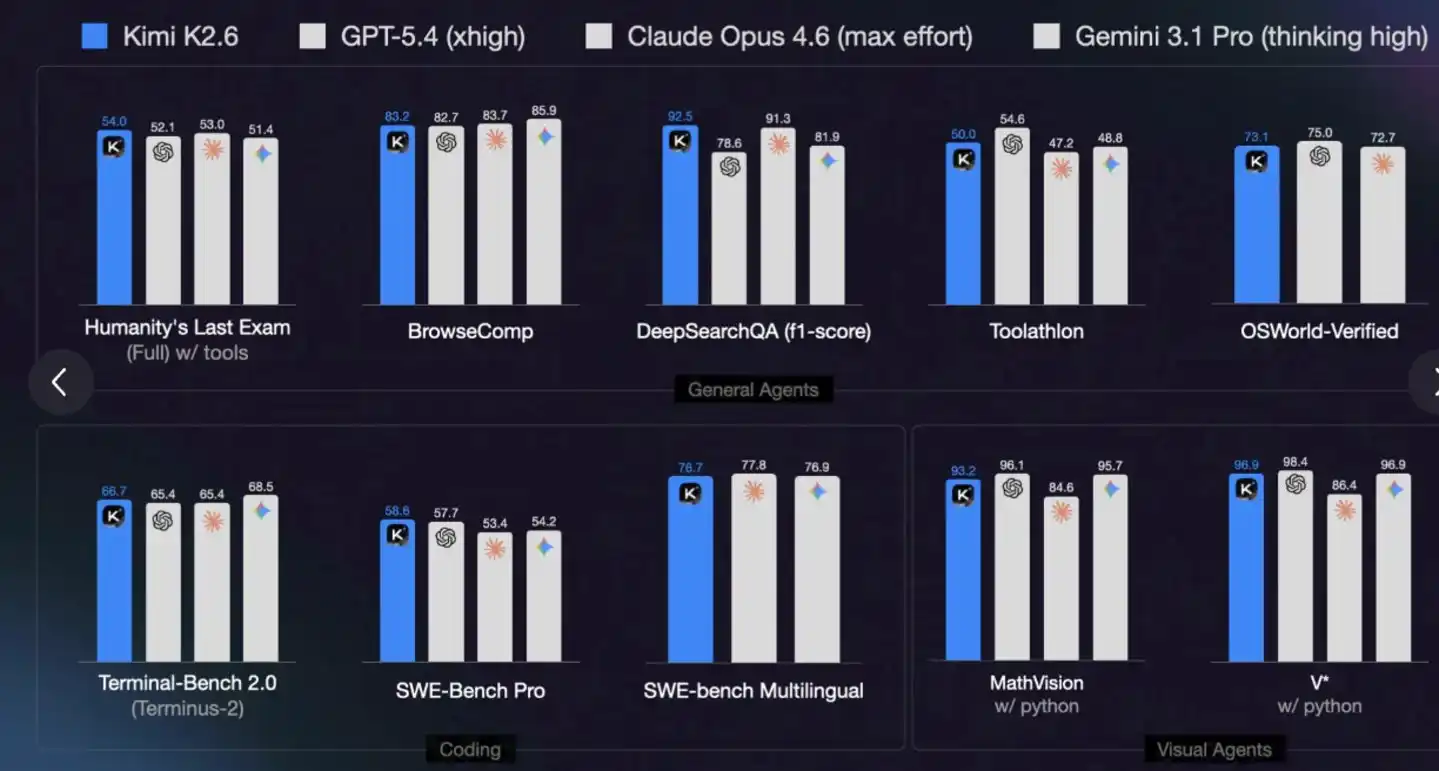
The second thing is benchmark comparisons. K2.6's official chosen references are GPT-5.4, Claude Opus 4.6, Gemini 3.1 Pro. All three are previous-generation flagships.

The same week, Anthropic released Claude Mythos, and Opus 4.7 just launched—both are a generation stronger than Opus 4.6. K2.6 didn't benchmark against them.

This is actually an active choice. Benchmarking against Mythos, K2.6 falls into the "catch-up" position; benchmarking against Opus 4.6, K2.6 falls into the "first tier" position. An $18 billion valuation needs the latter.

Kimi didn't really do this in the past. When K2 Thinking was released, the official ran full benchmarks, good and bad results, all released for developers to judge for themselves. That was the tech community's way—the community understands where you are strong and weak, and is willing to accept a model with obvious shortcomings but a clear roadmap.

Roadshow PPTs are not. Roadshow PPTs need a conclusion a fund manager can understand in 30 seconds: "on par with or superior to top international closed-source models." This sentence is verbatim from the K2.6 official blog.

The third thing is the Agent cluster and open-source dual track. K2.6 upgraded something called Claw Groups—a heterogeneous Agent ecosystem where Agents with different devices, different models, and different toolchains run in a collaborative space, with K2.6 acting as the scheduler. 300 sub-Agents in parallel, 4000 steps of collaboration, 5 days of autonomous operation.

These numbers are written for enterprise clients. Not for developers. For a developer, "300 Agents in parallel" has no practical meaning—they won't run 300 Agents in a local project. This configuration only makes sense for one type of client: large enterprises that need an Agent matrix to automate entire operational processes.

It's targeting the Salesforce story, not the HuggingFace story.

Meanwhile, K2.6 is fully open-sourced. Yang Zhilin said at the Zhongguancun Forum on March 26th that open source will be an absolute victory.

Open source + enterprise Agent clusters—this is a position between DeepSeek and Anthropic, half and half of both models. It sounds like a good story. But occupying both ends means having to prove both.

The capital market doesn't really care if these questions have answers. It only requires you to have a story for each line.

Price increase, benchmarking, Agent cluster—these three things together have an反常的共同点 (abnormal common point). None are for the tech community.

Kimi's underlying logic for releasing models in the past was—if developers like us, enterprise clients will eventually follow, and the capital market will follow even later. This playbook has a name: technical sincerity.

K2.6 isn't waiting. The price increase is a direct declaration of B-end pricing power; benchmarking against GPT-5.4 is preemptively securing a valuation position; Agent clusters and Claw Groups are the showroom for the enterprise service story.

Each thing corresponds to a question on the roadshow PPT: What is your commercialization capability? What is your benchmark position? What is your B-end moat?

Compressing the time from Preview to GA to 8 days is also this logic. Previous versions of the K2 series all went through 2-3 month preview periods, letting the community test enough, provide feedback, and iterate enough. K2.6 didn't give itself this space. It's not that the technology matured faster; the window won't wait.

An IPO in the second half of 2026 requires 4 to 6 months for filing, inquiry, hearing, roadshow, pricing, and cooling-off period according to HKEX procedures. Starting the roadshow in September means the product must be ready by April.

If GA isn't released in April, there's no window later.

K3 is the Real Grand Finale

But K2.6 is also not the strongest card Moonshot AI can play.

There is a very restrained sentence in the official blog—K2.6 is the "runway prepared for K3".

12-hour long-range coding, 300-Agent cluster, context compressor—these are not the final form of the K2 series; they are the execution layer infrastructure that a larger base model can support. Moonshot AI wouldn't spend effort making this work unless it was certain a larger model would consume these capabilities.

Rumors about K3 leaked on Reddit earlier, targeting a parameter scale of 3-4 trillion. Compared to the trillion-scale of the K2 series, this is a base leap.

If K3 can be released during the roadshow window—that is the real answer sheet. The runway paved by K2.6 allows K3 to take off.

The question is whether it can make it. How long does it take to train a 3-4 trillion parameter model? GPT-5 and Claude Opus 4.6 both had roughly 6-9 month pre-training cycles, plus several months for post-training and safety evaluation. Can Moonshot AI's existing compute—judging from the Alibaba Cloud cooperation and current cash reserves—compress this cycle to 5-6 months?

This bet is placed on K2.6.

Eight days from Preview to GA, Agent cluster expanding from 100 to 300 in one go, long-range execution stretching from hundreds of steps to 4000 steps—every move compresses time, making room for the possibility of K3.

If K3 can be released before August or September—that's the grand finale on the roadshow.

If it doesn't make it—K3 becomes a "model that can only be released after the IPO," and K2.6 has to shoulder the entire valuation narrative alone.

Moonshot AI is betting it can be done.

What Does the $18 Billion Valuation Anchor?

Back to valuation.

Three months ago, Moonshot AI was valued at $4.3 billion; two months ago, $5.5 billion; now, $18 billion.

It's not that Moonshot AI became four times stronger in these three months. It's that Zhipu and MiniMax went public and rose 4x, pushing the ceiling of the entire sector up. Zhipu's HK market cap is HK$305 billion, MiniMax's is HK$309.2 billion—both exceeding SenseTime's historical peak.

The valuation logic for these two is not "what the next-gen technology can do," but "how much AI assets can be priced in the Hong Kong market pool."

Moonshot AI's $18 billion valuation anchors the same thing. It is no longer proving it is the strongest Chinese AI company; it is proving it is a priceable Chinese AI company.

All of K2.6's moves—price increase, benchmarking, Agent cluster, open-source dual track—respond to this proposition.

But there is one thing K2.6 has not yet proven. Will Kimi's C-end users be willing to pay for the more expensive K2.6? Will paying subscribers churn to DeepSeek or MiniMax? How many enterprise clients are actually running Claw Groups, and how many just signed a POC?

These are numbers investors will definitely ask during the roadshow. K2.6 can only put the product out now. Whether it turns into numbers depends on the next three months.

When Zhipu went public, it submitted a prospectus where profits weren't yet positive; MiniMax did too. Investors accepted this story because the grand narrative of "Chinese AI assets" had just opened. Moonshot AI is half a year late. For the same question, Zhipu and MiniMax could say "we are validating," Moonshot AI must say "we are monetizing."

This pressure falls entirely on the three months between K2.6 and K3.

So back to the initial question—Is K2.6 Moonshot AI's final roadshow before the IPO?

No.

If K3 catches the roadshow window, K3 is the real grand finale. K2.6 is just the runway paved for it. If K3 misses the roadshow window, K2.6 has to carry the entire IPO narrative. Then it is Yang Zhilin's被迫提前开讲的第一场 (first, forced-to-start-early one).

Neither outcome was what Yang Zhilin wanted four months ago.

But everything that happened in these four months—Zhipu MiniMax IPO, valuation ceiling pushed up, window period compressed—forced a person who dislikes "rushing" to have to rush.

When K3 is released, it will be the second act.

Perguntas relacionadas

QWhat is the significance of the K2.6 model release for Moonshot AI's IPO plans?

AThe K2.6 model release is Yang Zhilin's first roadshow for Moonshot AI's planned IPO. It is a strategic move to demonstrate the company metrics crucial for valuation, such as enterprise pricing power, competitive positioning, and B2B capabilities, ahead of a potential listing in the second half of 2026.

QHow did Moonshot AI adjust its API pricing with the K2.6 release, and what was the strategic reason?

AMoonshot AI raised its API input price from $0.60 to $0.95 per million tokens, a 58% increase. This was a structured price hike designed to be friendly to enterprise clients with high cache hit rates (who saw a smaller increase) while passing the full increase to more casual, price-comparing users. The move was necessary to improve gross margin figures for the IPO prospectus and to align pricing with the high token consumption of the new Agent era.

QWhy did the K2.6 benchmark choose to compare itself to older models like GPT-5.4 instead of the latest ones?

AK2.6 was benchmarked against previous-generation flagship models like GPT-5.4 and Claude Opus 4.6 rather than the newer, stronger contemporaries (e.g., Claude Mythos) to position itself in the 'first tier' of models for its roadshow narrative. This creates a more favorable comparison for fund managers, supporting a valuation story of being 'on par with or superior to top international closed-source models'.

QWhat is the 'Claw Groups' feature in K2.6, and which audience is it targeting?

AClaw Groups is a feature for heterogeneous Agent ecosystems, allowing up to 300 different Agents across various devices, models, and toolchains to operate collaboratively with K2.6 as the scheduler. This targets enterprise clients, not developers, as it demonstrates a solution for large corporations seeking to automate full-process operations with an Agent matrix, akin to a Salesforce enterprise story.

QWhat is the relationship between the K2.6 release and the anticipated K3 model?

AK2.6 is described as the 'runway' for the much larger K3 model (rumored to be 3-4 trillion parameters). Features like long-context execution and the Agent cluster infrastructure are built to be consumed by a more powerful base model. The rushed 8-day preview-to-GA cycle for K2.6 is a bet that K3 can be ready in time to be the centerpiece of the IPO roadshow; if not, K2.6 must carry the entire valuation narrative alone.

Leituras Relacionadas

Deconstructing the U.S. Stock Quantum Computing Sector: IonQ, Rigetti, D-Wave, Which of These Concept Stocks is Worth Betting On?

**Title:** Analyzing the US Quantum Computing Race: IonQ, Rigetti, D-Wave – Which Concept Stock is Worth Betting On? **Summary:** The podcast discusses the resurgence of quantum computing as a national priority for both the US and China, driven by its potential to break current encryption, revolutionize drug discovery, finance, and logistics. The core challenge is commercializing the technology, which is hampered by high error rates in quantum bits (qubits). Quantum error correction, requiring thousands of physical qubits per reliable logical qubit, is key but years away. The analysis compares three main publicly traded US quantum computing firms: * **IonQ (Ion Trap):** Considered the most financially stable with the fastest commercial progress (2025 revenue: $130M, +202%) and high-quality clients. Its valuation is very high, pricing in significant future growth. * **Rigetti (Superconducting):** Seen as the highest-risk, highest-potential-reward bet. It has the smallest revenue but recently launched a 108-qubit system. Its valuation multiples are extreme, making it highly sensitive to news. * **D-Wave (Quantum Annealing):** Has the most unique positioning with real-world enterprise clients today (e.g., Mastercard, Volkswagen) solving optimization problems. Its recent acquisition moves it into general-purpose quantum computing ("dual-platform"), adding execution risk. Major tech giants like Google, IBM, and Microsoft are also heavily invested, pursuing various technical approaches. Nvidia is positioning itself as the essential bridge between classical and quantum computing. The investment phase is likened to AI in 2018-2020: promising underlying technology with accelerating breakthroughs but a commercial inflection point still 3-7 years away, suggesting potential for a market correction ("bubble washout"). For investors, suggested approaches include gaining exposure through tech giants with quantum divisions (e.g., Google, IBM) or using niche ETFs like WQTM for pure-play quantum exposure, rather than direct stock picks in the highly volatile pure-play companies at this early stage.

marsbitHá 10m

Deconstructing the U.S. Stock Quantum Computing Sector: IonQ, Rigetti, D-Wave, Which of These Concept Stocks is Worth Betting On?

marsbitHá 10m

From Parallel Finance to Mainstream Finance: The On-Chain Securities Era Ushers in a Historic Window

From Parallel Finance to Mainstream: The Dawn of On-Chain Securities For over a decade, the crypto industry has operated as a parallel financial system with its own currencies, markets, and assets—from Bitcoin and ICOs to DeFi, NFTs, and memecoins. Despite building a robust internal ecosystem, a wall has separated it from the traditional financial world. That barrier is now crumbling. The industry's first act was one of internal evolution: ICOs streamlined fundraising, DeFi recreated financial services on-chain, and layer-2 networks competed for scalability—all within the crypto bubble. While innovative, this cycle remained closed, with capital and users circulating internally, leading to volatile boom-bust cycles. Even Bitcoin ETFs, while attracting Wall Street capital, merely provided a channel to buy crypto assets without bridging the systems. The next, larger narrative is Real-World Assets (RWA) moving on-chain. This involves tokenizing stocks, bonds, funds, and future cash flows. Blockchain can compress the complex traditional processes of trading, settlement, clearing, and custody into a seamless, automated network operating in seconds. This shift is creating a new financial gateway: the native crypto securities broker. This entity will combine functions of an exchange, broker, bank, and custodian into a unified global financial operating system. Consequently, the next major battleground won't be the "public chain wars" focused on speed and cost, but the competition to build the financial infrastructure capable of hosting high-quality, liquid real-world assets. Access to global equities, index funds, or stakes in companies like SpaceX could erase the boundary between crypto and traditional finance, unlocking a market orders of magnitude larger than crypto's current valuation. In summary, after years of creating a separate financial world, crypto's next decade will be defined by its integration into the existing global financial system, marking the true beginning of its largest growth story.

marsbitHá 31m

From Parallel Finance to Mainstream Finance: The On-Chain Securities Era Ushers in a Historic Window

marsbitHá 31m

Wang Chuan: When the Neighbor Old Wang Made 30x on Memory Stocks, How to Avoid Anxiety (Part Six) - The Trap of Commoditized Goods

Wang Chuan: When the Neighbor Lao Wang Made 30x on Storage Stocks, How to Stay Anxiety-Free (Part 6) - The Trap of Commoditized Goods. This essay uses historical and current examples to analyze the cyclical and high-risk nature of the data storage industry. It begins with the 1990s rise and dramatic fall of Iomega, whose stock soared over 160x in 18 months before collapsing 97% from its peak, illustrating the fleeting success of storage "meme stocks." The core problem is that storage products, like DRAM and flash memory, are highly commoditized. This leads to extreme volatility: prices have plummeted over 80% multiple times, and company stocks often crash 95% or go bankrupt. The industry's dynamic is defined by "elastic demand facing heavy-asset, long-cycle, rigid supply." When demand spikes and supply is fixed, prices skyrocket, as seen recently with AI-driven demand for High Bandwidth Memory (HBM). Companies like Sandisk and Micron have reported massive revenue and gross margin jumps (e.g., Sandisk's gross margin rising from 22.5% to 78.3%) despite minimal increases in production volume. However, these high margins are self-defeating. They incentivize massive new capacity investments (hundreds of billions planned from 2026), with supply expected to surge by late 2027. Once new supply meets demand, prices and profits will crash, potentially leading to a scenario where "selling more results in earning less." The article debunks the safety of long-term supply agreements, comparing them to fragile non-aggression pacts easily broken when market conditions shift. It warns that when an industry is highly profitable but trades at low P/E ratios, the risk is greatest, as plummeting prices quickly erase those earnings. Multiple asymmetric risks loom, including economic recession, reduced AI spending, faster-than-expected capacity expansion (especially from Chinese firms), and technological innovations that reduce memory requirements. In conclusion, the storage sector is a cyclical trap where periods of euphoric profits are often precursors to devastating downturns, luring unprepared investors into a "wealth incinerator."

marsbitHá 40m

Wang Chuan: When the Neighbor Old Wang Made 30x on Memory Stocks, How to Avoid Anxiety (Part Six) - The Trap of Commoditized Goods

marsbitHá 40m

Wang Chuan: When the neighbor Lao Wang earned thirty times from investing in memory storage stocks, how can you still avoid anxiety (6) - The trap of homogeneous products

The article, "Wang Chuan: How to Remain Unanxious After Neighbor Lao Wang's Thirty-Fold Gain on Storage Stocks (Part 6) - The Trap of Commoditized Goods," analyzes the cyclical and perilous nature of the data storage industry through historical and current case studies. It begins with the example of Iomega, whose Zip drives led to a stock surge of over 160x in the mid-1990s before collapsing over 97% from its peak due to competition from cheaper CD-R technology. This pattern is characteristic of storage, where products like DRAM are highly commoditized, leading to extreme price volatility. The sector has seen prices crash over 80% multiple times, with companies often facing bankruptcy. The core dynamic is "elastic demand facing heavy-asset, long-cycle, rigid supply." High prices attract new capacity, but the long lead time means supply eventually overshoots, causing sharp price corrections. The current AI-driven boom, exemplified by surging demand for High-Bandwidth Memory (HBM), has led to skyrocketing prices and profit margins for companies like SanDisk and Micron, despite relatively flat production volumes. However, the author warns this high-margin environment is self-defeating. The high profits are already triggering massive new capacity investments (hundreds of billions starting 2026), with supply expected to ramp up by late 2027. When supply catches up, total revenue and profits may fall even as more units are sold. Long-term supply agreements offer little protection, as buyers can find ways to renegotiate if market prices drop, similar to fragile political treaties. Key risks include economic downturns, cuts in AI spending, faster-than-expected capacity expansion (especially from Chinese firms), and innovations in chip/algorithm design that reduce memory needs. A critical trap is that at the cycle's peak, storage stocks often appear cheap with low P/E ratios, luring value investors just before an impending downturn where profits evaporate. The conclusion cautions that for commoditized goods like storage, high margins inevitably destroy themselves, and the current asymmetry favors downside risk over further upside. The neighbor's dream of easy wealth from storage stocks is portrayed as a precarious illusion.

链捕手Há 58m

Wang Chuan: When the neighbor Lao Wang earned thirty times from investing in memory storage stocks, how can you still avoid anxiety (6) - The trap of homogeneous products

链捕手Há 58m

Trading

Spot
Futuros

Artigos em Destaque

O que é $S$

Compreender o SPERO: Uma Visão Abrangente Introdução ao SPERO À medida que o panorama da inovação continua a evoluir, o surgimento de tecnologias web3 e projetos de criptomoeda desempenha um papel fundamental na formação do futuro digital. Um projeto que tem atraído atenção neste campo dinâmico é o SPERO, denotado como SPERO,$$s$. Este artigo tem como objetivo reunir e apresentar informações detalhadas sobre o SPERO, para ajudar entusiastas e investidores a compreender as suas bases, objetivos e inovações nos domínios web3 e cripto. O que é o SPERO,$$s$? O SPERO,$$s$ é um projeto único dentro do espaço cripto que procura aproveitar os princípios da descentralização e da tecnologia blockchain para criar um ecossistema que promove o envolvimento, a utilidade e a inclusão financeira. O projeto é concebido para facilitar interações peer-to-peer de novas maneiras, proporcionando aos utilizadores soluções e serviços financeiros inovadores. No seu núcleo, o SPERO,$$s$ visa capacitar indivíduos ao fornecer ferramentas e plataformas que melhoram a experiência do utilizador no espaço das criptomoedas. Isso inclui a possibilidade de métodos de transação mais flexíveis, a promoção de iniciativas impulsionadas pela comunidade e a criação de caminhos para oportunidades financeiras através de aplicações descentralizadas (dApps). A visão subjacente do SPERO,$$s$ gira em torno da inclusão, visando fechar lacunas dentro das finanças tradicionais enquanto aproveita os benefícios da tecnologia blockchain. Quem é o Criador do SPERO,$$s$? A identidade do criador do SPERO,$$s$ permanece algo obscura, uma vez que existem recursos publicamente disponíveis limitados que fornecem informações detalhadas sobre o(s) seu(s) fundador(es). Esta falta de transparência pode resultar do compromisso do projeto com a descentralização—uma ética que muitos projetos web3 partilham, priorizando contribuições coletivas em vez de reconhecimento individual. Ao centrar as discussões em torno da comunidade e dos seus objetivos coletivos, o SPERO,$$s$ incorpora a essência do empoderamento sem destacar indivíduos específicos. Assim, compreender a ética e a missão do SPERO é mais importante do que identificar um criador singular. Quem são os Investidores do SPERO,$$s$? O SPERO,$$s$ é apoiado por uma diversidade de investidores que vão desde capitalistas de risco a investidores-anjo dedicados a promover a inovação no setor cripto. O foco desses investidores geralmente alinha-se com a missão do SPERO—priorizando projetos que prometem avanço tecnológico social, inclusão financeira e governança descentralizada. Essas fundações de investidores estão tipicamente interessadas em projetos que não apenas oferecem produtos inovadores, mas que também contribuem positivamente para a comunidade blockchain e os seus ecossistemas. O apoio desses investidores reforça o SPERO,$$s$ como um concorrente notável no domínio em rápida evolução dos projetos cripto. Como Funciona o SPERO,$$s$? O SPERO,$$s$ emprega uma estrutura multifacetada que o distingue de projetos de criptomoeda convencionais. Aqui estão algumas das características-chave que sublinham a sua singularidade e inovação: Governança Descentralizada: O SPERO,$$s$ integra modelos de governança descentralizada, capacitando os utilizadores a participar ativamente nos processos de tomada de decisão sobre o futuro do projeto. Esta abordagem promove um sentido de propriedade e responsabilidade entre os membros da comunidade. Utilidade do Token: O SPERO,$$s$ utiliza o seu próprio token de criptomoeda, concebido para servir várias funções dentro do ecossistema. Esses tokens permitem transações, recompensas e a facilitação de serviços oferecidos na plataforma, melhorando o envolvimento e a utilidade gerais. Arquitetura em Camadas: A arquitetura técnica do SPERO,$$s$ suporta modularidade e escalabilidade, permitindo a integração contínua de funcionalidades e aplicações adicionais à medida que o projeto evolui. Esta adaptabilidade é fundamental para manter a relevância no panorama cripto em constante mudança. Envolvimento da Comunidade: O projeto enfatiza iniciativas impulsionadas pela comunidade, empregando mecanismos que incentivam a colaboração e o feedback. Ao nutrir uma comunidade forte, o SPERO,$$s$ pode melhor atender às necessidades dos utilizadores e adaptar-se às tendências do mercado. Foco na Inclusão: Ao oferecer taxas de transação baixas e interfaces amigáveis, o SPERO,$$s$ visa atrair uma base de utilizadores diversificada, incluindo indivíduos que anteriormente podem não ter participado no espaço cripto. Este compromisso com a inclusão alinha-se com a sua missão abrangente de empoderamento através da acessibilidade. Cronologia do SPERO,$$s$ Compreender a história de um projeto fornece insights cruciais sobre a sua trajetória de desenvolvimento e marcos. Abaixo está uma cronologia sugerida que mapeia eventos significativos na evolução do SPERO,$$s$: Fase de Conceituação e Ideação: As ideias iniciais que formam a base do SPERO,$$s$ foram concebidas, alinhando-se de perto com os princípios de descentralização e foco na comunidade dentro da indústria blockchain. Lançamento do Whitepaper do Projeto: Após a fase conceitual, um whitepaper abrangente detalhando a visão, os objetivos e a infraestrutura tecnológica do SPERO,$$s$ foi lançado para atrair o interesse e o feedback da comunidade. Construção da Comunidade e Primeiros Envolvimentos: Esforços ativos de divulgação foram feitos para construir uma comunidade de primeiros adotantes e investidores potenciais, facilitando discussões em torno dos objetivos do projeto e angariando apoio. Evento de Geração de Tokens: O SPERO,$$s$ realizou um evento de geração de tokens (TGE) para distribuir os seus tokens nativos a apoiantes iniciais e estabelecer liquidez inicial dentro do ecossistema. Lançamento da dApp Inicial: A primeira aplicação descentralizada (dApp) associada ao SPERO,$$s$ foi lançada, permitindo que os utilizadores interagissem com as funcionalidades principais da plataforma. Desenvolvimento Contínuo e Parcerias: Atualizações e melhorias contínuas nas ofertas do projeto, incluindo parcerias estratégicas com outros players no espaço blockchain, moldaram o SPERO,$$s$ em um jogador competitivo e em evolução no mercado cripto. Conclusão O SPERO,$$s$ é um testemunho do potencial do web3 e das criptomoedas para revolucionar os sistemas financeiros e capacitar indivíduos. Com um compromisso com a governança descentralizada, o envolvimento da comunidade e funcionalidades inovadoras, abre caminho para um panorama financeiro mais inclusivo. Como em qualquer investimento no espaço cripto em rápida evolução, potenciais investidores e utilizadores são incentivados a pesquisar minuciosamente e a envolver-se de forma ponderada com os desenvolvimentos em curso dentro do SPERO,$$s$. O projeto demonstra o espírito inovador da indústria cripto, convidando a uma exploração mais aprofundada das suas inúmeras possibilidades. Embora a jornada do SPERO,$$s$ ainda esteja a desenrolar-se, os seus princípios fundamentais podem, de facto, influenciar o futuro de como interagimos com a tecnologia, as finanças e uns com os outros em ecossistemas digitais interconectados.

69 Visualizações TotaisPublicado em {updateTime}Atualizado em 2024.12.17

O que é $S$

O que é AGENT S

Agent S: O Futuro da Interação Autónoma no Web3 Introdução No panorama em constante evolução do Web3 e das criptomoedas, as inovações estão constantemente a redefinir a forma como os indivíduos interagem com plataformas digitais. Um projeto pioneiro, o Agent S, promete revolucionar a interação humano-computador através do seu framework aberto e agente. Ao abrir caminho para interações autónomas, o Agent S visa simplificar tarefas complexas, oferecendo aplicações transformadoras em inteligência artificial (IA). Esta exploração detalhada irá aprofundar-se nas complexidades do projeto, nas suas características únicas e nas implicações para o domínio das criptomoedas. O que é o Agent S? O Agent S é um framework aberto e agente, especificamente concebido para abordar três desafios fundamentais na automação de tarefas computacionais: Aquisição de Conhecimento Específico de Domínio: O framework aprende inteligentemente a partir de várias fontes de conhecimento externas e experiências internas. Esta abordagem dupla capacita-o a construir um rico repositório de conhecimento específico de domínio, melhorando o seu desempenho na execução de tarefas. Planeamento ao Longo de Longos Horizontes de Tarefas: O Agent S emprega planeamento hierárquico aumentado por experiência, uma abordagem estratégica que facilita a decomposição e execução eficientes de tarefas intrincadas. Esta característica melhora significativamente a sua capacidade de gerir múltiplas subtarefas de forma eficiente e eficaz. Gestão de Interfaces Dinâmicas e Não Uniformes: O projeto introduz a Interface Agente-Computador (ACI), uma solução inovadora que melhora a interação entre agentes e utilizadores. Utilizando Modelos de Linguagem Multimodais de Grande Escala (MLLMs), o Agent S pode navegar e manipular diversas interfaces gráficas de utilizador de forma fluida. Através destas características pioneiras, o Agent S fornece um framework robusto que aborda as complexidades envolvidas na automação da interação humana com máquinas, preparando o terreno para uma infinidade de aplicações em IA e além. Quem é o Criador do Agent S? Embora o conceito de Agent S seja fundamentalmente inovador, informações específicas sobre o seu criador permanecem elusivas. O criador é atualmente desconhecido, o que destaca ou o estágio nascente do projeto ou a escolha estratégica de manter os membros fundadores em anonimato. Independentemente da anonimidade, o foco permanece nas capacidades e no potencial do framework. Quem são os Investidores do Agent S? Como o Agent S é relativamente novo no ecossistema criptográfico, informações detalhadas sobre os seus investidores e financiadores não estão explicitamente documentadas. A falta de informações disponíveis publicamente sobre as fundações de investimento ou organizações que apoiam o projeto levanta questões sobre a sua estrutura de financiamento e roteiro de desenvolvimento. Compreender o apoio é crucial para avaliar a sustentabilidade do projeto e o seu impacto potencial no mercado. Como Funciona o Agent S? No núcleo do Agent S reside uma tecnologia de ponta que lhe permite funcionar eficazmente em diversos ambientes. O seu modelo operacional é construído em torno de várias características-chave: Interação Humano-Computador Semelhante: O framework oferece planeamento avançado em IA, esforçando-se para tornar as interações com computadores mais intuitivas. Ao imitar o comportamento humano na execução de tarefas, promete elevar as experiências dos utilizadores. Memória Narrativa: Utilizada para aproveitar experiências de alto nível, o Agent S utiliza memória narrativa para acompanhar os históricos de tarefas, melhorando assim os seus processos de tomada de decisão. Memória Episódica: Esta característica fornece aos utilizadores orientações passo a passo, permitindo que o framework ofereça suporte contextual à medida que as tarefas se desenrolam. Suporte para OpenACI: Com a capacidade de funcionar localmente, o Agent S permite que os utilizadores mantenham o controlo sobre as suas interações e fluxos de trabalho, alinhando-se com a ética descentralizada do Web3. Fácil Integração com APIs Externas: A sua versatilidade e compatibilidade com várias plataformas de IA garantem que o Agent S possa integrar-se perfeitamente em ecossistemas tecnológicos existentes, tornando-o uma escolha apelativa para desenvolvedores e organizações. Estas funcionalidades contribuem coletivamente para a posição única do Agent S no espaço cripto, à medida que automatiza tarefas complexas e em múltiplos passos com mínima intervenção humana. À medida que o projeto evolui, as suas potenciais aplicações no Web3 podem redefinir a forma como as interações digitais se desenrolam. Cronologia do Agent S O desenvolvimento e os marcos do Agent S podem ser encapsulados numa cronologia que destaca os seus eventos significativos: 27 de Setembro de 2024: O conceito de Agent S foi lançado num artigo de pesquisa abrangente intitulado “Um Framework Agente Aberto que Usa Computadores como um Humano”, mostrando a base para o projeto. 10 de Outubro de 2024: O artigo de pesquisa foi disponibilizado publicamente no arXiv, oferecendo uma exploração aprofundada do framework e da sua avaliação de desempenho com base no benchmark OSWorld. 12 de Outubro de 2024: Uma apresentação em vídeo foi lançada, proporcionando uma visão visual das capacidades e características do Agent S, envolvendo ainda mais potenciais utilizadores e investidores. Estes marcos na cronologia não apenas ilustram o progresso do Agent S, mas também indicam o seu compromisso com a transparência e o envolvimento da comunidade. Pontos-Chave Sobre o Agent S À medida que o framework Agent S continua a evoluir, várias características-chave destacam-se, sublinhando a sua natureza inovadora e potencial: Framework Inovador: Concebido para proporcionar um uso intuitivo de computadores semelhante à interação humana, o Agent S traz uma abordagem nova à automação de tarefas. Interação Autónoma: A capacidade de interagir autonomamente com computadores através de GUI significa um avanço em direção a soluções computacionais mais inteligentes e eficientes. Automação de Tarefas Complexas: Com a sua metodologia robusta, pode automatizar tarefas complexas e em múltiplos passos, tornando os processos mais rápidos e menos propensos a erros. Melhoria Contínua: Os mecanismos de aprendizagem permitem que o Agent S melhore a partir de experiências passadas, aprimorando continuamente o seu desempenho e eficácia. Versatilidade: A sua adaptabilidade em diferentes ambientes operacionais, como OSWorld e WindowsAgentArena, garante que pode servir uma ampla gama de aplicações. À medida que o Agent S se posiciona no panorama do Web3 e das criptomoedas, o seu potencial para melhorar as capacidades de interação e automatizar processos significa um avanço significativo nas tecnologias de IA. Através do seu framework inovador, o Agent S exemplifica o futuro das interações digitais, prometendo uma experiência mais fluida e eficiente para os utilizadores em diversas indústrias. Conclusão O Agent S representa um ousado avanço na união da IA e do Web3, com a capacidade de redefinir a forma como interagimos com a tecnologia. Embora ainda esteja nas suas fases iniciais, as possibilidades para a sua aplicação são vastas e cativantes. Através do seu framework abrangente que aborda desafios críticos, o Agent S visa trazer interações autónomas para o primeiro plano da experiência digital. À medida que avançamos mais profundamente nos domínios das criptomoedas e da descentralização, projetos como o Agent S desempenharão, sem dúvida, um papel crucial na formação do futuro da tecnologia e da colaboração humano-computador.

652 Visualizações TotaisPublicado em {updateTime}Atualizado em 2025.01.14

O que é AGENT S

Como comprar S

Bem-vindo à HTX.com!Tornámos a compra de Sonic (S) simples e conveniente.Segue o nosso guia passo a passo para iniciar a tua jornada no mundo das criptos.Passo 1: cria a tua conta HTXUtiliza o teu e-mail ou número de telefone para te inscreveres numa conta gratuita na HTX.Desfruta de um processo de inscrição sem complicações e desbloqueia todas as funcionalidades.Obter a minha contaPasso 2: vai para Comprar Cripto e escolhe o teu método de pagamentoCartão de crédito/débito: usa o teu visa ou mastercard para comprar Sonic (S) instantaneamente.Saldo: usa os fundos da tua conta HTX para transacionar sem problemas.Terceiros: adicionamos métodos de pagamento populares, como Google Pay e Apple Pay, para aumentar a conveniência.P2P: transaciona diretamente com outros utilizadores na HTX.Mercado de balcão (OTC): oferecemos serviços personalizados e taxas de câmbio competitivas para os traders.Passo 3: armazena teu Sonic (S)Depois de comprar o teu Sonic (S), armazena-o na tua conta HTX.Alternativamente, podes enviá-lo para outro lugar através de transferência blockchain ou usá-lo para transacionar outras criptomoedas.Passo 4: transaciona Sonic (S)Transaciona facilmente Sonic (S) no mercado à vista da HTX.Acede simplesmente à tua conta, seleciona o teu par de trading, executa as tuas transações e monitoriza em tempo real.Oferecemos uma experiência de fácil utilização tanto para principiantes como para traders experientes.

1.2k Visualizações TotaisPublicado em {updateTime}Atualizado em 2025.03.21

Como comprar S

Discussões

Bem-vindo à Comunidade HTX. Aqui, pode manter-se informado sobre os mais recentes desenvolvimentos da plataforma e obter acesso a análises profissionais de mercado. As opiniões dos utilizadores sobre o preço de S (S) são apresentadas abaixo.

活动图片














