Jito Foundation to return to US amid 'clearer rules' for digital assets

cointelegraphPublicado em 2025-12-17Última atualização em 2025-12-17

Resumo

The Jito Foundation, a nonprofit supporting the Solana-based MEV infrastructure platform Jito, has decided to return to the United States, citing clearer regulatory rules for digital assets. The organization had previously moved operations overseas due to debanking and regulatory hostility during what industry figures call "Operation Chokepoint 2.0." Jito Labs CEO Lucas Bruder stated that banks and vendors refused to work with them, creating significant legal risks. Recent developments, including the passage of the GENIUS stablecoin bill and progress on a crypto market structure bill, influenced the decision to return. Despite a more favorable regulatory environment under the new SEC leadership, some crypto industry executives report that debanking practices continue.

The Jito Foundation, the nonprofit organization facilitating the development of the Jito platform, said it will return to the United States, citing “clearer rules” for digital assets in the country.

Jito is a maximal extractable value (MEV) infrastructure builder for the Solana network. MEV refers to the profit that traders or validators can make by controlling the order, inclusion or exclusion of transactions in a blockchain block. By rearranging transactions before they are confirmed, MEV participants can capitalize on opportunities such as arbitrage or front-running to earn extra fees on transaction rewards.

The Jito Foundation was forced to operate overseas due to the debanking of the crypto industry during the so-called Operation Chokepoint 2.0, according to Lucas Bruder, co-founder and CEO of Jito Labs. Bruder, pseudonymously known as “buffalu,” said:

“Banks wouldn’t service us. Vendors wouldn’t contract with us. Every product decision carried real but unquantifiable legal risk from a hostile and capricious regulatory agency gone rogue.”
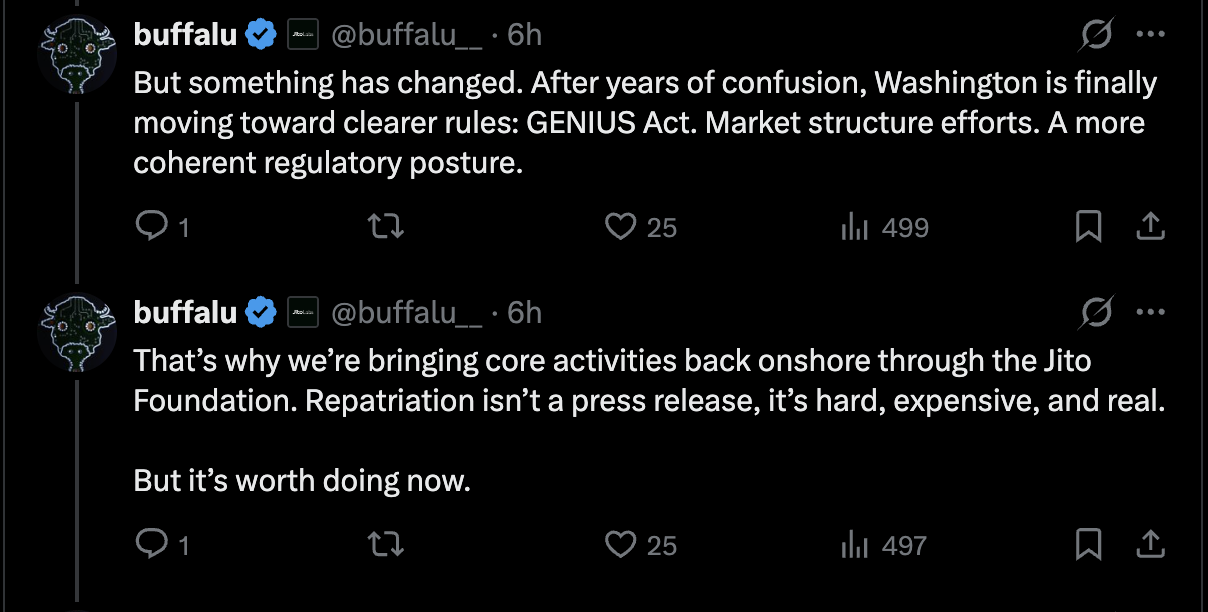
Source: buffalu

Bruder cited recent regulatory changes, including the passage of the GENIUS stablecoin bill and lawmakers working on a crypto market structure bill, as reasons for the Jito Foundation returning to the US.

The announcement reflects the regulatory sea change in the US, particularly at the Securities and Exchange Commission (SEC), following the 2024 presidential election and the appointment of Paul Atkins as SEC chair.

Related: ‘Grow up... We debank Democrats, we debank Republicans:’ JPMorgan CEO

Crypto industry executives say Operation Chokepoint 2.0 is ongoing in 2025

Even with a pro-crypto administration in the White House and at the SEC, crypto industry executives continue to report being victims of debanking.

In November, Jack Mallers, the CEO of Bitcoin Lightning Network payments company Strike, said JPMorgan Chase closed his personal bank account.

The financial services giant did not specify the reason for closing the account, Mallers said, adding that his father had been a private client for over 30 years.
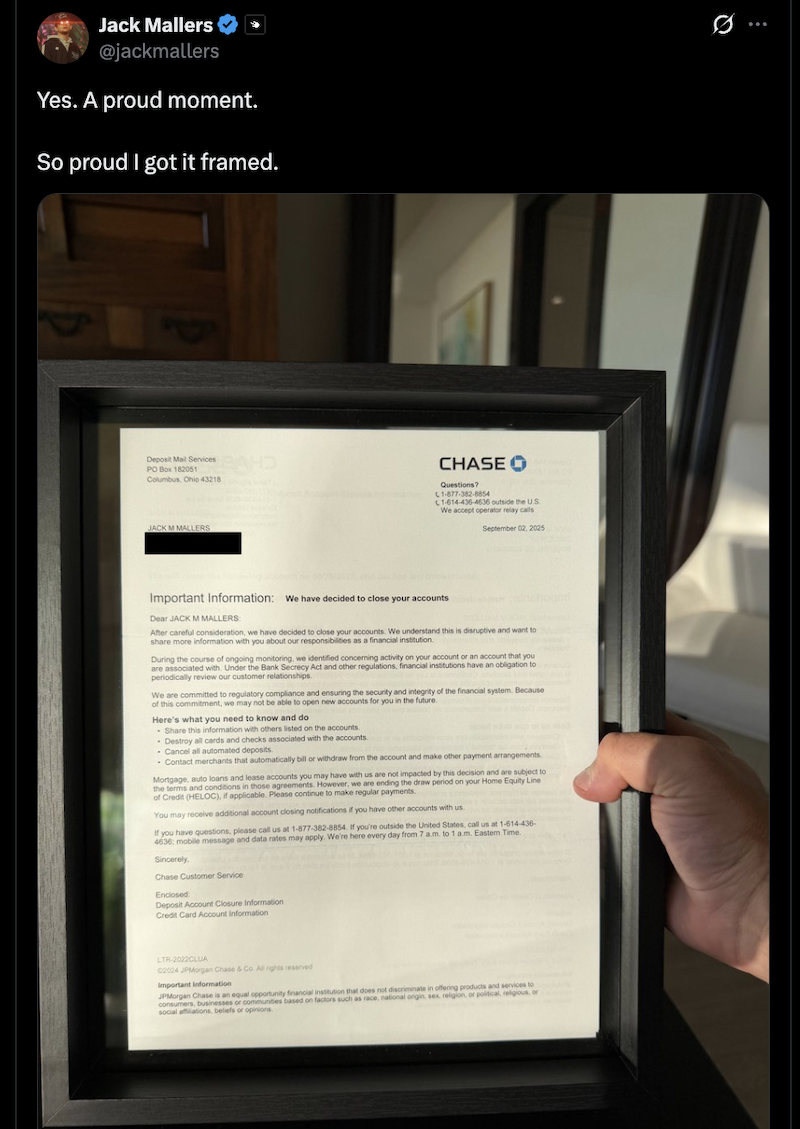
Jack Mallers shares a framed copy of the debanking letter he received from JPMorgan Chase. Source: Jack Mallers

In August, Alex Rampell, a general partner at venture capital firm Adreessen Horowitz, warned of the continuation of Operation Chokepoint by the banking industry through other tactics.

These tactics include banks charging excessive fees for clients moving crypto to wallets, centralized exchanges, Web3 applications and other digital asset service providers or outright blocking transfers to specific crypto platforms, Rampell said.

Magazine: Proton Mail exposing activists’ info showed the limits of encryption

Criptomoedas em alta

Leituras Relacionadas

Embodied Intelligence 'Gaokao' is Insanely Hard, Humans Score 100, Best Model Only 12.8

Embodied AI Faces a Daunting "Everest": New Benchmark Reveals Huge Gap Between Models and Humans A comprehensive new benchmark for robotic manipulation, RoboDojo, has been released, painting a stark picture of the current state of embodied AI. It serves as a unified evaluation platform covering both simulation and real-world robot tasks. The benchmark assesses five core capabilities: Generalization (adapting to new scenes/objects), Memory, Precision manipulation, Long-Horizon multi-step tasks, and Open semantic understanding. It includes 42 simulation tasks and 18 standardized real-world tasks across three dual-arm robot platforms. The results are sobering. In simulation, the best-performing generalist robot policy achieved an average success rate of only 8.80%. Performance in the real world was slightly higher but still low, with the top model succeeding 12.8% of the time on average. In stark contrast, human experts scored 76.03% in simulation and 100% in real-world tests. The benchmark highlights significant, uneven gaps in current models' abilities. While some excel in specific areas like visual recognition or simple actions, they struggle with reliability, especially in long-horizon tasks where errors accumulate and in open-ended semantic instructions. The low scores, particularly in real-world deployment with physical uncertainties like camera noise and contact dynamics, underscore that today's models are far from being robust, general-purpose operational robots. RoboDojo is more than just a ranking; it's an infrastructure designed for fair, reproducible comparison. Its companion system, XPolicyLab, standardizes the interface for different models to be evaluated. Maintained by an academic consortium without commercial ties, it aims to provide a community-wide "altitude meter" to track genuine progress toward reliable and generalizable robot manipulation.

marsbitHá 1h

Embodied Intelligence 'Gaokao' is Insanely Hard, Humans Score 100, Best Model Only 12.8

marsbitHá 1h

Trading

Spot

Artigos em Destaque

Como comprar US

Bem-vindo à HTX.com!Tornámos a compra de Talus Network (US) simples e conveniente.Segue o nosso guia passo a passo para iniciar a tua jornada no mundo das criptos.Passo 1: cria a tua conta HTXUtiliza o teu e-mail ou número de telefone para te inscreveres numa conta gratuita na HTX.Desfruta de um processo de inscrição sem complicações e desbloqueia todas as funcionalidades.Obter a minha contaPasso 2: vai para Comprar Cripto e escolhe o teu método de pagamentoCartão de crédito/débito: usa o teu visa ou mastercard para comprar Talus Network (US) instantaneamente.Saldo: usa os fundos da tua conta HTX para transacionar sem problemas.Terceiros: adicionamos métodos de pagamento populares, como Google Pay e Apple Pay, para aumentar a conveniência.P2P: transaciona diretamente com outros utilizadores na HTX.Mercado de balcão (OTC): oferecemos serviços personalizados e taxas de câmbio competitivas para os traders.Passo 3: armazena teu Talus Network (US)Depois de comprar o teu Talus Network (US), armazena-o na tua conta HTX.Alternativamente, podes enviá-lo para outro lugar através de transferência blockchain ou usá-lo para transacionar outras criptomoedas.Passo 4: transaciona Talus Network (US)Transaciona facilmente Talus Network (US) no mercado à vista da HTX.Acede simplesmente à tua conta, seleciona o teu par de trading, executa as tuas transações e monitoriza em tempo real.Oferecemos uma experiência de fácil utilização tanto para principiantes como para traders experientes.

407 Visualizações TotaisPublicado em {updateTime}Atualizado em 2026.06.02

Como comprar US

Discussões

Bem-vindo à Comunidade HTX. Aqui, pode manter-se informado sobre os mais recentes desenvolvimentos da plataforma e obter acesso a análises profissionais de mercado. As opiniões dos utilizadores sobre o preço de US (US) são apresentadas abaixo.

活动图片