Jito Foundation to return to US amid 'clearer rules' for digital assets

cointelegraphPublicado em 2025-12-17Última atualização em 2025-12-17

Resumo

The Jito Foundation, a nonprofit supporting the Solana-based MEV infrastructure platform Jito, has decided to return to the United States, citing clearer regulatory rules for digital assets. The organization had previously moved operations overseas due to debanking and regulatory hostility during what industry figures call "Operation Chokepoint 2.0." Jito Labs CEO Lucas Bruder stated that banks and vendors refused to work with them, creating significant legal risks. Recent developments, including the passage of the GENIUS stablecoin bill and progress on a crypto market structure bill, influenced the decision to return. Despite a more favorable regulatory environment under the new SEC leadership, some crypto industry executives report that debanking practices continue.

The Jito Foundation, the nonprofit organization facilitating the development of the Jito platform, said it will return to the United States, citing “clearer rules” for digital assets in the country.

Jito is a maximal extractable value (MEV) infrastructure builder for the Solana network. MEV refers to the profit that traders or validators can make by controlling the order, inclusion or exclusion of transactions in a blockchain block. By rearranging transactions before they are confirmed, MEV participants can capitalize on opportunities such as arbitrage or front-running to earn extra fees on transaction rewards.

The Jito Foundation was forced to operate overseas due to the debanking of the crypto industry during the so-called Operation Chokepoint 2.0, according to Lucas Bruder, co-founder and CEO of Jito Labs. Bruder, pseudonymously known as “buffalu,” said:

“Banks wouldn’t service us. Vendors wouldn’t contract with us. Every product decision carried real but unquantifiable legal risk from a hostile and capricious regulatory agency gone rogue.”
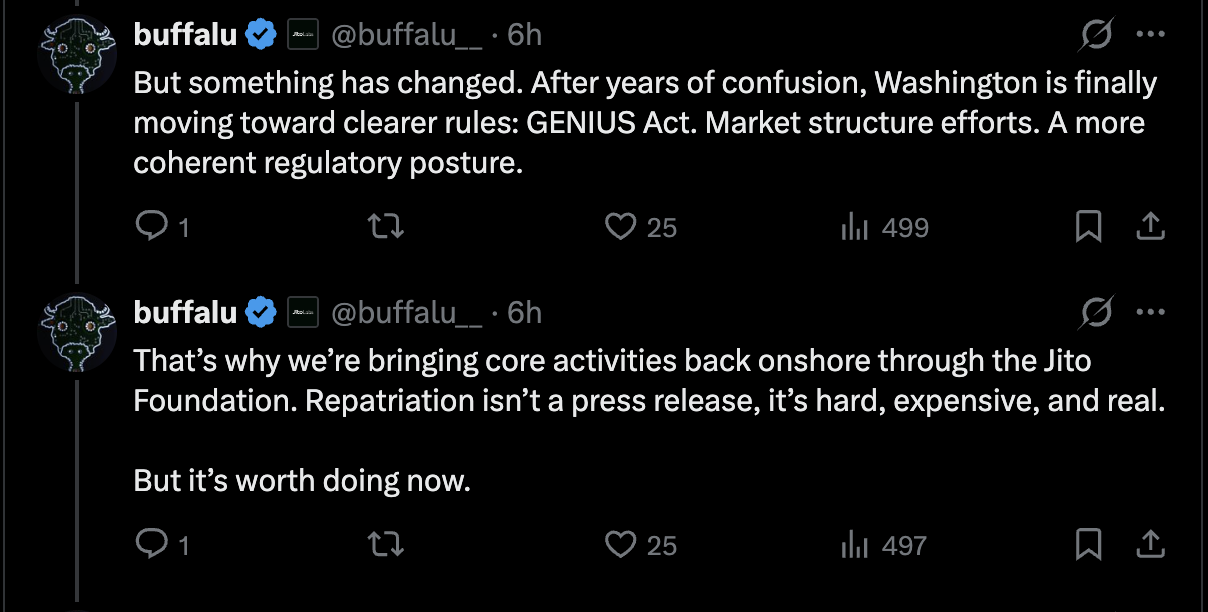
Source: buffalu

Bruder cited recent regulatory changes, including the passage of the GENIUS stablecoin bill and lawmakers working on a crypto market structure bill, as reasons for the Jito Foundation returning to the US.

The announcement reflects the regulatory sea change in the US, particularly at the Securities and Exchange Commission (SEC), following the 2024 presidential election and the appointment of Paul Atkins as SEC chair.

Related: ‘Grow up... We debank Democrats, we debank Republicans:’ JPMorgan CEO

Crypto industry executives say Operation Chokepoint 2.0 is ongoing in 2025

Even with a pro-crypto administration in the White House and at the SEC, crypto industry executives continue to report being victims of debanking.

In November, Jack Mallers, the CEO of Bitcoin Lightning Network payments company Strike, said JPMorgan Chase closed his personal bank account.

The financial services giant did not specify the reason for closing the account, Mallers said, adding that his father had been a private client for over 30 years.
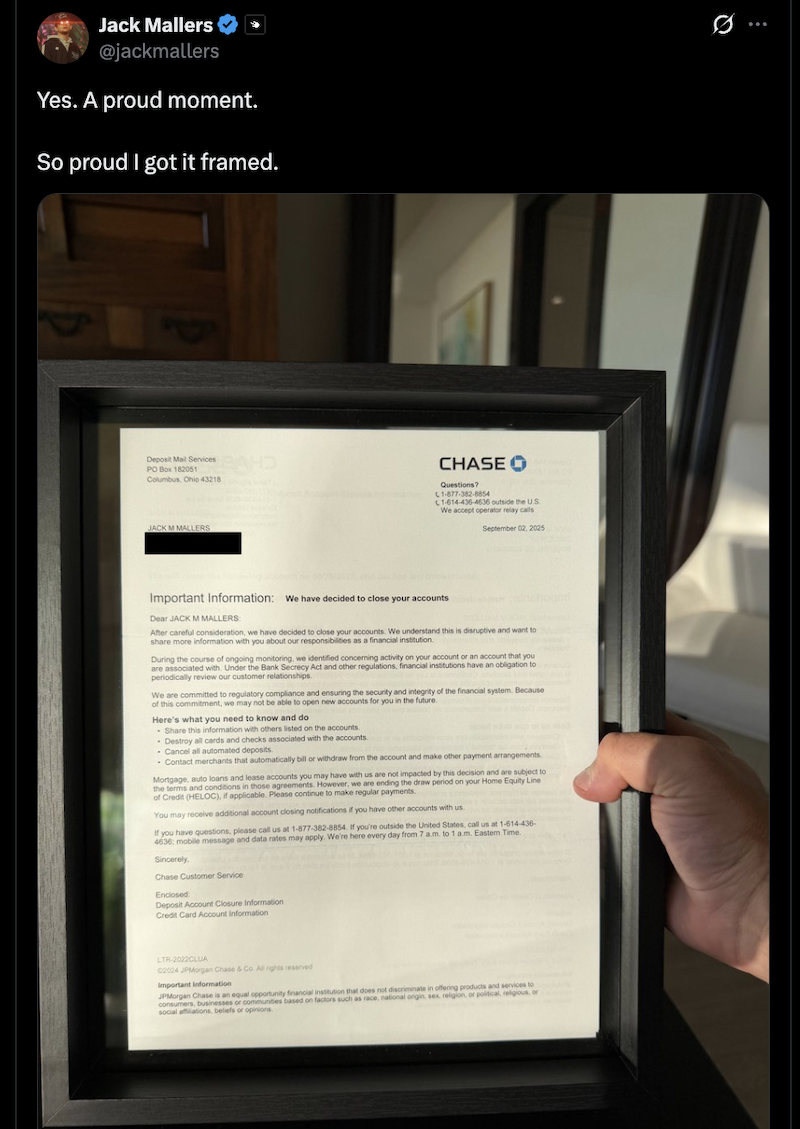
Jack Mallers shares a framed copy of the debanking letter he received from JPMorgan Chase. Source: Jack Mallers

In August, Alex Rampell, a general partner at venture capital firm Adreessen Horowitz, warned of the continuation of Operation Chokepoint by the banking industry through other tactics.

These tactics include banks charging excessive fees for clients moving crypto to wallets, centralized exchanges, Web3 applications and other digital asset service providers or outright blocking transfers to specific crypto platforms, Rampell said.

Magazine: Proton Mail exposing activists’ info showed the limits of encryption

Leituras Relacionadas

Blockchain Capital Partner: Most People Have a Narrow Understanding of the On-Chain Economy

Author Spencer Bogart, a partner at Blockchain Capital, argues that most people have a narrow view of the on-chain economy, seeing it primarily as a faster, cheaper version of existing financial systems. While this represents a significant opportunity, he believes it's only a small part of the story. Bogart compares the current state of crypto to the early internet, where email was the obvious "faster mail" application. The truly transformative categories—like search, social media, and cloud computing—were entirely new and unimaginable beforehand. Similarly, the most profound innovations in crypto will not be incremental improvements but entirely new categories enabled by the core properties of public blockchains: atomic execution, shared global state, programmable custody, and composability. He cites the "flash loan" as a prime example of a "new verb"—a financial action structurally impossible before programmable assets and atomic settlement. It allows for uncollateralized, trustless borrowing of any size, provided repayment occurs within the same transaction, enabling novel strategies like arbitrage and collateral swaps. Bogart admits the difficulty in precisely predicting these future innovations, as human imagination tends to extrapolate from the past. He posits that the most exciting applications in ten years will be things that don't exist today and have no precedent—products only possible in a global, composable, always-on environment with programmable assets. While the exploration of this vast design space will involve many failures, the potential for transformative, category-defining breakthroughs is what makes the next decade so promising.

链捕手Há 22m

Blockchain Capital Partner: Most People Have a Narrow Understanding of the On-Chain Economy

链捕手Há 22m

Cloud PC Gets a Second Chance, Google/Alibaba/Microsoft Battle for Cloud AI Dominance

Google unexpectedly announced "Android Computer," a new high-end productivity-focused PC series, positioning cloud AI as its core rather than an add-on. This move signals a potential revival for the "cloud computer" concept in the AI era. The article argues that current "AI PCs" are essentially traditional Windows machines with AI features grafted on, heavily reliant on cloud AI for complex tasks due to limited local consumer-grade hardware capabilities. This reliance raises questions about the value of premium local AI hardware. Cloud computers, which struggled with latency-sensitive applications like cloud gaming, are seen as a natural fit for AI PCs due to AI's higher tolerance for response time. Google's Android Computer deeply integrates AI (powered by its Gemini model) into the OS interface, making it contextually available. Its hardware-agnostic approach (supporting both x86 and ARM chips) further underscores the shift towards cloud-centric AI. Other players are adapting: Cloud service providers like Alibaba are enhancing their AI cloud computer offerings; chipmakers (Intel, AMD) are focusing on data center AI chips; traditional PC brands are adding AI software layers; and Apple is leveraging its ecosystem and affordable hardware. Microsoft is defining AI PC standards, embedding Copilot (powered by GPT and Bing) into Windows, and also relying on cloud AI. In conclusion, Android Computer challenges the traditional PC form factor by proposing a "light local, heavy cloud" model. This approach appears promising amid rising hardware costs and local compute bottlenecks. The future PC market will involve a multifaceted competition around cloud integration, OS-level AI, and cross-device ecosystems, potentially redefining the PC as a screen and network conduit to cloud-based AI productivity.

marsbitHá 43m

Cloud PC Gets a Second Chance, Google/Alibaba/Microsoft Battle for Cloud AI Dominance

marsbitHá 43m

Encrypted ETF Weekly Report | Last Week, US Bitcoin Spot ETF Net Outflow $9.95 Billion; US Ethereum Spot ETF Net Outflow $255 Million

Last week, U.S. Bitcoin spot ETFs saw significant net outflows totaling $995 million over three days, with a major contribution of $317 million from BlackRock's IBIT. Their total net asset value (NAV) stands at $104.2 billion. U.S. Ethereum spot ETFs also experienced net outflows of $255 million over five days, largely from BlackRock's ETHA ($186 million out), bringing their total NAV to $12.93 billion. In Hong Kong, Bitcoin spot ETFs recorded a net outflow of 24.91 BTC, reducing their NAV to $323 million. Hong Kong's Ethereum spot ETFs saw no inflows, with an NAV of $68.13 million. U.S. Bitcoin spot ETF options showed increased activity, with a total nominal trading volume of $797 million and a put/call trading ratio of 1.63, indicating a bullish market sentiment. The total open interest reached $23.08 billion. Key developments include VanEck and Grayscale simultaneously filing amended proposals for BNB ETFs, signaling potential SEC review progress. Grayscale also filed for the first U.S. privacy coin ETF (Zcash). Avenir Group remains Asia's largest institutional holder of Bitcoin ETFs. 21Shares launched an actively managed crypto ETF (TKNS), and Bitwise's Hyperliquid ETF (BHYP) is set to list on the NYSE. Institutional activity varied: JPMorgan dramatically increased its Bitcoin ETF holdings (IBIT up 174%), while Jane Street significantly reduced its exposure (IBIT down 71%). Dartmouth College disclosed holdings of $7.7M in Bitcoin ETF and $3.4M in a Solana ETF.

链捕手Há 47m

Encrypted ETF Weekly Report | Last Week, US Bitcoin Spot ETF Net Outflow $9.95 Billion; US Ethereum Spot ETF Net Outflow $255 Million

链捕手Há 47m

Trading

Spot
Futuros

Artigos em Destaque

Como comprar US

Bem-vindo à HTX.com!Tornámos a compra de Talus Network (US) simples e conveniente.Segue o nosso guia passo a passo para iniciar a tua jornada no mundo das criptos.Passo 1: cria a tua conta HTXUtiliza o teu e-mail ou número de telefone para te inscreveres numa conta gratuita na HTX.Desfruta de um processo de inscrição sem complicações e desbloqueia todas as funcionalidades.Obter a minha contaPasso 2: vai para Comprar Cripto e escolhe o teu método de pagamentoCartão de crédito/débito: usa o teu visa ou mastercard para comprar Talus Network (US) instantaneamente.Saldo: usa os fundos da tua conta HTX para transacionar sem problemas.Terceiros: adicionamos métodos de pagamento populares, como Google Pay e Apple Pay, para aumentar a conveniência.P2P: transaciona diretamente com outros utilizadores na HTX.Mercado de balcão (OTC): oferecemos serviços personalizados e taxas de câmbio competitivas para os traders.Passo 3: armazena teu Talus Network (US)Depois de comprar o teu Talus Network (US), armazena-o na tua conta HTX.Alternativamente, podes enviá-lo para outro lugar através de transferência blockchain ou usá-lo para transacionar outras criptomoedas.Passo 4: transaciona Talus Network (US)Transaciona facilmente Talus Network (US) no mercado à vista da HTX.Acede simplesmente à tua conta, seleciona o teu par de trading, executa as tuas transações e monitoriza em tempo real.Oferecemos uma experiência de fácil utilização tanto para principiantes como para traders experientes.

384 Visualizações TotaisPublicado em {updateTime}Atualizado em 2025.12.11

Como comprar US

Discussões

Bem-vindo à Comunidade HTX. Aqui, pode manter-se informado sobre os mais recentes desenvolvimentos da plataforma e obter acesso a análises profissionais de mercado. As opiniões dos utilizadores sobre o preço de US (US) são apresentadas abaixo.

活动图片