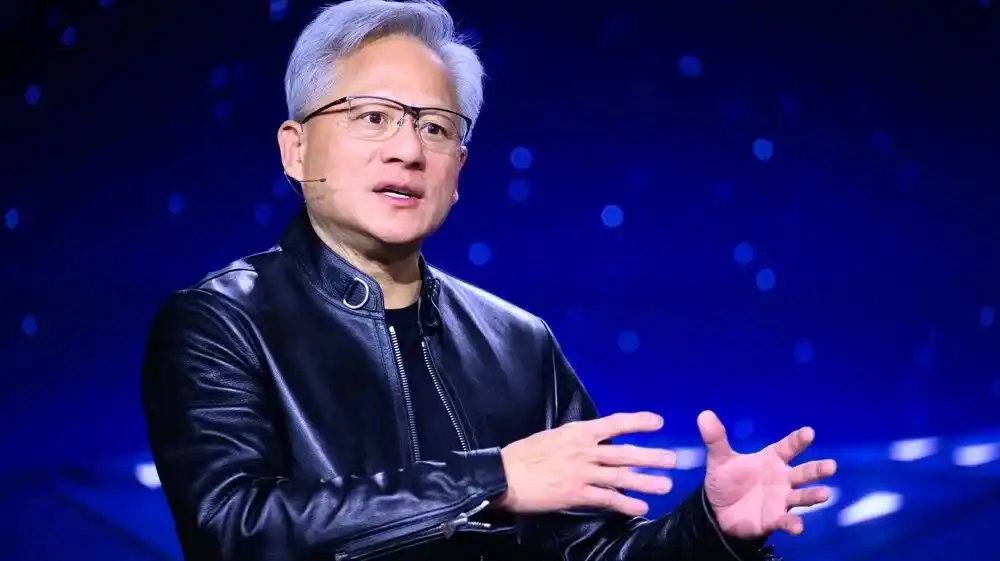
Jensen Huang is Satoshi Nakamoto

marsbitPublicado em 2026-03-19Última atualização em 2026-03-19

Resumo

Summary: The article draws a compelling parallel between Jensen Huang, CEO of NVIDIA, and Satoshi Nakamoto, the pseudonymous creator of Bitcoin. It argues that both figures, though operating in different eras, fundamentally architected new "token economies" based on a core conversion rule: inputting computational power (electricity) to output a valuable token. Nakamoto's 2008 whitepaper defined a system where Proof-of-Work mining produces scarce cryptographic tokens, creating a decentralized "faith economy" based on speculative value. In 2026, Huang is portrayed as performing a structurally identical act at GTC. Instead of merely selling GPUs, he presented a complete "token economics" framework, segmenting the market into tiers (Free, Medium, High, Premium, Ultra) based on inference speed, model type, and price per million tokens. He defined valuable computation for the AI age. The key distinction lies in the tokens' purpose and resulting scarcity. Crypto tokens derive value from artificial, code-enforced scarcity (e.g., Bitcoin's 21 million cap) and are meant to be held. AI tokens derive value from their immediate consumption for productive tasks (coding, decision-making) and face a natural, physical scarcity governed by the laws of thermodynamics, land, and power grids, which Huang's hardware is designed to maximize. Ultimately, while Nakamoto created a speculative asset, Huang is building an indispensable utility. The AI token economy, powered by NVIDIA ecosystem, is ar...

Author: Luo Yihang

In January 2009, an anonymous individual invented something called a "token." You invest computing power, obtain tokens, and these tokens circulate, are priced, and traded within a consensus network. The entire crypto economy was born from this. Over a decade later, people are still debating whether this token has any value.

In March 2025, a man in a leather jacket redefined another thing called a "token." You invest computing power, produce tokens, and these tokens are instantly consumed in an AI inference (inference & reasoning) process: thinking, reasoning, writing code, making decisions. The entire AI economy is accelerating because of this. No one debates whether this token has value because you just used millions of them this morning.

Two types of tokens, the same name, the same underlying structure: computing power goes in, something valuable comes out.
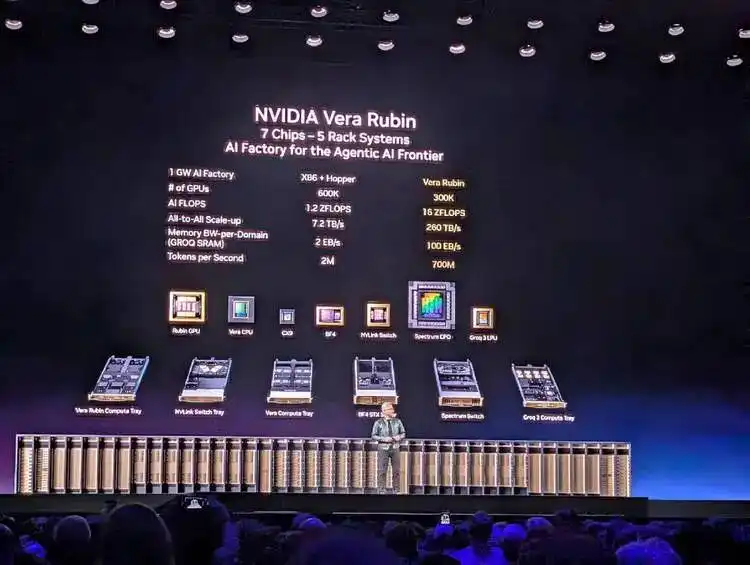
In March 2026, I sat in the NVIDIA GTC venue and listened to Jensen Huang deliver a keynote speech with almost no product promotion. Yes, he unveiled Vera Rubin, a product combining CPU and GPU. But this time, he didn't talk about chip specifications or manufacturing processes; he talked about a complete economics of token production, pricing, and consumption:

Which model corresponds to which token speed; which token speed corresponds to which price range; which price range requires what level of hardware to support.

He even prepared data center computing power allocation plans for the CEOs and decision-makers holding the corporate checkbooks in the audience: 25% for the free tier, 25% for mid-tier, 25% for high-end, 25% for the high-premium tier.

Yes, this time he wasn't specifically selling a particular GPU group, like he did with Blackwell two years ago. But this time, he was selling something bigger. After two hours, I felt the sentence he most wanted to say was: Welcome to consume tokens, and only Nvidia's factory could produce.

At that moment, I realized that this man was doing something structurally identical to what that anonymous person did 17 years ago when he mined the first token.

The Same Conversion Rules

The anonymous individual using the pseudonym "Satoshi Nakamoto" wrote a nine-page white paper in 2008, designing a set of rules: invest computing power, complete a mathematical proof (Proof of Work), and receive a crypto token as a reward.

The brilliance of this rule lies in the fact that it doesn't require anyone to trust anyone else—as long as you accept these rules, you automatically become a participant in this economy. The rule is correct; after all, it brought so many deceitful people together.

And Jensen Huang, on the stage at GTC 2026, did something structurally identical.

He showed a chart illustrating the relationship and tension between inference efficiency and token consumption: the Y-axis is throughput (tokens produced per megawatt of power), the X-axis is interactivity (token speed perceived per user). Then, he labeled five pricing tiers below the X-axis: Free uses Qwen 3, $0/million tokens; Medium uses Kimi K2.5, $3/million tokens; High uses GPT MoE, $6/million tokens; Premium uses GPT MoE 400K context, $45/million tokens; and Ultra, $150/million tokens.

This chart could almost serve as the cover of Jensen Huang's "token economics" white paper.
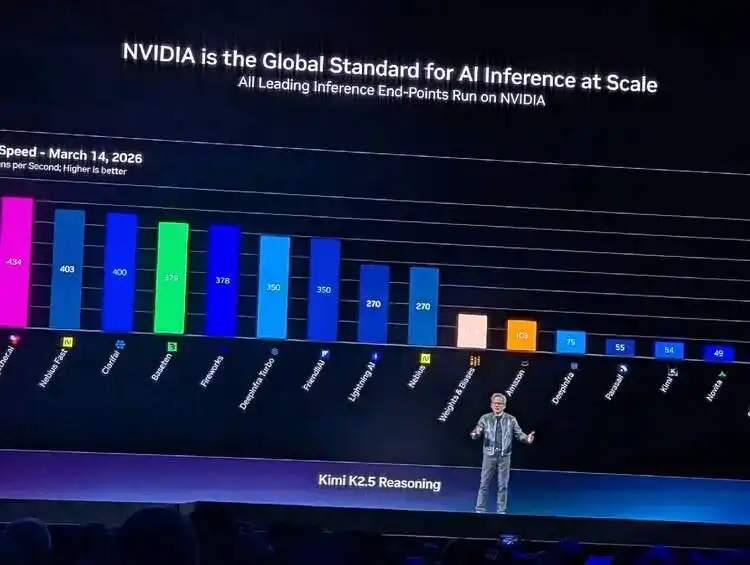
Satoshi defined "what constitutes valuable computation"—completing an SHA-256 hash collision was valuable. Jensen Huang defined "what constitutes valuable inference"—producing tokens for a specific scenario at a specific speed under given power constraints is valuable.

Neither Satoshi Nakamoto nor Jensen Huang directly produced tokens; they both defined the rules for token production and the pricing mechanism.

A sentence Huang said on stage could almost be written directly into the abstract of a token economics white paper—

Tokens are the new commodity, and like all commodities, once it reaches an inflection, once it becomes mature, it will segment into different parts.

Token is the new commodity. Commodities naturally stratify once they mature. He wasn't describing the status quo; he was predicting a market structure and then precisely laying out his hardware product line across every layer of this structure.

The production processes of the two types of tokens even have a semantic symmetry: mining is called mining, inference is called inference.

The essence of both mining and inference is turning electricity into money. Miners spend electricity costs to mine crypto tokens and then sell them. Inference models and AI Agents spend electricity costs to generate AI tokens and then sell them to developers priced per million. The middle steps are different, but the two ends are the same: on the left is the electricity meter, on the right is revenue.

Two Ways to Write Scarcity

The most important design decision Satoshi Nakamoto made was not Proof of Work, but the 21 million Bitcoin supply cap. He used code to create artificial scarcity—no matter how many mining rigs flood in, the total number of Bitcoins will never exceed 21 million. This scarcity is the value anchor of the entire crypto economy.

And Jensen Huang created natural scarcity using physical laws. He said:

"You still have to build a gigawatt data center. You still have to build a gigawatt factory, and that one gigawatt factory for 15 years amortized... is about $40 billion even when you put nothing on it. It's $40 billion. You better make for darn sure you put the best computer system on that thing so that you can have the best token cost."

A 1GW data center will never become 2GW. This isn't a code limitation; it's a law of physics.

Land, electricity, cooling—each has a physical limit. How many tokens this factory you built for $40 billion can produce over its 15-year lifecycle depends entirely on what computing architecture you put inside it.
Satoshi's scarcity can be forked. If you don't like the 21 million cap, fork a new chain, change it to 200 million, call it Ether or whatever, and issue a white paper. And people did just that, with great relish.

But the scarcity Huang creates cannot be forked. After all, you can't fork the second law of thermodynamics, you can't fork a city's power grid capacity, you can't fork the physical area of a piece of land.

But whether it's Satoshi Nakamoto or Jensen Huang, the scarcity they created led to the same result: a hardware arms race.

The history of mining is: CPU→GPU→FPGA→ASIC. Each generation of specialized hardware rendered the previous generation obsolete. And the history of AI training and inference is replaying: Hopper→Blackwell→Vera Rubin→Groq LPU. Start with general-purpose hardware, settle with specialized hardware. The Groq LPU showcased by Huang at this year's GTC, the deterministic dataflow processor released after acquiring Groq. Static compilation, compiler scheduling, no dynamic scheduling, 500MB on-chip SRAM—its architectural philosophy is the ASIC of the inference field. Do one thing, but do it to the extreme.

Interestingly, GPUs played a key role in both waves.

Around 2013, miners found that GPUs were more suitable for mining crypto tokens than CPUs, and NVIDIA graphics cards were sold out. 10 years later, researchers found that GPUs are the best tool for training and inferring AI models, and NVIDIA data center cards were sold out again. GPU, as a processor category, has successively served two generations of token economies.

The difference is, the first time NVIDIA benefited passively, and that was it. The second time, as the main battlefield of AI computing consumption shifted from pre-training to inference, NVIDIA quickly seized the opportunity to actively design the entire game, becoming the writer of the AI rules of the game.

The World's Most Profitable Shovel Seller

In the gold rush, the most profitable weren't the gold miners, but the shovel seller Levi Strauss. In the mining boom, the most profitable weren't the miners, but the mining machine seller Bitmain and Jihan Wu. In the AI pre-training and inference wave, the most profitable aren't the foundation models and Agents, but the GPU seller NVIDIA.

But honestly, the roles of Bitmain and NVIDIA in their respective industries are no longer comparable.

Bitmain only sold mining machines; NVIDIA was even a supplier to Bitmain. You bought a mining machine, what coin to mine, which mining pool to join, at what price to sell, all had nothing to do with Bitmain. It was a pure hardware supplier, earning one-time equipment profits.

NVIDIA is different. He doesn't just sell hardware; now, especially since the explosion of inference-side AI in 2025, he deeply defines what should be mined with this GPU, how to price tokens, who to sell tokens to, how data center computing power should be allocated... All of this is in Huang's presentation PPT: he divides the market into five tiers, each tier corresponding to which model, context length, interaction speed, and price... NVIDIA has standardized and formatted the future market driven by AI inference.

Around 2018, global computing power was concentrated in a few large mining pools—F2Pool, Antpool, BTC.com—they competed for computing power share, but the source of mining machines was highly concentrated in Bitmain.

Just like NVIDIA today, 60% of revenue comes from competing "hyperscalers" like AWS, Azure, GCP, Oracle, CoreWeave, while 40% comes from dispersed AI Natives, sovereign AI projects, and enterprise customers. Large "mining pools" contribute the main revenue, small "miners" provide resilience and diversification.

The structure of the two ecosystems is exactly the same. But Bitmain later encountered competitors—MicroBT, Innosilicon, Canaan—all eating into its share. Mining machines are relatively simple ASIC designs, so followers had a chance. But shaking NVIDIA seems increasingly difficult: 20 years of CUDA ecosystem, hundreds of millions of GPU install base, six generations of NVLink interconnect technology, the decoupled inference architecture after the Groq integration—NVIDIA's technical complexity and ecosystem barriers have rendered most competitive tools ineffective.

This might last for 20 years.

The Fundamental Fork of Two Tokens

What makes cryptocurrency and AI training/inference tokens fundamentally different is the motivation and psychology of their users.

The demand side for Crypto tokens is speculation. No one "needs" Bitcoin to get work done. All white papers claiming blockchain tokens can solve your problems were written by scammers. You hold crypto because you believe someone will buy it from you at a higher price in the future. Bitcoin's value comes from a self-fulfilling prophecy: if enough people believe it has value, it has value. This is the faith economy.

The demand side for AI tokens is productivity. Nestlé needs tokens to make supply chain decisions—its supply chain data refresh rate went from every 15 minutes to every 3 minutes, costs reduced by 83%; this value can be directly mapped to the P&L. 100% of NVIDIA engineers already need tokens to write code instead of hand-coding; research teams need tokens for scientific research. You don't need to believe tokens have value; you just need to use them, and the value proves itself in use.

This is the most essential difference between the two tokens. Crypto tokens are produced to be held and traded—their value lies in not being used. AI tokens are produced to be consumed immediately—their value lies in the moment they are used.

One is digital gold, more valuable the more you hoard it; the other is digital electricity, produced to be burned.

This difference determines that: the AI token economy will not become as bubble-prone as the crypto token economy. Bitcoin rises and falls sharply because the price of a speculative item is driven by sentiment. But the price of [AI] tokens is driven by usage volume and production cost. As long as AI remains useful—as long as people are still using Claude Code to write code, using ChatGPT to write reports, using Agents to run business processes—the demand for tokens won't collapse. It doesn't rely on faith; it relies on being indispensable.

In 2008, the Bitcoin white paper needed to repeatedly argue why a decentralized electronic cash system was valuable. 17 years later, people are still arguing.

In 2026, token economics did not引发 any debate; it didn't even need论证 and became consensus. When Huang stood on the GTC stage and said "tokens are the new commodity," no one questioned it. Because everyone sitting in the audience had used Claude Code or ChatGPT to consume millions of tokens this morning. They didn't need to be convinced that tokens have value—their credit card bills had already proven it.

In this sense, Huang really is a副本 of Satoshi Nakamoto, the副本 that stayed behind to monopolize mining machine production, defined the usage scenarios and norms for tokens, and holds an annual show at the San Jose SAP Center telling people how powerful the next generation of "mining machines" supporting AI training and inference will be.

Satoshi Nakamoto had a charm of cautious desire; he designed the rules, handed them over to the code, and then disappeared. This is cypherpunk romance. And Huang is more of a businessman than any scientist; he designed the rules, maintains them personally, constantly adds bricks and tiles, and solidifies his moat.

The token you used to see because you believed, now you can see without believing. It is the next one after Watt, Ampere, Bit.

Perguntas relacionadas

QWhat is the core similarity between Satoshi Nakamoto's crypto token and Jensen Huang's AI token as described in the article?

ABoth involve a fundamental structure where computational power (electricity and hardware) is converted into valuable tokens. In crypto, proof-of-work mining produces tokens for a decentralized financial network, while in AI, inference computation produces tokens for immediate consumption in tasks like reasoning and decision-making.

QHow does Jensen Huang's 'token economics' define the value of AI tokens, according to the article?

AHuang defines the value of AI tokens based on the efficiency of their production—how many tokens can be generated per megawatt of power at specific speeds (latency) for different pricing tiers (e.g., free, medium, high, premium, ultra), correlating directly with the computational hardware and model used.

QWhat is the key difference in how scarcity is created between Bitcoin tokens and AI tokens, as per the article?

ABitcoin's scarcity is artificial and code-enforced, with a fixed supply limit of 21 million coins, which can be forked and altered. AI token scarcity is natural and physics-bound, limited by real-world constraints like land, electricity, cooling, and the fixed capacity of data centers (e.g., a 1GW facility's output is capped by its hardware efficiency).

QWhy does the article claim that AI token economics is less prone to bubbles compared to crypto token economics?

ACrypto tokens derive value from speculation and belief, with prices driven by sentiment and trading, leading to volatility. AI tokens derive value from immediate productivity and utility (e.g., coding, decision-making), with demand anchored in real-world use cases and cost of production, making them more stable and less bubble-prone.

QHow has Nvidia's role evolved from the crypto mining era to the AI era, as highlighted in the article?

ADuring the crypto era, Nvidia was a passive beneficiary as GPUs were used for mining, but it did not define the ecosystem. In the AI era, Nvidia actively shapes the market by designing the rules—hardware, token pricing tiers, data center allocation, and inference architectures—becoming the central rule-maker and infrastructure provider for AI token production.

Leituras Relacionadas

Will MicroStrategy Fall Into a Death Spiral? How Will the Macro Outlook Evolve in the Second Half of the Year?

**Summary:** The discussion centers on recent Bitcoin price declines and the evolving financial strategy of MicroStrategy (MSTR). The core argument is that the primary pressure is not from one-off Bitcoin sales by MSTR, but from the market's new expectation that MSTR may need to engage in *sustained, small-scale* Bitcoin sales to cover cash flow obligations for its growing portfolio of preferred shares and debt instruments (like STRC). This shift is driven by its stated goal of maintaining "bitcoins per share neutrality." The market is now testing whether it can absorb this potential ongoing selling pressure without entering a severe "death spiral" with Bitcoin's price. A resolution may involve MSTR softening its approach to avoid damaging both its stock and Bitcoin. The conversation then explores the parallel rise of AI-related stocks. The guest posits that AI is fundamentally restructuring labor, with "tokens" (representing access to AI models/compute) becoming a new form of capital and a substitute for human execution. This drives corporate efficiency and profits, benefiting upstream hardware providers (semiconductors, data centers), which explains the sustained rally. This represents the early stages of a "machine economy." Regarding crypto exchanges offering US stock trading, this is seen as a natural evolution. With few crypto-native assets generating lasting value, exchanges are pivoting to distribute valuable real-world assets (RWAs). This doesn't necessarily harm crypto's long-term prospects, as blockchain infrastructure may become crucial for future machine-to-machine economies. The analysis concludes that the era of rampant altcoin speculation is likely over, heavily damaged by the liquidity shock of the "1011" event (likely referring to a major market crash). Meme-driven capital has largely migrated to US equities. Looking ahead, macroeconomic uncertainty is rising due to potential large IPOs (e.g., SpaceX) and the US elections. While short-term market corrections are possible, the long-term trends of AI-driven productivity gains and the maturation of blockchain towards real-world utility and institutional adoption remain intact.

marsbitHá 4m

Will MicroStrategy Fall Into a Death Spiral? How Will the Macro Outlook Evolve in the Second Half of the Year?

marsbitHá 4m

Will MicroStrategy Fall into a Death Spiral? What Will the Macro Trend Be in the Second Half of the Year?

The podcast features investor Didier discussing the recent Bitcoin downturn and the evolving strategy of MicroStrategy (MSTR). He argues the core pressure is not macro factors or ETF outflows, but the market pricing in an expectation that MSTR will engage in continuous, small-scale Bitcoin sales to fund its increasing preferred stock and debt obligations under its "bitcoin-per-share neutrality" principle. This creates a structural headwind. However, he is cautiously optimistic a "death spiral" is avoidable without new major shocks, as market support is likely to emerge at a certain price point. Didier then posits that the AI-driven bull market in US stocks (semiconductors, data centers) is fundamentally driven by AI agents and tokens becoming the "new labor force," displacing human roles and boosting corporate margins. This shift toward a machine economy is still in its early stages. He comments on crypto exchanges adding US stock trading, viewing it as a natural move toward valuable real-world assets as truly valuable crypto-native assets remain scarce. For crypto-native traders, he suggests existing strategies (e.g., meme-chasing or value investing) can translate to similar assets in US markets. The discussion notes the severe liquidity damage from the "1011 event" (likely referring to a major market crash) has essentially ended the altcoin cycle, with speculative momentum shifting to the more liquid US stock market. Regarding the macroeconomic outlook for H2 2024, Didier expresses increased caution due to potential market pressure from upcoming mega-IPOs (e.g., SpaceX) and US midterm election risks. Long-term, he remains bullish on AI's productivity gains and its convergence with blockchain/Web3, which he sees maturing into a more institutional, real-asset-focused phase.

链捕手Há 6m

Will MicroStrategy Fall into a Death Spiral? What Will the Macro Trend Be in the Second Half of the Year?

链捕手Há 6m

Dylan Patel: Founder of SemiAnalysis, Praised by Jensen Huang, is a 'Beekeeper' and 'Forum Enthusiast'

Dylan Patel, founder of the independent research firm SemiAnalysis, has an unconventional background. A former beekeeper from rural Georgia, he entered the semiconductor world as a self-taught "forum warrior," discussing chip technology anonymously online from a young age. He launched the SemiAnalysis blog in May 2020, which later transitioned to a paid subscription model. The firm has grown from a one-person operation to a global team of around 60, with a dedicated teardown lab. Its detailed, technically-focused analysis on semiconductor supply chains, AI infrastructure, and products has earned significant industry recognition. Notably, NVIDIA founder Jensen Huang has publicly cited their reports. In a landmark case, a critical 2024 report on AMD's MI300X GPU software stack led to a 90-minute call with AMD CEO Lisa Su, who thanked him for the constructive feedback. SemiAnalysis later acknowledged AMD's improvements. The firm's influence on markets was seen when a report on NVIDIA's Rubin memory configuration was partially shared, affecting memory stock prices. Dylan Patel emphasized the importance of context, contrasting the shared excerpt with the report's actual title. SemiAnalysis, now a multi-faceted consultancy with revenue projected to reach $100 million, is known for its deep technical insights that influence major industry players and investment decisions.

marsbitHá 56m

Dylan Patel: Founder of SemiAnalysis, Praised by Jensen Huang, is a 'Beekeeper' and 'Forum Enthusiast'

marsbitHá 56m

Dylan Patel: SemiAnalysis, Praised by Jensen Huang, is Founded by a 'Beekeeper and Forum Warrior'

Dylan Patel, founder of the independent research firm SemiAnalysis, has an unconventional background. Growing up in rural Georgia, he later worked as a beekeeper in Minnesota. His entry into semiconductors began as a self-taught "forum warrior," engaging anonymously in online tech communities from a young age. In May 2020, he started the SemiAnalysis blog on WordPress, later moving it to Substack as a paid subscription service. The firm has since evolved from a one-person operation into a global company with around 60 employees, featuring a dedicated chip teardown lab. Its revenue, reaching $20 million last year, is projected to surpass $100 million this year. SemiAnalysis is highly regarded in the AI and semiconductor industry for its deep technical analysis. NVIDIA founder Jensen Huang has publicly praised its reports. In a notable instance, a critical report on AMD's MI300X GPU software shortcomings prompted a 90-minute call with CEO Lisa Su, who thanked Patel for the "constructive feedback." A later report acknowledged AMD's subsequent improvements. The firm's analyses have significant market impact. For example, a June report discussing potential memory configuration changes in NVIDIA's next-generation servers was cited as a factor in pressure on memory-related stocks. Patel plans to establish a venture capital firm, having already made personal investments in about 20 startups. SemiAnalysis combines roles as a consultancy, model platform, and tech lab, focusing on the practical bottlenecks in AI infrastructure.

Odaily星球日报Há 1h

Dylan Patel: SemiAnalysis, Praised by Jensen Huang, is Founded by a 'Beekeeper and Forum Warrior'

Odaily星球日报Há 1h

Ethereum Q1 Report: On-chain Activity Hits Record High, Tokenized Assets Lead the Industry

Ethereum Q1 2026 Report: On-chain activity hits record high, tokenized assets lead the industry. In Q1 2026, Ethereum's network experienced a unique divergence: on-chain activity soared while USD-denominated metrics declined. Monthly active users reached 13.2 million, transactions hit 200.4 million, and TPS averaged 25.78, all setting new highs. However, total value locked (TVL) fell 11.0% to $316.2B, DEX volume dropped 24.0% to $134.5B, and ETH's fully diluted market cap fell 30.3% to $290B. A key driver was the Blob Parameter Fork (BPO#2) in January, which increased data capacity and caused a sharp 47.9% drop in layer-1 transaction fees despite higher usage. Etherean's tokenized asset market cap reached $203.4B, up 42.9% year-over-year. While stablecoins ($178.9B) saw a slight dip, tokenized funds ($19.4B, +73.1% YoY), commodities ($4.7B, +325.9% YoY), and stocks ($365.1M) grew strongly. Ethereum dominates cross-chain comparisons, holding 71% of TVL, 79.2% of active loans, 61.8% of stablecoins, and 73% of tokenized funds among top chains. The report highlights a "Jevons Paradox" scenario: network expansion reduces per-transaction costs but unleashes latent demand, driving long-term growth. Ethereum's strategy mirrors Amazon's early focus on scale over profit. Its open, neutral foundation is seen as critical for institutional adoption, as evidenced by growing activity from firms like BlackRock and JPMorgan. The roadmap targets further scalability, aiming for thousands of TPS by 2029 to solidify its role as a global financial settlement layer.

marsbitHá 1h

Ethereum Q1 Report: On-chain Activity Hits Record High, Tokenized Assets Lead the Industry

marsbitHá 1h

Trading

Spot
Futuros
活动图片