Dylan Patel: Founder of SemiAnalysis, Praised by Jensen Huang, is a 'Beekeeper' and 'Forum Enthusiast'

marsbitPublicado em 2026-06-19Última atualização em 2026-06-19

Resumo

Dylan Patel, founder of the independent research firm SemiAnalysis, has an unconventional background. A former beekeeper from rural Georgia, he entered the semiconductor world as a self-taught "forum warrior," discussing chip technology anonymously online from a young age. He launched the SemiAnalysis blog in May 2020, which later transitioned to a paid subscription model. The firm has grown from a one-person operation to a global team of around 60, with a dedicated teardown lab. Its detailed, technically-focused analysis on semiconductor supply chains, AI infrastructure, and products has earned significant industry recognition. Notably, NVIDIA founder Jensen Huang has publicly cited their reports. In a landmark case, a critical 2024 report on AMD's MI300X GPU software stack led to a 90-minute call with AMD CEO Lisa Su, who thanked him for the constructive feedback. SemiAnalysis later acknowledged AMD's improvements. The firm's influence on markets was seen when a report on NVIDIA's Rubin memory configuration was partially shared, affecting memory stock prices. Dylan Patel emphasized the importance of context, contrasting the shared excerpt with the report's actual title. SemiAnalysis, now a multi-faceted consultancy with revenue projected to reach $100 million, is known for its deep technical insights that influence major industry players and investment decisions.

Original|Odaily Planet Daily(@OdailyChina)

Author|Wenser(@wenser2010 )
Speaking of SemiAnalysis, the massive earthquake in the US stock memory and chip industry triggered by the institution's research report content not long ago is still fresh in memory.

As an independent investment research institution with annual revenue expected to surpass $100 million, today's SemiAnalysis integrates multiple roles such as consulting firm, model service platform, and technology laboratory. At the helm of this rapidly developing, highly recognized research institution—praised by Nvidia founder Jensen Huang and AMD CEO Lisa Su—is not a technical expert or an engineer deeply involved in chip manufacturing, but a former beekeeper from Minnesota and a 'forum enthusiast' who anonymously discussed technical issues on various US hobbyist forums.

This edition of Character Decode by Odaily Planet Daily shares the story of —SemiAnalysis founder Dylan Patel.

SemiAnalysis Founder: A 'Forum Tech Wizard' Who 'Maxed Out Skill Points' and is Self-Taught

Compared to Citrini, which focuses more on macro trends and long-term themes, SemiAnalysis chooses to dig deeper and more narrowly into the semiconductor industry, and its founder Dylan Patel (hereafter referred to as Dylan) is a proper 'industry legend'.

Early Experience: Georgia Countryside Beekeeper, American Version 'Forum Enthusiast'

According to Dylan's sharing during an interview on Latent Space's culinary-themed program, he grew up in rural Georgia, attending the University of Georgia. After college, he even worked as a beekeeper in Minnesota for about a year and a half.

At that time, he was somewhat in a 'lost state'. Now, summarizing his past in his own words, he said: 'I feel like I've just gone through many stages of life... It seems there wasn't any clear, direct path to follow.' (Odaily Planet Daily Note: This refers to his identity shifts from chip enthusiast, semiconductor forum moderator, anonymous chip blogger, to investment research institution founder, hedge fund founder, and even more roles)

His entry into the industry was also 'full of twists and turns'.

As early as between the ages of 8 and 12, he was highly active on semiconductor forums as a 'forum warrior' (Odaily Planet Daily Note: similar to the domestic tech enthusiast gathering spots like Baidu Tieba, commonly known as 'Tieba old-timers'). He taught himself semiconductor knowledge by reading chip documentation while repairing hardware devices like Xbox and exchanging ideas with community enthusiasts.

Thus, starting as an anonymous chip blogger, he began sharing chip knowledge, discussing chip manufacturing technology, chip industry supply chains, and other hardcore topics on platforms like Reddit, WordPress, and Silicon Twitter.

In May 2020, Dylan officially founded his personal blog channel, SemiAnalysis, with the goal of providing accurate, independent technical analysis of the semiconductor industry. Looking at the timing back then, this was before the 'AI explosion moment driven by GPT', and the semiconductor industry was still a technically niche field, with very few such in-depth contents available in the market.

Initially, SemiAnalysis was just a very niche personal content channel built on WordPress. Upon repeated suggestions from his good friend Doug, Dylan later migrated it to the Substack platform and switched from a free model to a paid subscription model. (Odaily Planet Daily Note: According to Dylan himself, this friend later joined Substack a few years later)

From then on, Dylan began building his 'personal business system' around the paid content channel, including technical content analysis, business consulting, and research report production covering semiconductor supply chains, AI infrastructure products, cloud ecosystems, machine learning models, and even more cutting-edge industries.

SemiAnalysis: From a One-Person Company to a Global Team of Over 60

By 2025, SemiAnalysis had gradually transformed from Dylan's original 'One-Person Company model' (OPC) into a global company with a professional research team of about 60 people. They also established a professional chip and semiconductor product teardown laboratory, STEEL (SemiAnalysis Teardown Engineering & Evaluation Lab), in Oregon, USA.

Last year, the institution's revenue reached a scale of $20 million; this year, according to The Information's report, SemiAnalysis' revenue is expected to break $100 million, with main income coming from hyperscalers, semiconductor giants, startups, and institutional subscriptions/models/consulting. Dylan himself has indicated plans to subsequently establish a VC investment firm. Previously, he had personally invested/invested via SPV structures in about 20 startups, and even helped computing power giant Fluidstack raise $50 million in funding through an SPV structure.

External Influence: High Recognition from Jensen Huang, AMD CEO, and Others

After nearly six years of development, Dylan and SemiAnalysis have become the 'industry textbook' and 'must-read guide' in the current AI track and semiconductor industry.

Previously, Nvidia founder Jensen Huang mentioned SemiAnalysis multiple times during his speeches at the GTC Developer Conference, publicly praising the details of their reports, especially benchmarks like Nvidia's InferenceX, which could be considered a 'public endorsement'.

Earlier, in December 2024, after conducting about five months of in-depth testing and benchmark evaluation of AMD's MI300X GPU, the SemiAnalysis team published a critical report titled 'MI300X vs H100 vs H200 Benchmark Part 1: Training - CUDA Moat Still Alive'. The report pointed out that although the AMD MI300X GPU hardware had decent paper specifications, its ROCm software stack had significant gaps (e.g., many bugs, poor usability, immature ecosystem), resulting in a far inferior actual user experience compared to Nvidia's CUDA software stack architecture, making it ineffective as a powerful product for training workloads.

Within hours of the report's release, AMD CEO Lisa Su personally contacted Dylan and had a phone conversation with him the next day. Notably, this exchange was originally scheduled for 30 minutes but ultimately extended to 90 minutes due to the large amount of information, numerous feedback issues, and technical detail discussions involving engineers. This is a rare, in-depth dialogue between the CEO of a trillion-dollar market cap listed company and an independent third-party investment research institution. Finally, Lisa Su publicly thanked him for his 'constructive feedback' (even if it was critical) (Odaily Planet Daily Note: The original quote was 'Feedback is a gift even when it's critical').
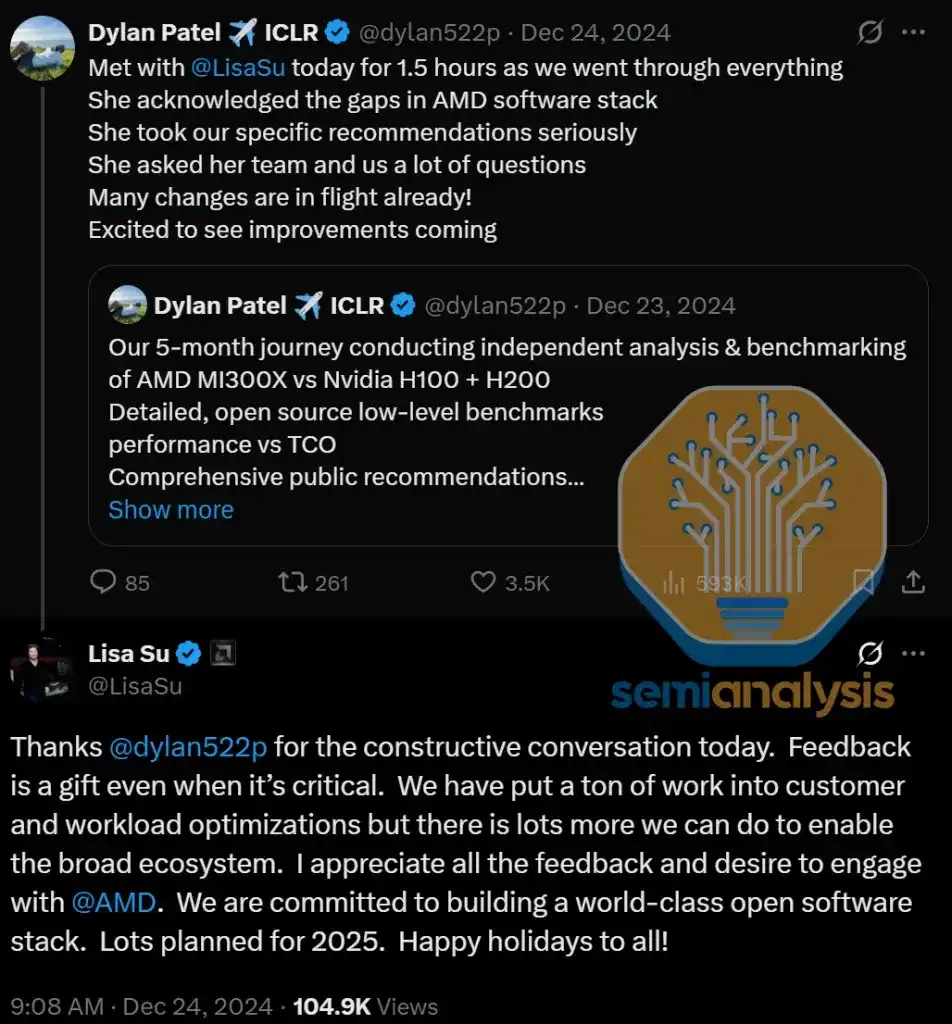
High praise and positive response from AMD CEO Lisa Su

In April 2025, SemiAnalysis againpublished a follow-up reportstating 'Over four months later, AMD is accelerating progress in ROCm, developer relations, CI/CD, etc. AMD MI450X is expected to beat Nvidia,' also acknowledging AMD's subsequent improvements, becoming a landmark case of its 'independent research directly influencing major company decisions.'

In early June, Citrini analyst Jukan forwarded parts of a SemiAnalysis research report, which indicated that 'Nvidia's next-generation AI server cluster Rubin NVL72 made significant adjustments to its memory configuration. To address tight supply chain constraints and ensure the on-time delivery of Rubin racks, the single-rack capacity was drastically reduced from the originally planned 55TB to 28TB, a reduction of about 50%, using scaled-down 96GB SOCAMM memory modules instead of the previous 192GB high-spec modules.' Possibly influenced by this news, many memory-related stocks including Micron and SK Hynix came under pressure and fell that day.

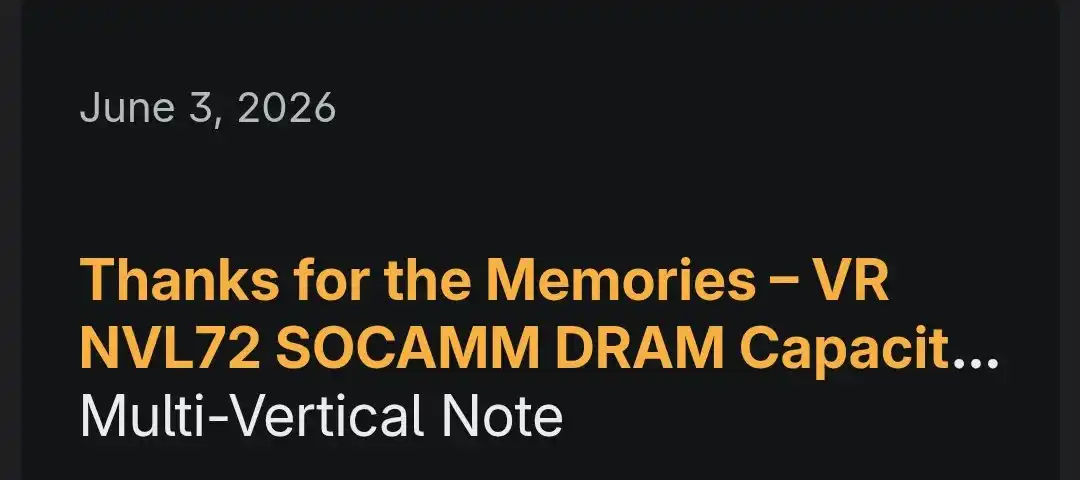
In response, Dylan stated: 'I love this: When people forward what we say, they often take it out of context. Actually, our original report did not use such a clickbait headline.' The image he subsequently posted showed the original report title was 'Thanks for the Memories...'.
In comparison, SemiAnalysis places greater emphasis on 'technical implementation details,' focusing on real bottlenecks in AI construction (power shortages, supply chain inheritance, inference scaling, Nvidia ecosystem dynamics, etc.). It often embeds realistic constraint analysis within optimistic demand judgments, making it more suitable for guiding specific investments and industrial decisions. For more details on SemiAnalysis, see 'From Community 'Hardware Geek' to AI Circle's 'Muddy Waters': How SemiAnalysis, Nearing $100 Million in Annual Revenue, Stirs the Semiconductor Market?'

Recommended Reading:

Latent Space Episode One: Scene Cooking with SemiAnalysis Founder Dylan Patel

Perguntas relacionadas

QWhat is the unique professional background of SemiAnalysis founder Dylan Patel before becoming a research analyst?

AHe worked as a beekeeper in Minnesota and was an active member on semiconductor hobbyist forums, essentially a 'forum warrior' or 'tech enthusiast' who taught himself about chips from a young age.

QHow did Dylan Patel's personal blog, SemiAnalysis, evolve into a major independent research firm?

AIt started as a small, free WordPress blog. Following a friend's advice, he moved it to Substack, implemented a paid subscription model, and gradually built a business around it, expanding into analysis, consulting, and reports. It has grown from a one-person company to a global team of about 60 people.

QWhat notable response did AMD CEO Lisa Su have after a critical SemiAnalysis report on the MI300X GPU?

ALisa Su personally contacted Dylan Patel and had a 90-minute call to discuss the report's findings. She publicly thanked him for the 'constructive feedback,' stating 'Feedback is a gift even when it's critical.'

QHow did a recent SemiAnalysis report reportedly impact the financial markets in early June 2025?

AA report excerpt, discussing potential memory configuration changes in Nvidia's upcoming Rubin server, was circulated. This was interpreted as signaling supply chain issues and led to a drop in the stock prices of memory-related companies like Micron and SK Hynix.

QWhat are the primary revenue sources for SemiAnalysis as of 2025, and what is its projected revenue?

AIts revenue primarily comes from subscriptions, models, and consulting services for hyperscalers, semiconductor giants, startups, and institutions. It reportedly achieved $20 million in revenue last year and is projected to surpass $100 million in 2025.

Leituras Relacionadas

Coin-Equity Barometer | Strategy Sells 1,638 BTC for $105 Million; Michael Saylor Reiterates He Has Not Sold Any Bitcoin, Strategy's Trading Activity Unrelated to Personal Holdings (August 4th)

**Summary: Cryptocurrency & Stock Market Update (August 4th)** Global stock markets remain under pressure, with Korean markets facing liquidity outflows and US tech stocks showing mixed results during earnings season. Major US cloud providers (Microsoft, Amazon, Google) saw gains, reinforcing their pivotal role amid computing, energy, and storage demands. In crypto-related stocks, Coinbase and Strategy traded lower post-earnings, while Robinhood demonstrated strong long-term potential despite short-term declines. Key BTC Treasury Corporate Activity: * Global publicly listed companies (excluding miners) were net sellers of Bitcoin, with a weekly net outflow reaching $101 million. * **Strategy** sold 1,638 BTC for approximately $105 million, reducing its holdings to 842,138 BTC. Concurrently, it repurchased $81.2 million of its preferred stock. * Michael Saylor clarified he has **never sold any of his personal Bitcoin holdings**, stressing that Strategy's corporate treasury management is separate from his personal long-term investment philosophy. * Several other companies, including Strive, OrangeBTC, and Capital B, reported new Bitcoin purchases last week. * Hyperscale Data sold 100 BTC to establish a Bitcoin-backed credit facility for AI infrastructure funding. ETH Treasury Corporate Activity: * **Bitmine** significantly increased its Ethereum position, adding 10,399 ETH last week for a total holding of ~5.79 million ETH. * The company continues active staking, recently staking 28.8k ETH via Coinbase Prime and an additional 150.1k ETH directly, with roughly 87% of its total ETH now staked. Other Developments: * Nasdaq-listed **Solmate** partnered with Kraken Institutional for SOL staking and validator infrastructure support. * The total BTC held by tracked public companies (excluding miners) stands at 1,138,643 BTC, valued at ~$72.42 billion (5.7% of circulating supply). *(Note: Content is for informational purposes only and not investment advice.)*

marsbitMesmo agora

Coin-Equity Barometer | Strategy Sells 1,638 BTC for $105 Million; Michael Saylor Reiterates He Has Not Sold Any Bitcoin, Strategy's Trading Activity Unrelated to Personal Holdings (August 4th)

marsbitMesmo agora

Analog Chips Are Picking Up

The analog chip market is showing signs of recovery, as evidenced by strong Q2 2026 earnings and guidance from major players like TI, STMicroelectronics, NXP, and onsemi. Revenue growth, improved order backlogs, and declining inventory levels across the supply chain indicate the start of a new upward cycle. Industrial markets led the recovery, followed by data centers and a notable pickup in automotive demand in Q2. The rebound is broad-based but uneven, with specific product areas like automotive analog, power management, and AI server power chains seeing tighter supply and pricing power, while consumer-focused and general-purpose segments remain competitive. A critical turning point is the normalization of inventory. After a prolonged multi-level destocking phase from OEMs to end customers, channel inventories have returned to healthy levels (e.g., NXP at 11 weeks). This has triggered restocking, particularly in automotive, and is now being supplemented by genuine end-demand from new system designs. AI is emerging as a key growth driver, creating new demand in two areas: 1) high-power data center infrastructure (power conversion, thermal management, signal integrity for GPUs, and optical modules) and 2) "Physical AI" in automotive, robotics, and industrial equipment (sensors, motor drivers, power management). This provides a growth vector less dependent on traditional consumer cycles. While some price increase notices have been issued, the revenue impact in Q3 is expected to be minimal, with volume driving growth. The recovery's sustainability will depend on the strength of underlying end-demand now taking over from inventory replenishment.

marsbitHá 5m

Analog Chips Are Picking Up

marsbitHá 5m

From 'Speculative Asset' to 'Next-Generation Financial Backbone': Is Crypto Evolving into a New TradFi World?

From "Speculative Asset" to "Next-Generation Financial Infrastructure": Is Crypto Evolving a New TradFi World? The crypto industry has long been dominated by the question: "What's the next asset to rise?" However, since 2026, a confluence of developments across different sectors suggests a fundamental shift. Crypto's capabilities in issuance, custody, trading, payment, and settlement are evolving beyond serving crypto assets themselves and are beginning to serve broader financial activities and the machine economy. A new layer of infrastructure is emerging beneath the speculative market. This transformation is driven by several key components reaching maturity and beginning to interconnect: 1. **Stablecoins as Programmable Money Interfaces:** Evolving from a tool for crypto trading, stablecoins are becoming a programmable form of money that applications can directly integrate and call like an API, facilitating global, 24/7 payments and settlements. 2. **RWA (Real-World Assets) as Programmable Objects:** Tokenization is moving beyond simple asset mapping. Initiatives like DTCC and Nasdaq are working to connect tokenized securities with real-world ownership, custody, and legal rights, allowing blockchain to host parts of traditional asset lifecycles. 3. **Prediction Markets for Price Discovery:** These markets aggregate dispersed information into real-time probability prices for future events, providing a price discovery layer that traditional finance often lacks. 4. **AI Agents as Economic Actors:** AI agents capable of autonomous decision-making are becoming new economic participants. Their need for frequent, low-value, automated payments is a natural fit for stablecoins and low-cost blockchains. Together, these elements form the early layers of a potential next-generation financial infrastructure: asset issuance/mapping, 24/7 payment/settlement, continuous trading/price discovery, and identity/permission management. The regulatory conversation is also shifting from whether crypto should exist to defining rules for its operation. However, the journey from a functional system to a reliable, widely-trusted infrastructure is long. Critical challenges remain, including establishing legal finality for on-chain actions, defining liability boundaries for AI agents, overcoming liquidity fragmentation, ensuring privacy for institutional use, and building the complex credit and risk management frameworks inherent to traditional finance. In summary, while speculation remains, crypto is undeniably building foundational capabilities beneath it. The most significant trend of 2026 is not a single breakout sector, but the convergence of previously independent pieces—programmable assets and money, continuous markets, autonomous software agents, and clearer regulation—into a more coherent system for real-world financial activity.

marsbitHá 10m

From 'Speculative Asset' to 'Next-Generation Financial Backbone': Is Crypto Evolving into a New TradFi World?

marsbitHá 10m

NEAR Co-Founder Proposes Creation of Protocol Sovereign Fund

NEAR co-founder Ilya Polosukhin has proposed creating a sovereign protocol fund to support ecosystem development through targeted funding. The fund aims to improve the project's sustainability, moving away from the current model where most L1 blockchains, including NEAR, pay for network security via token inflation, diluting non-staking holders. Inspired by sovereign wealth funds in countries like Singapore and Norway, the NEAR fund would use protocol revenue and treasury assets to generate yield, covering security costs and other public goods, ultimately aiming to lower inflation and potentially transition to a fixed token supply model. The initial phase would involve allocating around 30 million NEAR (approximately $50 million) to the fund. It would use protocol revenue to buy back NEAR and invest in yield-generating protocols. Profits would fund ecosystem initiatives like validator support and MPC provider payments. Unlike traditional sovereign funds holding fiat assets, this fund would primarily hold NEAR tokens, introducing additional risk that Polosukhin believes can be mitigated through diversified yield strategies. Token holders could participate in the fund's returns via the existing House of Stake delegation mechanism. The launch is planned to be gradual, with checkpoints to verify the model's effectiveness before allocating more capital. Polosukhin has opened the proposal for a two-week community discussion, emphasizing that final parameters will be determined by stakeholders, including validators and token holders.

cryptonews.ruHá 13m

NEAR Co-Founder Proposes Creation of Protocol Sovereign Fund

cryptonews.ruHá 13m

Trading

Spot
活动图片