Is the MicroStrategy Model Failing? Imitator Holding 30,000 Bitcoins Sees Pre-IPO Investors Backing Out

marsbitPublicado em 2026-07-13Última atualização em 2026-07-13

Resumo

"The 'Bitcoin Treasury' model is facing a critical test. BSTR Holdings, a company founded by Adam Back and holding 30,021 Bitcoin, has called off its planned merger with SPAC Cantor Equity Partners I. The deal, which would have taken it public, fell apart as the attached private investment (PIPE) financing collapsed. This failure highlights a core vulnerability of the 'Bitcoin accumulation company' strategy popularized by MicroStrategy. The model relies on a key metric: mNAV, or the premium of a company's stock market value over the value of its Bitcoin holdings. This premium fuels a cycle where companies issue shares at a premium, use the cash to buy more Bitcoin, and theoretically increase the Bitcoin per share for investors. However, with Bitcoin's price down roughly 49% from its late-2024 peak, this premium has evaporated across the sector. Companies like American Bitcoin and Metaplanet are also under severe pressure. For BSTR, the lack of premium meant investors were unwilling to fund the original deal structure at the proposed terms. The companies are now renegotiating. The next SEC filing detailing any new agreement will be a crucial indicator. It will show if the model can be repriced for a low-premium environment by preserving Bitcoin holdings and investor commitments, or if it requires significantly diluting shareholders and scaling back ambitions. The outcome is a public stress test for the entire 'Bitcoin treasury' investment thesis."

Author: Claude, Deep Tide TechFlow

Deep Tide Introduction: On July 8, BSTR, the bitcoin treasury company of Blockstream co-founder Adam Back, and SPAC company Cantor Equity Partners I (Nasdaq: CEPO) jointly announced they would not complete the merger as per the original agreement dated July 2025, and the private placement (PIPE) tied to the transaction is no longer required to be completed. The special shareholder meeting originally scheduled for July 10 is postponed indefinitely. This deal was supposed to bring 30,021 bitcoins and up to $1.5 billion in cash PIPE funding to the public market. Bitcoin is currently around $64,000, nearly halved from its all-time high of $126,000 in October last year. With the stock price premium that fueled the 'bitcoin-holding company' model gone, whether this financing machine can restart depends on the next SEC filing.

Adam Back, inventor of Hashcash, holds 30,000 bitcoins but cannot raise money in the capital markets.

On July 8, Cantor Equity Partners I filed an 8-K form with the SEC, disclosing it and BSTR Holdings were discussing a revised transaction structure and terms to 'better reflect current market conditions.' The most critical sentence in the filing is: both parties will not complete the transaction under the original merger agreement dated July 16, 2025, and the private placement tied to this transaction is no longer required to be completed.

A company announcement issued the same day added two points: the special shareholder meeting originally scheduled for July 10 is postponed indefinitely; public shares for which redemption requests have been submitted will be returned and not redeemed.

Bitcoin hasn't crashed; what has crashed is the financing structure built to buy it.

The Original Scale: 30,000 Bitcoins

BSTR's selling point from the start was scale.

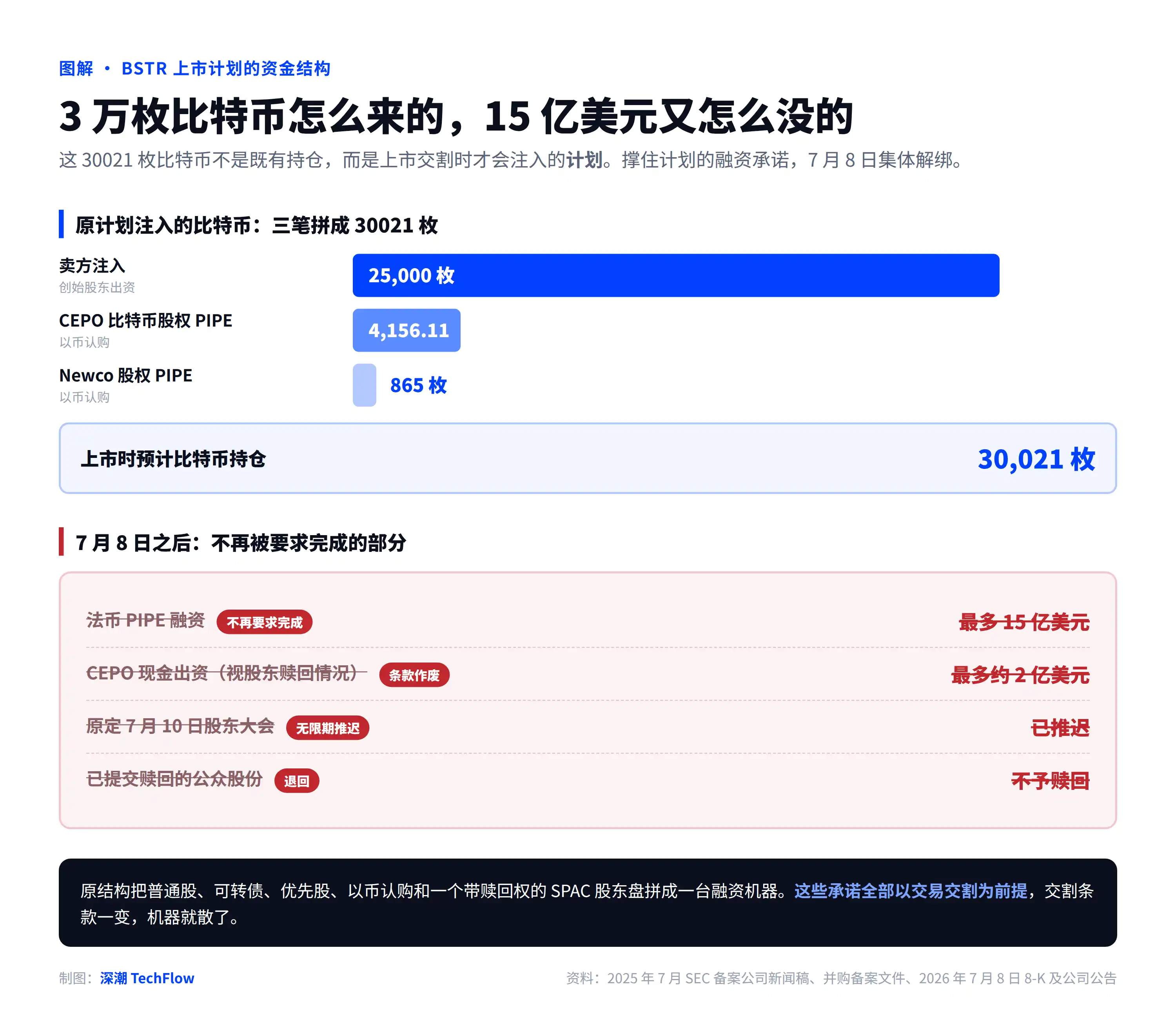
According to a company press release submitted to the SEC in July 2025, BSTR expected its balance sheet upon listing to include 30,021 bitcoins, plus up to $1.5 billion in cash PIPE financing, 5,021 bitcoins for an in-kind PIPE, 25,000 bitcoins from founding shareholders, and up to approximately $200 million in cash from Cantor Equity Partners I (depending on shareholder redemptions).

The number 30,021 is not a single block; detailed merger documents break it into three parts: 25,000 from sellers, 4,156.11 from the CEPO bitcoin equity PIPE, and 865 from the Newco equity PIPE. Additionally, there were cash equity, convertible notes, preferred stock, and bitcoin-denominated subscription commitments, all contingent on the successful closing of the transaction.

These commitments were the true load-bearing walls. They turned a pile of bitcoin into a financing machine for the public markets: common stock, convertible notes, preferred stock, bitcoin subscriptions, plus a SPAC shareholder base with redemption rights—five funding sources pieced together.

Adam Back himself served as CEO of BSTR, and the transaction narrative revolved around 'Bitcoin per share' rather than simply passive holding.

After the July 8 announcement said the private placement didn't have to be completed, the question became whether new terms could bring these funds back.
The Engine is Stock Premium, Not Bitcoin

The operating logic of the 'bitcoin-holding company' model is actually separate from whether bitcoin rises.

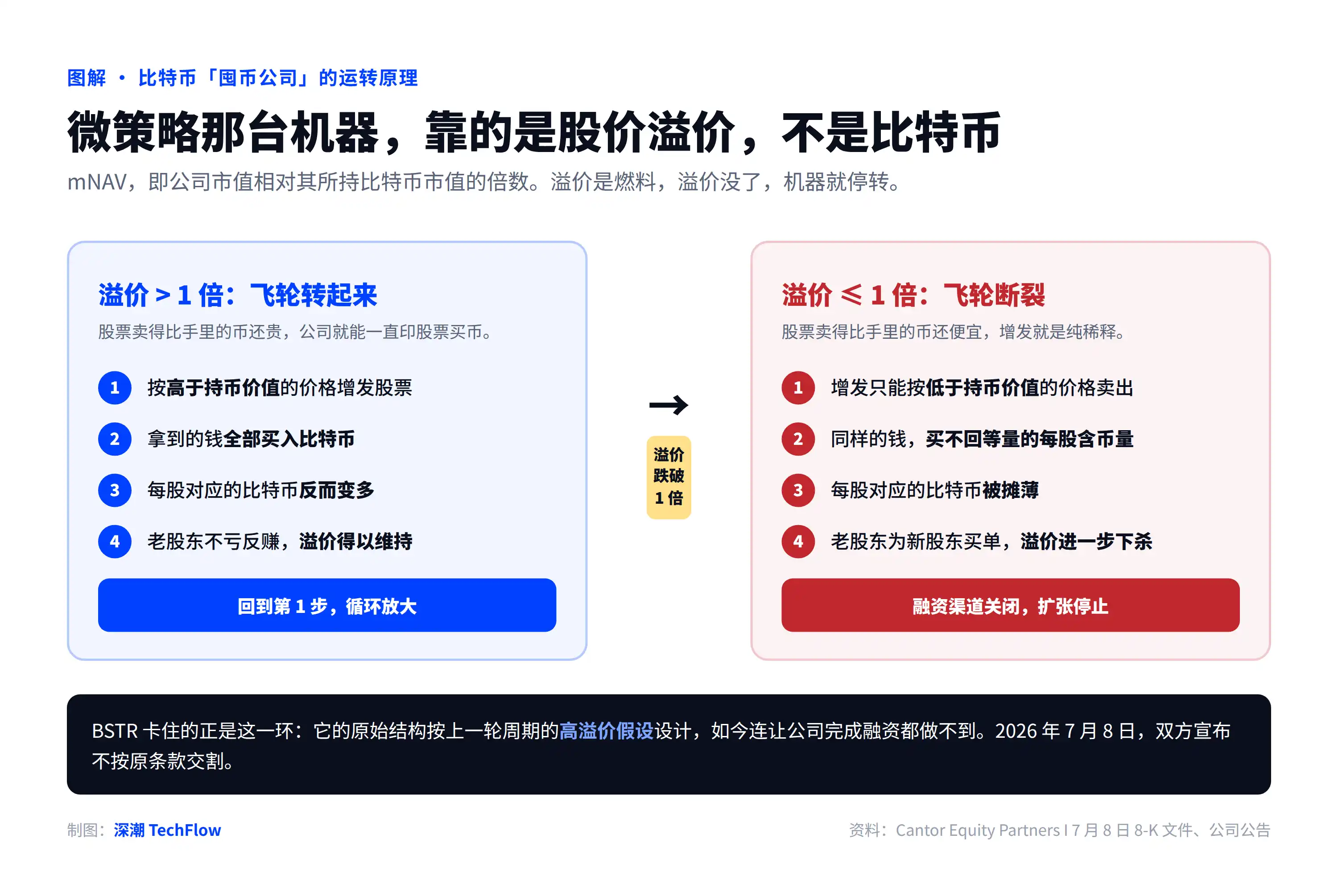
The key metric is mNAV, meaning the company's stock market capitalization relative to the market value of the bitcoin it holds. A company with a market cap double its bitcoin holdings has an mNAV of 2. This premium is the fuel for the entire machine: the company issues shares at a price above net asset value, uses the money to buy more bitcoin, the bitcoin per share actually increases, shareholders profit rather than lose, and the cycle repeats. MicroStrategy (now Strategy) was built by rolling this cycle.

Once the premium converges to 1x or even falls below 1x, this cycle breaks. Issuing shares to buy bitcoin no longer increases bitcoin per share but dilutes existing shareholders. The machine stops.

This is precisely BSTR's problem. The original structure was designed based on premium assumptions from the last cycle, and those assumptions are no longer something anyone is willing to pay for. So this isn't about 'whether the stock can maintain its premium after listing,' but rather that the premium assumption cannot even get the company to complete its financing.
The Entire Sector is Under Pressure

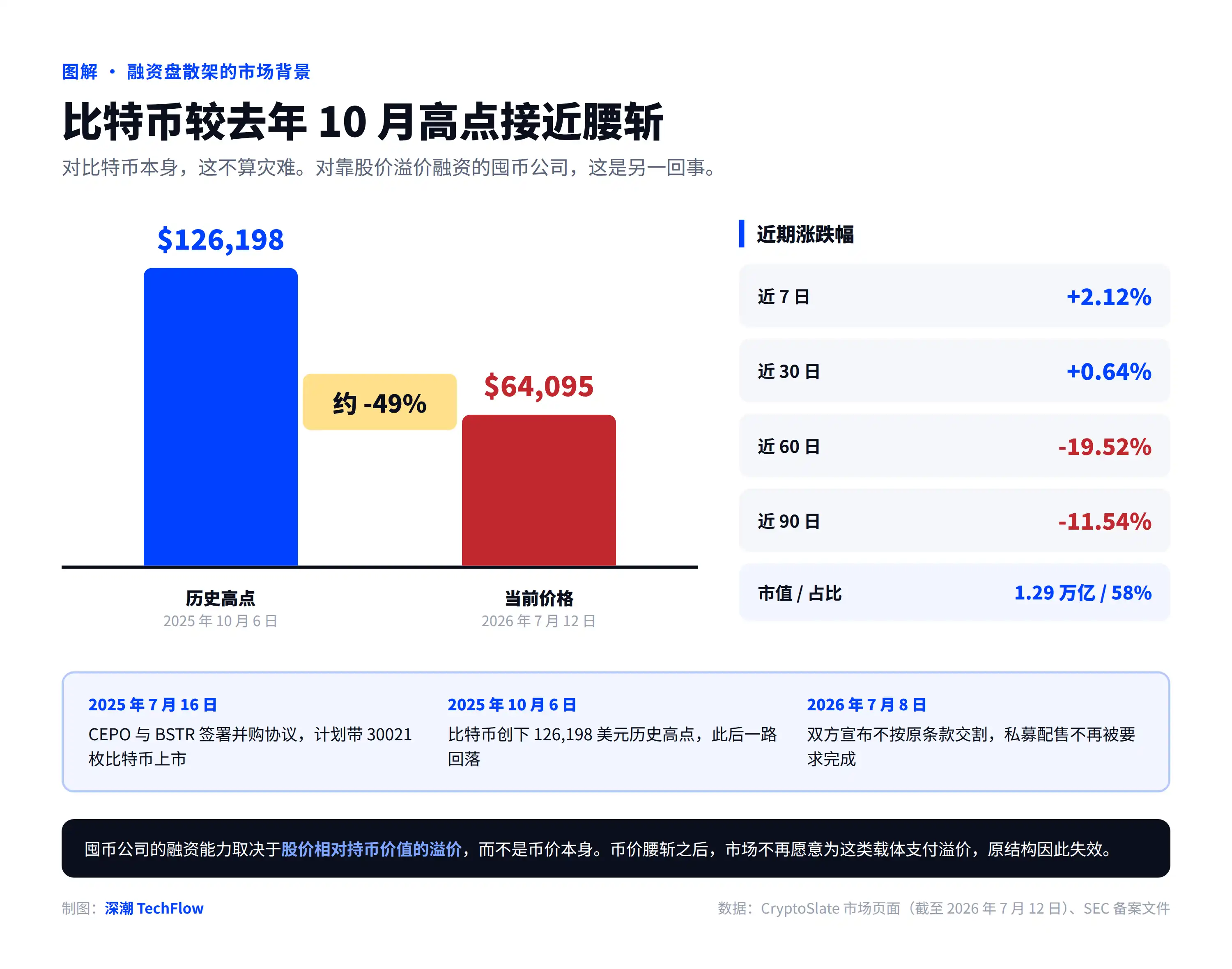
Bitcoin was quoted around $64,000 on July 12, with a market cap of about $1.27 trillion, accounting for roughly 58% of the crypto market. This price has fallen about 49% from the all-time high of $126,200 set on October 6 last year, down about 19.5% over the past 60 days.

For bitcoin itself, this is not a disaster. For bitcoin-holding companies relying on premium financing, it's another story.

Other news from the same week serves as a reference. American Bitcoin, involving Eric Trump, was forced to implement a 1-for-15 reverse stock split to maintain Nasdaq's minimum bid price requirement; it holds about 8,000 bitcoins. Strategy's preferred stock fell below par value in June. Metaplanet's stock price is already below the value of its bitcoin holdings. In early July, another US bitcoin-holding company liquidated its entire bitcoin holdings under debt and Nasdaq compliance pressures.

Meanwhile, money is flowing elsewhere. AI computing company CoreWeave just completed a $20 billion financing round.
The Next SEC Filing is the Real Verdict

Cantor and BSTR are still negotiating; the original terms are void.

If the two parties reach a new agreement, a new SEC filing will amend or supplement the registration statement and proxy materials. That filing will answer three questions: how much of the 30,021 bitcoin scale remains, how much of the original PIPE commitments remain, and at what price investors are now willing to put in money.

According to market data cited by TFTC, CEPO's stock price is currently around $10.50, close to its trust value. This position itself is a signal: the market is not assigning any premium to this transaction.

The risk factors listed in the July 8 filing are almost a negotiation checklist: public shareholder redemptions, public float percentage, liquidity, exchange listing, bitcoin price volatility, competition, regulatory uncertainty, and difficulty in expanding bitcoin accumulation and treasury operations.

For readers holding bitcoin-holding stocks, the implications are twofold:

If the new agreement preserves the 30,000 bitcoin scale, retains substantial investor commitments, and does not heavily transfer costs to new shareholders, it means this model can be repriced in a low-premium environment without dying.

If the new terms reduce the bitcoin holding scale, increase funding costs, weaken investor protections, or rely more on dilution to raise money, it means the next batch of bitcoin-holding companies can no longer feast on the premium红利 left by the last cycle. Those buying such stocks are essentially paying for someone else's restructuring.

BSTR is now a public stress test for the entire sector. The test results will be written in the next SEC filing.


Criptomoedas em alta

Perguntas relacionadas

QWhat was the core reason behind the failure of the original merger and PIPE financing deal for BSTR Holdings?

AThe original financing structure, based on assumptions of a significant premium to the company's net asset value (the 'mNAV' multiple), failed to attract investors in the current market. The 'premium' that fuels the 'Bitcoin hoarding company' model had vanished, making the deal unattractive. Investors were no longer willing to pay the expected price.

QWhat is the 'mNAV' multiple and why is it crucial for companies like BSTR and MicroStrategy?

AThe 'mNAV' (Market-to-Net Asset Value) multiple is the ratio of a company's market capitalization to the market value of the Bitcoin it holds. A premium (mNAV > 1) is crucial as it allows these companies to issue new shares at a price above their underlying Bitcoin value. The proceeds are used to buy more Bitcoin, increasing the Bitcoin-per-share metric for all shareholders. This self-reinforcing cycle is the core engine of their business model.

QWhat are the two possible interpretations for investors depending on the new terms BSTR negotiates?

A1. If the new terms preserve the 30,000 Bitcoin scale, retain substantial investor commitments, and don't heavily transfer costs to new shareholders, it signals the model can be re-priced and survive in a low-premium environment. 2. If the terms reduce the Bitcoin holdings, increase financing costs, weaken investor protections, or rely heavily on shareholder dilution, it signifies that future 'hoarding companies' can no longer benefit from past-cycle premiums. Buying such stock would mean investors are essentially paying for the company's restructuring.

QAccording to the article, what broader market trends are putting pressure on the 'Bitcoin hoarding company' sector?

AThe entire sector is under pressure as the premium (mNAV multiple) has collapsed across the board. Examples include American Bitcoin resorting to a reverse stock split, MicroStrategy's (Strategy) preferred shares trading below par, Metaplanet's stock trading below its Bitcoin holdings value, and another unnamed U.S. company liquidating its Bitcoin treasury due to debt and compliance pressures. Meanwhile, capital is flowing to other sectors like AI (e.g., CoreWeave's $20B funding round).

QWhat key information will be revealed in BSTR's next major SEC filing?

AThe next significant SEC filing, which would contain a revised or amended registration statement, will reveal: 1) How much of the originally planned 30,021 Bitcoin scale remains, 2) How many of the original PIPE financing commitments are still in place, and 3) What price or terms investors are now demanding to provide capital. This document will serve as the verdict on whether the model can be restructured successfully.

Leituras Relacionadas

The Success of Robinhood Chain Proves Ethereum Is Not Dead

The article argues that Robinhood's decision to build its own dedicated blockchain, Robinhood Chain, as an Ethereum Layer 2 (L2) using Arbitrum technology is a powerful endorsement of Ethereum's L1+L2 model, not a rejection of it. This move reflects a broader shift in the crypto industry from projects focused on token monetization to real-world businesses building cash-generating operations. Historically, many crypto projects chose infrastructure to support token sales and speculative value. In contrast, businesses like Robinhood and Coinbase (with Base) choose infrastructure based on commercial needs: security, liquidity, customer reach, and control. Ethereum's model provides a trusted, neutral, and liquid global settlement layer (L1) coupled with customizable, high-performance execution environments (L2s). This allows companies to maintain control and specialization without the cost and risk of building an independent L1 from scratch. The author contends that as more traditional enterprises enter the space to build sustainable businesses, they will rationally select Ethereum's L1 for maximum security and liquidity and its L2s for scalability and customization. This trend strengthens Ethereum's network effects and the utility of ETH as the native gas and asset within this expanding ecosystem. Robinhood's choice is thus seen as a landmark example of pragmatic business strategy aligning with Ethereum's architectural strengths.

marsbitHá 39m

The Success of Robinhood Chain Proves Ethereum Is Not Dead

marsbitHá 39m

South Korean Broker's 'Below-Expectations' Forecast Triggers 12% Plunge in SK Hynix, Putting Pressure on Entire Storage Sector

South Korean brokerage KIS released a forecast for SK Hynix's Q2 2026 earnings, predicting operating profit of 60.4 trillion won, up 556% year-over-year. However, this figure was about 8% below the market consensus of 65 trillion won. The shortfall was attributed to SK Hynix's high proportion of HBM (High Bandwidth Memory) revenue. HBM is typically sold under long-term agreements (LTAs) with fixed prices, which limited the company's average selling price (ASP) growth compared to the soaring spot market prices for standard DRAM and NAND. KIS emphasized this was a methodological adjustment to include LTA pricing, not a fundamental deterioration, and maintained its buy rating and 3.8 million won target price. Nevertheless, the report triggered a sharp market sell-off. SK Hynix's stock plunged over 12%, falling below 2 million won and extending its pullback from recent highs. The sell-off spread to related assets: leveraged ETFs tracking SK Hynix and Samsung Electronics fell sharply in Hong Kong, and A-share memory stocks also declined. Analysts note the incident highlights market sensitivity to earnings misses versus high expectations. However, KIS argues the long-term investment thesis remains intact, with the industry shift toward LTAs potentially leading to more stable, sustained profitability rather than volatile quarter-to-quarter ASP gains.

链捕手Há 46m

South Korean Broker's 'Below-Expectations' Forecast Triggers 12% Plunge in SK Hynix, Putting Pressure on Entire Storage Sector

链捕手Há 46m

Want Another Bull Market? Bitcoin Needs Trillions in Fresh Capital Inflow

Title: Want Another Bull Run? Bitcoin Needs Trillions in New Capital Bitcoin has fallen 50% from its October 2025 high of $126k, now trading near $63,000. Recent on-chain reports reveal structural differences in this downturn compared to past cycles, extending beyond simple price charts. A key issue is declining capital efficiency. CryptoQuant analysis shows the capital required for price appreciation has surged dramatically. In 2011, $27 billion in net inflows drove a 55,436% gain. From 2018-2021, $36.5 billion fueled a ~2000% rise. This cycle, $69.7 billion in realized cap growth has yielded only a 689% increase. Today, an estimated $101 billion is needed to double the price, versus just $5 million in 2011. The report concludes that triggering a major bull run now likely requires over $1 trillion in new institutional capital, positioning Bitcoin as a core global asset class rather than relying on retail ETF flows. Meanwhile, supply is tightening. K33 Research notes long-term holder supply has hit a record 79% of circulating coins. Dormant bitcoin moving after 2+ years is at its lowest since 2012. Alphractal data confirms this trend, with ~830k BTC recently moving to long-term storage. This scarcity of tradable supply can amplify price moves from any new buying pressure but doesn't guarantee capital inflow. Profitability metrics signal a potential bottom. CryptoQuant's Net Realized Profit/Loss ratio has dropped to -0.35, a 43-month low matching levels seen during the 2022 FTX crash. Historically, such extremes preceded major bull markets in 2015 and 2019. The current price is only 16% above the network's realized price; historically, this has led to average gains of 41% in six months and 81% in one year. Bitcoin is testing key support near $60,000, with analysts noting a potential W-bottom pattern forming. Macro headwinds persist. U.S. spot Bitcoin ETFs saw record monthly outflows of over $4.5 billion in June. Uncertainty around Federal Reserve policy under a potential new chair and mixed economic data add pressure. While European institutional infrastructure is slowly developing (e.g., German banks offering BTC services), this is a demand factor, not an immediate liquidity catalyst. In summary, the market shows signs of bottoming: sell-side pressure is largely exhausted, supply is scarce, and metrics are at historical extremes. However, for a significant bull run akin to past cycles, unprecedented institutional capital—likely exceeding $1 trillion—is required to overcome the new reality of drastically lower capital efficiency. The decisive variable of massive new institutional inflows remains absent.

Foresight NewsHá 1h

Want Another Bull Market? Bitcoin Needs Trillions in Fresh Capital Inflow

Foresight NewsHá 1h

Trading

Spot

Artigos em Destaque

O que é BITCOIN

Compreender o HarryPotterObamaSonic10Inu (ERC-20) e a Sua Posição no Espaço Cripto Nos últimos anos, o mercado de criptomoedas assistiu a um aumento na popularidade das moedas meme, cativando não apenas os traders, mas também aqueles que procuram envolvimento comunitário e valor de entretenimento. Entre estes tokens únicos está o HarryPotterObamaSonic10Inu (ERC-20), um projeto intrigante que mistura referências culturais no tecido das criptomoedas. Este artigo explora os principais aspetos do HarryPotterObamaSonic10Inu, examinando os seus mecanismos, a sua ética orientada pela comunidade e o seu envolvimento com o vasto panorama cripto. O que é o HarryPotterObamaSonic10Inu (ERC-20)? Como o nome sugere, o HarryPotterObamaSonic10Inu é uma moeda meme construída na blockchain Ethereum, classificada sob o padrão ERC-20. Ao contrário das criptomoedas tradicionais, que podem enfatizar a utilidade prática ou o potencial de investimento, este token prospera no valor de entretenimento e na força da sua comunidade. O projeto visa promover um ambiente onde utilizadores envolvidos possam reunir-se, partilhar ideias e participar em atividades inspiradas por diversos fenómenos culturais. Uma característica notável do HarryPotterObamaSonic10Inu é a zero taxa sobre transações. Este elemento atraente visa encorajar a negociação e o envolvimento da comunidade, isento de encargos adicionais que podem desencorajar os traders de pequena escala. A oferta total da moeda está fixada em mil milhões de tokens, uma cifra que marca a sua intenção de manter uma circulação substancial dentro da comunidade. Criador do HarryPotterObamaSonic10Inu (ERC-20) As origens do HarryPotterObamaSonic10Inu estão um pouco envoltas em mistério; os detalhes sobre o criador permanecem desconhecidos. O desenvolvimento deste token carece de uma equipa identificável ou de um plano explícito, o que não é raro no setor das moedas meme. Em vez disso, o projeto surgiu de forma orgânica, com o seu progresso a depender fortemente do entusiasmo e da participação da sua comunidade. Investidores do HarryPotterObamaSonic10Inu (ERC-20) No que diz respeito a investimentos externos e apoios, o HarryPotterObamaSonic10Inu também permanece ambíguo. O token não lista quaisquer fundações de investimento conhecidas ou apoio organizacional significativo. Em vez disso, o “sangue vital” do projeto é a sua comunidade de base, que informa o seu crescimento e sustentabilidade através da ação coletiva e do envolvimento no espaço cripto. Como Funciona o HarryPotterObamaSonic10Inu (ERC-20)? Como uma moeda meme, o HarryPotterObamaSonic10Inu opera principalmente fora dos quadros tradicionais que muitas vezes governam o valor dos ativos. Existem vários aspetos distintivos que definem como o projeto funciona: Transações Sem Taxas: Sem taxas sobre transações, os utilizadores podem comprar e vender o token livremente, sem a preocupação de custos ocultos. Envolvimento da Comunidade: O projeto prospera na interação da comunidade, aproveitando plataformas de redes sociais para criar entusiasmo e facilitar a participação. Discussões, partilha de conteúdo e envolvimento são elementos cruciais que ajudam a expandir o seu alcance e a fomentar a lealdade entre os apoiantes. Sem Utilidade Prática: Deve ser notado que o HarryPotterObamaSonic10Inu não oferece utilidade concreta dentro do ecossistema financeiro. Em vez disso, é classificado como um token principalmente para entretenimento e atividades comunitárias. Referência Cultural: O token incorpora de forma inteligente elementos da cultura popular para atrair interesse, conectando-se tanto com entusiastas de memes como com seguidores de criptomoedas. HarryPotterObamaSonic10Inu exemplifica como as moedas meme operam de forma diferente de projetos de criptomoedas mais tradicionais, entrando no mercado como construções sociais inovadoras em vez de ativos utilitários. Linha do Tempo do HarryPotterObamaSonic10Inu (ERC-20) A história do HarryPotterObamaSonic10Inu é marcada por vários marcos notáveis: Criação: O token surgiu de um meme viral, capturando a imaginação de muitos entusiastas de criptomoedas. Datas específicas de criação não estão disponíveis, sublinhando a sua ascensão orgânica. Listagem em Exchanges: O HarryPotterObamaSonic10Inu conseguiu entrar em várias exchanges, permitindo um acesso e negociação mais fáceis pela comunidade. Iniciativas de Envolvimento da Comunidade: Atividades contínuas direcionadas a melhorar a interação comunitária, incluindo concursos, campanhas em redes sociais e geração de conteúdo por fãs e defensores. Planos de Expansão Futura: O roteiro do projeto inclui o lançamento de uma coleção de NFTs, mercadorias e um site de eCommerce relacionado aos seus temas culturais, envolvendo ainda mais a comunidade e tentando adicionar mais dimensões ao seu ecossistema. Pontos-Chave sobre o HarryPotterObamaSonic10Inu (ERC-20) Natureza Orientada pela Comunidade: O projeto prioriza a contribuição coletiva e a criatividade, assegurando que o envolvimento dos utilizadores está na vanguarda do seu desenvolvimento. Classificação como Moeda Meme: Representa o epítome da criptomoeda baseada em entretenimento, destacando-se dos veículos de investimento tradicionais. Sem Afiliação Direta com o Bitcoin: Apesar da semelhança no nome do ticker, o HarryPotterObamaSonic10Inu é distinto e não tem qualquer relação com o Bitcoin ou outras criptomoedas estabelecidas. Foco na Colaboração: O HarryPotterObamaSonic10Inu é projetado para criar um espaço de colaboração e partilha de histórias entre os seus detentores, proporcionando uma via para a criatividade e o fortalecimento da comunidade. Perspectivas Futuras: A ambição de expandir além da sua premissa inicial para NFTs e mercadorias delineia um caminho para o projeto potencialmente entrar em avenidas mais mainstream dentro da cultura digital. À medida que as moedas meme continuam a capturar a imaginação da comunidade cripto, HarryPotterObamaSonic10Inu (ERC-20) destaca-se devido aos seus laços culturais e abordagem centrada na comunidade. Embora possa não se encaixar no molde típico de um token orientado para utilidade, a sua essência reside na alegria e camaradagem fomentadas entre os seus apoiantes, destacando a natureza em evolução das criptomoedas em uma era cada vez mais digital. À medida que o projeto continua a desenvolver-se, será importante observar como as dinâmicas comunitárias influenciam a sua trajetória no panorama em constante mudança da tecnologia blockchain.

1.7k Visualizações TotaisPublicado em {updateTime}Atualizado em 2024.12.03

O que é BITCOIN

Como comprar BTC

Bem-vindo à HTX.com!Tornámos a compra de Bitcoin (BTC) simples e conveniente.Segue o nosso guia passo a passo para iniciar a tua jornada no mundo das criptos.Passo 1: cria a tua conta HTXUtiliza o teu e-mail ou número de telefone para te inscreveres numa conta gratuita na HTX.Desfruta de um processo de inscrição sem complicações e desbloqueia todas as funcionalidades.Obter a minha contaPasso 2: vai para Comprar Cripto e escolhe o teu método de pagamentoCartão de crédito/débito: usa o teu visa ou mastercard para comprar Bitcoin (BTC) instantaneamente.Saldo: usa os fundos da tua conta HTX para transacionar sem problemas.Terceiros: adicionamos métodos de pagamento populares, como Google Pay e Apple Pay, para aumentar a conveniência.P2P: transaciona diretamente com outros utilizadores na HTX.Mercado de balcão (OTC): oferecemos serviços personalizados e taxas de câmbio competitivas para os traders.Passo 3: armazena teu Bitcoin (BTC)Depois de comprar o teu Bitcoin (BTC), armazena-o na tua conta HTX.Alternativamente, podes enviá-lo para outro lugar através de transferência blockchain ou usá-lo para transacionar outras criptomoedas.Passo 4: transaciona Bitcoin (BTC)Transaciona facilmente Bitcoin (BTC) no mercado à vista da HTX.Acede simplesmente à tua conta, seleciona o teu par de trading, executa as tuas transações e monitoriza em tempo real.Oferecemos uma experiência de fácil utilização tanto para principiantes como para traders experientes.

4.3k Visualizações TotaisPublicado em {updateTime}Atualizado em 2026.06.02

Como comprar BTC

O que é $BITCOIN

OURO DIGITAL ($BITCOIN): Uma Análise Abrangente Introdução ao OURO DIGITAL ($BITCOIN) OURO DIGITAL ($BITCOIN) é um projeto baseado em blockchain que opera na rede Solana, com o objetivo de combinar as características dos metais preciosos tradicionais com a inovação das tecnologias descentralizadas. Embora partilhe um nome com o Bitcoin, frequentemente referido como “ouro digital” devido à sua percepção como uma reserva de valor, o OURO DIGITAL é um token separado projetado para criar um ecossistema único dentro da paisagem Web3. O seu objetivo é posicionar-se como um ativo digital alternativo viável, embora os detalhes sobre as suas aplicações e funcionalidades ainda estejam em desenvolvimento. O que é o OURO DIGITAL ($BITCOIN)? OURO DIGITAL ($BITCOIN) é um token de criptomoeda explicitamente projetado para uso na blockchain Solana. Em contraste com o Bitcoin, que fornece um papel amplamente reconhecido como armazenamento de valor, este token parece focar em aplicações e características mais amplas. Aspectos notáveis incluem: Infraestrutura Blockchain: O token é construído na blockchain Solana, conhecida pela sua capacidade de lidar com transações de alta velocidade e baixo custo. Dinâmicas de Oferta: O OURO DIGITAL tem um fornecimento máximo limitado a 100 quatrilhões de tokens (100P $BITCOIN), embora os detalhes sobre o seu fornecimento circulante ainda não tenham sido divulgados. Utilidade: Embora as funcionalidades precisas não estejam explicitamente delineadas, existem indicações de que o token poderia ser utilizado para várias aplicações, potencialmente envolvendo aplicações descentralizadas (dApps) ou estratégias de tokenização de ativos. Quem é o Criador do OURO DIGITAL ($BITCOIN)? Neste momento, a identidade dos criadores e da equipa de desenvolvimento por trás do OURO DIGITAL ($BITCOIN) permanece desconhecida. Esta situação é típica entre muitos projetos inovadores no espaço da blockchain, particularmente aqueles alinhados com finanças descentralizadas e fenómenos de moedas meme. Embora tal anonimato possa fomentar uma cultura orientada pela comunidade, intensifica as preocupações sobre governança e responsabilidade. Quem são os Investidores do OURO DIGITAL ($BITCOIN)? As informações disponíveis indicam que o OURO DIGITAL ($BITCOIN) não tem apoiantes institucionais conhecidos ou investimentos proeminentes de capital de risco. O projeto parece operar num modelo peer-to-peer focado no apoio e adoção da comunidade, em vez de rotas de financiamento tradicionais. A sua atividade e liquidez estão principalmente situadas em exchanges descentralizadas (DEXs), como a PumpSwap, em vez de plataformas de negociação centralizadas estabelecidas, destacando ainda mais a sua abordagem de base. Como Funciona o OURO DIGITAL ($BITCOIN) A mecânica operacional do OURO DIGITAL ($BITCOIN) pode ser elaborada com base no seu design de blockchain e nas características da rede: Mecanismo de Consenso: Ao aproveitar o exclusivo proof-of-history (PoH) da Solana combinado com um modelo de proof-of-stake (PoS), o projeto assegura uma validação eficiente das transações, contribuindo para o alto desempenho da rede. Tokenomics: Embora mecanismos deflacionários específicos não tenham sido extensivamente detalhados, o vasto fornecimento máximo de tokens implica que pode atender a microtransações ou casos de uso de nicho que ainda estão por definir. Interoperabilidade: Existe o potencial para integração com o ecossistema mais amplo da Solana, incluindo várias plataformas de finanças descentralizadas (DeFi). No entanto, os detalhes sobre integrações específicas permanecem não especificados. Cronologia de Eventos Chave Aqui está uma cronologia que destaca marcos significativos relacionados ao OURO DIGITAL ($BITCOIN): 2023: O lançamento inicial do token ocorre na blockchain Solana, marcado pelo seu endereço de contrato. 2024: O OURO DIGITAL ganha visibilidade ao tornar-se disponível para negociação em exchanges descentralizadas como a PumpSwap, permitindo que os utilizadores o negociem contra SOL. 2025: O projeto testemunha atividade de negociação esporádica e potencial interesse em envolvimentos liderados pela comunidade, embora não tenham sido documentadas parcerias ou avanços técnicos notáveis até ao momento. Análise Crítica Forças Escalabilidade: A infraestrutura subjacente da Solana suporta altos volumes de transações, o que pode aumentar a utilidade do $BITCOIN em vários cenários de transação. Acessibilidade: O potencial preço de negociação baixo por token pode atrair investidores de retalho, facilitando uma participação mais ampla devido a oportunidades de propriedade fracionada. Riscos Falta de Transparência: A ausência de apoiantes, desenvolvedores ou um processo de auditoria publicamente conhecidos pode gerar ceticismo em relação à sustentabilidade e confiabilidade do projeto. Volatilidade do Mercado: A atividade de negociação depende fortemente do comportamento especulativo, o que pode resultar em volatilidade significativa dos preços e incerteza para os investidores. Conclusão O OURO DIGITAL ($BITCOIN) surge como um projeto intrigante, mas ambíguo, dentro do ecossistema em rápida evolução da Solana. Embora tente aproveitar a narrativa do “ouro digital”, a sua divergência do papel estabelecido do Bitcoin como reserva de valor sublinha a necessidade de uma diferenciação mais clara da sua utilidade pretendida e estrutura de governança. A aceitação e adoção futuras dependerão provavelmente da abordagem da atual opacidade e da definição mais explícita das suas estratégias operacionais e económicas. Nota: Este relatório abrange informações sintetizadas disponíveis até outubro de 2023, e desenvolvimentos podem ter ocorrido além do período de pesquisa.

130 Visualizações TotaisPublicado em {updateTime}Atualizado em 2025.05.13

O que é $BITCOIN

Discussões

Bem-vindo à Comunidade HTX. Aqui, pode manter-se informado sobre os mais recentes desenvolvimentos da plataforma e obter acesso a análises profissionais de mercado. As opiniões dos utilizadores sobre o preço de BTC (BTC) são apresentadas abaixo.

活动图片