IREN's AI Revenue Exceeds Mining Income for the First Time

cryptonews.ruPublicado em 2026-08-28Última atualização em 2026-08-28

Resumo

For the quarter ending June 30, 2026, IREN's revenue from AI cloud services, at $70.5 million, surpassed its Bitcoin mining revenue of $66.7 million for the first time. This shift contributed to a net loss of $684 million, partly due to $450.4 million in asset impairments from repurposing mining equipment for AI. Total quarterly revenue fell 5% to $137.2 million. While AI revenue doubled, Bitcoin mining income fell by approximately 40%. The company's adjusted EBITDA also dropped 68% to $19.2 million. Other miners showed similar diversification trends. TeraWulf reported that 71% of its $44.8 million Q2 revenue came from High-Performance Computing (HPC) leasing, surpassing its $12.8 million from digital assets. Despite this, it posted a negative adjusted EBITDA and a significant net loss. Cipher Mining's revenue remained entirely from Bitcoin mining at $24.8 million, while Riot Platforms generated $174.2 million, with data centers contributing 13% of that total. The trend highlights a strategic pivot by public Bitcoin miners towards AI infrastructure, driven by rising capital expenditures and demand for energy-secure sites for high-power computing.

For the fourth quarter of the 2026 fiscal year, which ended on June 30, IREN's revenue from cloud AI services exceeded its Bitcoin mining income for the first time — $70.5 million compared to $66.7 million. This is stated in the company's announcement.

Amid the transition, IREN reported a net loss of $684 million. The figure was impacted by a non-cash impairment of assets amounting to $450.4 million, primarily related to the decommissioning of mining equipment during the repurposing of sites for AI Cloud.

The company's total quarterly revenue was $137.2 million — approximately 5% less than the previous period. Revenue from cloud AI services doubled from $33.6 million, while revenue from mining the leading cryptocurrency decreased by about 40% — from $111.2 million.

Adjusted EBITDA fell by 68% — from $59.5 million to $19.2 million. IREN explained the decline by increased personnel expenses and investments in the platform ahead of the anticipated scaling of AI Cloud.

After the publication of the report, the company's stock declined in pre-market trading.
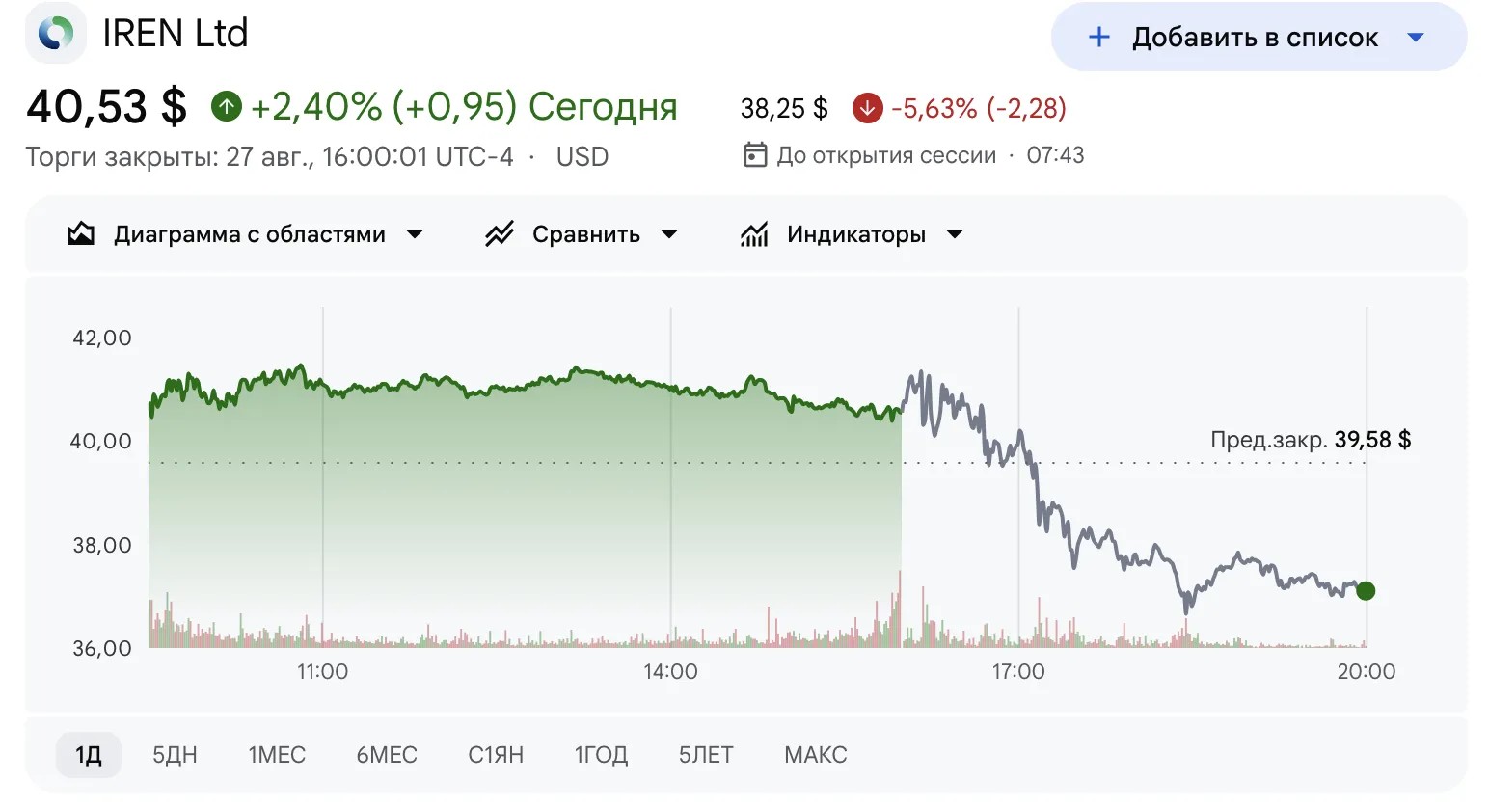
Source: Google Finance.

TeraWulf's Performance

TeraWulf generated $44.8 million in revenue in the second quarter, of which $31.9 million (about 71%) came from leasing capacity for high-performance computing (HPC). Digital assets accounted for $12.8 million; a year earlier, mining revenue reached $47.6 million.

As of the end of June, the Lake Mariner campus had 81 MW of critical IT capacity already generating revenue. Following the commissioning of the next building on July 6, this figure increased to 102 MW.

However, HPC becoming the primary source of income has not yet made TeraWulf profitable. Adjusted EBITDA was −$18.3 million compared to $14.5 million a year earlier.

The net loss attributable to TeraWulf reached $939.9 million. The main contribution came from a non-cash change in the fair value of warrants amounting to $755.7 million. An additional $56.4 million was allocated to interest expenses.

Reports from Cipher and Riot

Cipher Digital's new infrastructure did not yet generate revenue in the second quarter. The company reported $24.8 million in revenue — the entire amount came from Bitcoin mining.

Adjusted EBITDA was −$30 million, and the net loss was $267.5 million. The latter was impacted by the revaluation of warrant liabilities of $150.5 million and interest expenses of $66.7 million.

The company began handing over the first capacities of the Black Pearl data center to the customer only in August. The accrual of lease payments also started then.

Riot Platforms has already started reflecting data center revenue, but it is still significantly lower than mining income. In the second quarter, the company's total figure was $174.2 million:

  • Bitcoin mining — $113.7 million;
  • Data centers — $23.2 million;
  • Engineering — $37.3 million.

The data center segment accounted for about 13% of total revenue. However, only $4.9 million were direct lease payments, with another $18.3 million coming from services for preparing infrastructure for the lessee.
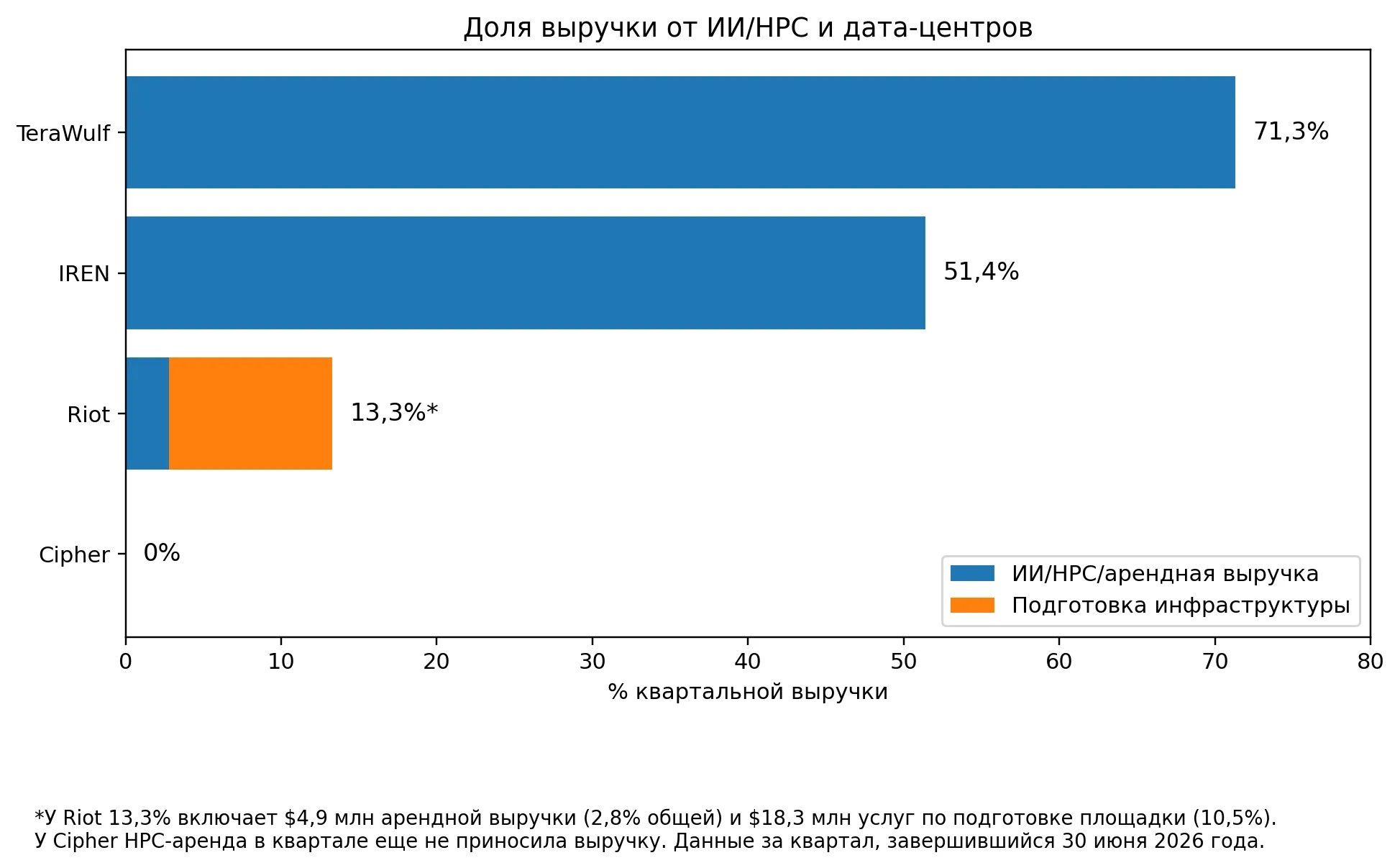
Source: IREN, TeraWulf, Cipher Digital, Riot Platforms, ForkLog.

Recall that in June, public Bitcoin miners intensified their pivot to AI infrastructure. The trend became especially noticeable against the backdrop of rising capital expenditures in the AI sector and demand for sites with access to electricity.

Miners' and AI operators' equipment costs rose to $30.7 billion
end-content

Perguntas relacionadas

QIn which quarter did IREN's AI cloud services revenue exceed bitcoin mining revenue for the first time?

AThe fourth quarter of the 2026 fiscal year, which ended on June 30.

QWhat were IREN's revenues from AI cloud services and bitcoin mining in that quarter?

AAI cloud services revenue was $70.5 million, while bitcoin mining revenue was $66.7 million.

QWhat major factor contributed to IREN's net loss of $684 million in the quarter?

AA non-cash asset impairment of $450.4 million, largely due to the decommissioning of mining equipment during the conversion of facilities for AI Cloud.

QWhat percentage of TeraWulf's Q2 revenue came from High-Performance Computing (HPC) power leasing?

AApproximately 71% ($31.9 million out of $44.8 million total revenue).

QHow did Riot Platforms' Q2 revenue from data centers compare to its bitcoin mining revenue?

AData center revenue ($23.2 million) was significantly lower than bitcoin mining revenue ($113.7 million), accounting for about 13% of the company's total revenue.

Leituras Relacionadas

BTC Price Forecast: BTC Bulls Regain Control as Brandt Supports Breakout Above $81K

Bitcoin is consolidating near the $80,000 level as bulls defend key technical levels and leverage returns to the market. After a strong rally, BTC faces significant resistance around $81,255. A decisive close above this level could confirm renewed upward momentum and open a path toward $83,000 and possibly $85,000. Trader Peter Brandt has shifted his technical view, now holding a long Bitcoin position following the completion of an inverse head-and-shoulders pattern. The four-hour chart shows a solid bullish structure, with Bitcoin trading above its key Exponential Moving Averages (20, 50, 100, 200-period). Immediate support is seen at the 20 EMA near $79,084, followed by $77,283 and $76,515. Market data shows a recovery in Bitcoin's open interest, rising to $56.48 billion, indicating traders are re-establishing leveraged positions alongside the price recovery. However, this also increases liquidation risks during sharp reversals. Spot flows have been inconsistent, with a recent moderate net inflow of $17.73 million on August 28, but lacking signs of aggressive accumulation. The September outlook hinges on whether buyers can defend the $79,084 support while gathering enough momentum to break the $81,255 resistance. The bullish EMA structure favors buyers, but a confirmed breakout above $81,255 is seen as critical for the next major leg up. Failure to hold $79,084 could trigger pullbacks toward $77,283 and $76,515.

cryptonews.ruHá 14m

BTC Price Forecast: BTC Bulls Regain Control as Brandt Supports Breakout Above $81K

cryptonews.ruHá 14m

Bitcoin Price Surge in August. A Temporary Spike or the Start of a New Cycle

"Bitcoin Price Surge in August: Temporary Spike or Start of a New Cycle?" The cryptocurrency market is ending August with a recovery attempt following a prolonged downtrend that began in October 2025. Bitcoin has seen confident growth recently, aided by macroeconomic and market factors. However, analysts agree it's too early to call a trend reversal, with bearish risks remaining and sideways price movement expected in the coming months within a wide range. Bitcoin's current dynamics fit the classic four-year cycles historically marked by alternating bull and bear trends. These cycles are linked to Bitcoin's halving events. Based on this pattern, the recent lows might indicate a local bottom and an attempt to break the October 2025 downtrend. Many key players statistically predict the cycle's bottom for autumn 2026. Analysts highlight persistent pressure from external macroeconomic factors, including high interest rates and the US Federal Reserve's firm stance, alongside geopolitical uncertainty. However, if recent positive inflation trends continue, the likelihood of Fed policy easing could increase, benefiting BTC and other risky assets. De-escalation in Iran-related tensions could also provide the Fed more room to soften its policy. Another pressure factor is competition from other asset classes, notably semiconductors and AI development. Mining companies are reportedly selling accumulated coin reserves and shifting towards providing computing power for AI, a more profitable and predictable business. This trend is mirrored by institutional investors who have seen higher returns and volatility in traditional assets, contributing to outflows from spot Bitcoin ETFs and reduced trading interest in crypto. Nonetheless, Bitcoin ETFs have attracted over $3.5 billion since early August, signaling a recovery in institutional demand. From a technical perspective, analysts do not expect explosive growth. Strong resistance is seen around $86,000, with a potential correction toward an accumulation zone near $74,000. If this support holds, a path could open toward $96,000 and then $100,000. A broader forecast suggests Bitcoin may enter a wide sideways range between $60,000 and $85,000 until Fed rhetoric softens or interest in semiconductors and AI sectors subsides.

cryptonews.ruHá 15m

Bitcoin Price Surge in August. A Temporary Spike or the Start of a New Cycle

cryptonews.ruHá 15m

Trading

Spot
活动图片