Polish Olympic chief charged in Zondacrypto probe, justice minister says

cointelegraphPublicado em 2026-08-28Última atualização em 2026-08-28

Resumo

Polish Olympic Committee President Radosław Piesiewicz has been charged and detained as part of an investigation into the defunct cryptocurrency exchange Zondacrypto. Justice Minister and Prosecutor General Waldemar Żurek announced the charges, which include alleged influence peddling and preferential treatment of certain creditors during insolvency. Reports suggest Piesiewicz managed to recover his own investments through Zondacrypto while thousands of other customers could not access their funds. The exchange, which became a sponsor of the Polish Olympic Committee in October 2025, halted trading in April amid a liquidity crisis. Its former CEO, Przemysław Kral, who claimed the exchange lost access to a wallet containing about 4,500 Bitcoin, has also been charged with large-scale fraud and is cooperating with authorities.

Polish prosecutors charged the head of the Polish Olympic Committee in an investigation linked to defunct cryptocurrency exchange Zondacrypto.

Authorities detained the committee’s president, Radosław Piesiewicz, in connection with the Zondacrypto probe, Poland’s Justice Minister and Prosecutor General Waldemar Żurek announced in an X post on Thursday.

Żurek later said prosecutors charged Piesiewicz under two provisions of Poland’s Penal Code, involving allegations of influence peddling and favoring some creditors over others while facing insolvency.

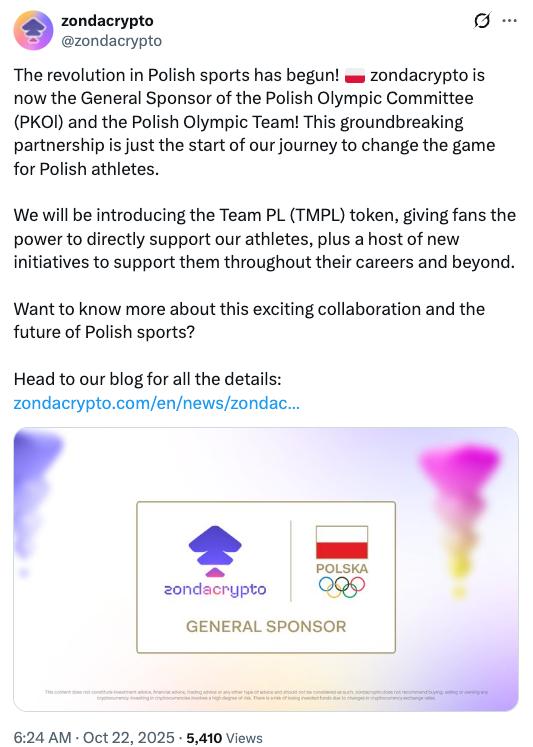
According to local news outlet TVP World, the allegations include Piesiewicz recovering all the money he had invested through Zondacrypto while thousands of other customers could not withdraw their funds. The exchange became a general sponsor of the Polish Olympic Committee in October 2025.
Source: Zondacrypto

Piesiewicz’s detention marks one of the first arrests in the Zondacrypto investigation. The exchange stopped trading in April amid a liquidity crisis, around the same time then-CEO Przemysław Kral said it could not access a wallet holding about 4,500 Bitcoin because it did not have the private keys.

Kral has reportedly been charged with participating in large-scale fraud and is cooperating with investigators in an effort to receive a reduced sentence.

Related: Bithumb wins 2 suits over mistaken Bitcoin credits: Report

Perguntas relacionadas

QWho was charged by Polish prosecutors in the Zondacrypto investigation and what is his official position?

ARadosław Piesiewicz, the president of the Polish Olympic Committee, was charged by Polish prosecutors in the Zondacrypto investigation.

QWhat specific charges were brought against Radosław Piesiewicz under Poland's Penal Code?

AHe was charged under two provisions of Poland's Penal Code involving allegations of influence peddling and favoring some creditors over others while facing insolvency.

QAccording to the article, what specific allegation is made regarding Piesiewicz's financial dealings with Zondacrypto?

AThe allegations include that Piesiewicz recovered all the money he had invested through Zondacrypto while thousands of other customers could not withdraw their funds.

QWhat key event preceded Zondacrypto's trading halt and what reason was given by its then-CEO for the issue?

AThe exchange stopped trading in April amid a liquidity crisis. At that time, then-CEO Przemysław Kral stated the exchange could not access a wallet holding about 4,500 Bitcoin because it did not have the private keys.

QWhat is the reported legal status of Zondacrypto's former CEO, Przemysław Kral, in this investigation?

APrzemysław Kral has reportedly been charged with participating in large-scale fraud and is cooperating with investigators in an effort to receive a reduced sentence.

Leituras Relacionadas

Solana's Historic First Governance Vote Concludes: Why Did SGP-003 Spark Massive Controversy?

Solana has completed its first-ever formal on-chain governance vote, marking a shift towards decentralized decision-making. Three proposals, SGP-0001, SGP-0002, and SGP-0003, were voted on. SGP-0001, establishing the foundational governance framework, and SGP-0002, accelerating the reduction of SOL's inflation rate, both passed. However, the most contentious proposal, SGP-0003, failed to reach the required supermajority. SGP-0003 proposed a significant change to Solana's fee structure, introducing a variable "Resource Fee" based on computational unit (CU) consumption, which would be entirely burned. Supporters, including some core developers, argued it would create fairer resource pricing and increase SOL's deflationary pressure. Opponents, led by major DeFi applications like Jupiter and Drift, criticized it as an effective tax on complex applications, warning it would unpredictably increase operational costs and undermine business models built on Solana's low fees. The vote outcome highlights a critical tension within Solana's growing ecosystem: balancing the interests of SOL holders (through deflationary mechanisms), validators (through rewards), and application developers (through cost predictability). As Solana evolves from a high-performance blockchain to one hosting substantial economic activity, governance is becoming central to its future development and competitiveness.

marsbitHá 20m

Solana's Historic First Governance Vote Concludes: Why Did SGP-003 Spark Massive Controversy?

marsbitHá 20m

Wash's Jackson Hole Debut: Bidding Farewell to 'Forward Guidance', Reshaping Fed Discipline Amidst the Squeeze Between AI and Inflation

In his first Jackson Hole speech, new Fed Chair Kevin Warsh signaled a significant shift in monetary policy communication. He declared that "forward guidance," a tool heavily used since the financial crisis, has outlived its usefulness in normal times and should be retired. He cautioned that over-reliance on it can distort market signals and constrain the Fed's flexibility. Instead, Warsh emphasized a return to data-dependence and decision-making discipline. Warsh outlined seven key principles to guide policy: anchoring the 2% inflation target, pursuing the employment mandate, using short-term rates as the primary tool, acknowledging the importance of money, and maintaining purposeful, restrained communication. He stressed that policy should focus on trends, not single data points. On the current economic outlook, Warsh noted that the labor market is consistent with full employment but inflation remains "far above" the Fed's target. He highlighted that over half of the PCE basket's components are still rising above 3% annually. While acknowledging AI's transformative potential for productivity and capital allocation, he admitted its full economic impact remains uncertain and is not a factor in current policy decisions. His core message was a commitment to policy discipline rather than pre-set decisions. Warsh stated the Fed's primary focus must be on restoring price stability, vowing, "We still have work to do," until there is clear evidence inflation is moving decisively toward 2%. He concluded by framing effective monetary policy as crucial for economic prosperity and U.S. global leadership.

Odaily星球日报Há 1h

Wash's Jackson Hole Debut: Bidding Farewell to 'Forward Guidance', Reshaping Fed Discipline Amidst the Squeeze Between AI and Inflation

Odaily星球日报Há 1h

Trading

Spot
活动图片